

Most people assume that getting a document notarized means blocking off time in their schedule, driving across town, finding parking, and sitting in a waiting room. That assumption costs people hours every week. The truth is that a mobile notary is a commissioned notary public who travels to the signer's chosen location, whether that's your kitchen table, your hospital room, or your office conference room. This guide covers everything you need to know about mobile notary services in Florida: how they work, what they cost, which documents they handle, and why bilingual access matters more than most people realize.
Table of Contents
- What is a mobile notary service?
- Key benefits of using a mobile notary in Florida
- Common documents notarized by mobile notaries
- Florida mobile notary fees: what to expect
- Why mobile notary transparency matters more than ever
- Get affordable mobile notary and legal document help in Florida
- Frequently asked questions
Key Takeaways
| Point | Details |
|---|---|
| Mobile notary comes to you | Mobile notaries travel to your home, office, or other convenient locations for signing. |
| Fees regulated by law | Florida caps notary fees at $10 per notarial act; travel fees are separate and must be disclosed. |
| Wide range of documents | Common notarized documents include powers of attorney, real estate closings, affidavits, and immigration forms. |
| Bilingual service available | Many mobile notary services in Florida offer support in English and Spanish for accessibility. |
| Transparency is key | Reputable mobile notary services provide clear, upfront explanations of all fees involved. |
What is a mobile notary service?
A mobile notary, sometimes called a traveling notary, is not a separate license or a different type of official. They hold the same Florida notary commission as any notary sitting behind a bank counter or courthouse desk. The single defining difference is that they come to you.
As notaries.com explains, "a mobile notary (also called a traveling notary) is a commissioned notary public who travels to the signer's chosen location to perform notarizations." That means the credential is identical. The service model is what changes.
Once at your location, the notary performs the same core functions you would expect anywhere else. They verify your identity, watch you sign the document, apply their official seal, and complete their notarial certificate. Mobile notaries perform the same core notarial acts as traditional notaries. The primary difference is the location.
Here is where mobile notaries typically travel:
- Private residences and apartments
- Business offices and corporate suites
- Hospitals, rehabilitation centers, and nursing homes
- Coffee shops, libraries, and other public meeting spots
- Real estate offices and title companies
- Jails and correctional facilities (when permitted)
"The notary comes to you" is not just a marketing phrase. For someone managing a health crisis, caring for young children, or running a business without a free afternoon, it is the only realistic option.
Our mobile notary services in South Florida are designed around exactly this kind of real-world flexibility. Scheduling happens around your calendar, not ours.
Key benefits of using a mobile notary in Florida
Florida has a uniquely diverse population. You have retirees managing estate documents, small business owners closing deals, immigrant families navigating paperwork in a second language, and first-time homebuyers signing stacks of loan documents. A mobile notary serves all of them, and the benefits go well beyond simple convenience.
Flexible scheduling that fits real life. Traditional notary offices keep business hours. Mobile notaries often work evenings and weekends. If you close a real estate deal on a Friday afternoon or need a power of attorney signed before a Monday morning surgery, a mobile notary can meet that window.
Accessibility for people who cannot travel. Elderly clients, individuals with disabilities, and patients in medical facilities often cannot get to a notary. The notary verifies identity with government-issued ID, witnesses the signing, and completes the notarization wherever the client is located. That accessibility is not a luxury. For many clients, it is the only way to execute critical legal documents.
Speed for time-sensitive transactions. Real estate closings, business agreements, and legal filings often have hard deadlines. A mobile notary can arrive the same day in many cases, preventing costly delays.

Bilingual service for Spanish-speaking communities. Florida is home to millions of Spanish speakers, particularly in South Florida. A bilingual mobile notary removes the language barrier that can turn a simple signing into a stressful guessing game. Clients deserve to understand every document they sign, not just trust that it says what someone told them.
Reduced document handling risk. When you carry sensitive paperwork across town, you risk losing pages, mixing up documents, or handing originals to the wrong person. A mobile notary comes to where the documents already are, keeping everything organized and secure.
Pro Tip: Before your mobile notary arrives, gather all documents, your government-issued photo ID, and any co-signers who need to be present. Having everything ready at the start saves time and prevents a second visit.
For clients who also need help preparing the actual paperwork, pairing notarization with legal document preparation ensures the documents are both correctly drafted and properly executed. If your situation involves immigration paperwork, immigration forms help can address the specific requirements before the notary ever arrives.
Common documents notarized by mobile notaries
Mobile notaries handle a wide range of personal and business documents. Understanding which documents require notarization helps you plan ahead and avoid last-minute scrambles.
Here is a breakdown of the most common document categories:
| Document type | Who typically needs it | Notes |
|---|---|---|
| Power of attorney | Individuals, families | Often urgent; frequently signed at hospitals |
| Real estate closing docs | Buyers, sellers, lenders | High page volume; loan signing agents specialize here |
| Healthcare directives | Individuals, elderly clients | Must be signed while mentally competent |
| Affidavits | Individuals, businesses | Sworn statements for court or legal proceedings |
| Loan documents | Borrowers | Mortgage, refinance, and personal loans |
| Business contracts | Small business owners | Partnerships, operating agreements, vendor deals |
| Immigration forms | Immigrants, families | Some USCIS forms require notarized affidavits |
| Certified translations | Bilingual clients | Translated documents often need notarized certification |
As noted earlier, mobile notaries perform the same core notarial acts as any traditional notary. The document type does not change what they can do. What changes is where and when it happens.
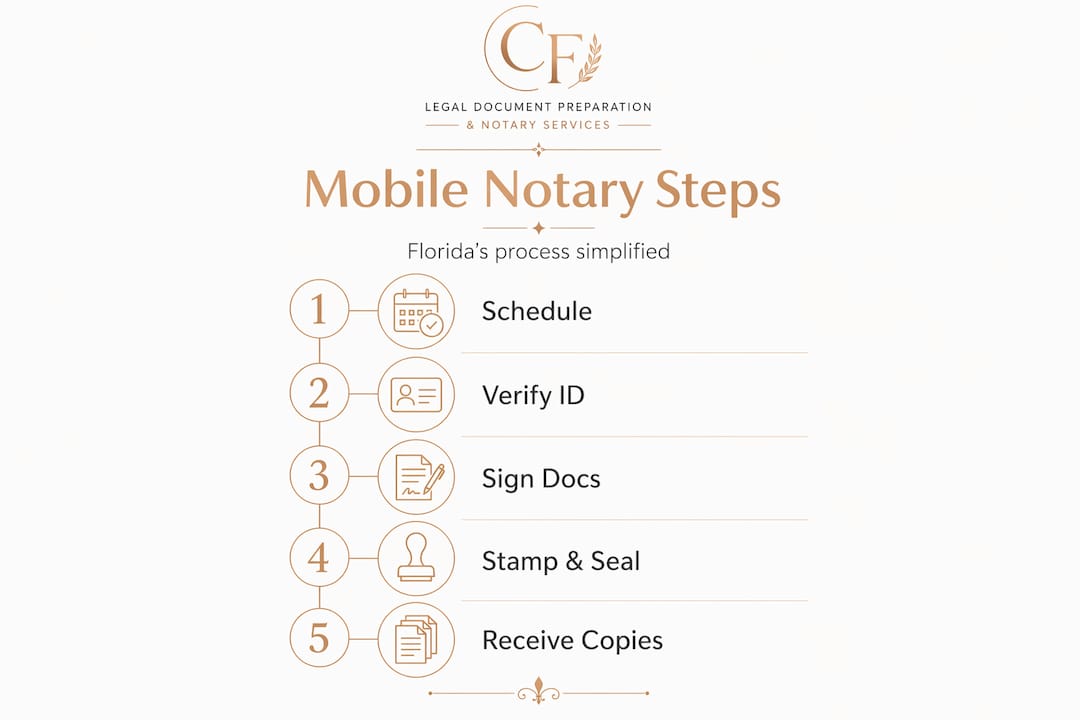
Here is the step-by-step process for a typical mobile notary appointment:
- Schedule the appointment. Contact the mobile notary, provide the document type, number of signers, and your preferred location and time.
- Prepare your documents. Have all pages ready and in order. Do not sign anything before the notary arrives.
- Verify your identity. Present a valid, government-issued photo ID such as a driver's license or passport.
- Review the document. The notary is not your attorney and cannot give legal advice, but they will confirm the document is complete and ready for signing.
- Sign in the notary's presence. This is the legally required step. Signing before the notary arrives invalidates the notarization.
- Notarization is completed. The notary applies their seal, signs the certificate, and records the act in their notary journal.
For business owners, documents like operating agreements and registered agent designations often need notarization as part of business formation assistance. If you are handling your own filings, our DIY legal filing guides walk you through what each document requires before it ever reaches a notary.
Florida mobile notary fees: what to expect
Cost is the question most people ask second, right after "can you come to me?" Florida law is actually quite clear on how notary fees work, and understanding the structure protects you from unexpected charges.
The statutory cap on notarial acts. Florida caps many standard notarial acts at $10 per act. That means for each individual signature you have notarized, the notary can charge no more than $10 for the notarization itself. If you have five signatures on a document, that could be up to $50 in notarial fees.
Travel fees are separate and legal. The $10 cap applies only to the notarial act. Mobile notaries are permitted to charge a separate travel or convenience fee, and Florida law does not cap that amount. However, the travel fee must be disclosed before the appointment. You should always know the total cost upfront.
What affects the travel fee? Several factors influence what a mobile notary charges for travel:
- Distance from their base location to your address
- Time of day (evening and weekend appointments may cost more)
- Urgency (same-day or rush requests typically carry a premium)
- Number of documents or signers involved
Here is a simple comparison to illustrate the fee structure:
| Fee type | Who sets it | Florida cap | Disclosure required |
|---|---|---|---|
| Notarial act fee | Florida statute | $10 per act | N/A (statutory) |
| Travel fee | Notary | No cap | Yes, before appointment |
| Loan signing fee | Notary/agency | No cap | Yes, before appointment |
| Marriage ceremony fee | Notary | $10 statutory | N/A (statutory) |
Remote notarization is a separate category. Florida also allows remote online notarization (RON), where the signer and notary connect via video. The fee rules are similar, but the platform and technology fees may add to the total cost. Remote notarization is ideal when travel is not practical for either party.
Pro Tip: Always ask for an itemized fee breakdown before confirming your appointment. A reputable mobile notary will tell you exactly what you are paying for: the notarial act fee, the travel fee, and any additional charges. If a notary cannot explain their fees clearly, that is a warning sign.
For clients in Naples and surrounding areas, our Florida notary services follow a transparent, flat-fee model so there are no surprises when the appointment is done.
Why mobile notary transparency matters more than ever
Here is something the industry does not talk about enough: the notary space in Florida has a trust problem, and it disproportionately affects immigrant and Spanish-speaking communities.
We have seen it firsthand. A client comes in after paying a notary who also offered to "help" with their immigration paperwork, without disclosing that they were not a licensed attorney or certified document preparer. The client paid hundreds of dollars for incorrectly prepared forms and a notarization that did not even apply to their situation. That is not a rare story. It is a pattern.
The issue is not just hidden fees. It is the entire information gap that surrounds notary services. Many clients do not know that a notary cannot give legal advice. They do not know that the $10 cap exists. They do not know that a travel fee should be disclosed before the appointment, not added to an invoice afterward. And when the entire interaction happens in a second language with no bilingual explanation, that gap becomes a canyon.
Transparency is not a bonus feature. It is the foundation of ethical notary practice. When we quote a fee, we explain every line. When a client asks what a document means, we tell them clearly what a notary can and cannot explain, and we refer them to the right resource when they need legal advice. Our notary and document resources exist specifically to close that information gap before a client ever walks into an appointment.
The mobile format actually supports transparency in a unique way. When a notary comes to your home or office, you are on your own turf. You have time to ask questions, review the document at your own pace, and involve family members who can help you understand. That environment reduces the pressure that sometimes leads people to sign things they do not fully understand.
For bilingual clients, having a notary who speaks Spanish is not just convenient. It is a matter of informed consent. Signing a legal document you do not fully understand is a risk no one should have to take.
Get affordable mobile notary and legal document help in Florida
Knowing how mobile notary services work is the first step. The second step is finding a provider who delivers that service with honesty, clear pricing, and real bilingual support.
At CF Legal Document Preparation & Notary Services LLC, we offer mobile notary service options across South Florida, including Naples and surrounding communities, in both English and Spanish. Whether you need a power of attorney notarized at a family member's home, loan documents signed at your office, or immigration affidavits prepared and certified, we handle it with flat-fee pricing and no hidden charges. Our legal document preparation in Florida services cover family law, business formation, immigration forms, and more. Reach out today to schedule your appointment and get the support you need without the confusion.
Frequently asked questions
What identification do I need for a mobile notary in Florida?
You need a valid government-issued photo ID such as a driver's license, state ID card, or passport. The ID must be current and clearly show your photo and name.
Are mobile notary services more expensive than traditional notaries?
The notarial act itself is capped at $10 per act by Florida statute, but mobile notaries can add a separate travel fee that must be disclosed to you before the appointment begins.
Can mobile notaries in Florida notarize documents in Spanish?
Yes, bilingual mobile notaries can notarize documents prepared in Spanish as long as the notary and signer both understand the language and the document is otherwise legally complete.
Which documents require a mobile notary in Florida?
Common documents include real estate closing packages, powers of attorney, healthcare directives, loan agreements, and certain immigration affidavits. Mobile notaries handle the same acts as any commissioned notary in Florida.
How do I verify if a mobile notary is commissioned in Florida?
Ask to see their notary commission certificate at the appointment, and confirm their active status through the Florida Department of State's online notary search tool at dos.fl.gov.