

Imagine your elderly mother is in the hospital, and you need to access her bank account to pay her bills. You hand over the power of attorney (POA) you had prepared months ago, only to be told it cannot be accepted because the notarization was done incorrectly. That single mistake can freeze everything, from medical decisions to financial transactions, at the worst possible moment. Getting a Florida POA notarized properly is not complicated, but it does require following every step in the right order. This guide walks you through exactly what Florida law requires so your document is accepted the first time, whether you speak English, Spanish, or both.
Table of Contents
- What makes a Florida power of attorney valid?
- Gathering what you need: People and paperwork
- Step-by-step: How to notarize a power of attorney in Florida
- Common mistakes and how to avoid POA rejection
- Troubleshooting: What if your Florida POA is still rejected?
- Why Florida POAs get rejected more often than you think
- Get affordable, Florida-compliant help with your POA
- Frequently asked questions
Key Takeaways
| Point | Details |
|---|---|
| Two witnesses are required | A Florida POA must be signed in front of two witnesses and a notary to be valid. |
| Use current statutory forms | Older or non-statutory POA forms are more likely to be rejected even if technically valid. |
| Review every 3-5 years | Update your POA regularly as institutions may refuse to honor outdated documents. |
| Know your recourse options | If a POA is rejected, request a written reason and provide proper supporting documents. |
What makes a Florida power of attorney valid?
A power of attorney is a legal document that lets one person, called the principal, authorize another person, called the agent or attorney-in-fact, to act on their behalf. In Florida, a POA that is missing even one required element is not just weak. It is completely invalid.
Under Florida law, a valid POA requires the principal's signature in the presence of two witnesses and a Florida notary public. This is not optional. Every single element must be present, and they must all happen at the same time in the same place, or through approved remote notarization procedures.
Here is a quick overview of the core requirements:
| Requirement | Details |
|---|---|
| Principal's signature | Must sign voluntarily and with mental capacity |
| Two witnesses | Must observe the principal signing |
| Florida notary public | Must verify identity and notarize the document |
| Durable language | Required if POA should survive incapacity |
| Florida-compliant form | Must meet statutory requirements under Chapter 709 |
For a durable POA, which is the most common type used for long-term planning, the document must include specific language stating that the authority granted is not terminated by the principal's subsequent incapacity. Without that language, the POA may become useless exactly when you need it most.
You can explore more about Florida legal document requirements to understand how POAs fit into the broader landscape of essential legal paperwork.
Key requirements at a glance:
- The principal must be at least 18 years old and mentally competent at the time of signing
- Both witnesses must be present simultaneously, not signing at separate times
- The notary cannot also serve as one of the two required witnesses
- The agent named in the document cannot serve as a witness
- Durable POAs must include Florida-specific statutory language
Gathering what you need: People and paperwork
With the legal requirements clear, let's get all the right people and paperwork in place before you sign anything.
One of the most common reasons a POA notarization fails is not showing up unprepared on the day of signing. Missing a witness, bringing the wrong ID, or using a form that does not meet Florida's current statutory requirements can derail the whole process. Preparation is everything.
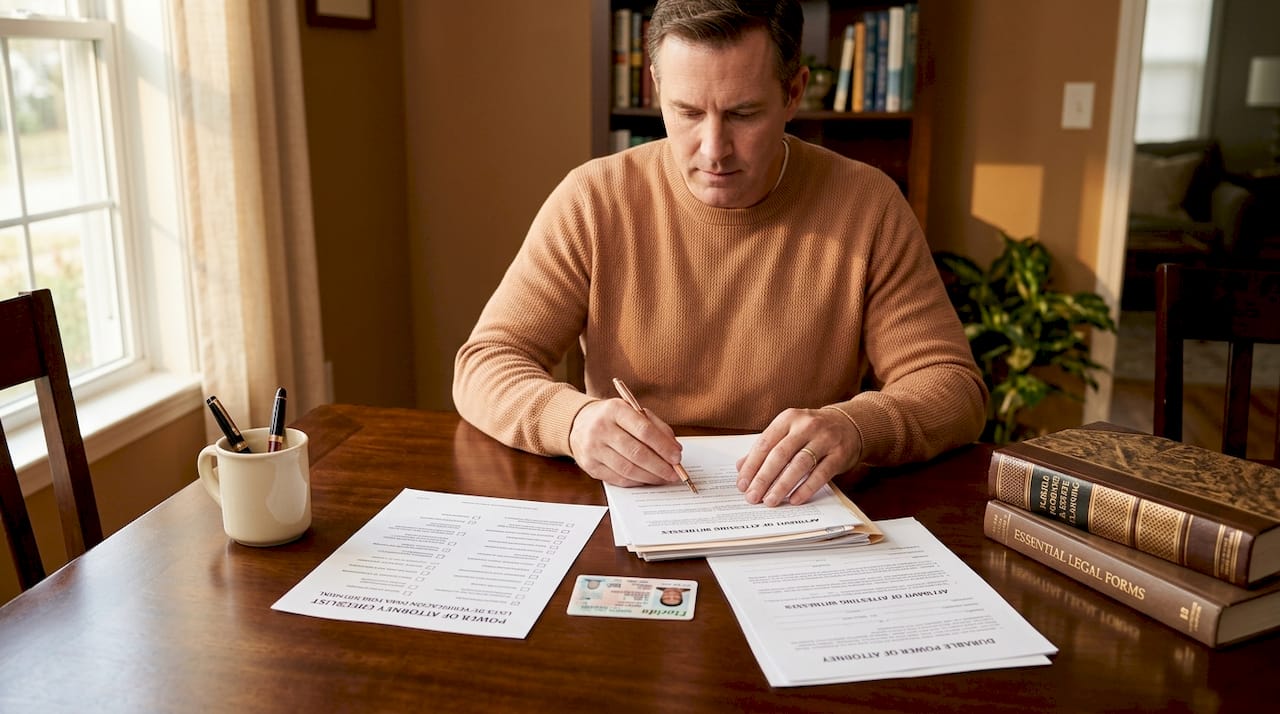
Who needs to be present:
| Party | Role | Who can serve |
|---|---|---|
| Principal | Person granting authority | Must be present in person or via remote notarization |
| Agent (attorney-in-fact) | Person receiving authority | Does NOT need to be present at signing |
| Witness 1 | Observes principal's signature | Any competent adult not named as agent |
| Witness 2 | Observes principal's signature | Any competent adult not named as agent |
| Florida notary public | Verifies identity, notarizes | Must be commissioned in Florida |
Documents and items to bring:
- A Florida-compliant POA form that meets Chapter 709 requirements
- Valid, government-issued photo ID for the principal (passport, driver's license, or state ID)
- Valid ID for both witnesses
- If using a bilingual or Spanish-language POA, bring a certified translation so the notary can confirm the content
For Spanish speakers, this last point is especially important. Some notaries may hesitate to notarize a document they cannot read. Having a certified translation ready alongside the original document removes that barrier immediately.
If you are not sure whether your POA form meets Florida's current requirements, getting legal document preparation help before your appointment can save you from having to start over.
Step-by-step: How to notarize a power of attorney in Florida
Now that you've gathered everyone and everything, let's walk through each step to ensure your document is flawlessly notarized.
Step 1: Confirm everyone's identity before signing begins. The notary will ask to see valid photo identification for the principal and often for the witnesses as well. Do not skip this step or assume the notary knows everyone. Identity verification is a legal requirement and protects the document's validity.
Step 2: Review the document together. Before any pen touches paper, the principal should read through the entire POA or have it read aloud. If the document is in Spanish, the principal should fully understand its contents. This is also the moment to confirm that the durable language is included if that is the intent.
Step 3: The principal signs first, in front of both witnesses and the notary. This is the most critical step. All four parties, the principal, both witnesses, and the notary, must be present at the same time when the principal signs. Signing at different times or in different rooms is not acceptable.
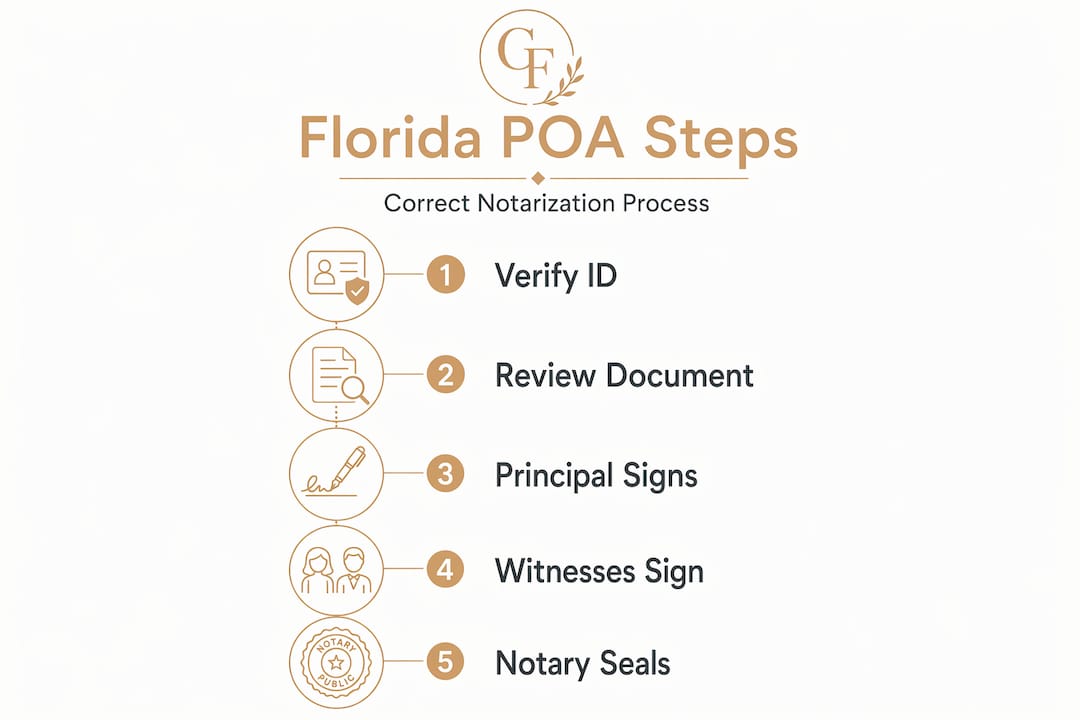
Step 4: Both witnesses sign immediately after the principal. The witnesses sign to confirm they observed the principal sign voluntarily and appeared to be of sound mind. They do not need to read the document, but they must have been present for the principal's signature.
Step 5: The notary completes the notarization last. The notary verifies identity, confirms the signing was voluntary, and then applies their signature and official seal. The notary's seal and signature are what transform the document into a legally recognized instrument.
Step 6: For durable POAs, verify the statutory language is present. A durable POA remains effective even after the principal becomes incapacitated, but only if the document contains the required language. Confirm this before you leave the notary's office.
Florida law is clear: all signatures on a power of attorney must occur in the presence of the notary. A notary who signs after the fact, without having witnessed the signing, is not legally completing a valid notarization.
Pro Tip: If you cannot travel to a notary's office, Florida law allows remote online notarization using approved audio-video technology. This is a legitimate and increasingly popular option, especially for clients in rural areas or those with mobility challenges.
Common mistakes and how to avoid POA rejection
Following the process doesn't guarantee acceptance. Avoid these common missteps for peace of mind after notarization.
Even a well-intentioned POA can be rejected if it contains technical errors. Financial institutions and healthcare providers have their own internal compliance teams, and they will look for any reason to decline a document they are uncertain about.
The most frequent errors that lead to rejection:
- Using a generic or outdated POA template that does not meet Florida's current statutory requirements
- Having the agent sign as a witness, which immediately invalidates the document
- Missing one of the two required witness signatures
- Forgetting the notary seal or having an expired notary commission
- Not including durable language when the principal intended the POA to survive incapacity
- Submitting a POA that is more than five years old to a bank or financial institution
On that last point, Florida-compliant statutory forms should be updated every three to five years. Even if a POA is technically still valid under Florida law, many banks and hospitals will refuse to honor a document that looks old. They worry about whether the principal's circumstances have changed, and they are not legally required to accept a POA that raises red flags.
If a third party refuses your valid POA, Florida law gives you real options. Under FS 709.2120, you can demand a written explanation for the refusal. If the refusal is unreasonable, the refusing party may be liable for damages and attorney's fees.
Pro Tip: Keep a copy of your POA in a secure digital format so you can quickly provide a fresh copy to any institution that requests one. Some agents carry multiple certified copies to avoid delays.
Additional steps to strengthen your POA's acceptance:
- Use the Florida statutory short form power of attorney whenever possible
- Have your document reviewed by a knowledgeable document preparer before signing
- Consult DIY legal guides to stay current on Florida's requirements
- Ask the notary to provide a notarial certificate that clearly identifies the type of notarization performed
Troubleshooting: What if your Florida POA is still rejected?
Even with the best preparation, problems still arise. Here's exactly what you can do if someone refuses your valid Florida POA.
A rejection does not mean the end of the road. Florida law provides a clear escalation process, and knowing your rights can turn a frustrating situation into a resolved one.
What to do when your POA is refused:
-
Ask for a written explanation. Under FS 709.2120, any third party that refuses to honor a POA must provide a written reason within a reasonable time. Do not accept a verbal "we can't accept this" without documentation.
-
Provide an agent affidavit. An agent affidavit is a sworn statement from the agent confirming the principal's current status and the validity of the POA. Many institutions will accept this alongside the original document.
-
Request a clarification letter from an attorney or document preparer. A short letter confirming the document's compliance with Florida law can often resolve institutional hesitation quickly.
-
Escalate if the refusal is unreasonable. Florida law is clear that unreasonable refusals expose the refusing party to liability. If a bank or hospital refuses a clearly valid, properly notarized POA without a legitimate reason, you may have grounds to seek damages.
"An institution that refuses a valid POA without a legitimate legal reason is not just being difficult. Under Florida law, that refusal can cost them."
For Spanish speakers, an extra layer of complexity arises when the POA itself is written in Spanish or is a bilingual document. Some institutions may question whether the document is an official legal instrument. Working with a provider who offers bilingual legal help and certified translations can resolve this concern before it becomes a problem.
Why Florida POAs get rejected more often than you think
Having explored troubleshooting, let's look behind the scenes at what makes even a flawless POA stumble in practice.
Here is something most guides will not tell you: a technically valid, properly notarized POA can still be rejected, and it happens more often than people expect. The reason is that institutions are not required to accept every POA they receive. They apply their own internal policies on top of Florida's legal requirements.
Banks, in particular, are notorious for this. A large financial institution may have a compliance policy that automatically flags any POA older than three years, regardless of its legal validity. A hospital's legal department may require their own internal POA form. These are institutional preferences, not legal requirements, but they carry real-world weight.
The uncomfortable truth is that a POA is only as good as the institution that honors it. That is why periodic review matters so much. Updating your POA every few years, using the most current Florida statutory language, and keeping the document looking fresh and professional all reduce the chance of unnecessary pushback.
For Spanish-speaking clients, the stakes are even higher. Translation accuracy is scrutinized closely. A poorly translated document, or one that uses informal language instead of legal terminology, can raise doubts about authenticity. Working with someone who understands both the legal requirements and the language nuances is not a luxury. It is a practical necessity.
Relying on a generic template you found online and never revisiting it is one of the most common mistakes we see. Florida law does change, and so do institutional policies. Staying current with updating legal documents is the kind of proactive step that protects you and your family when it matters most.
Get affordable, Florida-compliant help with your POA
Ready to ensure your POA is accepted the first time? Here's where to get reliable support.
Getting a power of attorney notarized correctly in Florida does not have to be stressful or expensive. At CF Legal Docs & Notary, we specialize in helping individuals and families prepare, review, and notarize Florida-compliant legal documents, in both English and Spanish.
Our legal document preparation services ensure your POA uses the correct Florida statutory language, includes all required elements, and is ready for signing. We also offer mobile notary and loan signing services, so we can come to you, whether you are at home, a hospital, or a care facility. Flat-fee pricing means no surprises. Bilingual support means nothing gets lost in translation.
Frequently asked questions
Do I need a lawyer to notarize a power of attorney in Florida?
No, you do not need a lawyer. However, you must follow all of Florida's legal requirements, including having two witnesses and a commissioned notary present, as required under Florida Statutes Chapter 709.2105.
Can my family members serve as witnesses for my Florida POA?
Witnesses should not be related by blood or marriage to the principal, and they cannot be the named agent. While Florida law does not explicitly prohibit all family members, choosing neutral, unrelated adults is the safest approach to avoid any challenge to the document's validity.
How long is a notarized power of attorney valid in Florida?
A POA remains valid until it is revoked or the principal passes away, but many institutions will not accept forms older than three to five years. To minimize rejection risk, update your POA regularly to reflect current Florida statutory requirements.
What should I do if my POA is rejected by a bank or hospital?
Request a written reason for the rejection and provide an agent affidavit or attorney letter explaining the document's validity. Under FS 709.2120, unreasonable refusals can expose the refusing party to legal liability, including damages.
Can I notarize a power of attorney remotely in Florida?
Yes. Florida permits remote online notarization using state-approved audio-video technology and platforms. This is a fully legal option that follows the same witnessing and identity verification requirements as in-person notarization.