

To notarize documents for overseas use means more than getting a notary stamp. It requires a chain of authentication steps, including apostilles or consular legalization, that foreign governments actually recognize. Skipping any link in that chain gets your documents rejected at the border, at the embassy, or in a foreign court. The U.S. Department of State, your Secretary of State's office, and international treaties like the 1961 Hague Apostille Convention all play defined roles in this process. Understanding each one before you start saves weeks of delays and real money.
How to notarize documents for overseas use: start with the destination country
The single most efficient move you can make is to identify your destination country's treaty status before you notarize anything. That status determines whether you need an apostille or an authentication certificate, and the two processes involve completely different government offices.
Countries that signed the 1961 Hague Apostille Convention accept a standardized certificate called an apostille. This certificate is attached directly to your notarized document and is recognized by all other member countries without further steps. Over 120 countries are members, including Mexico, Germany, Spain, Brazil, and India. If your destination is on that list, apostille services for documents are your path forward.
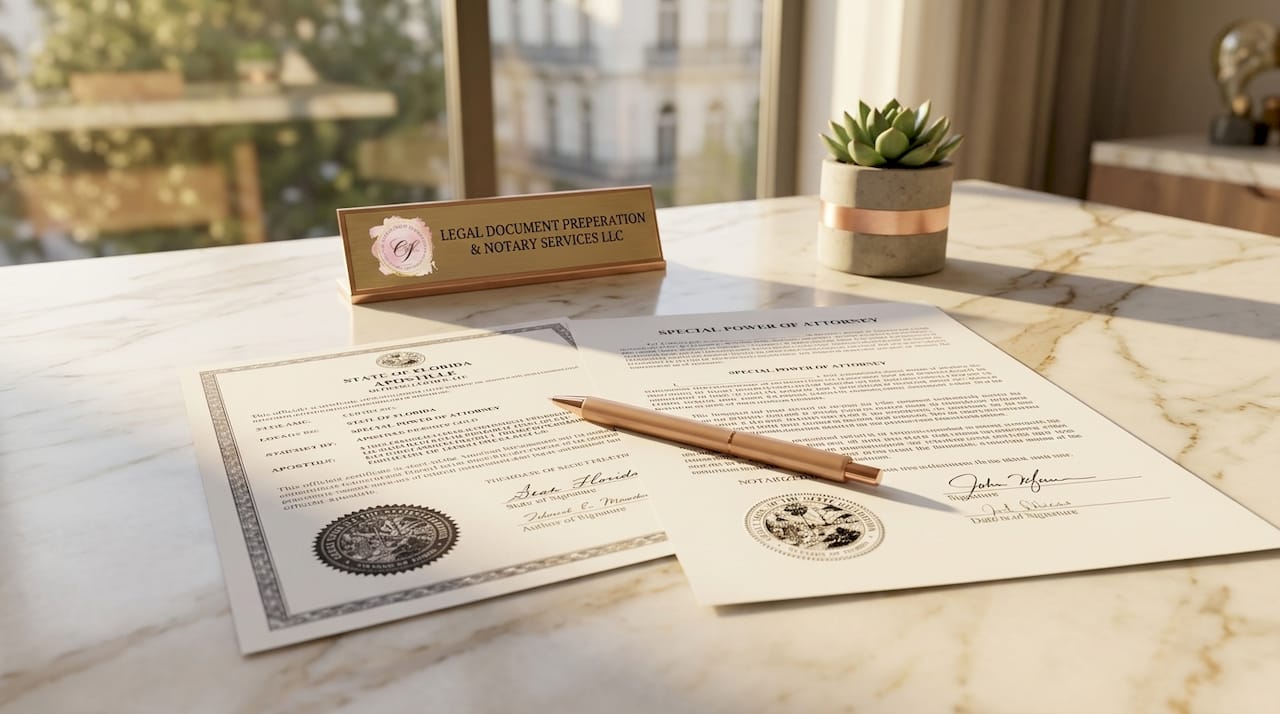
Countries outside the Hague Convention require a different process called an authentication certificate, sometimes followed by consular legalization. Authentication certificates are issued by the U.S. Department of State and confirm the notary's credentials for foreign governments that do not participate in the apostille system. China, Canada for certain documents, and several Gulf states fall into this category.
Here is how to check which category applies to your situation:
- Visit the USAGov authentication page to see the current list of Hague Convention member countries.
- Contact the destination country's embassy or consulate in the U.S. directly to confirm their specific document requirements.
- Check whether the document is state-issued (like a birth certificate or state business license) or federally issued (like an FBI background check or federal court document), since each follows a different authentication track.
- Ask the receiving institution in the foreign country, such as a university, court, or employer, exactly what certification they require.
Pro Tip: Confirm destination requirements before you sign or notarize anything. A document signed before notarization is often rejected, and requirements vary even within the same country depending on the receiving institution.
Step-by-step process for notarizing and authenticating international documents
Once you know what your destination country requires, the actual process follows a clear sequence. Rushing or reordering these steps is the most common cause of rejection.
-
Gather your documents and verify identity requirements. Collect the original document or a certified copy. Confirm whether the foreign authority accepts copies or requires originals. Have valid government-issued photo ID ready for the notarization appointment.
-
Choose the right notarization method. In-person notarization with a commissioned notary public is the most universally accepted method for international document notarization. Embassy notaries are available at U.S. embassies abroad for Americans overseas. Remote online notarization platforms like Proof can be convenient, but online notarization may not meet international authentication requirements. Foreign authorities frequently reject electronically notarized documents because apostille eligibility depends on the issuing jurisdiction's rules for electronic notarizations.
-
Sign the document in front of the notary. Never pre-sign. The notary must witness your signature. Pre-signed documents are invalid for notarization purposes and will be rejected at every subsequent step.
-
Submit to your Secretary of State for apostille or state authentication. For state-issued documents, the Secretary of State's office in the issuing state handles apostilles. Florida residents submit to the Florida Department of State. Processing times vary by state but typically run one to three weeks.
-
Submit federal documents separately to the U.S. Department of State. The Office of Authentications handles federal documents. Mail processing takes about five weeks, not counting shipping time in either direction. Walk-in service is available in Washington, D.C., with a seven-business-day turnaround. Same-day appointments exist for documented family emergencies.
-
Separate state and federal documents into different submissions. Submitting mixed documents together causes processing delays because each type goes to a different issuing authority. Keep them in separate packages with separate cover letters.
-
Complete consular legalization if required. For non-Hague countries, after the U.S. Department of State issues an authentication certificate, you may need to submit the document to the destination country's embassy or consulate in the U.S. for a final legalization stamp. This step can add another one to four weeks.
Pro Tip: Build at least eight to ten weeks into your timeline for federal documents going to non-Hague countries. That accounts for notarization, federal authentication, shipping, and consular legalization. Urgent travel or legal deadlines require expedited appointments booked well in advance.
Apostille vs. authentication certificate vs. consular legalization
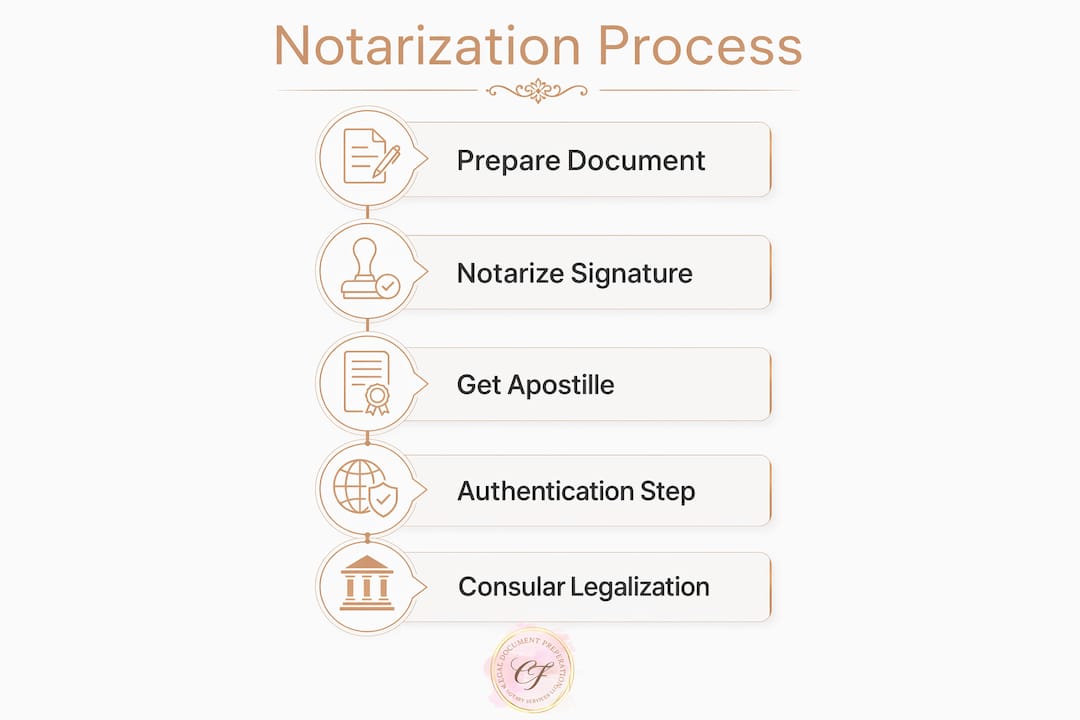
These three terms describe distinct processes, and confusing them is one of the most expensive mistakes in international notarization. The table below clarifies each one.
| Verification type | Issuing authority | Countries that require it | Typical timeline |
|---|---|---|---|
| Apostille | Secretary of State (state docs) or U.S. Dept. of State (federal docs) | Hague Convention members: Mexico, Spain, Germany, Brazil, India | 1 to 3 weeks for state; 5 weeks by mail for federal |
| Authentication certificate | U.S. Department of State, Office of Authentications | Non-Hague countries: China, Saudi Arabia, UAE | 5 weeks by mail; 7 business days walk-in |
| Consular legalization | Destination country's embassy or consulate in the U.S. | Non-Hague countries requiring an additional embassy stamp | 1 to 4 weeks after authentication |
An apostille is a standardized certificate created by the Hague Convention. It attaches to your notarized document and is self-sufficient. No further steps are needed for member countries. Common documents that go through this path include powers of attorney for property purchases in Spain, academic transcripts for foreign universities, and corporate documents for international business registration. If you are buying property in Spain remotely, for example, a notarized power of attorney with an apostille is the standard requirement.
An authentication certificate serves the same purpose as an apostille but for countries outside the Hague system. It confirms the notary's authority to a foreign government that does not recognize the apostille format. Skipping this step and submitting only a notarized document to a non-Hague country virtually guarantees rejection.
Consular legalization is the final layer some non-Hague countries require. After the U.S. Department of State issues an authentication certificate, the destination country's embassy in the U.S. adds its own stamp confirming the document meets their national standards. Legalization by consulates is only necessary for countries not party to the Apostille Convention, which simplifies the process for the majority of international transactions.
Troubleshooting common problems with international notarization
Even well-prepared documents run into problems. Knowing the most common failure points lets you prevent them before they cost you time.
-
Online notarization rejection. Remote notarization platforms do not automatically provide apostilles or comply with foreign legal requirements. If you used a platform like Proof for convenience, verify with the Secretary of State's office whether that jurisdiction supports apostilles for electronically notarized documents before submitting.
-
Wrong document track. State-issued and federally issued documents require separate authentication tracks. A Florida birth certificate goes to the Florida Secretary of State. An FBI background check goes to the U.S. Department of State. Mixing them in one submission delays both.
-
Missing supporting documents for business paperwork. Corporate documents often require a certificate of good standing, articles of incorporation, and an operating agreement, all notarized and authenticated separately. Foreign authorities reviewing business filings expect a complete package. One missing document rejects the entire submission.
-
Formality mismatch. Some countries require documents to be notarized by a notary with specific credentials or in a specific format. A notary public for international documents should be familiar with these requirements. Ask your notary directly whether they have experience with documents destined for your specific country.
-
Timing failures. Federal authentication processing excludes shipping delays. Five weeks of processing plus two weeks of shipping in both directions means a realistic minimum of seven to nine weeks for mail submissions.
Pro Tip: Always confirm the exact requirements with the receiving institution in the foreign country, not just the embassy. A Spanish university and a Spanish court have different document standards even for the same apostille-certified document.
A final pre-submission checklist worth running through: confirm the destination country's Hague status, verify the document type and issuing authority, check that signatures were made in front of the notary, confirm the correct government office for apostille or authentication, and verify whether consular legalization is required as a final step.
Key takeaways
Notarizing documents for overseas use requires notarization, apostille or authentication, and sometimes consular legalization, in that exact order, based on the destination country's treaty status.
| Point | Details |
|---|---|
| Check treaty status first | Determine if the destination country is a Hague Convention member before starting any paperwork. |
| Notarize in person | In-person notarization is the most accepted method; online platforms often fail international authentication requirements. |
| Separate state and federal docs | Submit state and federal documents to different offices to avoid processing delays. |
| Build a realistic timeline | Federal mail processing alone takes five weeks; add shipping and consular legalization for non-Hague countries. |
| Confirm with the receiving institution | Embassy requirements and the foreign institution's requirements can differ. Always verify with both. |
What I have learned from years of international notarization work
The most common mistake I see is clients treating notarization as the finish line when it is actually the starting line. A notarized document with no apostille is like a signed contract with no witnesses. It looks official but carries no weight where it needs to.
I have worked with clients who spent weeks waiting on a federal authentication, only to discover the receiving institution in their destination country required consular legalization as well. That is an avoidable delay. The fix is always the same: call the receiving institution directly, not just the embassy, before you notarize anything.
Remote online notarization is genuinely useful for domestic transactions, and I recommend it regularly for those. For international use, I tell clients to default to traditional in-person notarization unless they have confirmed in writing that the destination jurisdiction accepts electronic notarizations for apostille purposes. That confirmation is rare.
One more thing: if you are handling business documents for a foreign entity, treat each document as its own submission. A package of five corporate documents is five separate authentication processes, not one. Clients who understand this from the start avoid the most frustrating and costly delays I see in this work.
— Cristina
How Cflegalformhelp can support your international document needs
Preparing documents for overseas use involves multiple agencies, strict sequencing, and country-specific rules that change without much notice. Cflegalformhelp handles the preparation, notarization, and coordination work so you do not have to manage it alone.
Cristina Fernandez and the team at Cflegalformhelp offer notary and document preparation services for individuals and businesses in South Florida, including mobile notary appointments and certified translations. Whether you need a power of attorney apostilled for a foreign property transaction or corporate documents authenticated for international business registration, Cflegalformhelp provides flat-fee, bilingual support in English and Spanish. Visit Cflegalformhelp's legal document services to see the full range of options or contact the office directly to discuss your specific international notarization needs.
FAQ
What is the difference between an apostille and notarization?
Notarization verifies the identity of the signer and the authenticity of their signature. An apostille is a separate government-issued certificate that authenticates the notary's credentials for acceptance in Hague Convention member countries.
Which countries require an apostille for U.S. documents?
Any country that signed the 1961 Hague Apostille Convention requires an apostille. This includes Mexico, Spain, Germany, Brazil, India, and over 120 other nations.
Can I use online notarization for documents going overseas?
Online notarization is generally not accepted for international use. Platforms like Proof are designed for U.S. domestic transactions and do not automatically meet foreign authentication requirements.
How long does it take to get an apostille from the U.S. Department of State?
The U.S. Department of State's Office of Authentications processes federal documents in about five weeks by mail. Walk-in service in Washington, D.C., takes seven business days, and same-day appointments are available for documented emergencies.
What happens if my destination country is not in the Hague Convention?
You will need an authentication certificate from the U.S. Department of State instead of an apostille. Many non-Hague countries also require consular legalization as a final step, which adds one to four weeks to the process.