

A document preparer for pro se litigants is a non-attorney professional who prepares legal forms and paperwork based strictly on client instructions, without providing legal advice, courtroom representation, or legal strategy. The industry term for this role is "legal document assistant" or "legal document preparer," though most self-represented individuals simply call them document preparers. Understanding the role of document preparer pro se matters because the line between clerical help and unauthorized legal practice is narrow, and crossing it can cost you your case. This guide explains exactly what these professionals can do for you, where their authority ends, and how to use their services without exposing yourself to unnecessary risk.
What is the role of document preparer pro se?
A legal document preparer fills out, types, and formats court forms based on information you provide. That is the full scope of the job. In every U.S. state except Louisiana, document preparers must disclose their non-attorney status and are legally prohibited from giving legal advice or appearing in court on your behalf. This disclosure requirement exists to protect you from confusing clerical help with actual legal counsel.
The tasks a document preparer can legally perform for you include:
- Filling out divorce petitions, parenting plans, motions, and affidavits based on your instructions
- Typing and formatting court forms to meet local filing requirements
- Reviewing completed documents for clerical errors, missing fields, or formatting problems
- Organizing and assembling filing packets in the correct order
- Notarizing signatures where required (when the preparer holds a notary commission)
Common practice areas where document preparation services add real value include family law matters like uncontested divorces, small claims filings, bankruptcy petitions, landlord-tenant notices, and name change petitions. These are cases where the facts are straightforward and the primary challenge is completing the paperwork correctly.
Pro Tip: Before hiring any document preparer, ask them to show you their written disclosure statement. Florida law, for example, requires preparers to provide a written contract specifying that they are not attorneys and cannot give legal advice. If a preparer skips this step, walk away.

What can a document preparer NOT do compared to an attorney?
The gap between a document preparer and a licensed attorney is significant, and the core danger for pro se litigants is the absence of strategic legal guidance that only an attorney can provide. A preparer cannot tell you whether filing a motion is a good idea, what defenses apply to your situation, or how a judge is likely to rule. That is legal advice, and providing it without a law license is unauthorized practice of law.
| Service | Attorney | Document Preparer |
|---|---|---|
| Filling out and formatting court forms | Yes | Yes |
| Reviewing documents for clerical errors | Yes | Yes |
| Providing legal advice or strategy | Yes | No |
| Representing you in court | Yes | No |
| Assessing legal risks in your case | Yes | No |
| Ghostwriting motions with legal arguments | Yes | No |
| Malpractice coverage if something goes wrong | Yes | No |
Unlike attorneys, document preparers carry no professional liability insurance and have no malpractice oversight. If a preparer makes an error that harms your case, you have limited legal recourse. Attorneys are officers of the court and are bound by state bar rules. Preparers operate under a much lighter regulatory framework, which means your protection depends heavily on choosing someone reputable.
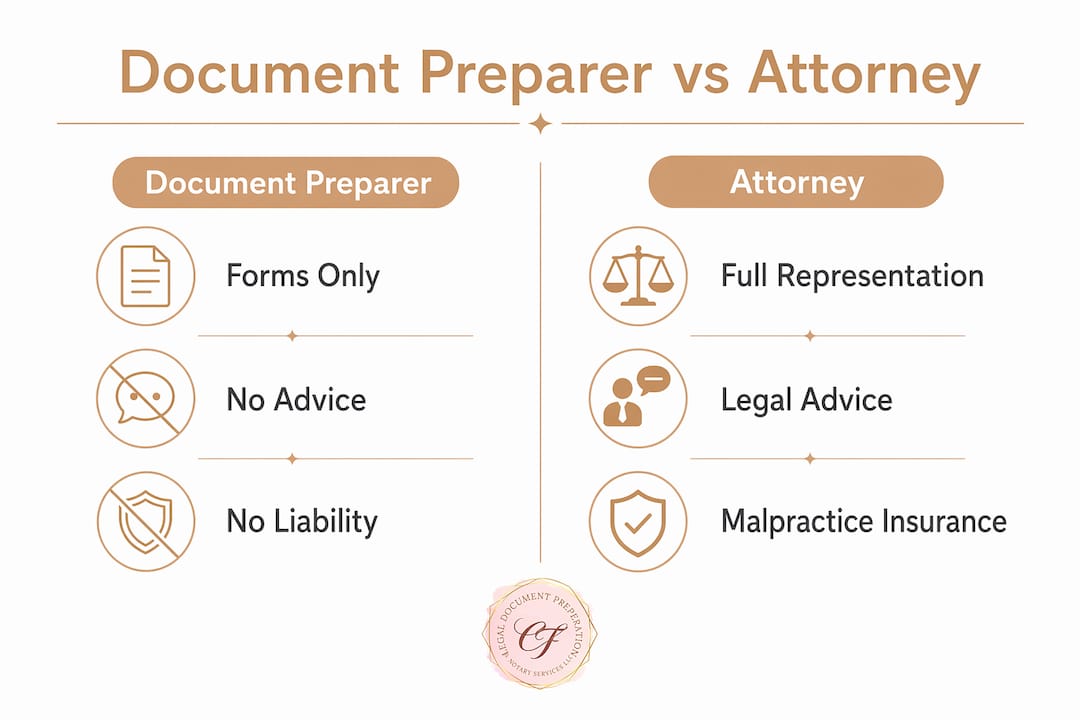
The consequences of relying too heavily on a document preparer can be severe. A bankruptcy case filed with deficient paperwork can be dismissed, putting your assets at immediate risk. A poorly drafted motion in a custody case can set a damaging legal precedent in your own file. These are not clerical problems. They are strategic failures that a document preparer is not equipped to prevent.
Pro Tip: Think of a document preparer the way you think of a tax form software. It helps you enter information correctly, but it cannot tell you whether you qualify for a deduction or whether you are being audited for the wrong reasons. For that, you need a professional.
How can document preparers and limited legal services work together?
The most effective approach for pro se litigants is to combine document preparation with targeted legal advice, a model known as limited-scope representation or unbundled legal services. All 50 states and Washington D.C. permit limited-scope legal help such as document review or motion ghostwriting for a flat fee, without requiring full attorney representation. This means you can hire a document preparer for the clerical work and pay an attorney for a one-hour consultation to review strategy.
Here is a practical workflow that many self-represented litigants use successfully:
- Identify your legal goal. Know what outcome you are seeking before you hire anyone. Are you filing for an uncontested divorce? Responding to a landlord's eviction notice? The clearer your goal, the more efficiently a preparer can help you.
- Consult an attorney for strategy. Pay for a limited consultation to understand your rights, your risks, and the strongest arguments in your favor. Many attorneys offer flat-fee consultations for exactly this purpose.
- Hire a document preparer for the paperwork. Bring your notes from the attorney consultation and instruct the preparer on what forms to complete and how. The preparer executes your instructions, not their own judgment.
- Use court self-help centers for procedural questions. Court staff can explain processes and form completion but cannot provide substantive legal guidance. These centers are free and underused by most pro se litigants.
- Have an attorney review the final documents before filing. A single review session can catch legal errors that a preparer would never spot. Clients can get documents reviewed for a flat fee instead of paying for full representation.
This layered approach gives you affordable clerical support while closing the strategy gap that leaves most pro se litigants vulnerable.
What are the fraud risks and how do you protect yourself?
Fraud in the document preparation industry is a documented problem with real financial consequences. In one federal case, a fraudulent preparer stole over $25,000 using client data to fraudulently obtain pandemic relief benefits. That case resulted in a federal prison sentence, but the clients who lost money had no easy path to recovery. This is what happens when you hand sensitive personal and financial information to an unvetted preparer.
Beyond outright fraud, honest mistakes by underqualified preparers carry their own costs:
- Filing deficient paperwork can result in case dismissal, meaning you lose your legal claim entirely
- Errors in bankruptcy filings can expose assets you expected to protect
- Missing deadlines because forms were incomplete can waive your rights permanently
- Incorrect information on immigration forms can trigger removal proceedings
To protect yourself, follow these steps before sharing any personal data with a document preparer:
- Verify the preparer's registration or certification in your state
- Check for complaints with the Florida Department of Agriculture and Consumer Services (in Florida) or your state's equivalent regulatory body
- Ask for a written contract that clearly states the services provided and the fee
- Never hand over original documents. Provide copies only
- Review every completed form yourself before signing
You should also take data breach risk in document handling seriously. Preparers who store your Social Security number, financial records, or immigration documents digitally create exposure if their systems are not secure. Ask how your data is stored and whether it is deleted after your matter closes.
Document preparation works best as a clerical aid for individuals who already understand their legal goals and get legal advice elsewhere. Without that foundation, even perfectly formatted paperwork can lead to the wrong outcome.
How do AI tools change the picture for pro se litigants?
AI tools like chatbots and automated document generators are increasingly marketed to self-represented individuals as affordable alternatives to both attorneys and document preparers. The reality is more complicated. Courts require pro se litigants to disclose AI use, and AI-generated filings that contain hallucinated case citations or fabricated legal standards can result in sanctions against the filer.
The practical risks of using AI without oversight include:
- AI tools can generate plausible-sounding but legally incorrect arguments
- Fake case citations produced by AI have led to court sanctions in documented 2024 and 2025 cases
- There is no work-product privilege for AI-generated drafts, meaning opposing counsel can request them during discovery
- AI tools cannot assess local court rules, judge preferences, or jurisdiction-specific procedures
Tools like AI Legal Beagle can help you analyze uploaded legal documents for general understanding, which is a legitimate use. The problem arises when AI output is filed directly without human review. Despite AI's promise to increase access to justice, the risk of quasi-legal filings lacking legal substance places a real burden on courts and on the litigants who file them.
Pro Tip: Use AI to understand documents and generate questions for your attorney consultation. Never file AI-generated text without having a licensed attorney or a certified document preparer review it first for accuracy and compliance with local court rules.
Key takeaways
A document preparer for pro se litigants provides clerical form preparation only, and pairing that service with limited attorney consultation is the most cost-effective way to protect your legal interests.
| Point | Details |
|---|---|
| Defined clerical role | Document preparers fill out and format forms based on your instructions. They cannot give legal advice. |
| Attorney comparison | Attorneys provide strategy, risk assessment, and courtroom advocacy. Preparers do none of these. |
| Limited-scope pairing | Combining a preparer with a flat-fee attorney consultation closes the strategy gap affordably. |
| Fraud and error risks | Verify certifications, use written contracts, and never share original documents with unvetted preparers. |
| AI tool caution | AI can support document understanding but requires human review before any court filing. |
What I have learned from working with pro se litigants every day
Most people who come to me have already spent hours trying to figure out the court system on their own. They are not uninformed. They are overwhelmed by paperwork that was designed by lawyers for lawyers. What I tell every client is this: I am your clerical partner, not your legal strategist. That distinction is not a limitation. It is a protection.
The biggest mistake I see is when someone treats a document preparer as a substitute for legal advice because they cannot afford an attorney. I understand that instinct completely. But a one-hour limited consultation with a family law attorney costs far less than refiling a dismissed case or losing a custody arrangement because the paperwork was technically correct but legally wrong. The DIY filing guides we provide at Cflegalformhelp are designed to help you understand what you are filing, not just how to fill it out.
I am also cautiously optimistic about AI tools, but I have seen clients walk in with AI-generated documents that cited cases that do not exist. That is not a minor error. That is a credibility problem in front of a judge. Use AI to learn. Use a certified preparer to execute. And when the stakes are high, spend the money on at least one attorney consultation. You will not regret it.
— Cristina
Get reliable document preparation support from Cflegalformhelp
If you are representing yourself in a Florida court and need accurate, professionally prepared legal documents, Cflegalformhelp is built for exactly that situation.
Cflegalformhelp, founded by Cristina Fernandez, a certified legal document preparer and immigration paralegal, offers flat-fee legal document preparation services for family law, immigration forms, business formation, and more. Every document is prepared in compliance with Florida law, with bilingual support in English and Spanish. The team operates transparently, provides written contracts, and never oversteps the legal boundaries that protect you as a client. Whether you need a divorce petition, a parenting plan, or an LLC formation package, Cflegalformhelp delivers reliable clerical support so your paperwork does not become the reason your case fails.
FAQ
What does a document preparer do for a pro se litigant?
A document preparer fills out, types, and formats legal forms based on your instructions without providing legal advice. They handle the clerical side of your filing so you can focus on understanding your legal position.
Can a document preparer give me legal advice?
No. Document preparers are prohibited from giving legal advice in every U.S. state except Louisiana and cannot represent you in court. For legal strategy, you need a licensed attorney.
What happens if a document preparer makes an error in my filing?
Unlike attorneys, document preparers carry no malpractice coverage, which means you have limited recourse if their error harms your case. Always review completed documents yourself before signing or filing.
Is it safe to use AI tools to prepare my court documents?
AI tools can help you understand documents, but courts require disclosure of AI use and have sanctioned litigants for filing AI-generated text with fabricated citations. Always have a certified preparer or attorney review any AI-generated content before it is filed.
How do I find a trustworthy document preparer?
Verify their registration with your state's regulatory body, request a written contract, check for complaints, and confirm they provide the required non-attorney disclosure. In Florida, Cflegalformhelp meets all of these standards and operates under a certified, registered professional.