

A family law petition is a formal legal document filed with a family court to initiate proceedings such as divorce, child custody, or domestic violence restraining orders. It is the document that puts the legal process in motion, telling the court who is involved, what issues need resolution, and what outcome you are requesting. Without a properly filed petition, no family court case can begin. Understanding the family law petition definition, what it must include, and how the filing process works gives you a real advantage before you ever walk into a courthouse.
What is a family law petition and why does it matter?
A family law petition is the cornerstone document that establishes the court's jurisdiction and sets the framework for all further proceedings. Think of it as the opening statement of your legal case. It names the petitioner (the person filing), the respondent (the other party), and the specific legal relief being requested, whether that is a divorce decree, a custody arrangement, or a protective order.
The petition does not grant you anything on its own. It opens the door for the court to hear your case. Courts across the country process enormous volumes of these filings. That volume underscores why accuracy and completeness matter from the very first document you submit.

Every family law petition must include certain core elements regardless of the type of case: the names and addresses of both parties, the basis for the court's jurisdiction, a clear statement of the facts, and the specific relief requested. Missing any of these elements can delay your case or result in dismissal.
What types of family law petitions exist?
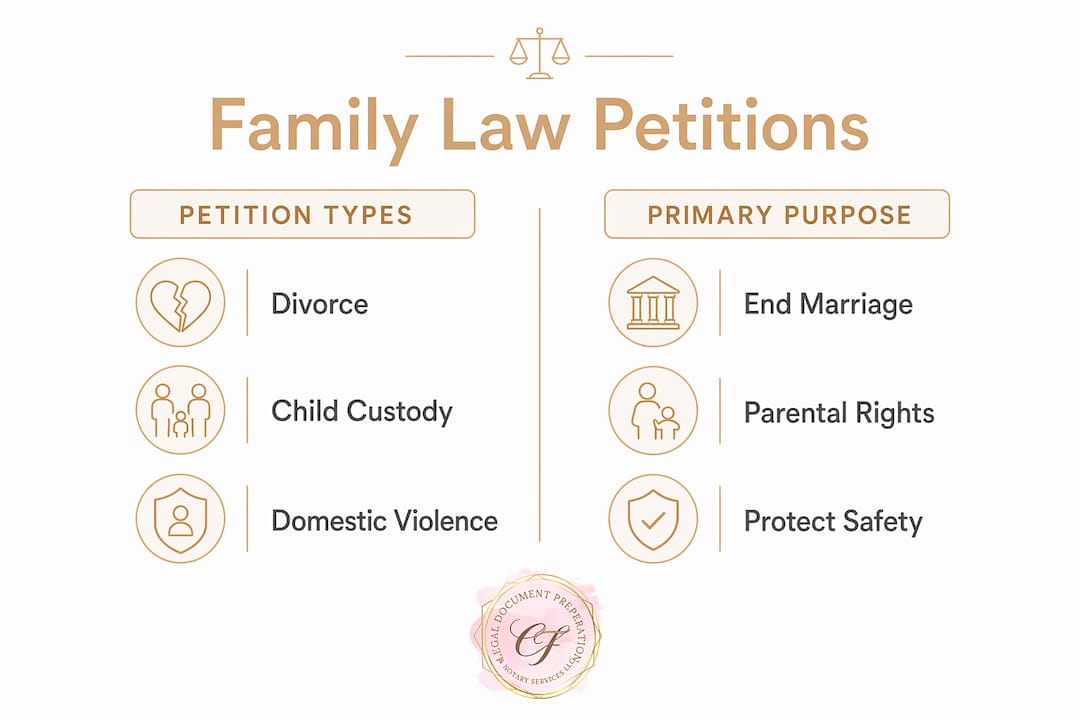
The types of family law petitions vary significantly depending on the legal issue at hand. Each type has its own required forms, supporting documents, and procedural rules. Here are the most common categories:
- Divorce or dissolution of marriage petition. This requests the legal termination of a marriage and typically addresses property division, spousal support, and, if applicable, child custody and support.
- Custody and parenting time petition. Filed by a parent seeking a formal court order establishing where a child lives and how parenting time is divided between the two households.
- Domestic violence restraining order petition. Requests emergency or long-term protection from an abusive partner or family member. Courts often expedite these cases.
- Child support petition. Asks the court to establish, modify, or enforce a financial support obligation for a minor child.
- Adoption petition. Initiates the legal process of permanently transferring parental rights from a biological parent to an adoptive parent.
- Guardianship petition. Requests that the court appoint a guardian for a minor or incapacitated adult who cannot care for themselves.
Each petition type carries different evidentiary requirements. A domestic violence petition, for example, may require a sworn declaration describing specific incidents. An adoption petition typically requires a home study report and background checks. Knowing which petition applies to your situation is the first decision you need to get right.
| Petition type | Primary purpose | Key requirement |
|---|---|---|
| Divorce/dissolution | End a marriage | Residency in filing state and county |
| Custody/parenting time | Establish child living arrangements | Proof of parentage or legal standing |
| Domestic violence restraining order | Obtain legal protection | Sworn statement of abuse or threat |
| Child support | Set or modify financial obligation | Income documentation for both parties |
| Adoption | Transfer parental rights permanently | Home study and background clearance |
How to file a family law petition: key steps
Filing a family law petition follows a defined sequence. Skipping or mishandling any step can invalidate your filing or delay your case by weeks.
-
Confirm jurisdiction and residency. You must file in the correct court. In California, for example, state residency requirements mandate that one spouse must have lived in the state for six months and in the county for three months before filing for divorce. Most states have comparable rules. Filing in the wrong jurisdiction results in automatic dismissal.
-
Obtain and complete the correct forms. Each court system has its own approved petition forms. Florida courts, for instance, use standardized forms available through the Florida Courts website. Fill out every field completely. Incomplete initial paperwork is one of the most common reasons cases stall, with errors in child information and missing details topping the list.
-
File with the family court clerk. Submit your completed petition, along with any required supporting documents, to the clerk of the family court. You will pay a filing fee at this stage. Fee waivers are available if you meet income eligibility requirements.
-
Receive your summons. After filing, the court issues a summons. This is a separate document from the petition. The summons legally notifies the respondent that a case has been filed and sets the deadline for their response.
-
Serve the petition and summons on the respondent. Both documents must be delivered to the respondent by a neutral third party, such as a process server or sheriff's deputy. Incorrect service of either document can invalidate the case start entirely. You cannot serve the documents yourself.
-
File proof of service. Once the respondent has been served, the server completes a proof of service form, which you file with the court. This document confirms the respondent received proper legal notice.
-
Understand amended petitions. If you need to change information after filing, you must file an amended petition. An amended petition replaces the original entirely and must be complete and self-contained. It is not a list of corrections. It is a brand new document that supersedes everything filed before it.
Pro Tip: Before submitting your petition, have someone unfamiliar with your case read through it. If they cannot understand the facts and what you are requesting, a judge may struggle too. Clarity in the petition directly affects how smoothly your case moves forward.
What happens after you file a family law petition?
Filing the petition is the beginning, not the end. Once the respondent is properly served, the family law petition process moves into its next phase.
-
The respondent has a deadline to respond. Response deadlines typically range from 20 days if the respondent is in-state to 30 days if they are located out of state. If no response is filed, the petitioner may request a default judgment, which means the court could grant the requests in the petition without the respondent's input.
-
Joint petitions follow a different path. When both parties agree on all terms before filing, they can file a joint petition. A joint petition starts the process but does not finalize the divorce or custody arrangement on its own. Both parties must still agree on every final term. If agreement breaks down at any point, the case shifts to contested status.
-
Contested cases proceed to hearings and mediation. When the respondent files a response that disputes the petitioner's requests, the court schedules hearings. Many jurisdictions require mediation before a judge will hear contested custody or property issues. Mediation gives both parties a structured opportunity to reach agreement outside of court, which typically saves time and money.
-
Temporary orders may be issued. While the case is pending, either party can request temporary orders covering child custody, support, or use of shared property. These orders remain in effect until the court issues a final judgment.
-
The case concludes with a final order. After all issues are resolved, either through agreement or a judge's ruling, the court issues a final order. In a divorce, this is the divorce decree. In a custody case, it is the parenting plan and custody order.
Common misconceptions about family law petitions
The biggest misconception about a family law petition is that the requests in it are final court orders. They are not. Filing a petition is the start of a negotiation and legal process, not the conclusion. The petition marks the start of the case, and the respondent has every right to contest every single request you make.
A second common misunderstanding involves service of process. Many people believe that handing documents to the other party themselves is sufficient. It is not. Proper service requires a neutral third party, and failure to follow this rule can strip the court of authority over the respondent entirely.
"Many people walk into the petition process believing that what they ask for is what they will get. The petition is your opening position, not your guaranteed outcome. The court weighs both sides before issuing any order."
A third area of confusion is the difference between joint and contested petitions. Some filers assume that because they and their spouse are on speaking terms, a joint petition is automatic. In reality, a joint petition requires complete agreement on every issue, including property, debt, custody, and support, before filing. You can review divorce process stages to understand where a joint petition fits in the overall timeline.
Pro Tip: Consulting an attorney or a certified legal document preparer before you file is one of the most cost-effective decisions you can make. Early legal guidance helps you complete forms correctly, understand local rules, and explore options like mediation or collaborative divorce before the process becomes adversarial.
Key takeaways
A family law petition is the formal document that opens a court case, and its accuracy, completeness, and proper service determine whether your case moves forward or stalls.
| Point | Details |
|---|---|
| Petition definition | A formal legal document that initiates a family court case and establishes jurisdiction. |
| Types of petitions | Divorce, custody, domestic violence, child support, adoption, and guardianship each require different forms. |
| Residency requirements | You must meet state and county residency rules before filing, or the court will dismiss the case. |
| Service of process | Both the petition and summons must be served by a neutral third party, or the case start is invalid. |
| Response deadlines | Respondents have 20 days (in-state) or 30 days (out-of-state) to file a response after being served. |
What I have learned from watching clients file their first petition
Working with self-represented filers in South Florida for years, I have seen one pattern repeat itself constantly. People treat the petition as the finish line when it is actually the starting block. They spend weeks agonizing over what to request and then rush through the actual paperwork, which is the part that determines whether the court even accepts the case.
The clients who move through the process most smoothly are the ones who understand two things early. First, the petition is a negotiating document. What you ask for shapes the conversation, but it does not lock in the outcome. Second, local court rules matter as much as state law. A form that works in Miami-Dade may not be accepted in Collier County without modification.
I also see people underestimate how much the service of process step can derail a case. One missed field on the proof of service form, or a document handed directly to the other party by the filer, and the whole timeline resets. That is a frustrating and avoidable delay. Getting the procedural steps right the first time is not about being overly cautious. It is about respecting the court's process and protecting your own case.
For anyone considering family law negotiation as an alternative to a fully contested case, I strongly recommend exploring that option before the petition filing escalates tensions. The earlier both parties can agree on a framework, the less the process costs everyone, financially and emotionally.
— Cristina
How Cflegalformhelp supports your family law petition
Filing a family law petition correctly the first time saves you time, money, and stress. Cflegalformhelp specializes in preparing accurate, court-ready family law documents for self-represented individuals throughout Florida, including divorce petitions, parenting plans, and custody forms.
Cristina Fernandez and the Cflegalformhelp team offer flat-fee legal document preparation services in both English and Spanish, so you always know what you are paying and what you are getting. The team also provides mobile notary and loan signing services to handle notarization requirements without requiring you to travel. Whether you are filing your first petition or need help correcting an existing one, Cflegalformhelp gives you the professional support to move your case forward with confidence.
FAQ
What is the difference between a petition and a complaint in family law?
A petition and a complaint both initiate court cases, but family courts typically use the term "petition" while civil courts use "complaint." The petitioner in a family law case is the equivalent of the plaintiff in a civil case.
How long does it take for a family law petition to be processed?
Processing time varies by court and case type, but most courts accept or reject a petition within a few business days of filing. The overall case timeline depends on whether the respondent contests the petition and how complex the issues are.
Can I file a family law petition without an attorney?
Yes. Self-represented litigants, known as pro se filers, file family law petitions regularly. Using a certified legal document preparer like Cflegalformhelp ensures your forms are completed correctly without the cost of full attorney representation.
What happens if the respondent ignores the petition?
If the respondent does not file a response within the required deadline (typically 20 to 30 days after service), the petitioner can request a default judgment. The court may then grant the requests in the petition without the respondent's participation.
Can a family law petition be changed after filing?
Yes, through an amended petition. An amended petition fully replaces the original and must be complete on its own. It is not a supplement or a list of corrections to the original document.