

A notary public is a state-commissioned officer authorized to witness important document signings, verify signer identity, and administer oaths, serving as an impartial check against fraud in legal transactions. Every time you close on a home, finalize a power of attorney, or submit an immigration affidavit, a notary's seal is the mechanism that makes those documents legally credible. Understanding exactly what a notary does, and what they cannot do, protects you from costly mistakes before you ever hand over a document to be stamped.
What does a notary public do?
A notary public performs three core duties: witnessing signatures, administering oaths and affirmations, and certifying copies of original documents. Each of these functions serves a specific legal purpose, and none of them overlap with the practice of law.
When a notary witnesses a signature, they confirm that the person signing is who they claim to be, that they are signing voluntarily, and that they appear mentally competent at the time of signing. The notary does not evaluate whether the contract is fair, legal, or accurate. As the notary public definition makes clear, a notary's signature attests only to identity verification and the act of signing. It does not validate the truth or accuracy of the document's content.

Administering oaths is equally significant. Notaries can swear in witnesses for depositions, affidavits, and sworn statements. This function gives those documents legal weight in court proceedings and government filings. Certifying copies, meanwhile, confirms that a photocopy is a true reproduction of an original document, which is commonly required for passports, diplomas, and financial records.
Here is what falls squarely within notary public duties:
- Verifying the identity of signers using government-issued photo ID
- Confirming the signer's willingness and awareness
- Administering oaths and affirmations
- Certifying true copies of eligible documents
- Completing a notary journal entry for each act performed
What a notary cannot do is equally important. A notary cannot provide legal advice or draft legal documents for a client. Doing so constitutes unauthorized practice of law and exposes the notary to personal liability. The notary's role is procedural, not advisory.
Pro Tip: Always bring a current, government-issued photo ID to any notarization appointment. Expired IDs are routinely rejected, and the notary is legally required to refuse service if identity cannot be confirmed.
How do you become a notary public?
Becoming a notary public requires a state-issued commission, and the process varies by state. Most states share a common framework, but the specifics of fees, training, and testing differ significantly.
-
Meet basic eligibility requirements. Most states require applicants to be at least 18 years old, a legal resident of the commissioning state, and free of felony convictions. Some states, like California and Florida, also require applicants to disclose any prior disciplinary actions or criminal history.
-
Complete any required training or exam. States like California require a mandatory six-hour training course and a proctored exam before an application is approved. Florida requires a three-hour education course for first-time applicants. Other states have no training requirement at all, though this is changing as notary fraud cases increase.
-
Submit your application and pay the fee. Applications go to the Secretary of State's office in most states. Fees typically range from $10 to $100 depending on the state.
-
Obtain a surety bond. Many states require a notary bond, which protects the public (not the notary) in case of errors or misconduct. Bond amounts commonly range from $5,000 to $15,000.
-
Take the oath of office. After approval, most states require the new notary to take a formal oath of office, often filed with a county clerk. This step is mandatory and skipping it can void the commission entirely.
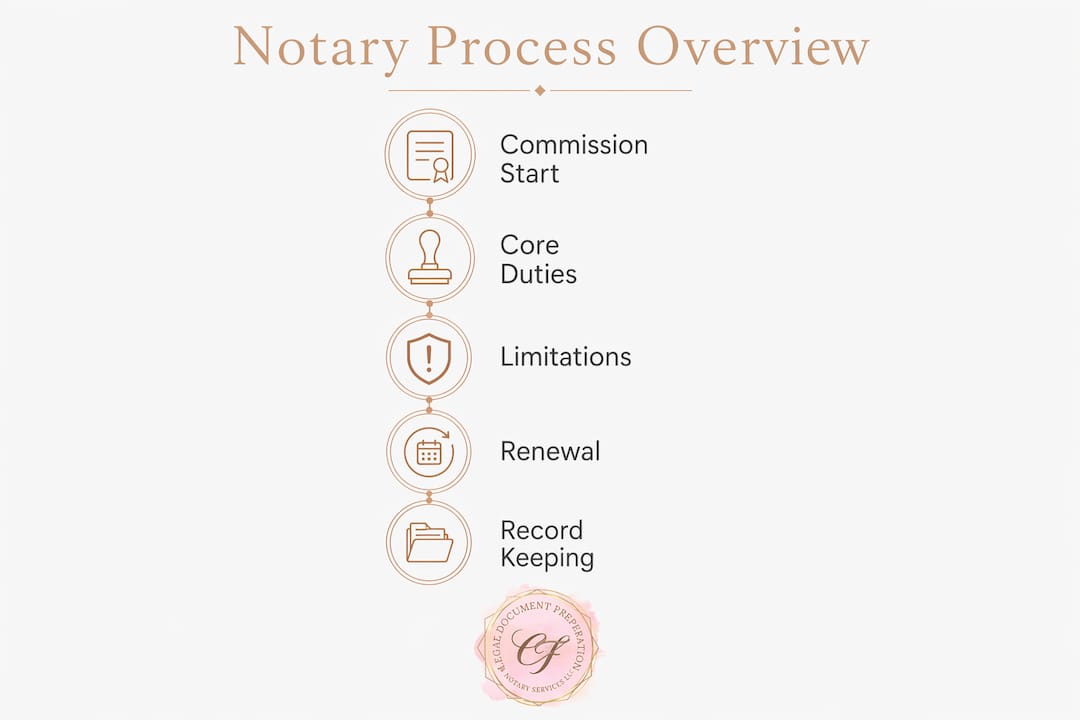
Notary commissions typically last four years, after which renewal requires repeating parts of the application process. The commission is a public trust. Misuse, including backdating documents, notarizing for prohibited parties such as immediate family members in some states, or omitting journal entries, can result in commission revocation and criminal prosecution.
Pro Tip: Keep a bound notary journal for every act you perform, even in states where it is not legally required. A complete journal is your best defense if a notarization is ever challenged in court.
What are the jurisdictional rules for notaries?
A notary commission is geographically bound to the state that issued it. This is one of the most misunderstood aspects of notary public requirements, and violations carry serious consequences.
- A Florida-commissioned notary cannot legally notarize a document while physically located in Georgia, even if the signer is a Florida resident.
- Notarizing outside your commissioning state can invalidate the notarization entirely and expose the notary to criminal prosecution.
- The signer's location matters too. If the signer is outside the notary's commissioning state during a remote online notarization session, the notary must verify whether their commission authorizes that act.
- Commission revocation is a real outcome for jurisdictional breaches, not just a theoretical risk.
Remote online notarization (RON) has added complexity to these rules. Florida, for example, authorizes its notaries to perform RON for signers located anywhere in the world, provided the notary is physically in Florida at the time of the notarization. Not every state has adopted RON legislation, so the rules differ sharply depending on where the notary holds their commission.
A notary commission is not a portable credential. It is a state-specific authorization that carries the full weight of public trust and the full risk of legal liability when misused.
How does notarization work for international documents?
Notarization for documents intended for use in a foreign country is a multi-step process, and a notary seal alone is rarely sufficient. This is where many individuals and businesses lose weeks of processing time.
The table below compares the two most common paths for authenticating documents internationally:
| Authentication type | What it involves | When it is required |
|---|---|---|
| Apostille | A certificate issued by a state authority confirming the notary's credentials | Documents going to countries that are members of the Hague Apostille Convention |
| Consular legalization | Authentication by the destination country's embassy or consulate | Documents going to countries outside the Hague Convention |
Many countries require an apostille or consular legalization after notarization. Skipping these steps renders documents unusable abroad, and the delay caused by resubmitting can stretch to several weeks. A birth certificate notarized in Florida for use in Mexico, for example, must also carry an apostille issued by the Florida Secretary of State before Mexican authorities will accept it.
The distinction between U.S. notaries and their counterparts in other countries also matters here. In England and Wales, notaries are regulated legal professionals with broader authority than U.S. notaries, and some foreign governments specifically require a civil law notary rather than a U.S.-style notary public. Knowing the destination country's requirements before you start the process prevents expensive rejections.
International notarization failures usually arise from improper process rather than the documents themselves. Verifying identity, confirming authority and capacity, and coordinating the correct authentication chain are all critical steps that must happen in the right order.
Pro Tip: Before notarizing any document for foreign use, contact the receiving authority or embassy directly to confirm exactly which authentication steps they require. Requirements change, and what worked two years ago may not work today.
Cflegalformhelp handles certified translations alongside notarization for clients preparing documents for international submission, which eliminates the coordination problem between two separate service providers.
Key takeaways
A notary public is a state-commissioned officer whose authority is strictly procedural, geographically limited, and legally accountable, making proper process the difference between a valid document and a rejected one.
| Point | Details |
|---|---|
| Core notary function | A notary verifies identity and witnesses signatures; they do not validate document content or provide legal advice. |
| Commission requirements | Most states require applicants to be 18, a state resident, bonded, and sworn in before performing any notarial acts. |
| Jurisdictional limits | A notary commission is valid only in the issuing state; acting outside that boundary can invalidate notarizations and trigger legal penalties. |
| International documents | Notarization alone is insufficient for foreign use; apostille or consular legalization is required depending on the destination country. |
| Public trust standard | Misuse of a notary commission, including backdating or omitting journal entries, risks revocation and criminal prosecution. |
Why most people misunderstand what a notary actually is
I have worked with hundreds of clients at Cflegalformhelp who arrive believing a notary stamp makes a document legally binding or legally correct. It does neither. What it does is confirm that the right person signed it, on the right date, of their own free will. That is a narrow but genuinely powerful function when used correctly.
The misconception that troubles me most is the idea that a notary is just a "stamp-for-hire." Treating a notary commission as a rubber-stamp service is exactly how notaries lose their commissions and how clients end up with documents that courts or government agencies reject. I have seen loan closings fall apart because a signing agent notarized documents while physically outside their commissioning state. I have seen immigration applications delayed by months because an apostille was skipped. These are not edge cases. They are predictable outcomes of treating procedure as optional.
The shift toward mobile notaries and remote online notarization is genuinely positive. 51.1% of U.S. notaries are now self-employed mobile notaries or signing agents, which means access to professional notarization has never been better. But convenience does not reduce the obligation to follow the rules. If anything, the expansion of RON has made jurisdictional compliance more complex, not less.
My advice: treat the notary process the way you would treat any legal procedure. Confirm requirements before you start, not after something goes wrong.
— Cristina
Get your documents notarized correctly the first time
Cflegalformhelp provides professional notarization and legal document preparation services for individuals and businesses throughout Florida and beyond. Whether you need a standard notarization, a mobile notary for a real estate closing, or help preparing immigration documents that require both notarization and certified translation, the team at Cflegalformhelp handles the full process with accuracy and compliance.
Cristina Fernandez and the Cflegalformhelp team offer flat-fee, bilingual services in English and Spanish, with deep experience in Florida notary law and international document authentication. From legal document preparation to apostille coordination, every service is designed to get your paperwork accepted the first time. Contact Cflegalformhelp today to schedule your notarization or document preparation appointment.
FAQ
What is a notary public in simple terms?
A notary public is a state-appointed official who witnesses document signings, verifies signer identity, and administers oaths to deter fraud. They do not provide legal advice or confirm that a document's content is accurate or lawful.
How long does a notary commission last?
Most notary commissions last four years, after which the notary must renew by reapplying through their state's Secretary of State office. Some states require retaking a training course or exam at renewal.
Can a notary notarize documents for family members?
Some states prohibit notarizing documents for immediate family members or anyone in which the notary has a direct financial interest. Florida, for example, bars notaries from notarizing their own signature or any document in which they are named as a party.
Is a notarized document the same as a legally binding contract?
No. Notarization confirms the identity of the signer and the voluntariness of the signature. It does not make a contract enforceable or verify that its terms are legal. A contract's legal validity depends on its content and the applicable law, not the notary seal.
Do international documents always need an apostille after notarization?
Documents going to countries that are members of the Hague Apostille Convention require an apostille after notarization. Documents going to non-member countries require consular legalization instead. Skipping either step makes the document unusable in the destination country.