

A signature witnessing notary is an official notarial act in which a notary public personally observes a signer executing a document, verifies their identity, and certifies the signing without administering any oath or affirmation. This is the standard industry term used by the National Notary Association and state regulators to describe one of the most misunderstood notarial acts in practice. Unlike an acknowledgment or a jurat, signature witnessing requires the signer to physically sign in front of the notary. Knowing exactly what this act involves protects your documents from rejection and keeps you on the right side of the law.
What is a signature witnessing notary and how does it work?
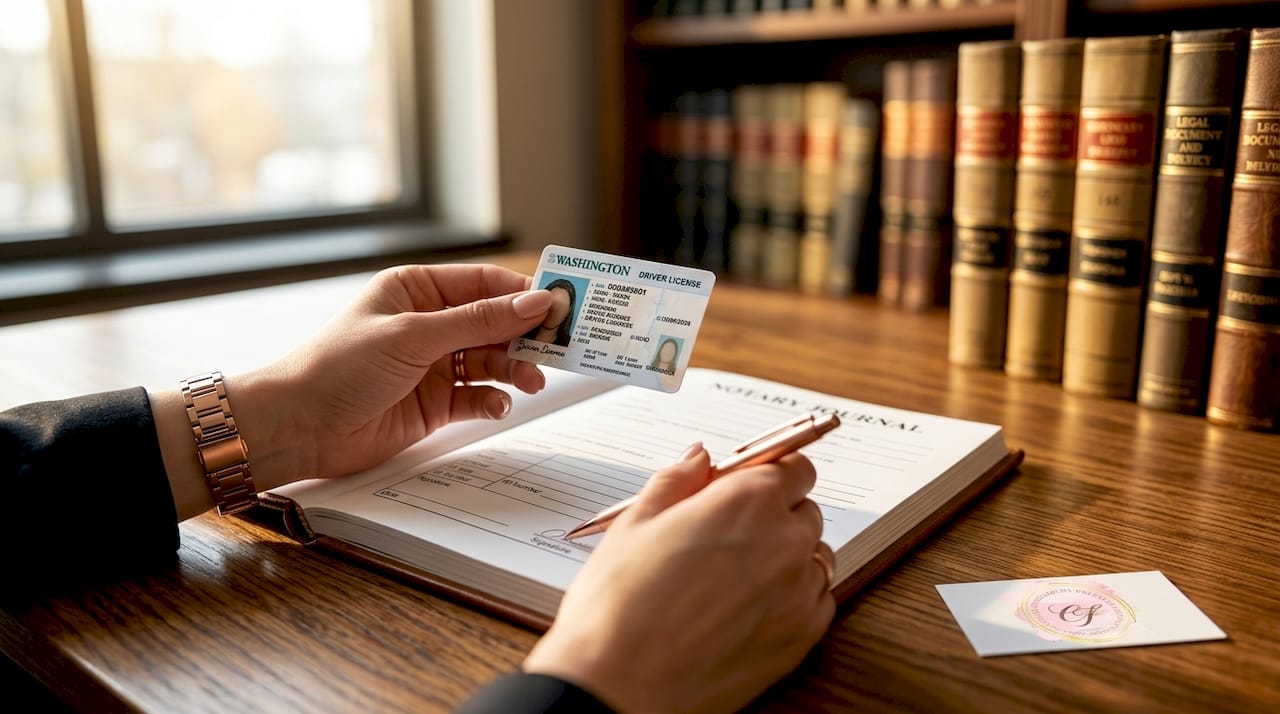
A signature witnessing notary confirms three things: the signer appeared in person, their identity was verified to the notary's satisfaction, and the signature was made in the notary's direct presence. No oath is taken. No sworn statement is made. The notary simply watches the pen hit the paper and certifies that fact.
The certificate wording is the clearest way to identify this act. Phrases like "Signed before me" confirm signature witnessing, while "Acknowledged before me" and "Sworn to before me" indicate an acknowledgment or jurat, respectively. If the certificate language does not match the act performed, the document can be challenged or rejected outright.
The notary's role here is purely observational and verificational. They are not certifying the truth of the document's contents, nor are they confirming the signer understood what they signed. They are certifying one specific fact: this person, whose identity I confirmed, signed this document while I watched.
How does a signature witnessing notary differ from other notarial acts?
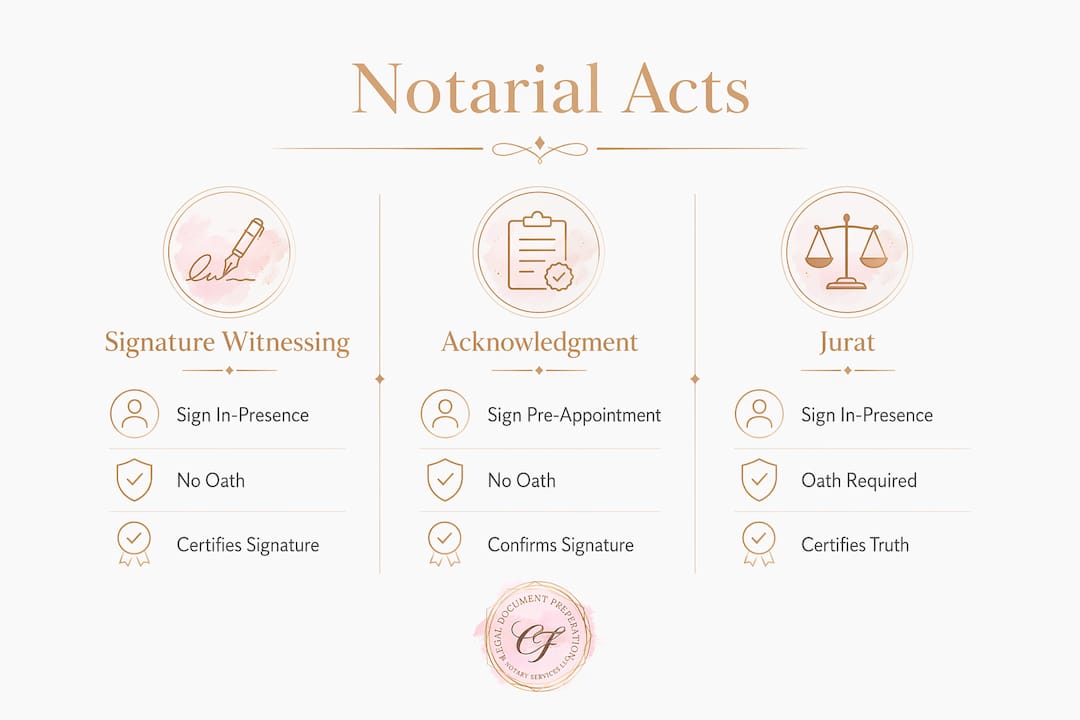
The three most common notarial acts are signature witnessing, acknowledgments, and jurats. Each serves a different legal purpose, and using the wrong one is a costly mistake.
With an acknowledgment, the signer does not have to sign in front of the notary. They can sign beforehand and then appear before the notary to acknowledge that the signature is theirs and that they signed willingly. This is the most common act used for real estate deeds and powers of attorney.
With a jurat, the signer must sign in the notary's presence AND take an oath or affirmation swearing the document's contents are true. No oath is required for signature witnessing, which is what separates it from a jurat. Jurats appear most often on affidavits and sworn statements.
With signature witnessing, the signer must sign in front of the notary, but no oath is administered. This act is used when the law or the receiving party requires proof that the signature was made in real time, under observation, without the added weight of a sworn statement.
| Notarial act | Signing in presence required | Oath required | Common use |
|---|---|---|---|
| Signature witnessing | Yes | No | Corporate resolutions, healthcare directives |
| Acknowledgment | No | No | Deeds, powers of attorney |
| Jurat | Yes | Yes | Affidavits, sworn statements |
A fourth category worth noting is the private witness, which is not a notarial act at all. A private witness simply observes a signature but holds no official authority to verify identity. Mixing the notary's official role with a private witness role creates conflicts of interest and can result in document rejection. A notary acting as both the official notary and a required document witness on the same instrument is a recognized problem in estate planning and real estate closings.
Pro Tip: Before your appointment, read the certificate language at the bottom of your document. If it says "Signed before me," you need a signature witnessing act. If it says "Acknowledged before me," you need an acknowledgment. Bringing the wrong document type to the wrong notary appointment wastes time and money.
What are the legal and procedural requirements for this notarial act?
The signature witnessing process follows a clear sequence, and skipping any step can invalidate the entire notarization.
- Personal appearance is mandatory. The signer must be physically present before the notary at the time of signing. Remote online notarization rules vary by state, but for traditional signature witnessing, in-person presence is the default standard.
- Identity must be verified. The notary checks government-issued photo identification such as a driver's license or passport. Some states allow credible identifying witnesses as an alternative when ID is unavailable.
- The document must be unsigned when presented. Signature witnessing is invalidated if the signer has already signed the document before appearing. The notary must watch the act of signing occur.
- The notary completes the certificate. After witnessing the signature, the notary fills in the certificate, applies their seal, and signs. The certificate language must match the act performed.
- Fees are regulated by state law. In Pennsylvania, signature witnessing fees are set at $5 per signature under 2026 regulations (4 Pa. Code § 167.3), billed separately from acknowledgment or jurat fees. Florida and other states have their own fee schedules.
Jurisdictional differences matter significantly. Signature witnessing is not a recognized notarial act in every state. Improper notarization can lead to document rejection, civil liability, or in serious cases, criminal charges. Nebraska courts have upheld criminal convictions for notaries who performed acts outside their authorized scope. Confirming that your state permits signature witnessing before requesting it is not optional. It is a legal necessity.
In what practical situations is a signature witnessing notary used?
Signature witnessing appears most often when a receiving party, a court, or a regulatory body needs proof that a signature was made voluntarily and in real time, not pre-signed and presented later.
Common documents that require this act include:
- Healthcare directives and living wills, where state law often requires a witness to confirm the signer was competent and acting freely at the moment of signing
- Corporate resolutions and business agreements, where boards or partners need certified proof that authorized signatories executed documents in a controlled setting
- Personal agreements and contracts, where one party demands a higher standard of signature verification than a simple acknowledgment provides
- Immigration-related affidavits of support, where specific document requirements may call for witnessed signatures rather than acknowledged ones
The practical importance of getting this right is significant. A healthcare directive signed before the notary arrived is legally worthless in states requiring signature witnessing. A corporate resolution with the wrong certificate language can be rejected by a bank or a court. Failing to check document requirements before the appointment is the single most common and most expensive mistake clients make.
The timing of the signature is not a technicality. It is the entire point of the act. The notary's value in signature witnessing is the real-time, in-person certification that the signature happened exactly when and how it was supposed to happen.
What are the 2026 regulatory updates and best practices to know?
Pennsylvania's 2026 final rules under 4 Pa. Code § 167.3 standardized signature witnessing fees at $5 per signature, making them fee-separable from other notarial acts. This means a notary can charge $5 for a signature witnessing act independently of any acknowledgment or jurat performed on the same visit. For businesses processing high volumes of documents, this distinction affects budgeting and vendor agreements with notary services.
| Notarial act | 2026 Pennsylvania fee |
|---|---|
| Signature witnessing | $5 per signature |
| Acknowledgment | Separate fee schedule |
| Jurat | Separate fee schedule |
Beyond fees, best practices for 2026 center on preparation and verification before the appointment.
Confirm the certificate language matches the required act. "Signed before me" is signature witnessing. Any other phrasing signals a different act entirely. If the document was prepared by an attorney or a government agency, call ahead to confirm which notarial act they require before scheduling.
Ask whether the document will need an apostille or consular legalization after notarization. Many clients treat notarization as the final step, only to discover their document needs further authentication for international use. An apostille from the Florida Secretary of State, for example, adds processing time and cost that must be planned for in advance.
Pro Tip: If your document is headed to a foreign country, ask your notary whether it needs an apostille or consular legalization before you leave the appointment. Discovering this requirement after the fact means starting the process over.
Work with notaries who specialize in the specific document type you are presenting. A notary experienced in legal document preparation will recognize the correct act immediately and flag errors before they become problems.
Key takeaways
A signature witnessing notary is defined by one non-negotiable requirement: the signer must sign in the notary's physical presence with verified identity, and no oath is administered.
| Point | Details |
|---|---|
| Core definition | The signer must sign in front of the notary; identity is verified; no oath is required. |
| Certificate language matters | "Signed before me" confirms signature witnessing; wrong wording invalidates the act. |
| Not permitted everywhere | Signature witnessing is not authorized in all states; confirm jurisdiction before requesting it. |
| 2026 fee update | Pennsylvania set the fee at $5 per signature under 4 Pa. Code § 167.3, billed separately. |
| Post-notarization steps | Documents for international use may require an apostille or consular legalization after notarization. |
What I have learned from years of witnessing signatures go wrong
Most document problems I see at Cflegalformhelp do not happen because people chose the wrong notary. They happen because nobody told the client what type of notarial act their document actually required. A client walks in with a healthcare directive already signed, confident they are saving time. The notary has to turn them away because the document requires a witnessed signature, not an acknowledgment. That is a wasted trip, a frustrated client, and sometimes a missed deadline.
The other pattern I see constantly is clients who do not realize that a private witness and a notary witness are completely different things. Some documents require both: a notary to perform the official act and one or two private witnesses to observe. A notary cannot fill both roles on the same document without creating a conflict of interest that can invalidate the notarization entirely.
My honest advice: read the certificate language before you book your appointment. If you are not sure what it means, call the notary and describe it. A knowledgeable notary will tell you exactly what act is required and what you need to bring. The five minutes that conversation takes will save you from a second appointment, a rejected document, or a legal challenge you did not see coming.
— Cristina
Get your documents notarized correctly the first time
At Cflegalformhelp, we handle signature witnessing notarizations, acknowledgments, jurats, and the full range of notarial acts for individuals and businesses across South Florida. Cristina Fernandez and the team know exactly which act each document requires and will confirm the certificate language before you sign. Whether you need a mobile notary appointment at your home, office, or hospital, or you need document preparation paired with notarization, Cflegalformhelp provides flat-fee, bilingual service in English and Spanish. Do not risk a rejected document. Book your appointment with a notary who gets it right.
FAQ
What does a signature witnessing notary actually do?
A signature witnessing notary verifies the signer's identity, watches them sign the document in person, and certifies that act with a notarial certificate reading "Signed before me." No oath or affirmation is administered.
Can a document be pre-signed before a signature witnessing appointment?
No. A document signed before the notary is present cannot be used for signature witnessing. The signer must execute the document in the notary's direct presence, or the notarization is invalid.
Is signature witnessing the same as an acknowledgment?
No. An acknowledgment allows the signer to sign beforehand and then appear before the notary to confirm the signature. Signature witnessing requires the signer to sign in front of the notary at the time of the appointment.
How do I find a notary who performs signature witnessing?
Contact a notary service directly and describe the certificate language on your document. Cflegalformhelp offers notary services for signature witnessing and related acts across South Florida, with mobile appointments available.
Does a notarized document always need an apostille?
Not always. An apostille is required only when the document will be used in a foreign country that is a member of the Hague Apostille Convention. Notaries must inform clients about this additional step so it can be planned before the document leaves the office.