

A sworn statement is a written declaration made under oath or affirmation that carries legal weight far beyond an ordinary written statement, and a notary public is the authorized official who certifies that oath. When you sign a document in front of a notary who administers an oath and witnesses your signature, that document becomes a legally sworn statement with real consequences under perjury law. This process, called jurat notarization, is what separates a casual written claim from a court-admissible declaration. Understanding how this works protects you from costly mistakes whether you are filing in a Florida state court, submitting immigration paperwork, or handling a business dispute.
What does a notary do in the sworn statement process?
A notary public serves as an impartial, state-commissioned official whose job is to verify identity, administer oaths, and certify signatures on legal documents. The National Notary Association defines this role clearly: the notary does not advise you on the law, draft your legal strategy, or guarantee the truth of what you write. The notary's authority is procedural, not legal. That distinction matters enormously when people walk in expecting a notary to tell them whether their document is correct.
For a sworn statement specifically, the notary follows a defined sequence of notary public responsibilities:
- Verify your identity. The notary checks your government-issued photo ID before anything else. No valid ID means no notarization.
- Confirm willingness. The notary confirms you are signing voluntarily and are not under duress.
- Administer the oath or affirmation. This verbal step is what makes the statement legally "sworn." The notary asks you to swear or affirm that the contents are true.
- Witness your signature. You sign only after the oath is administered, and you sign in the notary's physical presence.
- Complete the jurat certificate. The notary fills in the certificate wording, signs it, dates it, and affixes the official seal.
- Record the transaction. Most states require notaries to log the transaction in a notarial journal, including the document type, ID used, and date.
Pro Tip: Never sign your sworn statement before arriving at the notary appointment. A pre-signed document cannot be properly notarized as a jurat because the signature must occur after the oath is administered and in the notary's presence.
How do sworn statements differ from affidavits and acknowledgments?
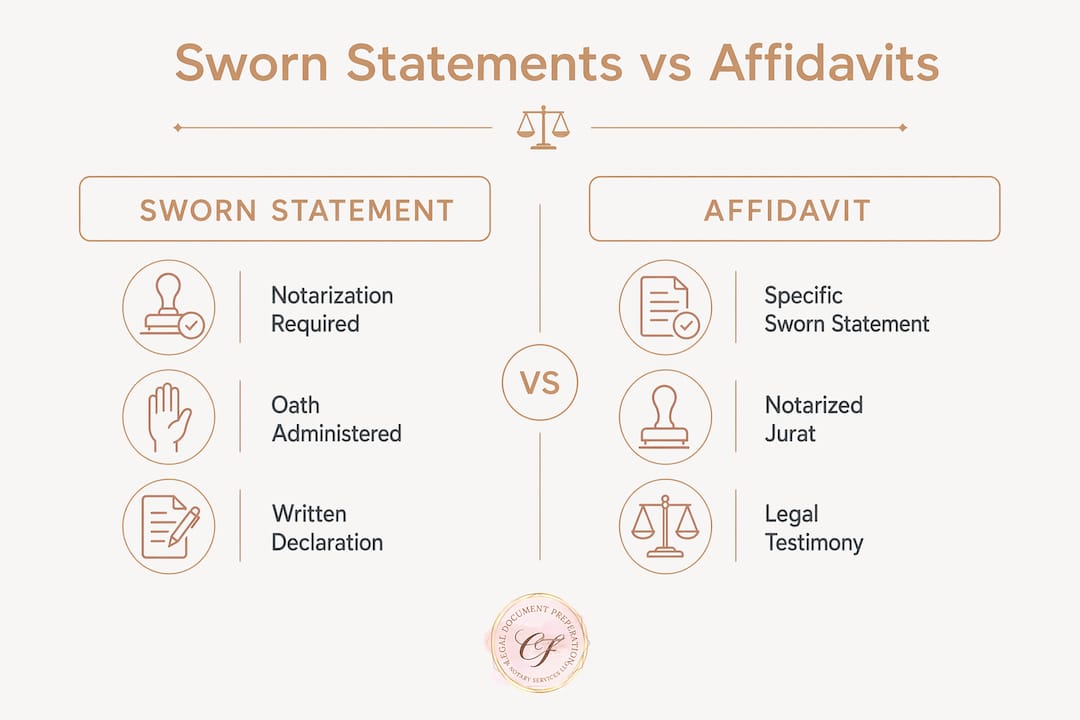
The terms "sworn statement," "affidavit," and "acknowledgment" get used interchangeably in everyday conversation, but they are legally distinct. Knowing the difference prevents document rejection and wasted time.
An affidavit is a specific type of sworn statement. It is a written declaration made under oath, notarized with a jurat, and used as evidence in legal proceedings. Every affidavit is a sworn statement, but not every sworn statement is formatted as a formal affidavit. The jurat notarization type centers on administering an oath, which is what makes the document legally sworn.
An acknowledgment is a completely different notarization type. The notary verifies your identity and confirms you signed voluntarily, but no oath is administered. Acknowledgments are common on deeds, mortgages, and powers of attorney. They do not make a statement "sworn" under penalty of perjury.
An unsworn declaration is a federal option created by 28 U.S.C. § 1746 that allows a person to substitute a notarized affidavit with a signed declaration that includes specific statutory language affirming truthfulness under penalty of perjury. No notary is required. This reduces filing burdens in federal proceedings considerably.
| Document type | Notarization required | Oath administered | Common uses |
|---|---|---|---|
| Sworn statement / affidavit | Yes (jurat) | Yes | State court filings, immigration, family law |
| Acknowledgment | Yes | No | Deeds, mortgages, powers of attorney |
| Unsworn declaration (federal) | No | No (statutory language substitutes) | Federal court filings, federal agency submissions |
The practical takeaway: always read the certificate wording block on your document before scheduling a notary appointment. That small block of text tells you exactly which notarization type is required. Choosing the wrong type is one of the most common reasons documents get rejected by courts and agencies.
What steps are involved in correctly notarizing a sworn statement?
Getting a sworn statement properly notarized is a short process when you prepare correctly. Skipping any step creates a defective document that may be rejected or challenged.
- Prepare the document unsigned. Draft your sworn statement with the correct jurat certificate wording already included at the bottom. Do not sign it yet.
- Bring valid government-issued photo ID. A driver's license, state ID, or passport are the standard acceptable forms. Some states allow credible witnesses to vouch for your identity if you lack qualifying ID.
- Arrive at the notary appointment with the unsigned document. The notary will review the document and confirm the notarization type required.
- Take the oath or affirmation. The notary will ask you to swear or affirm that the contents of the document are true. Answer clearly and verbally.
- Sign in the notary's presence. Sign immediately after the oath, while the notary watches. This sequence is legally critical. Signing before the oath invalidates the jurat.
- Allow the notary to complete the certificate. The notary fills in the date, signs the certificate, and stamps or embosses the official seal.
- Confirm the journal entry. In Florida and most states, the notary records the transaction in a notarial journal. You may be asked to provide a thumbprint for certain document types.
Pro Tip: If your document has multiple pages, ask the notary to initial each page or use a staple before the appointment ends. This prevents pages from being swapped out after notarization and protects the document's integrity.
Common mistakes to avoid include: bringing a pre-signed document, arriving without valid ID, using a notary who is not commissioned in the state where the document will be filed, and failing to check whether the document requires a jurat or an acknowledgment. Each of these errors can send you back to square one.
When is a notarized sworn statement required vs. an unsworn declaration?
The answer depends almost entirely on where the document will be filed and which agency or court will receive it.
State court and agency filings in Florida and most other states require notarized sworn statements with a proper jurat for documents like affidavits of service, financial affidavits in family law cases, and sworn statements in support of motions. Florida courts do not accept unsworn declarations as substitutes for notarized affidavits in most state proceedings.
Federal court and federal agency filings are different. Under 28 U.S.C. § 1746, an unsworn declaration that includes the required statutory language and is signed and dated carries the same legal force as a notarized affidavit in federal proceedings. This matters for immigration petitions filed with USCIS, federal civil litigation, and federal agency submissions.
Key situations where notarized sworn statements are typically required:
- Florida state court affidavits and sworn motions
- Family law financial disclosures and parenting plan affidavits
- Real estate transactions involving sworn representations
- Immigration affidavits of support filed with state agencies
- Business license applications requiring sworn certifications
Always verify the specific filing requirements with the court clerk or agency before preparing your document. Rules change, and assuming the wrong format can delay your case by weeks.
For documents used outside the United States, notarization alone is rarely sufficient. International document workflows typically require an apostille issued by the Florida Secretary of State or consular legalization depending on the destination country. An apostille certifies the notary's authority for use in countries that are parties to the Hague Apostille Convention. If your sworn statement is headed abroad, plan for this additional authentication step before your deadline.
Key takeaways
A sworn statement becomes legally binding only when a notary administers an oath before the signature, completing a valid jurat that distinguishes it from an ordinary written declaration.
| Point | Details |
|---|---|
| Sworn statement definition | A written declaration made under oath, certified by a notary through jurat notarization. |
| Jurat vs. acknowledgment | Jurats require an oath and witnessed signature; acknowledgments verify identity only and do not create a sworn document. |
| Correct signing sequence | The oath must be administered before signing. Signing first invalidates the jurat and the sworn status of the document. |
| Federal alternative | 28 U.S.C. § 1746 allows unsworn declarations under penalty of perjury for federal filings, eliminating the notarization requirement. |
| International documents | Notarization alone is insufficient for international use. An apostille or consular legalization is typically required. |
What I have learned from years of notarizing sworn statements
People walk into notary appointments with two common misconceptions. The first is that the notary will catch errors in their document. The second is that any notarization makes a document "official." Neither is true, and both lead to real problems.
The certificate wording block at the bottom of a document is the single most important detail most people ignore. I have seen clients bring documents that clearly required a jurat but had acknowledgment wording printed on them. Notarizing with the wrong certificate type does not just create a technical defect. It means the document was never legally sworn at all, regardless of what the signer believed.
The other issue I see constantly is the pre-signed document. Someone signs at home for convenience, then brings the document in expecting a stamp. A notary who completes a jurat on a pre-signed document is not following proper procedure, and that document can be challenged. The sequence of oath before signature is not a formality. It is the legal mechanism that creates the sworn status.
For anyone handling multi-step legal workflows, especially immigration or family law matters, I strongly recommend working with a document preparer who understands both the content requirements and the notarization requirements together. Preparing the document correctly and notarizing it correctly are two separate skills, and gaps between them are where documents fail. At Cflegalformhelp, we handle both sides of that process, which is exactly why clients avoid the back-and-forth that comes from working with disconnected services.
— Cristina
Get your sworn statement notarized correctly the first time
Sworn statement errors are expensive to fix. A rejected affidavit in a family law case or an immigration filing can set your timeline back by weeks, sometimes longer.
Cflegalformhelp provides professional document preparation and notary services for individuals and small businesses throughout Florida, with flat-fee pricing and bilingual support in English and Spanish. Whether you need a sworn affidavit for a state court filing, an immigration document, or a business matter, the team at Cflegalformhelp prepares the document with the correct jurat wording and notarizes it on the spot. Mobile notary appointments are also available. Visit Cflegalformhelp mobile notary services to schedule an appointment or get a flat-fee quote today.
FAQ
What is a sworn statement notary?
A sworn statement notary refers to a notary public who administers a jurat, which includes an oath or affirmation, witnesses the signer's signature, and certifies the document with a notarial seal. This process transforms a written declaration into a legally sworn statement subject to perjury law.
What does a notary do during a jurat notarization?
The notary verifies your identity, administers an oral oath or affirmation, witnesses you sign the document, then completes and seals the jurat certificate. The National Notary Association confirms that all four steps must occur in this exact sequence for the notarization to be valid.
Can I sign a sworn statement before seeing the notary?
No. For a jurat notarization, you must sign in the notary's presence and only after the oath is administered. A pre-signed document cannot be properly notarized as a sworn statement and may be rejected by courts or agencies.
When can I use an unsworn declaration instead of a notarized sworn statement?
Federal law under 28 U.S.C. § 1746 permits unsworn declarations with specific statutory language as substitutes for notarized affidavits in federal proceedings. State court filings in Florida generally still require a notarized jurat.
Does a notarized sworn statement work for international use?
Not on its own. Documents used internationally typically require an apostille from the Florida Secretary of State or consular legalization in addition to notarization, depending on the destination country's requirements.