
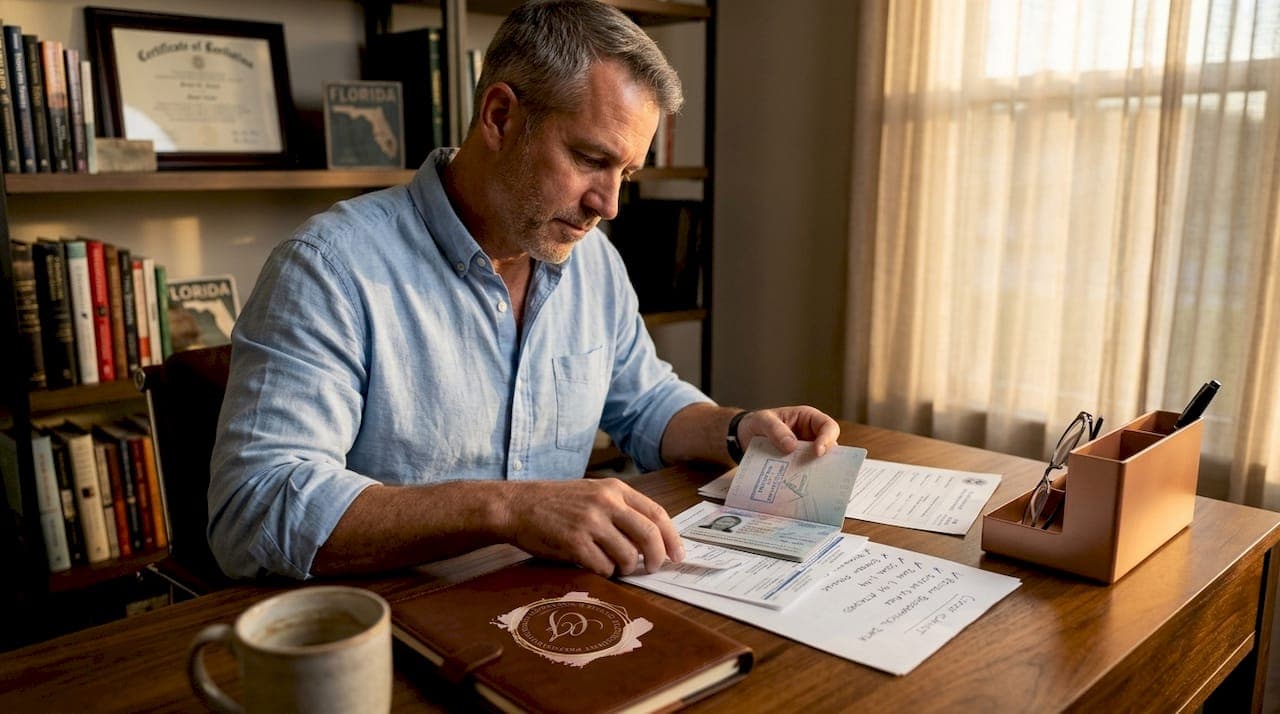
An immigration document checklist for Florida applicants is the single most effective tool for avoiding rejections, delays, and costly Requests for Evidence from USCIS. Whether you are filing Form I-485 for a green card, preparing for a marriage-based interview, or adjusting your status through an employer, the documents you submit define the outcome. Florida applicants face the same federal USCIS requirements as everyone else, but the volume of filings processed through Miami, Orlando, and Tampa field offices makes preparation even more critical. This guide breaks down exactly what you need, organized by document type and application category, including the 2024 rule change that now requires Form I-693 to be submitted with your initial I-485 package.
1. Core identity documents every Florida applicant must have
Every Florida immigration application starts with the same foundation: proof of who you are and how you entered the United States. These documents are non-negotiable regardless of the visa category or benefit you are seeking.
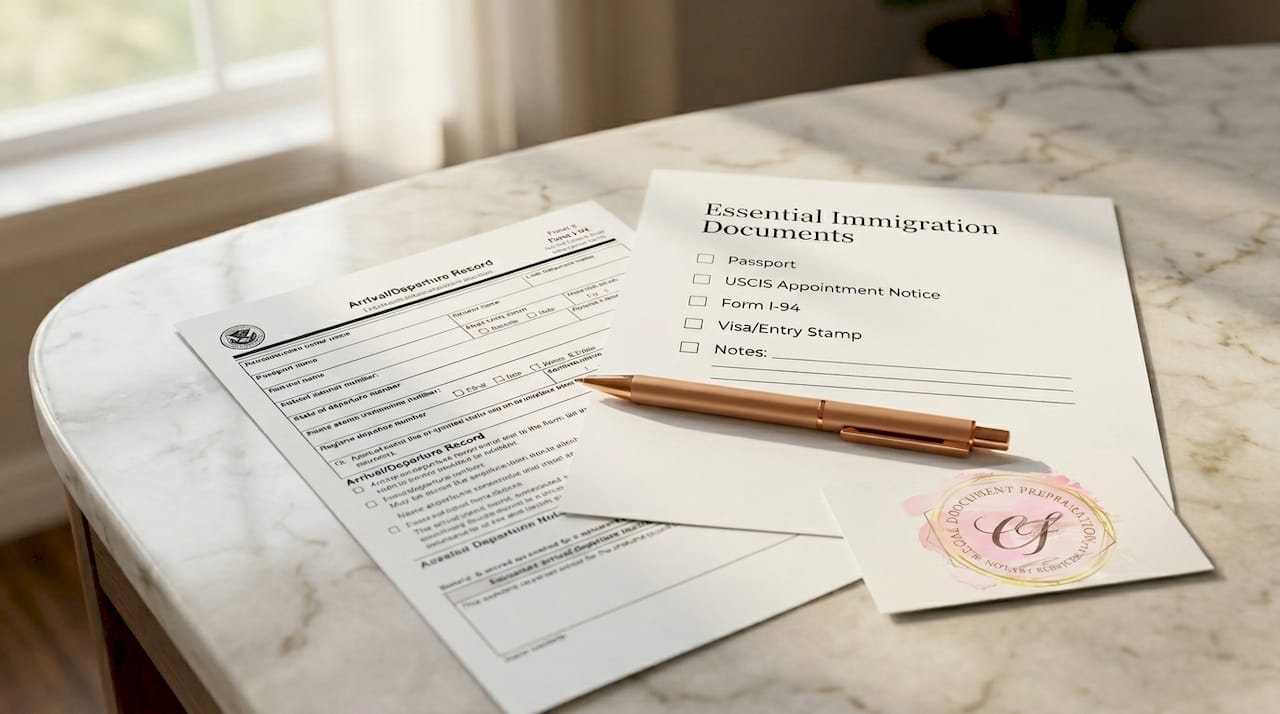
- Valid passport and all expired passports. Bring your current passport plus every expired passport that contains a U.S. entry stamp. USCIS officers use these to verify your travel history and confirm you entered lawfully.
- Original birth certificate with certified English translation. If your birth certificate is not in English, a certified translation is required before USCIS will accept it. A missing or uncertified translation is one of the most common causes of RFEs.
- Form I-94 arrival/departure record. The I-94 admission record is an 11-digit number (or 9 digits with letter and digit suffixes in recent versions) that confirms your admission class and authorized stay. Print your current I-94 from the CBP website before any filing or interview.
- Government-issued photo ID. A Florida driver's license or state-issued ID card supplements your passport and confirms your current address.
- Form I-797C appointment notice. This is your proof of a scheduled USCIS interview or biometrics appointment. Bring the original to every appointment.
- Two passport-style photos. Photos must meet USCIS specifications: 2x2 inches, white background, taken within 30 days of filing.
Pro Tip: Print a fresh I-94 record the week before any USCIS appointment. Discrepancies between your I-94 and your passport can trigger additional scrutiny that delays your case.
2. Documents for Form I-485 and green card interviews
Adjustment of status is the most document-intensive process in U.S. immigration. Submitting complete initial evidence with Form I-485 is the single most reliable way to avoid an RFE and speed up adjudication. USCIS provides an optional checklist tool for I-485 organization, and using it is strongly recommended.
- Form I-485 and all supporting forms. Include Form I-131 (travel document), Form I-765 (work authorization), and Form I-864 (affidavit of support) where applicable. Bring complete copies of everything you submitted to USCIS.
- Form I-693 medical examination. Since December 2, 2024, Form I-693 must be submitted with your initial I-485 filing rather than brought to the interview. A USCIS-designated civil surgeon must sign the form and seal it in an envelope. If you file online, you open the sealed envelope only to upload the form, then keep it until a final decision is issued.
- Form I-797C appointment notice. Bring the original notice confirming your interview date and location.
- Petitioner's documents. For family-based cases, the U.S. citizen or permanent resident petitioner must bring their own passport, birth certificate, and proof of status.
- Proof of lawful entry. Your passport entry stamps and I-94 record together confirm you entered the U.S. legally, which is a threshold requirement for adjustment of status.
- Police clearance certificates. Required for applicants who have lived in other countries for extended periods. Check USCIS instructions for your specific country of residence history.
Pro Tip: Never submit your only original of any document. Make certified copies before filing and keep the originals in a secure location at home.
3. Marriage-based applicants: relationship evidence checklist
Marriage-based green card cases require a second layer of documentation beyond identity and status. The USCIS officer's primary job at your interview is to determine whether your marriage is genuine. Relationship evidence organized chronologically gives officers exactly what they need to make that determination quickly and in your favor.
Documents proving the marriage is valid:
- Original marriage certificate with certified English translation if not in English
- Divorce decrees for any prior marriages (both spouses)
- Joint federal and state tax returns for the past two to three years
- Joint bank account statements showing shared finances
- Lease agreements or mortgage documents listing both names
- Utility bills, insurance policies, and credit card statements in both names
- Photographs from the relationship timeline, organized by date
- Affidavits from people who know the couple personally
Joint finances and residence proofs such as bank statements, leases, and utility bills are the strongest evidence of a bona fide marriage. Photographs alone are rarely sufficient. Organize everything in chronological order so the officer can follow your relationship timeline without asking you to search through a stack of papers.
4. Employment-based applicants: what your Florida visa document list needs
Employment-based adjustment of status requires a different set of supporting documents focused on your qualifications and your employer's petition. The core identity documents from Section 1 still apply, but you add a layer of professional and petition-related evidence.
Your Florida visa document list for employment-based cases should include Form I-140 (immigrant petition for alien workers) with the approval notice, your most recent three years of federal tax returns, and educational diplomas or transcripts with certified translations if issued in a foreign language. A current employment support letter on company letterhead confirming your position, salary, and continued intent to employ you is required. If your priority date is current, include proof of that as well.
One detail many applicants overlook: if you changed employers after your I-140 was approved and you are using portability under the American Competitiveness in the 21st Century Act, bring documentation of the new position and a letter explaining how it qualifies. USCIS officers at Florida field offices will ask about this directly.
5. How to handle translations, copies, and document organization
Certified translations are required for every document not written in English that you submit to USCIS. This includes birth certificates, marriage certificates, divorce decrees, police records, and any foreign-language court documents. A certified translation must include a statement from the translator confirming competency and accuracy, along with their signature and date.
Best practices for document organization:
- Keep a set of originals at home and bring certified copies to every appointment unless the officer specifically requests originals
- Use a three-ring binder with labeled tabs: "Identity Documents," "Petition Documents," "Relationship Evidence," "Financial Evidence," and "Medical Records"
- Organizing documents in a tabbed binder allows officers to locate specific items quickly, which shortens interview time and reduces the chance of confusion
- Place the most recently filed documents at the front of each section
- Bring two complete sets to every interview: one for the officer and one for your own reference
For Florida applicants working with a notary or document preparer, confirm that your translations carry the preparer's certification statement. USCIS rejects translations that lack this statement, even if the translation itself is accurate.
6. Comparison of document requirements by application type
The table below summarizes the key documents required across the three most common application categories in Florida. Use this as a quick reference when building your checklist for immigration in Florida.
| Document | Family-based | Employment-based | Florida residency adjustment |
|---|---|---|---|
| Valid passport + expired passports | Required | Required | Required |
| Form I-485 and supporting forms | Required | Required | Required |
| Form I-693 (medical exam) | Required | Required | Required |
| Form I-140 approval notice | Not applicable | Required | Depends on basis |
| Marriage certificate + translations | Required | Not applicable | Depends on basis |
| Joint financial evidence | Required | Not applicable | Not applicable |
| Employment support letter | Not applicable | Required | Depends on basis |
| Educational diplomas/transcripts | Not applicable | Required | Depends on basis |
| Police clearance certificates | Situational | Situational | Situational |
| Certified translations | Required if applicable | Required if applicable | Required if applicable |
The most critical difference between family-based and employment-based cases is the source of the petition. Family-based applicants build their case around relationship evidence. Employment-based applicants build theirs around professional qualifications and an approved I-140. Both require the same identity documents, the same medical exam, and the same attention to certified translations.
Key takeaways
A complete Florida immigration document checklist, organized by application type and submission rules, is the most reliable way to prevent RFEs and processing delays in 2026.
| Point | Details |
|---|---|
| I-693 now filed with I-485 | Since December 2024, submit the sealed medical exam with your initial I-485 package, not at the interview. |
| Certified translations are mandatory | Every non-English document requires a certified translation with a signed translator statement before USCIS will accept it. |
| Marriage evidence must be chronological | Joint tax returns, bank statements, leases, and photos organized by date give officers the clearest proof of a genuine marriage. |
| Tabbed binders speed up interviews | Organized binders with labeled sections reduce interview time and demonstrate preparedness to USCIS officers. |
| Complete initial filing prevents RFEs | Submitting all required evidence upfront with Form I-485 is the single most effective way to avoid costly delays. |
What I have learned from years of Florida immigration paperwork
The biggest mistake I see is not a missing document. It is a document that was submitted incorrectly. Clients bring a birth certificate translated by a bilingual friend, or they submit Form I-693 in an unsealed envelope because they did not know the civil surgeon's sealed envelope rule changed in December 2024. These are not careless errors. They are the result of relying on outdated information or well-meaning advice from people who are not current on USCIS requirements.
The second most common problem is treating the USCIS checklist as optional. USCIS labels it optional, but in practice, using the I-485 checklist tool as your organizational framework is the difference between a clean filing and a 12-month delay waiting for an RFE response.
What I tell every client at Cflegalformhelp: build your binder before you file, not after you receive a notice. Once USCIS sends an RFE, you are working under a deadline with a case already flagged for review. That is a harder position than getting it right the first time. The immigration guides and DIY filing resources we provide exist precisely to help you avoid that situation.
One more thing: if you have lived in multiple countries, do not assume your police clearance certificates are optional. Florida field offices in Miami and Orlando process a high volume of cases from applicants with complex travel histories. Officers there are experienced at spotting gaps in documentation. Fill those gaps before your interview, not during it.
— Cristina
Let Cflegalformhelp handle your Florida immigration paperwork
Preparing a complete immigration document checklist for Florida takes time, precision, and current knowledge of USCIS rules. Cflegalformhelp offers flat-fee immigration form preparation for Form I-485, Form I-693 coordination, and supporting document packages. The team provides certified translations in English and Spanish, mobile notary services throughout South Florida, and bilingual support for every step of the process. Whether you are a first-time applicant or adjusting status after years in Florida, the legal document preparation services at Cflegalformhelp are built to get your filing right the first time.
FAQ
What documents are required for a Florida green card interview?
For a Florida green card interview, bring Form I-797C, your passport, birth certificate, marriage certificate (if applicable), Form I-485 copies, and organized relationship or employment evidence. Core civil and relationship documents should be arranged chronologically in a tabbed binder.
When did the Form I-693 filing rule change?
USCIS changed the I-693 submission rule on December 2, 2024. Since that date, Form I-693 must be included with the initial I-485 filing in a sealed envelope signed by a civil surgeon, not brought separately to the interview.
Do I need certified translations for my Florida immigration application?
Yes. USCIS requires certified translations for all documents not written in English. A missing or uncertified translation is a leading cause of RFEs and can delay your Florida residency application document checklist review by months.
What is Form I-94 and why does it matter?
Form I-94 is the arrival and departure record that confirms your admission class and authorized period of stay in the United States. USCIS uses it during identity and status verification for every immigration filing.
Can I prepare my own immigration documents in Florida without an attorney?
Yes. Florida law allows non-attorney document preparers to assist with form completion and organization. Services like Cflegalformhelp provide professional immigration form assistance without legal representation, which keeps costs lower for self-represented applicants.