

A document preparer in business formation is a nonlawyer professional who helps entrepreneurs prepare and file the essential paperwork needed to legally establish a business entity, without providing legal advice or making strategic decisions. The role of document preparer in business formation covers tasks like drafting Articles of Incorporation for corporations and Articles of Organization for LLCs, collecting required information, and submitting filings to the appropriate state agency. What this role does not cover is equally important: document preparers cannot advise you on which business structure to choose, interpret laws, or represent you in any legal matter. For entrepreneurs in Florida and across the U.S., understanding this distinction saves time, money, and avoids serious compliance mistakes. Cflegalformhelp works precisely within these boundaries to deliver accurate, affordable formation support.
What is the role of document preparer in business formation?
The document preparer's role is administrative, not legal. Think of it as the difference between a tax preparer who fills out your return and a tax attorney who advises you on restructuring your assets. Both are valuable. Neither replaces the other.
In practice, document preparers gather the information needed to complete formation documents, check those documents for completeness and accuracy, and submit them to the state. For LLCs, the person performing this function is called the organizer. For corporations, the equivalent title is the incorporator. These are formal legal terms, not just job descriptions.

The incorporator prepares, signs, and files the Articles of Incorporation and may hold an organizational meeting if directors are not named in the articles. Once the state accepts the filing, the incorporator's role ends. The corporation legally exists at that point, and governance passes to the directors and officers named in the formation documents.
The same logic applies to LLCs. An LLC organizer prepares and files the Articles of Organization with the state, and their role ends once the filing is accepted. They do not manage or own the LLC unless separately designated as a member or manager. This temporary, task-specific nature is what defines the document preparer's position in the formation process.
What documents and tasks do document preparers handle?
Document preparers handle a specific and bounded set of tasks. Knowing exactly what falls inside that scope helps you plan the rest of your formation process accurately.
- Articles of Organization (LLC): Preparer collects the LLC name, registered agent details, member or manager names, and the principal business address, then formats and files the document with the state Division of Corporations.
- Articles of Incorporation (Corporation): Preparer gathers the corporate name, number of authorized shares, registered agent, and incorporator signature, then submits to the state.
- Filing fee payment: Preparers handle submission of the required state filing fee, which varies by state and entity type.
- Document accuracy review: Before filing, a preparer checks that all required fields are complete and consistent to avoid rejection by the state agency.
- Confirmation and record-keeping: After filing, preparers provide the entrepreneur with the stamped or approved formation documents as proof of legal existence.
What preparers do not do is just as important. Document preparers cannot give legal advice or make legal decisions. Their role is to help complete and file paperwork as factual document-fillers. Choosing between an LLC and a corporation, deciding on equity splits, or structuring liability protections all require an attorney.
Pro Tip: Ask any document preparer upfront: "What questions can you answer, and what falls outside your scope?" A reputable preparer will give you a clear, honest answer. If they start offering legal opinions, that is a red flag.
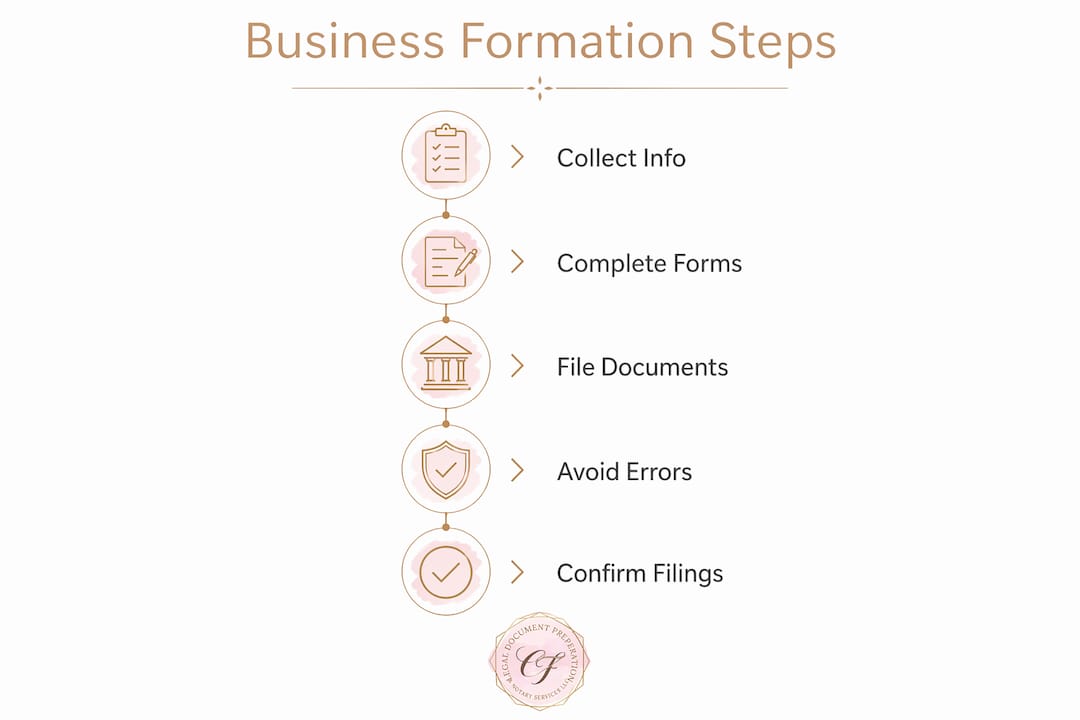
Common filing errors that preparers help you avoid include mismatched business names between state records and federal EIN applications, missing registered agent consent forms, and incorrect principal office addresses. These mistakes delay formation and can trigger rejection fees.
How do document preparers differ from attorneys, paralegals, and registered agents?
Entrepreneurs frequently confuse these four roles. The confusion is understandable because all four professionals touch the formation process at some point. The distinctions, however, are sharp.
Attorneys, paralegals, and filing services split the formation process into distinct functions: attorneys focus on legal structure and strategy, paralegals coordinate and organize, and filing partners handle submissions. A document preparer sits closest to the filing partner function, with no legal advisory capacity.
| Role | Authority | Primary responsibility |
|---|---|---|
| Attorney | Licensed to practice law | Legal advice, structure selection, contract drafting |
| Paralegal | Works under attorney supervision | Document coordination, research, case management |
| Document preparer | No legal authority | Completing and filing formation paperwork |
| Registered agent | Designated by state law | Receiving official state and legal correspondence |
The registered agent role is worth clarifying separately. A registered agent is a person or company designated to receive official state mail and legal process on behalf of the business. This is an ongoing role that continues for the life of the business. A document preparer's role ends at filing. Business formation services often bundle document preparation, registered agent setup, EIN filing, and compliance tracking together, which is why the roles can blur. When you see a bundled service, confirm which specific function each component covers.
A CPA advises on tax but not legal formation. An attorney handles legal structure. Entrepreneurs often misunderstand the limited nature of document preparers' roles versus legal counsel, which leads to mistakes when relying solely on preparers for legal strategy. Knowing which professional handles which task prevents those mistakes before they happen.
What legal and ethical boundaries must document preparers observe?
The central legal risk for document preparers is the unauthorized practice of law, commonly referred to as UPL. UPL occurs when a nonlawyer performs services that constitute the practice of law, such as giving legal advice, interpreting statutes, or recommending legal strategies. Every state has UPL statutes, and violations carry serious penalties.
The New York State Bar Association Ethics Opinion 1289 warns that nonlawyer document preparers must clearly disclaim they are not attorneys to avoid UPL implications. This applies even when the preparer is affiliated with or employed by an attorney. The opinion makes clear that the disclaimer must be explicit and visible, not buried in fine print. This ruling matters beyond New York because it reflects a national standard that regulators in other states reference.
Here is what ethical document preparers must do to stay within legal bounds:
- Display clear disclaimers stating they are not attorneys and do not provide legal advice.
- Decline to answer questions about which business structure is best for a client's situation.
- Avoid interpreting state statutes or advising on liability exposure.
- Accurately describe their services in all marketing materials, since marketing language can trigger UPL investigations if it implies legal counsel.
- Refer clients to licensed attorneys when legal questions arise.
State rules on who can serve as an organizer or incorporator also vary. Some states allow any adult to serve; others impose residency or registration requirements. Entrepreneurs should confirm local requirements before designating a preparer for these roles.
Pro Tip: Before hiring any document preparer, check whether they are registered or bonded in your state, verify they display a clear nonlawyer disclaimer on their website, and confirm they will refer you to an attorney for legal questions. These three checks take five minutes and protect you from significant risk.
What happens after the document preparer's role ends?
Filing the Articles of Organization or Articles of Incorporation is the start of your business, not the finish line. Formation filing is just the start. Missing governance documents later can cause operational and legal problems that are far more expensive to fix than they were to prevent.
Once the state accepts your filing, the organizer or incorporator steps back. You, as the business owner, take over. The responsibilities that follow include:
- Operating agreement (LLC) or bylaws (corporation): These internal governance documents define how the business is managed, how decisions are made, and how disputes are resolved. Many states do not require them to be filed publicly, but operating without them creates serious risk.
- Initial board or member meeting: Corporations typically hold an organizational meeting to appoint officers, adopt bylaws, and issue shares. LLCs hold a similar initial meeting to ratify the operating agreement.
- Employer Identification Number (EIN): Required for opening a business bank account and hiring employees. This is filed separately with the IRS, not the state.
- Ongoing compliance: Annual reports, registered agent maintenance, and state fee renewals are the entrepreneur's ongoing responsibility. Annual compliance for LLCs includes registered agent updates and state filing requirements that vary by jurisdiction.
- Business licenses and permits: Formation documents do not grant the right to operate. Industry-specific licenses, local business permits, and zoning approvals are separate requirements.
Founders who assume their document preparer handled everything often discover gaps months later, when a bank refuses to open an account without an operating agreement or a contract dispute exposes missing governance structure. The document preparer's job was never to prevent those problems. Knowing that upfront lets you plan accordingly.
Key takeaways
A document preparer's role in business formation is strictly administrative: preparing and filing formation documents accurately, then stepping back once the state approves the filing.
| Point | Details |
|---|---|
| Role is administrative, not legal | Document preparers file paperwork; they cannot advise on structure, liability, or legal strategy. |
| Role ends at filing | The organizer or incorporator's duties conclude once the state accepts the Articles of Organization or Incorporation. |
| UPL boundaries are firm | Preparers must display nonlawyer disclaimers and decline all legal advice to avoid unauthorized practice of law violations. |
| Post-filing work remains | Operating agreements, bylaws, EINs, and licenses are the entrepreneur's responsibility after formation. |
| Role differs from attorneys and agents | Attorneys advise on legal strategy; registered agents receive state correspondence; preparers only handle document filing. |
What I've learned from watching entrepreneurs get this wrong
Most of the entrepreneurs I work with at Cflegalformhelp arrive with one of two misconceptions. Either they think a document preparer is basically a cheap attorney, or they think formation is so simple they do not need any help at all. Both assumptions create problems.
The "cheap attorney" assumption is the more dangerous one. I have seen clients hand over their business decisions to a document preparer who was happy to offer opinions, not realizing that those opinions carried no legal weight and exposed both parties to risk. When the business later faced a dispute over ownership percentages, there was no properly drafted operating agreement to reference. The formation documents were filed correctly. Everything else was missing.
The "I can do it myself" assumption tends to produce a different set of errors: wrong entity names, missing registered agent consent, or Articles of Organization filed in the wrong state for a business that operates primarily somewhere else. These are fixable, but they cost time and money that a good preparer would have prevented.
My honest advice is this: use a document preparer for what they are genuinely good at, which is accurate, timely, compliant filing. Then invest in an attorney consultation for the structural decisions. The right business structure in Florida depends on liability exposure, tax treatment, and long-term goals. Those are legal questions. A flat-fee preparer handles the paperwork. An attorney handles the strategy. Both are worth their cost.
— Cristina
Ready to form your business with confidence?
Cflegalformhelp takes the administrative complexity out of business formation for entrepreneurs in Florida and beyond. From preparing your Articles of Organization or Incorporation to ensuring every field is complete and accurate before submission, the team at Cflegalformhelp handles the document preparation process so you can focus on building your business.
Services include LLC and corporation formation document preparation, notarization, and bilingual support in English and Spanish, all at transparent flat-fee pricing. Whether you are forming your first LLC or registering a new corporation, Cflegalformhelp provides reliable business formation assistance tailored to your needs. Visit Cflegalformhelp to get started or request a consultation today.
FAQ
What does a document preparer do in business formation?
A document preparer collects the required information, completes formation documents such as Articles of Organization or Articles of Incorporation, and files them with the appropriate state agency. They do not provide legal advice or make decisions about business structure.
Can a document preparer give legal advice about my LLC?
No. Document preparers are nonlawyers and cannot give legal advice or make legal decisions. Any preparer who offers legal opinions on structure, liability, or strategy is operating outside legal and ethical boundaries.
What is the difference between an organizer and an incorporator?
An organizer files the Articles of Organization for an LLC, while an incorporator files the Articles of Incorporation for a corporation. Both roles are temporary and end once the state accepts the formation filing.
What do I need to handle after my document preparer files my formation documents?
After filing, you are responsible for drafting an operating agreement or bylaws, obtaining an EIN from the IRS, holding an initial organizational meeting, and securing any required business licenses or permits. Formation filing does not complete your full business setup.
How do I choose a reputable document preparer?
Verify that the preparer displays a clear nonlawyer disclaimer, confirm they are registered or bonded in your state where required, and ask them directly what questions fall outside their scope. A reputable preparer will refer you to an attorney for legal questions without hesitation.