
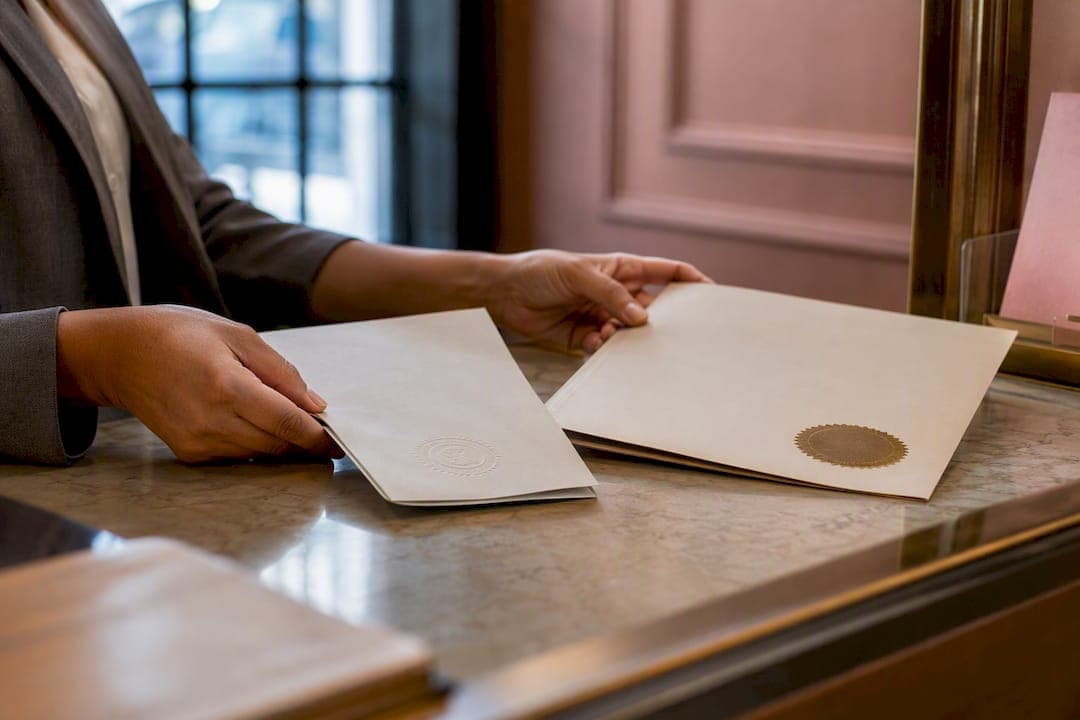
A certified copy is an official duplicate issued by the government office or institution holding the original record, confirming the copy matches what's on file. A notarized copy is different: a notary either compares a copy to the original and attests they match, or notarizes an affidavit from the document's custodian. One verifies the record itself. The other verifies identity, signature, or a supervised comparison. Which one you need depends entirely on who's asking for it.
TL;DR:
- Certified copies are issued by the record's custodian and verify that the duplicate matches the original record on file, typically featuring an embossed seal and signature.
- Notarized copies involve a notary public verifying identity and voluntary signing, without confirming the authenticity of the record itself.
- Many states prohibit notaries from certifying copies of public vital records, making custodian-issued certified copies necessary for official government documents.
- Costs and turnaround times differ: certified copies may take days or weeks through official channels, while notarized copies are often same-day but less universally accepted for official purposes.
- Confirming the recipient’s exact requirement before requesting is essential to avoid rejection, especially since international use often requires a certified copy prior to obtaining an apostille.
Table of Contents
- The Real Difference Between a Certified Copy and a Notarized Copy
- What a Certified Copy Actually Is (and Who Issues It)
- What a Notarized Copy Proves (and What It Doesn't)
- Certified Copy or Notarized Copy: How to Tell Which One You Need
- How to Obtain a Certified Copy vs. a Notarized Copy
- Who Can Certify Copies, and Where the Rules Change
- When You Need an Apostille Instead of Either One
- A Practitioner's Note on Common Mistakes
- A Simple Rule of Thumb
- Getting the Right Document the First Time With Cflegalformhelp
- Sources
The Real Difference Between a Certified Copy and a Notarized Copy
The confusion here is understandable. Both documents look official. Both carry a stamp and a signature. But they answer completely different questions, and mixing them up is one of the most common reasons document submissions get bounced back.
A certified copy comes from the entity that holds your original record. County clerks, state vital records offices, and court clerks issue certified copies because they're the custodian of that record. When they certify a copy, they're vouching for the record itself, as explained in detail in this legal guide for Australia. This is why certified copies are the default requirement for anything tied to a government-held document: birth certificates, marriage licenses, court judgments, land deeds.
A notarized copy involves a notary public who is not the record's custodian at all. The notary's job is narrower. In states that allow it, a notary can inspect your original document, compare it against a copy, and sign a certificate saying the two match. In states that don't allow direct copy certification, the notary instead notarizes an affidavit signed by whoever holds the document, attesting under oath that the copy is accurate. Either way, the notary isn't confirming that your birth certificate is real. They're confirming that a signature was made willingly by someone whose identity they verified.
What a Certified Copy Actually Is (and Who Issues It)
A certified copy is a duplicate produced or formally endorsed by the record custodian, meaning the office that legally holds the original. That's a county clerk for property records, a state vital records office for birth and death certificates, or a court clerk for judgments and probate filings. The custodian isn't guessing whether the copy is accurate. They're pulling from their own archive and attesting the copy matches what they have on file.
You'll recognize a certified copy by a few consistent features:
- An embossed or raised seal, sometimes an inked stamp instead
- A signature from an authorized custodian or clerk
- Security paper, watermarking, or a specific certificate format the issuing office controls
- Often a control number or date of issuance tying it to the office's records
Certified copies show up constantly in high-stakes paperwork: passport applications, probate proceedings, marriage and divorce filings, and land record transfers. Immigration cases lean on them heavily too, since USCIS frequently requires custodian-issued vital records rather than a private notarization. If an agency needs proof that a government record exists and says what you claim it says, a certified copy is almost always the answer.
What a Notarized Copy Proves (and What It Doesn't)
A notarized copy exists because a Notary Public physically compared an original document to its copy and signed a certificate attesting they match, or because the notary notarized a signed affidavit from the document's custodian when direct copy certification wasn't permitted. Either path puts the notary in the role of a witness, not an authenticator of the record's underlying truth.
Notarization proves two narrow things: that the person signing was who they claimed to be, and that they signed voluntarily. That's true whether the notary is handling an acknowledgment, a jurat, or a copy certification. Notaries are, in the words of the National Notary Association, impartial fraud deterrents. They don't validate whether the contents of a document are accurate or legally sound.
That distinction creates real limits:
- Many states prohibit notaries from certifying copies of public vital records like birth, death, and marriage certificates
- Private documents, such as passports, diplomas, powers of attorney, and contracts, are far more commonly eligible for notarial copy certification
- When a notary can't certify a copy directly, the fallback is having the custodian sign an affidavit that the notary then notarizes
If you hand a notary a birth certificate and ask for a certified copy, don't be surprised if they decline. In most states, that request has to go to vital records instead.
Certified Copy or Notarized Copy: How to Tell Which One You Need
The fastest way to avoid a rejected filing is to ask the recipient directly which type of copy they require, since acceptance standards vary by agency and by state. Here's how the two compare on the factors that actually matter:
| Factor | Certified copy | Notarized copy |
|---|---|---|
| Who issues it | Record custodian (clerk, vital records office, court) | Notary public |
| What's verified | Copy matches the record on file | Identity and voluntary signature, or supervised copy match |
| Common recipients | Government agencies, courts, USCIS, land offices | Banks, employers, private companies, some HR departments |
| International use | Often required before apostille | Rarely sufficient alone abroad |
| Typical rejection cause | Requesting from the wrong office or jurisdiction | Notary certifying a document type state law prohibits |
Notaries are barred from certifying certain public records in a number of states, according to guidance detailed in the Iowa Notary Handbook, which spells out both the prohibition and the sample certificate language notaries use when copy certification is allowed. That single rule causes more rejected filings than almost anything else in this space.
Cost and turnaround differ too. Certified copies from a vital records office can take days to weeks by mail, though many states now offer faster in-person or online requests for a fee. Notarized copies are typically same-day, since you're scheduling an appointment rather than waiting on a government office. The tradeoff is that speed doesn't help if the recipient specifically wanted a custodian-issued document.
How to Obtain a Certified Copy vs. a Notarized Copy
Getting the wrong document type costs you time twice: once to discover the mistake, and again to fix it. Here's the practical path for each.
For a certified copy:
- Identify the correct custodian. Vital records go through the state or county health department; court judgments go through the clerk of court; land records go through the county recorder.
- Confirm the ID and fee requirements, which vary by office and sometimes by relationship to the person named on the record.
- Choose your request method. Most offices allow in-person requests, mail-in applications, or online ordering through a state portal.
- Expect delivery on security paper or in a sealed, stamped envelope. A certified copy that arrives unsealed or on plain paper is often rejected outright.
For a notarized copy:
- Bring the original document along with a clean, complete copy. Don't sign anything ahead of time unless a jurat specifically requires it.
- Bring valid, government-issued photo ID for the notary to verify your identity.
- Let the notary inspect the original, compare it to the copy, and complete the notarial certificate, or make the copy under their own supervision if your state requires that.
- If your document type can't be notarized directly (many vital records), ask about copy certification by document custodian instead: the custodian signs an affidavit, and the notary notarizes that signature.
Pro Tip: Call the receiving agency before you request anything. A five-minute phone call confirming whether they need a custodian-certified copy, a notarized copy, or both can save you a second trip and a second fee.
Who Can Certify Copies, and Where the Rules Change
Not every state notary can legally certify a copy, and the restrictions catch more people off guard than you'd expect. County clerks, state vital records offices, and court clerks are the standard certifiers for records they hold. Notaries operate under a separate set of rules entirely.
Under the Revised Uniform Law on Notarial Acts (RULONA) framework that many states have adopted in some form, and under individual state notary handbooks, notaries are frequently barred from certifying copies of public records like birth and death certificates. Some states allow broad copy certification; others restrict it sharply.
- Check your state's notary handbook or the custodian's own guidance before assuming a notary can help
- Confirm with the receiving agency what they'll actually accept before paying for any service
- When in doubt, the custodian-affidavit alternative usually resolves the gap
When You Need an Apostille Instead of Either One
International use adds a layer neither certified copies nor notarized copies handle alone. An apostille or consular legalization authenticates a document for use in a foreign country, and it sits on top of, not instead of, notarization or certification.
- A notarized copy alone is rarely sufficient for documents headed overseas
- Many receiving countries specifically require a custodian-issued certified copy before it can even qualify for an apostille
- Requirements vary by destination country, so check the receiving government's or embassy's guidance directly rather than assuming
If you're preparing documents for use abroad, understanding the sequence matters more than understanding either document in isolation. Our guide on notarization versus apostille walks through that order step by step.
A Practitioner's Note on Common Mistakes
Cristina Fernandez, certified legal document preparer and immigration paralegal, has seen the same errors surface again and again in client files: requesting a notarized copy when the recipient needed a custodian-certified one, skipping the apostille step for a document headed overseas, and assuming notary rules are the same from state to state when they're not.
Bilingual support in English and Spanish, flat-fee pricing, and Florida-specific compliance knowledge exist precisely because these mistakes are common and costly to fix after the fact. Getting the document type right the first time is almost always cheaper than correcting it the second time.
A Simple Rule of Thumb
Ask the recipient first. If the document is a public record, government office, or court filing, go to the custodian for a certified copy. If it's a private document that mainly needs signature verification or a supervised copy comparison, a notary is the right call. Confirm the exact requirement, gather your ID and original document, and you'll avoid the single most common cause of rejected paperwork.
— Cristina
Getting the Right Document the First Time With Cflegalformhelp
Cflegalformhelp exists for the moment right after you read this article and realize you're still not sure which document your situation calls for. Rather than guessing between a custodian's office and a notary's desk, you get bilingual, flat-fee guidance that identifies the correct document type before you pay for the wrong one.
Whether you need help navigating immigration form requirements that call for custodian-certified vital records, mobile notary services for a private document that needs copy certification, or certified translations for paperwork headed abroad, the process starts with a straightforward conversation about what your recipient actually requires. Visit the legal document preparation and notary services page to request a consultation and get the correct document type confirmed before you spend time or money on the wrong one.
This article is general information, not a substitute for advice from a qualified lawyer. Consult a qualified legal professional about your own circumstances before acting on anything here.
Sources
- Certified copy — LII / Legal Information Institute
- What is a Notary Public? — National Notary Association
- Iowa notary handbook (copy certification guidance)
- Apostille and authentication requirements — U.S. Department of State