

Copy certification notarization in Florida is the formal process by which a commissioned notary public verifies that a photocopy is a true and accurate reproduction of an original document, performed under strict state rules. Florida residents need certified copies of documents ranging from diplomas and contracts to immigration records, and knowing the exact copy certification notary Florida steps prevents costly delays. The National Notary Association confirms that Florida notaries are authorized to certify true copies of original tangible or electronic records, provided they follow specific certificate wording and attachment procedures. Getting this process right the first time matters.
What are the copy certification notary Florida steps?
Copy certification notarization is also called an "attested copy" under Florida law. Both terms refer to the same notarial act: a notary public compares an original document to a photocopy and certifies that the copy is complete and accurate. The Florida Division of Corporations and the National Notary Association both recognize this act as a standard notarial function for commissioned Florida notaries.
Florida Statutes Section 117.05(12)(b) governs the exact certificate wording a notary must use. Failure to use the proper certificate form may cause the notarization to be invalid. That is not a technicality you want to discover after submitting documents to an agency or court.
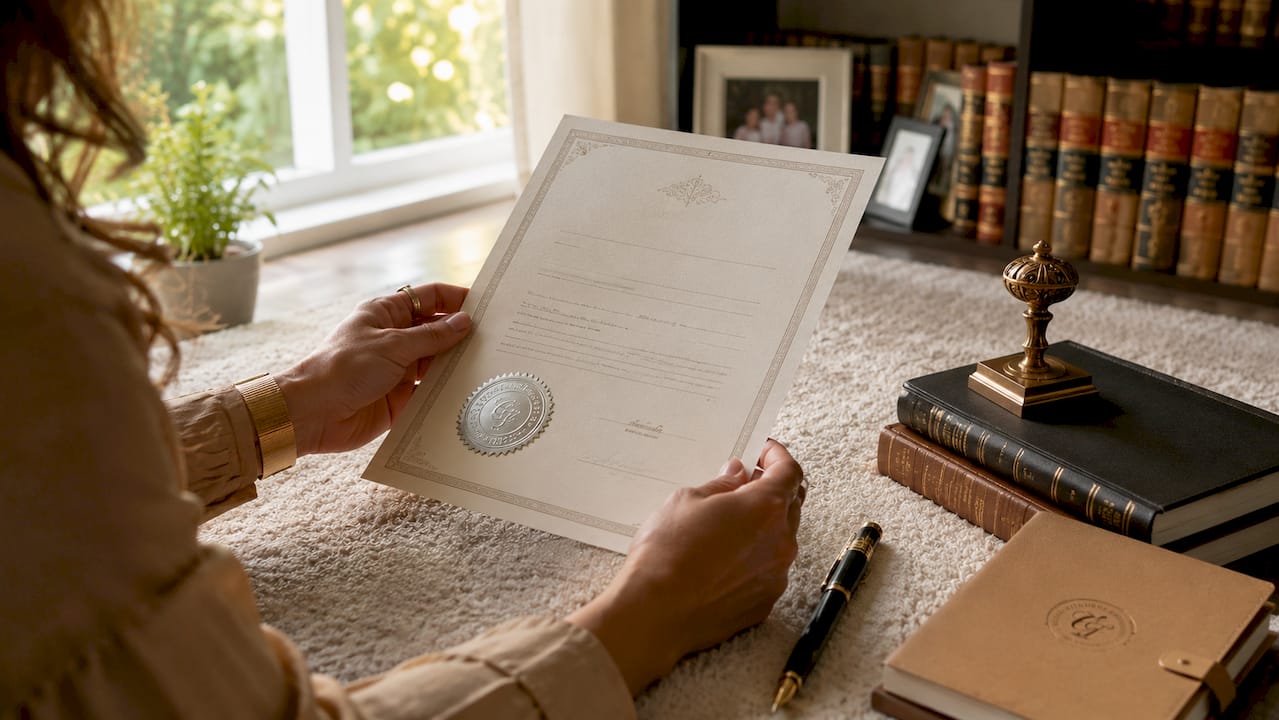
What prerequisites and tools do you need before starting?
Every Florida notary performing a copy certification must hold a current notary commission issued by the Florida Governor's office. Florida requires first-time notary applicants to complete a 3-hour course covering all notarial acts, including copy certification. That training requirement exists because procedural errors in copy certifications carry real legal consequences.
Documents eligible for copy certification
Florida notaries can certify copies of private documents that are not on file with a government agency. Common examples include:
- Personal contracts and agreements
- Diplomas, transcripts, and school records
- Foreign documents not held by a U.S. government office
- Business records and corporate resolutions
- Printouts of electronic records
Documents notaries cannot certify
Some documents are off-limits for notary copy certification. Certified copies of public records like birth certificates, death certificates, and marriage licenses must come from the official government custodian, not a notary. A notary who certifies a copy of a vital record steps outside their legal authority.
Required tools and supplies
| Item | Purpose |
|---|---|
| Current Florida notary commission | Legal authority to perform the act |
| Official notary seal (stamp or embosser) | Required on every notarial certificate |
| Copy certification certificate form | Mandated wording under Florida Statutes 117.05(12)(b) |
| Notary journal | Record of the act, date, ID used, and fee |
| Stapler | Secure physical attachment of certificate to copy |
| Valid ID from the requesting party | Identity verification before notarizing |
Review the full Florida notarization requirements checklist to confirm you have everything in order before the appointment.
How do you properly execute a copy certification notarization in Florida?
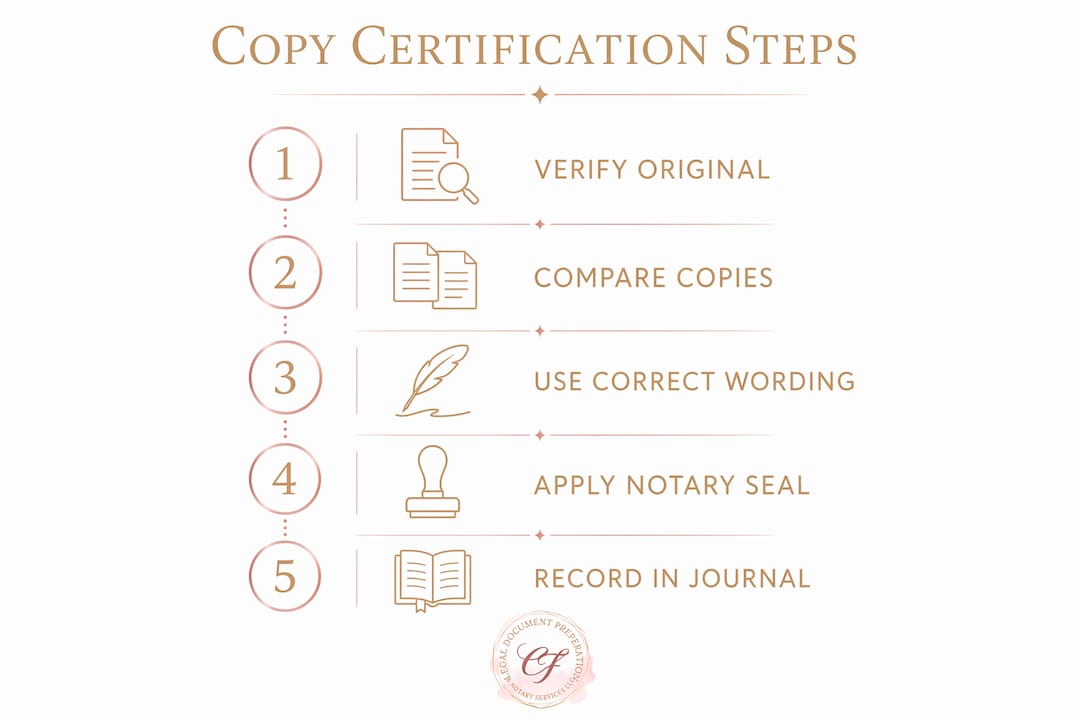
The execution process has six distinct steps. Skipping or rushing any one of them creates grounds for rejection or legal challenge.
-
Confirm the original document is present. You must have the actual original in hand. Florida law mandates that attested copies come from the original, not from a copy of a copy. If the person brings a photocopy and claims it is the original, stop the notarization.
-
Compare the original to the photocopy side by side. Check every page, every signature line, every stamp, and every seal on the original against the copy. The copy must be complete and identical. Even a missing page footer is grounds to reject the copy and start over.
-
Verify the identity of the requesting party. Check a government-issued photo ID such as a driver's license or passport. Record the ID type and number in your notary journal. Florida law requires this step even for copy certifications, where no signer signature is involved.
-
Complete the notarial certificate using the exact statutory wording. The Florida Division of Corporations publishes the required certificate language. Write or type the document title, the date of certification, your name, county, and commission expiration date. Every field must be filled in completely.
-
Attach the certificate to the copy and apply your seal. Staple the certificate securely to the photocopy so the two cannot be separated without obvious damage. Apply your notary seal clearly on the certificate. Sign your name exactly as it appears on your commission.
-
Record the act in your notary journal. Note the document title, date, type of ID presented, and any fee charged. This record protects you if the notarization is ever questioned.
Pro Tip: If your seal impression smudges or is unclear, place a second clean impression nearby rather than trying to fix the first one. An unclear seal impression can invalidate the entire notarization.
What are the common challenges when obtaining a copy certification in Florida?
Several issues come up repeatedly in copy certification notarizations. Knowing them in advance saves time and prevents rejection.
- Smudged or incomplete seal. A notary seal that is not fully legible raises immediate doubts about the notarization's validity. Always test your stamp on scrap paper before applying it to the certificate.
- Multi-page documents without cross-referencing. When certifying a multi-page document, the certificate must reference the document's title and date. Secure attachment and cross-referencing prevent fraudulent substitution of pages.
- Certifying electronic printouts incorrectly. Florida notaries can certify printouts of electronic records, but the certificate wording must specifically address the electronic origin of the document. Using a generic certificate for a digital printout is a common error.
- Accepting a copy as the original. Requesters sometimes present a high-quality photocopy as the original. If you cannot confirm the document is an original, decline the notarization.
- Missing journal entries. Some notaries skip the journal for copy certifications, believing it is optional. Florida best practice requires a journal entry for every notarial act.
"A notary must attach a certificate specifically worded for copy attestation to the photocopy and staple it securely. Cross-reference by noting the document's title and date on the certificate to prevent fraudulent alterations and protect both the notary and the requesting party."
Read the mobile notary appointment preparation guide for a practical checklist that prevents seal and assembly mistakes in the field.
What is the legal scope of copy certification in Florida?
Florida notaries operate under a defined statutory authority. Understanding the boundaries of that authority keeps you compliant and protects the people you serve.
Florida Statutes Section 117.05(12)(b) grants notaries the power to certify copies of original tangible or electronic records. That authority does not extend to public records held by government custodians. A birth certificate issued by the Florida Department of Health, for example, can only be certified by that department, not by a notary.
The difference between a notary-certified copy and an officially attested copy matters in legal proceedings. An officially attested copy is verified by the public official who is the custodian of the record. A notary-certified copy carries the notary's personal attestation that the copy matches the original the notary physically examined.
| Notarial act | Who performs it | Document type |
|---|---|---|
| Copy certification by notary | Commissioned Florida notary | Private documents, foreign records, electronic printouts |
| Certified copy by custodian | Government agency or official record keeper | Birth certificates, court records, vital records |
| Apostille attachment | Florida Secretary of State | Notarized documents for international use |
Improper notarization carries real consequences. A notarization performed outside statutory authority can be declared void. That outcome can derail an immigration application, a court filing, or a business transaction. Review the Florida remote notary acceptable documents guide to understand which document types qualify under current Florida rules.
Key Takeaways
Florida copy certification notarizations are valid only when performed on original documents using the exact statutory certificate wording, a legible notary seal, and a securely attached certificate that cross-references the document's title and date.
| Point | Details |
|---|---|
| Original document required | Florida law prohibits certifying a copy of a copy under any circumstances. |
| Statutory certificate wording | Use the exact form mandated by Florida Statutes 117.05(12)(b) or risk invalidation. |
| Seal legibility is non-negotiable | A smudged seal can void the notarization; apply a second clean impression if needed. |
| Secure physical attachment | Staple the certificate to the copy and cross-reference the document title and date. |
| Journal entry for every act | Record the document, date, ID type, and fee in your notary journal without exception. |
What I have learned from years of copy certification work in Florida
The single most common mistake I see is treating the certificate as an afterthought. Notaries complete the comparison, apply the seal, and then rush through the certificate wording. That order of priorities is backwards. The certificate is the legal instrument. The seal confirms it. If the certificate wording is wrong or incomplete, the seal means nothing.
Physical assembly matters more than most people realize. I have seen notarizations rejected because the certificate was paper-clipped instead of stapled. A paper clip can be removed without a trace. A staple through both documents creates a visible record of attachment. That small detail is the difference between a valid certified copy and a document that gets flagged for tampering.
Journal entries protect you as much as they protect the requesting party. If a document is ever challenged, your journal is your evidence that you followed the correct process. I record every copy certification the same way I record every acknowledgment or oath. No exceptions.
The 3-hour Florida notary training covers these principles, but classroom knowledge and real-world execution are different things. Slow down on your first several copy certifications. Check every field on the certificate twice. Your reputation as a notary depends on the accuracy of every single act you perform.
— Cristina
Professional copy certification support from Cflegalformhelp
Handling a copy certification notarization correctly takes preparation, the right supplies, and a clear understanding of Florida law. Cflegalformhelp provides mobile and office notary services across South Florida, including Naples, with flat-fee pricing and bilingual support in English and Spanish.
Whether you need a single document certified or ongoing notary support for immigration paperwork, business records, or personal documents, Cflegalformhelp offers mobile notary services that come to you. Scheduling is straightforward, fees are transparent, and every notarization follows Florida statutory requirements. Contact Cflegalformhelp to book your appointment and get your certified copies handled correctly the first time.
FAQ
What documents can a Florida notary copy certify?
Florida notaries can certify copies of private original documents such as contracts, diplomas, foreign records, and electronic printouts. They cannot certify vital records like birth or death certificates, which must come from the official government custodian.
Can a Florida notary certify a copy of a copy?
No. Florida law requires that the attested copy be made from the original document. Certifying a copy of a copy is outside a notary's legal authority and renders the notarization invalid.
What certificate wording is required for Florida copy certification?
Florida notaries must use the certificate form prescribed by Florida Statutes 117.05(12)(b). Using a generic or incorrect certificate form can invalidate the notarization entirely.
Does a Florida notary need to record copy certifications in a journal?
Yes. Florida best practice requires notaries to record every notarial act in their journal, including the document title, date, ID type presented, and any fee charged. This record protects both the notary and the requesting party.
What happens if the notary seal is smudged on a copy certification?
A smudged or illegible seal can invalidate the notarization. The correct fix is to apply a second clear impression nearby on the certificate rather than attempting to correct the original smudged impression.