

In the U.S., the documents most commonly accepted for notarization include powers of attorney, affidavits and sworn statements, real estate deeds, mortgage and loan closing documents, advance healthcare directives, business contracts and corporate resolutions, and wills or trusts where state law permits. Notarization is standard for documents involving high-value assets or significant personal authority, and it supports recording in government registries when required. That said, what a notary can legally do for you depends on your state, the document type, and whether the receiving institution accepts electronic or remote notarization.
Before your appointment, run through this quick checklist:
- Bring a valid, unexpired government-issued photo ID (driver's license, U.S. passport, military ID, or permanent resident card).
- Do not sign the document beforehand if a jurat is required — you must sign in the notary's presence.
- Bring any required witnesses and their IDs if your state or document type demands them.
- Confirm with the receiving institution (county recorder, bank, or agency) which notarial act and certificate wording they require.
- For remote online notarization (RON), have a stable internet connection, a camera, and your document in an accepted electronic format.
Table of Contents
- What are the main types of notarial acts?
- Which documents are commonly accepted for notarization?
- What ID does a notary need from you?
- What documents and situations will a notary refuse?
- How does remote online notarization work?
- Why do notarization rules vary by state?
- Pre-notarization checklist: what to bring to your appointment
- Key Takeaways
- What notarization mistakes actually look like in practice
- Cflegalformhelp handles the preparation so your notarization goes right the first time
- Useful sources for verifying notarization rules
What are the main types of notarial acts?
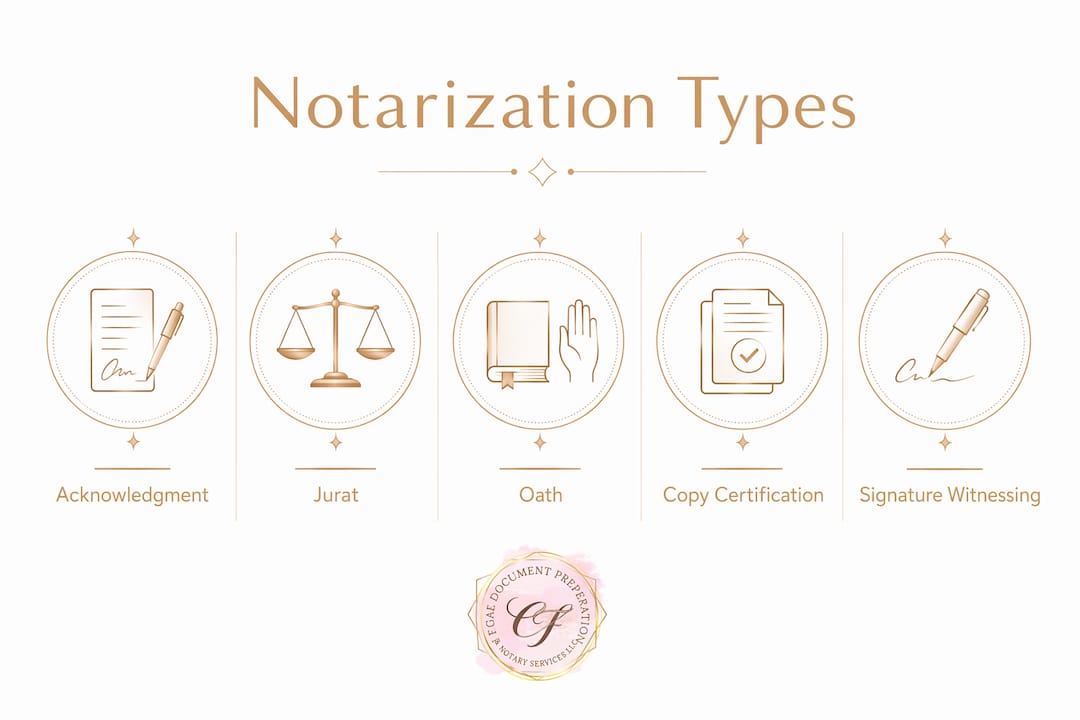
Knowing which notarial act applies to your document saves time and prevents a rejected filing. The two most common notarial acts are the acknowledgment and the jurat, but there are three others you may encounter.
Acknowledgment
An acknowledgment confirms that the signer appeared before the notary, was identified, and voluntarily signed the document. The signer may have signed it earlier — the key is that they acknowledge the signature as their own in the notary's presence. Deeds, powers of attorney, and mortgage documents typically use this act.
Jurat
A jurat requires the signer to sign the document in the notary's presence and to swear or affirm that the contents are true. Affidavits and sworn statements almost always call for a jurat. This timing distinction matters: if your document requires a jurat, do not sign it at home first.

Oath or affirmation
An oath or affirmation is a verbal act administered by the notary. It can stand alone (for a witness testifying, for example) or accompany a jurat. An oath invokes a higher power; an affirmation is a secular equivalent with the same legal weight.
Copy certification
A notary can certify that a copy of a document is a true and accurate reproduction of the original. However, many states prohibit notaries from certifying copies of recordable or vital records — birth certificates, death certificates, and recorded deeds, for example. For those, you must go to the issuing government agency.
Signature witnessing
Some states allow a notary to simply witness a signature without administering an oath. The notary verifies identity and watches the signing but does not certify the truth of the document's contents. This act is common for certain contracts and authorization forms.
Pro Tip: The notarial certificate — the block of text that identifies the act, date, location, and notary — is the legally critical element. A notary's stamp alone is not sufficient. If your document lacks certificate language, the notary must attach a separate certificate executed at the time of notarization.
Which documents are commonly accepted for notarization?
Whether notarization is mandatory or optional usually comes down to one question: will this document be recorded with a public office, or does it grant significant authority over assets or a person? Here is an annotated list of the most common notarized document types.
- Power of attorney — Grants one person authority to act for another; notarization is typically required by state law and by financial institutions that will honor it.
- Affidavits and sworn statements — Require a jurat; used in court filings, immigration applications, and insurance claims.
- Real estate deeds (warranty, quitclaim) — Must be notarized before recording with the county recorder or clerk.
- Mortgage and loan closing documents — Lenders and title companies require notarized signatures; loan signings often involve a notary signing agent.
- Lease agreements — Notarization is not always required but is frequently requested by landlords or required by state law for long-term leases.
- Wills and trust documents — Requirements vary by state; some states require notarization in addition to witnesses, while others do not.
- Advance healthcare directives and medical proxies — Most states require notarization or witnesses (sometimes both) for a living will or healthcare power of attorney.
- Business contracts and corporate resolutions — Notarization is often required when contracts will be recorded or when a party demands authenticated signatures.
- Certified copies of non-recordable documents — Diplomas, personal letters, and private contracts can often be copy-certified by a notary where state law allows.
- Government forms and applications — Certain immigration forms, benefit applications, and agency submissions explicitly require a notarized signature.
Notarization is optional for many everyday contracts — two parties can agree without it. But once a document needs to be filed with a government office or accepted by a bank, notarization is usually non-negotiable.
Pro Tip: Always check with the receiving institution before your appointment. A county recorder may require specific certificate wording; a bank may require an original wet signature rather than an electronic one. Confirming acceptance with the institution first prevents a wasted trip.
What ID does a notary need from you?
Acceptable identification for most notarizations is a single, valid government-issued photo ID. State laws vary on which forms qualify and whether expired IDs are ever acceptable, so the table below reflects the most widely recognized standards.

| ID Type | Generally Accepted? | Notes |
|---|---|---|
| State driver's license | Yes | Most widely accepted; must be current in most states |
| State-issued ID card | Yes | Accepted on par with a driver's license |
| U.S. passport or passport card | Yes | Accepted in all states |
| U.S. military ID | Yes | Active duty and dependent IDs typically accepted |
| Permanent resident card (Green Card) | Yes | Accepted in most states |
| Foreign passport | Varies | Some states accept; confirm with your notary |
| Social Security card | No | Not a photo ID; not accepted |
| School or university ID | No | Not government-issued; not accepted |
| Credit or debit card | No | Not an identity document |
When a signer cannot produce an acceptable ID, some states allow a credible identifying witness — a person who knows the signer and can vouch for their identity under oath. A few states permit two such witnesses. This is state-dependent, so check your state's notary requirements before assuming it applies to you.
Beyond ID, the notary must also confirm that the signer appears voluntarily, understands the document, and has the capacity to sign. The notary's role is limited to identity verification, voluntariness, and capacity — they cannot advise you on the document's legal effect.
What documents and situations will a notary refuse?
Some requests fall outside what a notary is legally permitted to do. Knowing these limits before you arrive prevents frustration.
Commonly prohibited document types:
- Vital records — Birth certificates, death certificates, and marriage licenses must be certified by the issuing government agency, not a notary. A notary cannot create a certified copy of these records.
- Recordable documents already on file — Recorded deeds and mortgages cannot be copy-certified by a notary in most states; you must request a certified copy from the county recorder.
- Probated wills — Once a will has been admitted to probate, certification of copies is handled by the court, not a notary.
Situations that block notarization:
- The document is incomplete or contains blank spaces where information should appear.
- The signer appears to be under duress, lacks capacity, or cannot communicate their understanding of the document.
- The notary is a named party, beneficiary, or has a financial interest in the document — a direct conflict of interest.
- A jurat is required but the signer already signed the document before appearing.
- The request involves backdating the notarial certificate.
When any of these situations arise, state manuals and training advise notaries to refuse and refer the signer to an attorney or the issuing agency. If a notary declines your document, that referral is the right next step, not a reason to find a less careful notary.
How does remote online notarization work?
Remote online notarization (RON) lets you complete a notarization over a live audiovisual session instead of appearing in person. The notary uses digital seals and electronic signatures, and the session is typically recorded. RON can handle many of the same document categories as in-person notarization, but state law and the receiving institution's rules determine whether a RON-notarized document will be accepted.
How identity is verified remotely:
- Knowledge-based authentication (KBA): you answer questions drawn from your credit or public records.
- Credential analysis: software scans your government-issued ID for authenticity markers.
- Live video confirmation: the notary visually confirms your ID and your identity during the session.
Documents frequently eligible for RON:
- Powers of attorney
- Affidavits and sworn statements
- Business agreements and corporate resolutions
- Loan closing documents where the lender accepts electronic notarization
Some states limit or exclude RON for certain recordable documents or vital records. Florida, for example, has a detailed RON framework; you can review Florida-specific RON guidance to confirm which documents qualify in that state.
Before a RON session, prepare the following:
- A valid government-issued photo ID (the same standards as in-person notarization apply).
- A stable internet connection and a working camera and microphone.
- Your document in an accepted electronic format (PDF is standard on most platforms).
- Confirmation from the receiving institution that they accept RON-notarized records.
Fees for RON sessions can differ from in-person fees, and not every notary is RON-commissioned. Confirm both the platform and the fee before scheduling.
Why do notarization rules vary by state?
Notarization in the U.S. is governed at the state level, which means the rules for which acts a notary may perform, which IDs are acceptable, whether RON is legal, and whether certified copies of certain records are permitted can all differ from one state to the next. Understanding state vs. federal notary requirements helps you avoid surprises when a document crosses state lines.
Common axes of variation include:
- Permitted notarial acts — Not every state authorizes all five acts described above; some states have a narrower list.
- Acceptable ID — Most states follow the government-issued photo ID standard, but some accept foreign passports or have specific rules for expired IDs.
- RON legality — Most states have enacted RON legislation, but the scope and permitted document types differ.
- Witness requirements — Some states require one or two witnesses for healthcare directives or wills, in addition to notarization.
- Copy certification limits — The list of records a notary cannot copy-certify varies by state statute.
How to verify your state's rules quickly:
- Search for "(your state) notary public manual" on your state's Secretary of State website (look for a .gov domain).
- Call the county recorder or the institution that requested the notarization — they know exactly what certificate wording and notarial act they require.
- Contact a local notary service and ask before scheduling; a knowledgeable notary will tell you upfront whether your document qualifies.
Pre-notarization checklist: what to bring to your appointment
A little preparation prevents the most common reasons notarizations fail. Work through this list before you leave for your appointment.
- Your document — Bring the original, fully completed document. Leave signature lines blank if the act requires signing in the notary's presence (jurat). If the act is an acknowledgment, you may have signed already, but confirm this with the notary first.
- Valid government-issued photo ID — Unexpired in most states. Bring the original, not a photocopy.
- Required witnesses — If your state or document type requires one or two witnesses, bring them with their own valid IDs. Witnesses are typically required to be disinterested parties.
- Fee payment — State law caps notary fees per signature or per act; amounts vary by state. Ask the notary about their fee schedule when you book.
- Supporting documents — Some agencies require additional paperwork alongside the notarized document (e.g., a cover letter, a recording fee, or a specific form). Confirm with the receiving institution.
- For RON appointments — Test your camera and audio at least 15 minutes before the session, have your electronic file ready to share, and confirm the notary's platform and any software requirements.
Pro Tip: Never sign a jurat-required document before your appointment. If you arrive with a pre-signed affidavit and the notary requires a jurat, they must either refuse or ask you to re-sign in their presence — and some documents cannot simply be re-signed without legal consequences. When in doubt, ask the notary before you sign anything.
Key Takeaways
Most notarization problems come down to three things: the wrong document type, missing ID, or the wrong notarial act — and all three are avoidable with a short checklist and a quick call to the receiving institution.
| Point | Details |
|---|---|
| Commonly accepted document types | Powers of attorney, affidavits, deeds, loan documents, healthcare directives, and business contracts are the core categories. |
| Two acts to know | Acknowledgments allow prior signing; jurats require signing in the notary's presence under oath. |
| Vital records are off-limits | Birth, death, and marriage certificates must be certified by the issuing government agency, not a notary. |
| ID requirements | A single valid government-issued photo ID (driver's license, U.S. passport, or military ID) satisfies most states. |
| Cflegalformhelp for Florida notarization | Cflegalformhelp offers in-person, mobile, and remote notarization with bilingual support for documents across Florida. |
What notarization mistakes actually look like in practice
The appointments that go wrong almost always share the same handful of problems. A signer arrives with a pre-signed affidavit and no ID, or with a birth certificate they want copy-certified, or with a document that still has blank fields. Each of these is a refusal waiting to happen.
Missing or unacceptable ID is the single most common reason a notarization cannot proceed. A school ID or a Social Security card is not sufficient, and an expired driver's license may not be accepted depending on the state. Calling ahead to confirm what ID the notary requires takes two minutes and saves a wasted trip.
Incomplete documents are the second most frequent issue. A notary cannot notarize a document with blank spaces — those blanks could be filled in after the fact, which undermines the entire purpose of notarization. Fill in every field before you arrive, even if a field requires "N/A."
Certificate language is where things get more technical. If the document you bring does not include the correct notarial certificate wording for your state, the notary may need to attach a separate certificate. This is legal and common, but it adds time. For complex closings, immigration paperwork, or multi-jurisdiction documents, working with a document-preparation service before the notarization appointment prevents certificate mismatches entirely. For family-law documents in Florida, some forms — like an acknowledgment of paternity — carry specific signing protocols that a local legal professional can clarify before you sit down with a notary.
One more thing worth saying plainly: a notary cannot give you legal advice about your document. If you are unsure whether a document is enforceable, what it obligates you to, or whether it is the right document for your situation, that question belongs to an attorney, not a notary. Knowing where a notary's role ends protects you from relying on the wrong professional for the wrong question.
Cflegalformhelp handles the preparation so your notarization goes right the first time
Document preparation and notarization are two separate steps, and skipping the first one is what causes most appointment failures. Cflegalformhelp provides flat-fee legal document preparation and notarization services across Florida, in English and Spanish, with no attorney markup and no surprise fees.
For clients who need a notary to come to them, Cflegalformhelp's mobile notary and loan signing service covers South Florida, including Naples, and handles everything from real estate closings to immigration affidavits. Remote online notarization is also available for documents that qualify under Florida's RON framework. Whether you need a power of attorney reviewed and notarized, a business resolution prepared for signing, or immigration paperwork completed correctly before a notary appointment, Cflegalformhelp can walk you through each step. Book online or call to confirm your document type, your ID, and your notarial act before you schedule — so your appointment succeeds on the first visit.
Useful sources for verifying notarization rules
These are the primary references to consult when you need to confirm state-specific rules, certificate language, or acceptable document types.
National Notary Association (NNA) — The NNA's knowledge center covers acceptable ID standards, notarial act definitions, and state-by-state guidance. Their how-to-prepare page is a practical starting point for first-time signers.
Pennsylvania Department of State — Sample Notary Public Statements — Provides sample certificate language for acknowledgments, jurats, and other acts. Useful even outside Pennsylvania as a reference for what correct certificate text looks like.
Texas Secretary of State — Types of Notarial Acts — A clear transcript-format explanation of each notarial act and the limits on copy certification; applicable as a model for understanding how most states structure these rules.
New York Department of State — Legal Memorandum LI03 — Covers statutory acknowledgment forms for deeds, leases, and mortgages in New York, including the corporate acknowledgment requirements under Real Property Law Sections 309 and 309-a.
DocuSign — Examples of Notarized Documents — A practical overview of common notarized document types and when notarization is typically required; useful for understanding institutional acceptance rules.
Your state's Secretary of State website — Search "(your state) notary public manual" on your state's .gov site. Most states publish a free manual that lists permitted acts, acceptable ID, fee caps, and RON rules. This is the authoritative source for your jurisdiction.
Your county recorder or clerk — For any document that will be recorded, call the recorder's office directly. They will tell you exactly which notarial act, certificate wording, and format they require before you schedule your appointment.
This article is general information, not legal advice. Notarization rules vary by state and document type. Confirm the current requirements with your state's Secretary of State, the receiving institution, or a qualified legal professional before your appointment.