

For most founders, a nonprofit corporation is often the right structure. It is the entity that most reliably qualifies for 501(c)(3) status, which allows for tax-deductible donations and many grant funding opportunities. A nonprofit LLC only works in a narrow situation: when every member is already a tax-exempt organization or a government unit. Choose wrong, and you risk taxable income, lost donor deductions, or a costly do-over.
TL;DR:
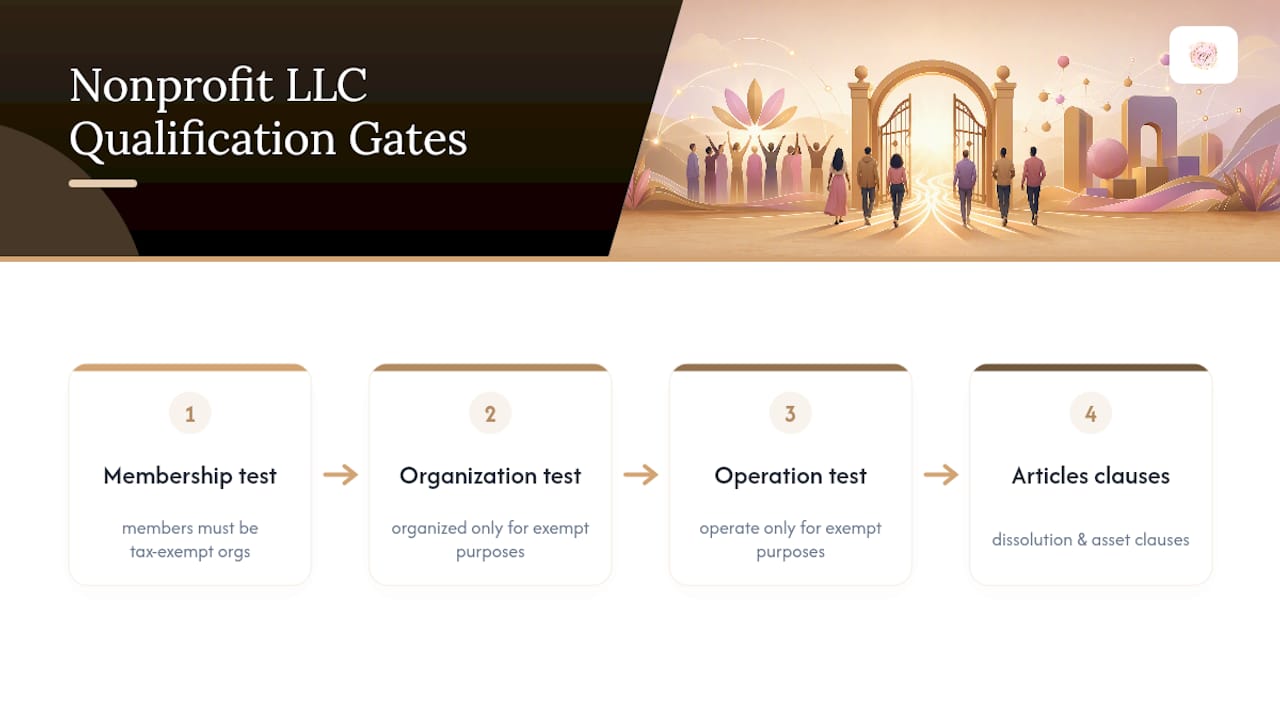
- Nonprofit LLCs can only qualify for tax exemption if all members are already tax-exempt organizations or government entities.
- A nonprofit corporation must include specific dissolution and purpose language in its articles to ensure IRS approval and maintain tax-exempt status.
- Failure to incorporate the required assets transfer clauses during dissolution can lead to rejection of exemption applications and loss of donor deductions.
- Most founders should choose a nonprofit corporation unless all potential members are exempt organizations, as it offers broader fundraising options and clearer legal precedent.
- Proper filing of formation documents with correct language is crucial to avoid costly rejections and legal complications with the IRS later.
Table of Contents
- What Is the Difference Between a Nonprofit LLC and a Nonprofit Corporation?
- Who Owns a Nonprofit and What Happens on Dissolution?
- What Does the IRS Require for a Nonprofit LLC to Qualify for 501(c)(3) Status?
- How Do Governance and Reporting Requirements Compare?
- Where Does Fundraising Money Actually Come From?
- How Do You Actually Form Each Entity?
- Pros and Cons: A Quick Checklist
- Which Structure Fits Your Situation?
- What Mistakes Do Founders Make Most Often?
- What Should Founders Do Next?
- Get Your Nonprofit Formation Documents Filed Correctly the First Time
- Where to Verify These Rules Yourself
- Sources
What Is the Difference Between a Nonprofit LLC and a Nonprofit Corporation?
The short answer: ownership and access to tax-exempt status. A nonprofit corporation has no owners at all. It's governed by a board of directors that holds assets in trust for a public purpose, and it can apply directly for 501(c)(3) recognition. A nonprofit LLC has members, similar to any limited liability company, and those members generally hold an economic interest unless the operating agreement removes it.
Here's what separates the two entities in practice:
- Ownership model: Nonprofit corporations are ownerless; nonprofit LLCs are member owned, though members can waive distribution rights.
- Tax-exempt donations: Corporations can seek 501(c)(3) status directly; LLCs can only qualify if all members are themselves exempt organizations or government units.
- Grant eligibility: Most private foundations and government grant programs require 501(c)(3) status, which favors the corporate form.
- Governance: Corporations answer to a board and public disclosure rules; LLCs run on a private operating agreement with far more flexibility.
- Typical use case: Corporations suit individual founders and community organizations; LLCs suit joint ventures between existing charities or public agencies.
If you're starting from scratch as an individual or small founding team, the corporate structure covers nearly every use case a nonprofit LLC does, plus the fundraising access an LLC usually can't offer.
Who Owns a Nonprofit and What Happens on Dissolution?
Ownership is where these two structures diverge the most, and it's the piece founders misunderstand most often. A nonprofit corporation belongs to no one. The board of directors manages it, but directors don't own equity, can't take profits home, and can't sell their board seat. Every dollar of surplus has to go back into the mission, a rule known as the non-distribution constraint. That constraint is exactly what qualifies a corporation for 501(c)(3) status and, by extension, what lets donors deduct their gifts.

An LLC works differently by default. Members typically hold economic interests, meaning they can share in profits or proceeds if the entity dissolves or sells assets. For a nonprofit LLC to have any shot at exemption, the articles of organization and operating agreement must strip that economic interest away and lock in nonprofit-style restrictions.
Dissolution rules matter just as much as day-to-day operations:
- A 501(c)(3) corporation must direct any remaining assets to another exempt organization when it winds down. No exceptions, no cash-outs to founders or board members.
- A nonprofit LLC seeking exemption needs the same dissolution language written into its articles, not just its operating agreement.
- This asset-lock provision protects donors and the public by guaranteeing charitable dollars stay charitable, even after the organization closes its doors.
Skip this language, and the IRS will reject the exemption application outright, regardless of how the organization actually operates.
What Does the IRS Require for a Nonprofit LLC to Qualify for 501(c)(3) Status?
Only 12 words separate most founders from a valid nonprofit LLC application: "all of its members are themselves tax-exempt organizations or governmental units." That's the standard the IRS lays out for LLCs seeking exempt status, and it rules out individual founders almost entirely. If you and a co-founder want to launch a nonprofit LLC as private citizens, the IRS won't recognize it as tax-exempt no matter how charitable your mission is.
Beyond the membership test, the LLC has to pass the same organizational and operational tests any nonprofit does. IRS Publication 557 spells out what that means: the entity has to be organized exclusively for exempt purposes, operate exclusively for those purposes, and include specific dissolution and asset-distribution clauses in its founding documents. For an LLC, those clauses generally need to sit in the articles of organization, not just the operating agreement, because the articles are the document state law treats as controlling. IRS TE/GE guidance, including examples tied to Notice 2021-56, walks through exactly which provisions examiners look for.
Get this wrong, and the consequences stack up fast. An LLC denied exemption is treated as a taxable entity or a pass-through, depending on its tax election, meaning income isn't shielded the way a 501(c)(3)'s is. Donors lose the ability to deduct contributions, which can quietly kill a fundraising campaign before anyone realizes why checks stopped coming in. And converting a rejected LLC into a proper nonprofit corporation later means new articles, often a new EIN, and refiling returns.
How Do Governance and Reporting Requirements Compare?
Nonprofit corporations run on a fairly standardized playbook. State law typically requires a board of directors, bylaws, and documented meeting minutes. Federally, most exempt organizations file an annual Form 990, which becomes public record. Funders, watchdog groups, and individual donors can all pull it up. Directors also carry fiduciary duties, meaning they're legally on the hook for acting in the organization's best interest.
Nonprofit LLCs offer more flexibility, for better or worse:
- Operating agreements can be customized member by member, with fewer statutory defaults to fall back on.
- A single member can, in some cases, retain significant control, which cuts against the collective-oversight model funders expect.
- Fewer courts have ruled on nonprofit LLC governance disputes, so there's less legal precedent to guide difficult decisions.
That flexibility can work against you when it's time to raise money. Foundation program officers and government grant reviewers are trained to look for board oversight and public filings. An LLC's private governance structure can read as a red flag during vetting, even when the underlying mission is sound.
Pro Tip: If you're weighing member control against fundraising access, run the math on how much of your budget realistically comes from grants and tax-deductible gifts versus earned revenue. That number usually settles the governance question on its own.
Where Does Fundraising Money Actually Come From?
Tax-deductible donations and most institutional grants flow almost exclusively to recognized 501(c)(3) organizations. A donor writing a check to an LLC, even a mission-driven one, generally can't claim a charitable deduction unless that LLC has independently secured exemption, which, as covered above, is rare outside of coalitions between existing exempt entities.
Nonprofit corporations often blend donations with earned revenue: program fees, ticket sales, merchandise, consulting income. When that earned activity grows large or unrelated to the core mission, it can trigger unrelated business income tax (UBIT), so many established nonprofits spin off a taxable subsidiary LLC to house the commercial side while keeping donor-funded programs under the parent nonprofit.
A few fundraising fundamentals apply no matter which structure you pick:
- Donor-facing transparency, including sharing your exemption letter and financials, builds trust faster than any marketing copy.
- Many states require charitable registration before you can legally solicit donations there, separate from your IRS filing.
- If you're running a nonprofit LLC as a coalition of existing charities, disclose that structure clearly. Funders don't like surprises.
How Do You Actually Form Each Entity?
Formation starts at the state level and finishes at the federal level, and the order matters.
- File your state charter. Nonprofit corporations file articles of incorporation; LLCs file articles of organization. State statutes govern what's required, and requirements vary by state.
- Write in exemption-ready language. Your purpose clause and dissolution clause need to match IRS Publication 557's organizational test, ideally in the articles themselves rather than buried in bylaws or an operating agreement.
- Draft your operating agreement (LLC only). If you're forming a nonprofit LLC, the operating agreement has to reinforce, not contradict, the nonprofit provisions in your articles.
- Apply to the IRS. Most organizations file Form 1023 or the streamlined Form 1023-EZ for smaller budgets. LLCs face extra scrutiny on the membership question.
- Register for charitable solicitation. Many states require this before you accept public donations, regardless of entity type.
Pros and Cons: A Quick Checklist
Nonprofit corporation advantages:
- Direct path to 501(c)(3) status and tax-deductible donations
- Standardized governance with decades of legal precedent
- Broad eligibility for private foundation and government grants
Nonprofit LLC advantages:
- Flexible governance for coalitions of existing exempt organizations
- Useful vehicle for joint ventures between charities or government units
- Can simplify shared ownership of a project among multiple exempt parties
Cons to weigh:
- LLCs face real funding limitations if any member isn't already tax-exempt
- Compliance costs exist for both structures, though corporations have more established templates
- Converting a rejected nonprofit LLC into a corporation later means redoing paperwork and possibly a new EIN
Which Structure Fits Your Situation?
Run through this quick diagnostic before you file anything:
- Do you need tax-deductible donations or foundation grants? If yes, form a nonprofit corporation. This covers the overwhelming majority of founders.
- Are all your potential members already 501(c)(3) organizations or government units? If yes, a nonprofit LLC may be viable, particularly for a joint program or shared facility.
- How much control do you want to retain personally? A corporation spreads authority across a board; an LLC can concentrate it, but only if you're not chasing exemption as an individual.
- Are you prepared for public financial disclosure? Corporations file Form 990 publicly. If that transparency feels uncomfortable, examine why before you commit to either structure.
If you answered "yes" to the first question and "no" to the second, the decision is already made for you.
What Mistakes Do Founders Make Most Often?
The most expensive mistake is assuming state approval to form a nonprofit LLC means the IRS will grant tax exemption. It doesn't. State law and federal tax law run on separate tracks, and plenty of properly formed state LLCs never clear the federal bar. A close second: leaving required dissolution or purpose language out of the articles of organization because it seemed like operating-agreement material instead.
Pro Tip: When in doubt, default to the nonprofit corporation. Have an attorney or document preparer review your articles before filing, and build in dissolution language from day one rather than treating it as an afterthought.
What Should Founders Do Next?
I'm Cristina Fernandez, a certified legal document preparer and immigration paralegal, and I've watched founders lose months chasing an LLC structure that was never going to qualify. Start cheap: draft your mission statement, write dissolution language into your articles, and if you're eyeing an LLC, line up your exempt-organization co-members first. Bring in an attorney once your structure involves complex asset transfers or multi-state operations.
— Cristina
Get Your Nonprofit Formation Documents Filed Correctly the First Time
Filing the wrong provisions in your articles, or in the wrong document entirely, is exactly the kind of mistake that turns into a rejected IRS application months later. Legal document preparation services can prepare the state filings and governing documents nonprofit founders need, drafted with the dissolution and purpose language exemption applications require, sometimes at a flat fee instead of hourly attorney billing.
Whether you're filing articles of organization for a nonprofit LLC coalition or setting up a standard nonprofit corporation, getting the paperwork right the first time saves you from refiling later. Founders weighing a collaborative structure with government partners may also find it useful to review guidance on nonprofit government relations before drafting membership terms. A bilingual team can prepare your articles, operating agreement, and supporting filings so they match IRS requirements from the start. Visit the business formation assistance page to get your documents started.
Where to Verify These Rules Yourself
- IRS exempt organization sample questions on LLCs
- IRS Publication 557
- IRS Internal Revenue Bulletin 1999-43
Sources
- Exempt organization sample questions — Limited liability company — IRS
- IRS Publication 557, Tax-Exempt Status for Your Organization
- Exempt purposes: Internal Revenue Code section 501(c)(3) — IRS