

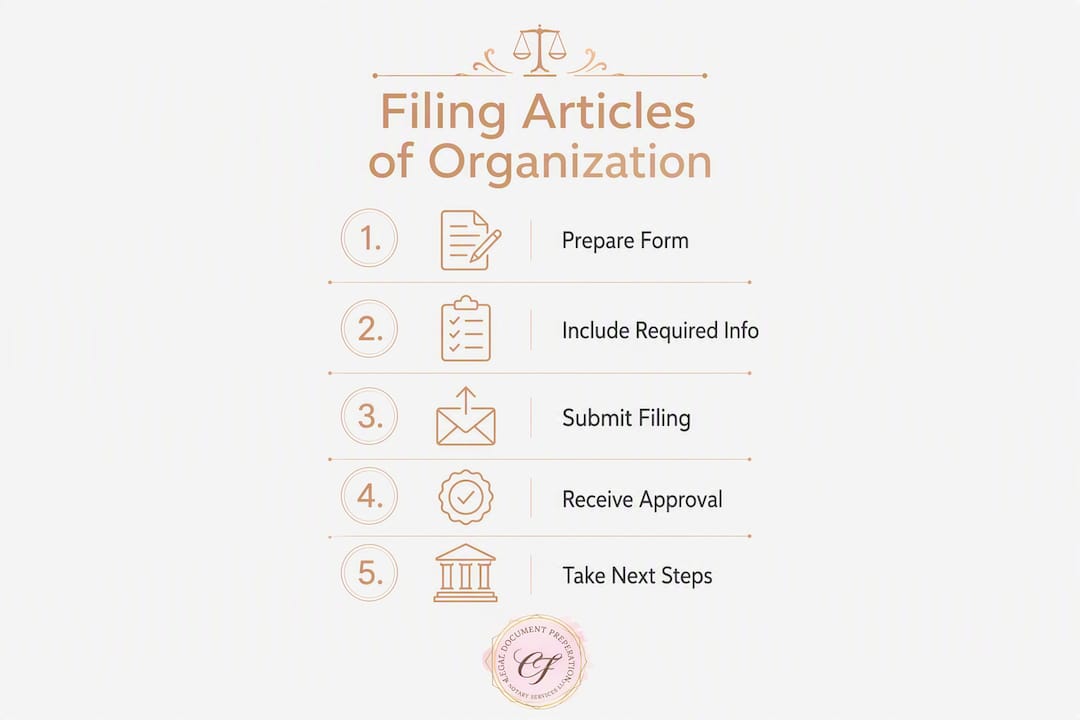
Articles of Organization are the official state filing that legally creates your LLC. You submit this document to your state's Secretary of State (or equivalent business registry), and once approved, your LLC exists as a separate legal entity. After approval, your two immediate next steps are to apply for an EIN from the IRS and draft an operating agreement.
Before you file, gather these core fields:
- LLC name (must include a designator such as "LLC" or "Limited Liability Company")
- Registered agent name and street address
- Principal office address (physical street address, not a P.O. Box in most states)
- Organizer name(s) and signature(s)
- Management structure (member-managed or manager-managed)
- Purpose statement (general or specific business purpose)
- Effective date (date you want the LLC to officially begin)
Table of Contents
- What do Articles of Organization actually do legally?
- What information do states require on the Articles?
- Where and how do you file Articles of Organization?
- What do filing fees and processing times look like?
- Why do filings get rejected, and how do you avoid it?
- What should you do after your Articles are approved?
- How do Articles of Organization differ from other formation documents?
- How do you amend, get certified copies, or dissolve your Articles?
- Privacy, registered agents, and what beginners often miss
- Key Takeaways
- Why the Articles matter more than most guides admit
- Cflegalformhelp can prepare your Articles of Organization
- Useful sources to consult before you file
What do Articles of Organization actually do legally?
Filing the Articles of Organization creates your LLC as a separate legal entity under state law. That separation is the foundation of limited liability: once the state approves the filing, the LLC's debts and legal obligations belong to the company, not to you personally. The state record also establishes the LLC's official existence date, its registered agent, and its management structure.
The document becomes part of the public record. Anyone can look up your LLC's name, registered agent address, and principal office address through the state's business registry. That public-record status has real privacy implications, which is why many owners are careful about which addresses they list.
What the Articles do not control is internal governance. They don't set profit-sharing percentages, voting rights, or what happens when a member wants to leave. That's the job of the operating agreement, a private document between the members. Think of the Articles as the LLC's birth certificate: they prove the entity exists, but they don't describe how it runs day to day.
One naming detail worth knowing: not every state calls this document "Articles of Organization." Some states use alternate names such as "Certificate of Formation" (Delaware, Texas) or "Certificate of Organization" (Massachusetts). The filing serves the same function regardless of what the state calls it.
What information do states require on the Articles?
Most states ask for the same core fields, though a few add state-specific requirements. Here is what to prepare:
Core required fields (nearly universal):
- LLC name with required suffix (LLC, L.L.C., Limited Liability Company, or state-approved equivalent)
- Registered agent full legal name and physical street address within the state
- Principal office address (the LLC's main place of business)
- Organizer information (name and address of the person or entity filing the Articles)
- Management structure (member-managed or manager-managed; some states require this explicitly)
- Business purpose (most states accept a general statement such as "any lawful purpose")
- Duration (perpetual is the default; state it if your LLC has a planned end date)
- Effective date (leave blank to default to the filing date, or specify a future date)
Optional or state-specific fields:
- Names of initial managers or members (required in some states, optional in others)
- Statement of professional LLC status (for licensed professionals such as doctors or attorneys)
- Organizer signature (required on the form itself in most states)
Most states require at minimum the business name, registered agent, principal place of business, and organizer details. Running a state business-name search before you fill out the form is a step you should never skip. State naming rules require a unique name and prohibit certain words, such as "bank," "insurance," or "attorney," unless your LLC meets specific licensing requirements.
Pro Tip: Copy the exact name format from your state's sample form, including punctuation and spacing. Clerks compare your submission against their template, and even a misplaced comma can flag a filing for review.

Where and how do you file Articles of Organization?
Every state has its own filing portal or paper form, and all filings go to the state's business registry, most commonly the Secretary of State. Using the state's official fill-in form or online portal reduces rejection risk because the fields match exactly what the clerk's system expects.
Filing methods:
- Online portal: The fastest option. Most states now offer a dedicated business-filing portal where you complete the form, pay by credit card, and receive confirmation by email. Processing is typically faster than mail.
- Mail: You print the state's PDF form, complete it, and mail it with a check or money order. Processing times are longer, and errors require back-and-forth by mail.
- In-person drop-off: Available in some states at the Secretary of State's office. Useful if you need same-day or next-day processing and your state allows walk-in expedited service.
Who can sign as organizer? Almost any adult can serve as the organizer, including a member, a future member, an attorney, or a document preparer. You do not need to be a resident of the state where you are filing. Most states allow multiple organizers, though a single organizer is common for small LLCs.
Before you submit, always run a name availability search on the state's official business-registrar website. A name that looks unique to you may already be registered under a slight variation. States treat names as conflicting when they are "deceptively similar," not just identical.
What do filing fees and processing times look like?
Fees and timelines vary widely by state. Typical filing fees and processing times range broadly, with low-end fees often being modest and high-end fees considerably more. Expedited processing options are frequently available at an additional cost that depends on the state and requested turnaround time. Always verify the exact current fee on your state's Secretary of State page before filing. Some states process online filings faster than paper ones even without an expedited request, simply because the digital queue moves more quickly.
State Secretary of State pages are the authoritative source for current fees, forms, and processing options. Fee schedules change, and a number you find on a third-party site may be outdated. Checking the official page takes two minutes and prevents a rejected payment from delaying your formation.
Why do filings get rejected, and how do you avoid it?
Name conflicts and missing or insufficient information are the leading causes of rejection across states. Here is a breakdown of the most common problems and how to prevent each one:
- Name conflict: Another entity already holds the same or a deceptively similar name. Fix: run the state's entity search before you draft the Articles. Reserve the name if your state offers that option.
- Missing required fields: A blank field, especially registered agent address or organizer signature, triggers an automatic rejection. Fix: use the state's checklist or form instructions and confirm every field is complete before submitting.
- Wrong form or outdated version: States update their forms, and an old PDF may be missing required fields. Fix: always download the form directly from the state's official website on the day you plan to file.
- Prohibited words in the LLC name: Words like "bank," "trust," "insurance," or "university" require regulatory approval or licensing. Fix: review your state's prohibited-word list before settling on a name.
- Incorrect registered agent information: The agent's address must be a physical street address within the state, not a P.O. Box. Fix: confirm the agent's exact address and that they consent to serve before listing them.
When a filing is rejected, most states return the document with a written explanation and allow you to correct and resubmit without starting over. You typically pay the filing fee again on resubmission, so getting it right the first time saves both money and time.
What should you do after your Articles are approved?
Approval is not the finish line. Several practical steps need to happen before your LLC can open a bank account or sign contracts.

1. Save your confirmation and get a certified copy. The state will send an approval notice or stamped certificate. Store it securely. If you need a certified copy for a bank or another state agency, request one from the Secretary of State's office, usually for a small fee.
2. Apply for an EIN. Filing the Articles is a prerequisite before the IRS will recognize your LLC for tax purposes, and most banks require an EIN to open a business account. You can apply for an EIN directly through the IRS at no cost, and the number is issued immediately when you apply online.
3. Draft an operating agreement. Even in states that don't require one, an operating agreement protects members by documenting ownership percentages, voting rights, and what happens if a member exits. Without one, your state's default LLC statutes fill the gaps, and those defaults may not match what you intended.
4. Open a business bank account. Banks typically ask for your approved Articles (or certificate), your EIN, and a government-issued ID. Keeping business and personal finances separate is one of the practical steps that supports the liability protection the LLC structure provides.
5. Obtain licenses and permits. Depending on your industry and location, you may need a local business license, a state professional license, or a sales tax permit. The SBA's business registration guide is a useful starting point for identifying what applies to your business type.
6. Register for state taxes if required. Some states require LLCs to register separately for sales tax, employer withholding, or an annual report. Check your state's revenue department website for requirements.
How do Articles of Organization differ from other formation documents?
Three documents come up repeatedly in LLC formation, and they serve distinct purposes:
Articles of Organization vs. Articles of Incorporation:
- Articles of Organization create an LLC at the state level.
- Articles of Incorporation create a corporation (C-corp or S-corp) at the state level.
- Both are public filings with the Secretary of State, but the entity types they create have different tax treatment, ownership structures, and governance requirements.
Articles of Organization vs. Operating Agreement:
- The Articles are a public document filed with the state; they establish that the LLC exists.
- The operating agreement is a private document between the members; it governs how the LLC operates internally.
- The Articles typically contain minimal information (name, agent, organizer). The operating agreement covers profit distribution, member roles, voting, and dissolution procedures.
A quick contrast:
- Legal effect: Articles create the entity; the operating agreement governs it.
- Public record: Articles are public; the operating agreement is private.
- Required by state: Articles are always required to form an LLC; operating agreements are required in some states and strongly recommended in all others.
- Content focus: Articles cover formation basics; the operating agreement covers management and ownership.
How do you amend, get certified copies, or dissolve your Articles?
Your LLC's circumstances will change, and the Articles can be updated to reflect those changes.
Amending the Articles: File Articles of Amendment with the same state office where you filed the original. Common amendments include changing the LLC name, updating the registered agent, switching from member-managed to manager-managed, or changing the principal office address. Most states charge an amendment filing fee, which is often lower than the original formation fee.
Requesting certified copies: A certified copy is an official copy stamped by the state confirming it matches the record on file. Banks, courts, and other states often require one. Request certified copies directly from the Secretary of State's office, either online or by mail, for a per-page or flat fee.
Certificate of Good Standing: Separate from certified copies, a Certificate of Good Standing (also called a Certificate of Status in some states) confirms your LLC is current on its filings and fees. Lenders and business partners frequently request this document.
Dissolving the LLC: To formally close the LLC, you file Articles of Dissolution (or a similar document) with the state. Before filing, you should settle outstanding debts, notify creditors, and distribute remaining assets to members. Failing to formally dissolve means the state may continue to expect annual reports and fees even after you stop operating.
Privacy, registered agents, and what beginners often miss
Because the Articles are public record, every address you list is visible to anyone who searches your state's business registry. Many owners use a commercial registered agent service to avoid listing a personal home address on public filings. A registered agent service gives you a physical street address in the state, handles service of process, and forwards official mail, all without your home address appearing on a public database.
Your options for the registered agent role:
- Yourself or a member: Free, but your personal address becomes public and you must be available during business hours to receive legal documents.
- A trusted individual in the state: Works if that person is reliable and willing to accept legal notices on the LLC's behalf.
- A commercial registered agent service: Provides a professional address, consistent availability, and often includes document scanning and forwarding. Annual fees typically run from $50 to $300 depending on the provider.
Privacy checklist before you file: Use a business address (not your home) for the principal office whenever possible. Consider a virtual mailbox service if you work from home. Use a commercial registered agent to keep your personal address off the public record. Limit personal information to only what the state form requires.
Pro Tip: A P.O. Box usually satisfies mailing address fields, but most states require a physical street address for the registered agent and principal office. A commercial registered agent or virtual office service meets that requirement without exposing where you live.
One thing many first-time filers don't realize: minor drafting errors in the Articles don't typically destroy your limited liability protection. The statutory grant of LLC status controls as long as the state accepted the filing and there is no fraud or gross negligence. That said, administrative issues from missing statutory statements can create headaches later, so accuracy still matters. The role of a document preparer in catching those errors before submission is often underestimated.
Key Takeaways
Filing Articles of Organization with your state's Secretary of State is the single required step that legally creates your LLC and activates its limited liability protection.
| Point | Details |
|---|---|
| Articles create the LLC | Filing with the Secretary of State is the required step that legally establishes your LLC as a separate entity. |
| Run a name search first | Check your state's business registry for name conflicts before drafting the Articles to avoid rejection. |
| Use the state's official form | Downloading the current form directly from the state's website reduces rejection risk more than any other single step. |
| Get your EIN after approval | Apply for an EIN through the IRS immediately after approval; most banks require it to open a business account. |
| Cflegalformhelp assists with preparation | Cflegalformhelp offers flat-fee document preparation and bilingual support to help you file Articles correctly the first time. |
Why the Articles matter more than most guides admit
Most formation guides treat the Articles of Organization as a checkbox: file it, move on. That framing misses something important. The Articles are the document that activates every other protection your LLC offers. Without a properly filed and accepted Articles, there is no entity, no liability shield, and no basis for an EIN or a business bank account. Everything else, the operating agreement, the licenses, the tax elections, depends on this one filing being correct.
What I see most often with clients who come in after a rejection or a delay is not a complex legal problem. It is a simple mismatch: the wrong form version, a name that was already taken, or a registered agent address that turned out to be a P.O. Box when the state required a street address. These are entirely preventable. The state's own template and a five-minute name search resolve most of them before the filing ever goes out.
The privacy angle is also consistently underemphasized. Listing a home address on a public document that anyone can search is a real consideration, not a minor footnote. A commercial registered agent costs less per year than most business owners spend on office supplies, and it keeps personal information off a database that is permanently public.
Cflegalformhelp can prepare your Articles of Organization
Preparing your Articles correctly the first time means fewer delays, no resubmission fees, and a faster path to your EIN and business bank account. Cflegalformhelp offers flat-fee LLC formation document preparation with bilingual support in English and Spanish, so you get clear guidance regardless of which language you work in.
The service covers document preparation, organizer signature coordination, registered agent guidance, and notarization where required. Cflegalformhelp's experience with Florida state filings and general U.S. filing best practices means the form that goes to the Secretary of State matches the state's current template and naming requirements. For readers who prefer to handle the process themselves, the DIY filing guides page provides step-by-step checklists. To get started with professional preparation, visit the business formation assistance page and request a flat-fee quote.
This article is general information, not legal advice. Confirm current fees, forms, and requirements with your state's Secretary of State or a qualified professional before filing.
Useful sources to consult before you file
The sources below are authoritative starting points. Always go to the official state or federal page for current forms and fees, since third-party sites may reflect outdated information.
- Legal Information Institute, Cornell Law School: Articles of Organization — clear legal definition and explanation of the public-record effect; useful for understanding the statutory basis of LLC formation.
- IRS: Get an Employer Identification Number — the official page for applying for an EIN online after your Articles are approved; free and issues the number immediately.
- SBA: Register Your Business — federal guidance on business registration steps, including links to state-level resources and license requirements.
- Cflegalformhelp: Business Formation Assistance — for readers who want professional document preparation support rather than filing alone.