

Yes, an LLC operating agreement matters. It protects your personal assets, makes your business rules legally enforceable, and keeps you in control of how your company runs — rather than leaving those decisions to your state's default statutes.
The short version:
- A signed operating agreement is your primary evidence that the LLC is a real, separate legal entity (critical for protecting personal assets from business debts).
- It lets members set their own profit splits, voting rules, and management structure instead of accepting whatever the state defaults to.
- Banks, lenders, and investors routinely require it before opening accounts or approving financing.
- It prevents costly disputes by spelling out buyout terms, transfer rules, and what happens if a member leaves.
- A few states — including California, Delaware, Maine, Missouri, and New York — legally require a written operating agreement.
Even if your state does not mandate one, skipping it is one of the most common and avoidable mistakes small business owners make.
Table of Contents
- What an operating agreement actually is (and what it is not)
- Why an operating agreement matters for your LLC's liability and governance
- Which states require a written operating agreement
- How to create, sign, and update your operating agreement
- How Cflegalformhelp helps you get this right
- Key Takeaways
- The document most small business owners underestimate
- Get your operating agreement prepared and notarized
- Useful sources and further reading
What an operating agreement actually is (and what it is not)
An operating agreement is an internal contract among LLC members that sets the rules for ownership, governance, and finances. According to the U.S. Small Business Administration, it acts as a binding contract once signed and governs both the financial and functional decisions of the business.
It is not the same as your Articles of Organization. The Articles are the public formation document you file with the state to create the LLC. The operating agreement is private. You do not file it with any government agency. You sign it, keep it with your company records, and give copies to each member, your bank, and any lender or investor who asks.
It is also not the same as corporate bylaws. Bylaws govern corporations. An operating agreement is specific to LLCs and reflects the more flexible structure that makes the LLC entity type attractive in the first place.
Key distinctions at a glance:
- Operating Agreement: — Internal, signed by all members, governs how the LLC actually runs.
According to Investopedia, a typical operating agreement for a small business LLC runs 10–20 pages, covering everything from ownership percentages to what happens when a member wants to exit.
Why an operating agreement matters for your LLC's liability and governance
The importance of an LLC operating agreement goes well beyond paperwork. Each reason below has a direct, practical consequence for your business.
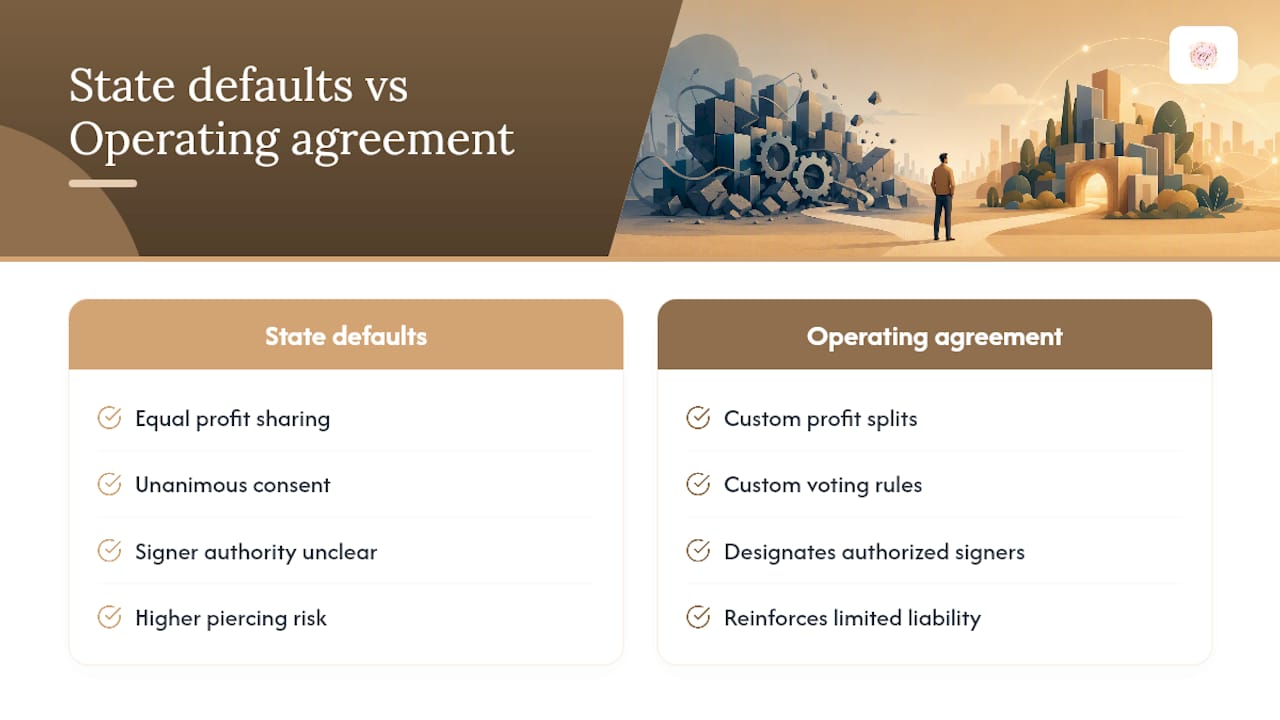
It reinforces your limited liability shield. The whole point of forming an LLC is to separate your personal assets from business liabilities. A signed operating agreement is one of the clearest ways to demonstrate that separation. Without it, a court or creditor can argue the LLC is not a genuine separate entity, a legal concept called "piercing the corporate veil." Single-member LLCs are especially vulnerable here — without a written agreement, courts have treated them as sole proprietorships in practice.

It lets you override state default rules. Every state has default LLC statutes that apply when members have no written agreement. Those defaults often prescribe equal profit sharing regardless of capital contributed, and unanimous member consent for major decisions. As Wolters Kluwer notes, a customized operating agreement lets members set durable internal rules that reduce dependency on changing statutory defaults — and state LLC laws do change. Your agreement locks in the rules you actually agreed to.
Banks and lenders require it. This is not theoretical. Lenders and banks routinely request the operating agreement as part of due diligence to verify structure and confirm who has authority to sign on behalf of the LLC. Major commercial lenders commonly require it to open business accounts and authorize signers, according to BoostSuite. If you cannot produce a signed copy, account opening and loan approvals can stall or fail entirely.
It prevents and resolves member disputes. Verbal agreements are difficult to enforce and frequently lead to expensive litigation. A written operating agreement prevents those disputes by establishing clear rules in advance — including what happens when a member wants to sell their interest, how buyouts are priced, and what the dispute-resolution process looks like. Thomson Reuters identifies this as one of the primary reasons the document matters.
Single-member LLCs still need one. Many solo owners assume the agreement is only for multi-member situations. That assumption is wrong. A single-member LLC without a written operating agreement is more likely to be treated as a disregarded entity with no real liability separation — exactly the protection you formed the LLC to get.
Which states require a written operating agreement
Most states do not legally require an LLC to have an operating agreement, but five do. According to Thomson Reuters, the states that explicitly require one are:
- California
- Delaware
- Maine
- Missouri
- New York
If your LLC is formed in any of these states and you do not have a written operating agreement, you are out of compliance with state law — not just missing a best practice.
For LLCs in all other states, the practical consequence of having no agreement is that state default rules fill the gap. Those defaults vary by state, but common examples include:
- Profits and losses split equally among members, regardless of how much each contributed.
- Major decisions requiring unanimous member consent, which can paralyze a business when members disagree.
- No clear process for a member to exit or transfer their interest.
Even when not legally required, courts, banks, and lenders treat a written operating agreement as the standard. Showing up to open a business bank account without one — at an institution like Chase or Bank of America — routinely results in delays. The Wolters Kluwer guide notes that a customized agreement also insulates your LLC from the effects of future statutory changes, since your internal rules stay in place even when the state amends its default LLC statutes.
How to create, sign, and update your operating agreement
The process is straightforward. Here is a practical sequence for small business owners:
- Draft the agreement. Use a state-specific template as a starting point, then customize every section to reflect your actual ownership percentages, management structure, and financial arrangements. For LLCs with complex ownership, multiple investors, or unusual profit arrangements, an attorney review is worth the cost.
- Review it with all members. Every member should read the full document before signing. Disagreements are far easier to resolve at the drafting stage than after the fact.
- Sign and date it. All members sign. If your state or your bank requires notarization, arrange that at the same time. Keep the original in your company records.
- Distribute copies. Give a copy to each member, your business bank, and any lender or investor who requests one. Keep a digital backup.
- Register it with your records. The operating agreement is not filed with the state (except in states that require submission), but it should be stored alongside your Articles of Organization and other formation documents. Florida startup owners can find guidance on which documents belong in company records in this Florida startup legal document guide.
- Amend it when circumstances change. Any time a member joins or exits, ownership percentages shift, or roles change, draft a formal amendment. Date it, have all relevant parties sign it, and attach it to the original agreement.
When to use a document-prep service vs. an attorney: For a straightforward single-member or two-member LLC with standard profit splits and no outside investors, a professional document-preparation service can produce a complete, bank-ready operating agreement at a fraction of attorney fees. If your LLC involves venture capital, complex equity arrangements, or multi-state operations, an attorney review is the right call.
For Florida LLCs specifically, the operating agreement should be completed before or at the same time as your business bank account application. Most Florida banks will ask for it on the spot.
How Cflegalformhelp helps you get this right
Cristina Fernandez, certified legal document preparer and immigration paralegal, founded CF Legal Document Preparation & Notary Services LLC to give individuals and small business owners a clear, affordable path through exactly this kind of paperwork.
The practical workflow Cflegalformhelp uses for operating agreement clients:
- Signer verification and notarization: Verify member identities and notarize signatures where required or requested, using mobile notary services that come to you.
When document preparation is the right fit: If your LLC is a straightforward small business with standard ownership and no outside investors, professional document preparation gives you a complete, signed, and bank-ready operating agreement without attorney-level fees. If your situation involves litigation risk, complex equity structures, or regulatory licensing, consult a licensed attorney. Cflegalformhelp prepares documents — it does not provide legal advice or legal representation.
Key Takeaways
A signed, customized operating agreement is the single most important internal document your LLC can have for protecting liability, governing operations, and satisfying banking and lending requirements.
| Point | Details |
|---|---|
| Liability protection | A signed agreement is primary evidence your LLC is a genuine separate entity, reducing veil-piercing risk. |
| Override state defaults | Without an agreement, state law sets your profit splits, voting rules, and exit procedures — often not what you intended. |
| Banking and lending | Banks and lenders require the operating agreement to open accounts and verify authorized signers. |
| Five states require it | California, Delaware, Maine, Missouri, and New York legally mandate a written operating agreement. |
| Cflegalformhelp | Cflegalformhelp prepares, notarizes, and produces bank-ready operating agreement copies for small business owners at flat-fee rates. |
The document most small business owners underestimate
The operating agreement rarely gets the attention it deserves at formation. Most new LLC owners are focused on the Articles of Organization, the EIN, and the bank account — and the operating agreement gets treated as an afterthought, or skipped entirely.
That order of priority is backwards. The Articles create your LLC on paper. The operating agreement is what makes it function as a real business. When a dispute arises, when a bank asks for proof of authority, or when a court examines whether your personal assets are truly separate from business liabilities, the operating agreement is the document that answers those questions. A missing or outdated one leaves you exposed in exactly the situations where you need protection most.
My practical advice: sign the operating agreement before you open your business bank account. Banks will ask for it, and having a complete, notarized copy ready on day one signals that your LLC is organized and legitimate. It also forces you to resolve any ownership or management ambiguities before they become problems.
Get your operating agreement prepared and notarized
Cflegalformhelp is the flat-fee alternative to paying attorney rates for a standard operating agreement. For small business owners who need a complete, signed, and bank-ready document without the cost of a law firm, Cflegalformhelp handles the full process: drafting based on your specific ownership and management structure, notarizing member signatures, and producing formatted copies that meet bank and lender requirements.
Services available for your operating agreement:
- Business formation assistance — operating agreement drafting and LLC formation support.
- Legal document preparation — flat-fee document prep for small business owners.
- Mobile notary and loan signing — signer verification and notarization, including remote options.
To get started, visit the business formation assistance page and submit your LLC details. Cflegalformhelp serves clients in English and Spanish throughout South Florida and remotely across the United States.
This article provides general information about LLC operating agreements and is not legal advice. Verify current requirements with your state's Secretary of State office or a licensed attorney in your jurisdiction.
Useful sources and further reading
These sources cover the legal standards, drafting guidance, and official requirements referenced throughout this article. Check your formation state's specific statutes and your bank's documentation requirements before finalizing your agreement.
- What is an operating agreement? Do I need one for my LLC?
- Basic Information About Operating Agreements
- LLC Operating Agreement: Essential Guide | Wolters Kluwer
- LLC Operating Agreement: Definition, Purpose, Format, and Importance
- Limited Liability Companies: Operating Agreement Components and Sample Language
- Business operating agreement (Shopify blog)
- LLC Operating Agreement: Meaning, Requirements & Benefits (BoostSuite)
- LLC Operating Agreement: Complete Guide 2026