
A complete DACA renewal packet needs Form I-821D, Form I-765, and Form I-765WS, plus two passport-style photos, the filing fee, and a copy of your prior DACA approval notice or EAD card. File 120 to 150 days before your current DACA expires. Most renewals don't require you to resubmit your original evidence of continuous residence.
TL;DR:
- Use only the current editions of forms I-821D, I-765, and I-765WS, and double-check all signatures, dates, and fees before filing to prevent rejection.
- Include only necessary supporting documents such as your prior approval notice, current EAD, passport photo, and new criminal or removal records if applicable, avoiding unnecessary evidence.
- File your renewal packet 120 to 150 days before DACA expiration, with online filing preferred for faster processing and case tracking.
- Organize your packet in the recommended order, clearly label all supporting documents, and keep copies to streamline review and reduce delays.
- Seek a professional review service if unsure about form completion or document accuracy, to avoid common mistakes like outdated forms, missing signatures, or incorrect fees.
Table of Contents
- Examples of DACA Renewal Documents and What Goes on Each Form
- Which Supporting Documents Should You Actually Include?
- Photo, Signature, and Copy Requirements That Trip People Up
- When and How to File Your Renewal
- Filing Mistakes That Get Renewal Packets Rejected
- Do You Need to Include Criminal or Removal Records?
- Building Your Packet: A Sample Checklist and Labeling System
- What I've Learned Reviewing Hundreds of DACA Renewal Packets
- Get Your DACA Renewal Packet Reviewed Before You File
- Sources
Examples of DACA Renewal Documents and What Goes on Each Form
Three forms carry the weight of your renewal, and each one asks for something different. Getting the specifics right on each form matters more than padding your packet with extra paperwork.
Form I-821D is where you formally request renewal. On the current edition, you'll check the box confirming this is a renewal request (not an initial request), and you'll list your current DACA expiration date exactly as it appears on your last approval notice. For example, if your notice shows an expiration of August 14, 2026, that date goes in the corresponding field precisely as printed. This form also asks about any new criminal history or immigration court proceedings since your last approval. If nothing has changed, you'll indicate that directly. If something has changed, that's the trigger for additional documentation covered later in this guide.
Form I-765 requests your Employment Authorization Document. Under the eligibility category section, DACA renewal requestors use the code "(c)(33)". Attach a photocopy of your current or most recently expired EAD card, front and back, so USCIS can verify your history without digging through prior case files.
Form I-765WS is the worksheet establishing your economic need for work authorization, a requirement tied to the employment authorization request itself. This is not the place for a long personal essay. A concise, factual entry works best. An example of appropriate phrasing: "I am currently unemployed and rely on my parents for financial support. I need employment authorization to obtain work and support myself and my family." If you're employed, you might write: "I am employed part-time earning approximately $1,200 per month, which is not sufficient to cover my living expenses without additional income." Keep it factual and brief.
Form G-1145, the e-notification request, is optional but worth including if you want a text or email confirming USCIS has received your packet. It doesn't replace tracking through your online account, but it gives you an early signal that your mail reached the right place.
A quick reference for what each form covers:
- I-821D: Confirms renewal status, expiration date, and any new criminal or removal history.
- I-765: Requests the EAD using eligibility category (c)(33).
- I-765WS: Documents economic necessity for work authorization in a few sentences.
- G-1145: Optional notification of receipt and biometric services appointment scheduling.
Which Supporting Documents Should You Actually Include?
This is where renewers often overprepare. The good news: USCIS instructions for Form I-821D state that renewal requestors generally don't need to resubmit evidence already provided with a prior approved DACA request, unless there's new criminal history or removal proceedings to report.
Here's what a typical renewal packet actually includes versus what stays in your personal file:
- Identity documents: a clear photocopy of your passport bio page, or a government-issued photo ID if you don't have a valid passport.
- Prior DACA evidence: a copy of your I-797 approval notice from your last grant, along with a front-and-back copy of your current or expired EAD.
- Continuity records (keep on file, don't submit): pay stubs, lease agreements, school transcripts, and utility bills that originally proved your continuous residence. These stay in a personal folder in case USCIS sends a request for evidence.
- New criminal or removal documents (include only if applicable): certified court dispositions or immigration court notices dated since your last approval.
One example: if you were approved for DACA in 2023 and nothing about your legal situation has changed, your 2026 renewal packet doesn't need your old lease or your 2022 pay stubs. Those already did their job. Save them anyway. USCIS occasionally sends a request for evidence even on routine renewals, and having your old documentation on hand means you can respond within the deadline instead of scrambling to track down records from years ago.
Pro Tip: Minor traffic violations generally don't need documentation unless they involved alcohol or drugs, according to USCIS instructions. Keep a record anyway. If USCIS asks, you want the paperwork ready, not somewhere in a drawer at your parents' house.
Photo, Signature, and Copy Requirements That Trip People Up
USCIS is strict about physical presentation, and small formatting errors cause real delays.
- Photos: two identical recent passport-style photos with plain background as specified by USCIS instructions, with a plain white or off-white background. Write your name and A-number lightly in pencil on the back of each photo, and attach them using the method described in the form instructions rather than stapling directly through the image.
- Signatures: every form requires a handwritten signature in black ink. A typed name or electronic signature (unless filing through your USCIS online account) results in rejection.
- Copies versus originals: submit photocopies of your identity documents and prior EAD unless USCIS specifically requests originals. Keep your actual passport and EAD in hand.
- Avoid processing snags: don't use highlighters on any form or document, since scanners can misread highlighted text as blank space. Always confirm you're using the current form edition listed on the DACA filing tips page from USCIS before printing anything.
When and How to File Your Renewal
Timing your renewal wrong creates two different problems. File too early, and USCIS may reject the request as premature. File too late, and you risk a gap in employment authorization that can cost you your job or your driver's license eligibility depending on your state.
- Mark your calendar 150 days out. USCIS guidance recommends filing 120 to 150 days before your current DACA expires. This window gives USCIS enough processing time while staying close enough to your expiration that the agency won't flag the request as premature.
- Create a USCIS online account before you file, even if you plan to mail your packet. An account lets you track your case status, upload documents if USCIS issues a request for evidence, and receive updates faster than paper mail allows.
- Choose online or mail filing. Online filing through your USCIS account routes your case directly into the digital system and tends to move through initial processing faster. Mail filing requires looking up the correct lockbox address for your state on the USCIS I-821D page, since sending your packet to the wrong facility adds weeks to processing.
- Use certified mail with tracking if you file by paper, and keep a complete photocopy of everything you send.
- After filing, expect a receipt notice within a few weeks, followed by a biometric services appointment notice if USCIS needs updated fingerprints or photos. If a request for evidence arrives, your online account lets you upload the response directly rather than mailing it back.
Filing Mistakes That Get Renewal Packets Rejected
USCIS rejects a surprising number of renewal packets over errors that have nothing to do with eligibility. The ILRC's annotated renewal checklist notes that even small filing errors, like an outdated form edition or a missing signature, can result in outright rejection rather than a simple request for clarification.
- Outdated forms: USCIS updates its forms periodically, and older editions get rejected on sight. Check the edition date printed in the bottom corner of each form against the current version listed on the I-821D page before you print anything.
- Missing signatures: an unsigned form is treated as if it were never filed.
- Wrong fee amount: verify the current fee on the USCIS fee schedule before mailing a check or money order, since fees do change.
- Wrong filing address: mailing to the wrong lockbox facility delays your case by weeks while USCIS forwards or rejects your packet.
- Over-documenting: submitting your entire original evidence file when you only needed the renewal forms slows down processing without helping your case.
- Under-documenting: leaving out a required new document, like a recent court disposition, when your circumstances have changed since your last approval.
Run these four checks before you seal the envelope or hit submit: confirm every form's edition date, confirm every required signature is present in black ink, confirm your fee matches the current published amount, and confirm your mailing address matches the lockbox assigned to your state.
Do You Need to Include Criminal or Removal Records?
Most renewals skip this section entirely, and that's by design. USCIS only wants new criminal or removal-related documentation if something has changed since your last approved DACA request.
The trigger events are specific: a new arrest, a new conviction, or being placed into removal proceedings since your last approval. If none of these apply to you, you leave this part of your packet empty and move on.
If one does apply, USCIS expects specific documents, not a summary or explanation in your own words:
- Certified disposition records from the court showing the outcome of any new criminal charge.
- Charging documents, such as the original complaint or indictment.
- Final orders from immigration court, if you've been placed into removal proceedings.
To get a certified disposition, contact the clerk's office at the court where your case was handled and request an official copy bearing the court seal, not a printout from an online docket. If the record isn't in English, you'll need it translated. Contact the clerk's office directly to ask whether they require a certified translation or whether a standard certified translation from a qualified translator will suffice.
Building Your Packet: A Sample Checklist and Labeling System
USCIS officers review thousands of these packets. An organized submission gets read faster and generates fewer requests for evidence over documents an officer simply couldn't locate.
Follow this order when assembling your renewal packet:
- Cover page or table of contents listing every item included, in order.
- Form I-821D, signed and dated.
- Form I-765, signed and dated.
- Form I-765WS, signed and dated.
- Form G-1145, if you're including it.
- Two passport-style photos, attached per instructions.
- Filing fee payment (check, money order, or credit card authorization form).
- Copy of prior I-797 approval notice.
- Copy of current or most recent EAD, front and back.
- New criminal or removal documents, only if applicable, labeled clearly and placed last.
A few labeling habits make a real difference in how smoothly your packet moves through initial processing:
- Label any new supporting document with a short header, like "Exhibit A: Certified Court Disposition, dated March 2026."
- Use paper clips or binder clips rather than staples if you might need to pull a document back out for photocopying later.
- Keep a duplicate of the entire packet at home before you mail the original, organized in the same order you submitted it.
- If mailing, write your A-number on a sticky note attached to the outside of your envelope's contents (not the envelope itself) as a quick reference for USCIS staff.
Organizing evidence in this order, tied to the actual DACA guidelines USCIS reviews, tends to reduce follow-up requests over documents an officer had trouble locating in a disorganized stack.
What I've Learned Reviewing Hundreds of DACA Renewal Packets
The same three mistakes show up over and over: an outdated form edition printed months ago and forgotten in a drawer, a missing signature on the I-765WS because people assume the main form's signature covers all three documents, and a fee sent at the wrong amount because someone used a figure they remembered from a previous renewal cycle instead of checking the current schedule.
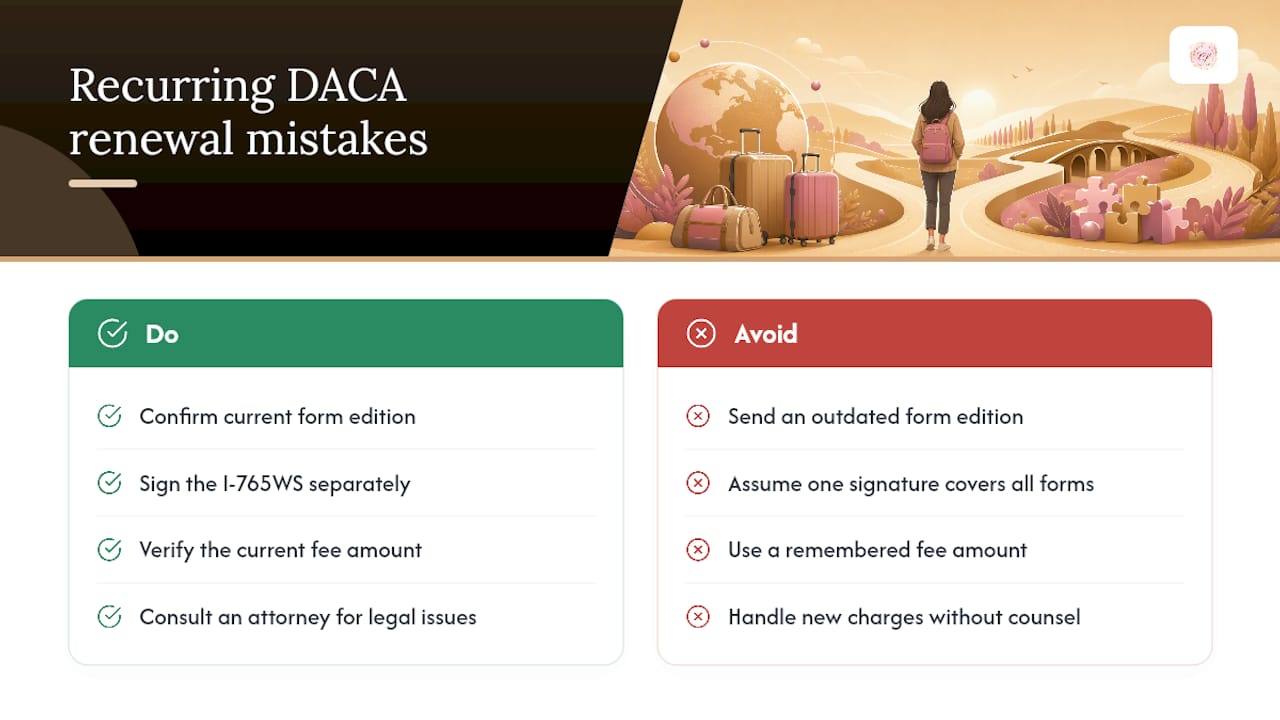
None of these mistakes reflect eligibility problems. They reflect the fact that USCIS paperwork rewards precision over effort. That's not the system being unreasonable. It's the system being literal, and literal systems don't leave room for "close enough."
Where a document-prep review earns its keep is catching exactly these small, correctable issues before they cost you weeks of processing time. It's also worth being honest about the boundary here: a document preparer organizes, reviews, and helps you prepare accurate paperwork. If your situation involves a new criminal charge, removal proceedings, or anything legally complicated, that's the point to consult a licensed immigration attorney instead. Bilingual support matters too. A lot of renewal errors trace back to a form instruction that didn't translate cleanly for a Spanish-speaking applicant working through the process alone.
— Cristina
Get Your DACA Renewal Packet Reviewed Before You File
You can get a document-prep review service that checks form editions, signatures, fee amounts, and packet order before you mail your renewal packet.
This service offers form review, packet organization, notarization where required, and certified translations for court records, with bilingual support in English and Spanish. It does not provide legal representation or legal advice, and pricing is flat-fee and transparent.
If you want a second set of eyes on your renewal packet before you submit it, visit the immigration forms help page to see how the review process works and get your documents checked ahead of your filing window.
This article is general information, not a substitute for advice from a qualified lawyer. Consult a qualified legal professional about your own circumstances before acting on anything here.
Sources
- Form I-821D instructions (evidence for renewal requests only) | USCIS
- How to complete a DACA renewal | ILRC