

A well-drafted independent contractor agreement defines the working relationship between you and the contractor, protects your intellectual property, and serves as your first line of defense in an IRS or state labor audit. Before you send a single invoice or start a project, you need this document in place.
TL;DR checklist — your agreement must include:
- Full legal names and contact details of both parties
- Scope of work and deliverables
- Compensation, payment schedule, and invoicing terms
- Independent contractor status clause
- Intellectual property assignment
- Confidentiality provisions
- Indemnification and liability limits
- Termination and notice terms
- Dispute resolution method
- Governing law and jurisdiction
- Insurance requirements
- Signatures with ESIGN consent if signing electronically
Table of Contents
- What is an independent contractor agreement, and when do you need one?
- What clauses does every U.S. contractor agreement need?
- How do you prepare and customize a contractor agreement?
- How do you avoid worker misclassification and common drafting mistakes?
- Sample clauses and a contractor agreement checklist you can use today
- How Cflegalformhelp can help you finalize and notarize your agreement
- Key Takeaways
- What most people get wrong about contractor agreements
- Cflegalformhelp prepares your contractor agreement from start to finish
- Useful sources for further reading
What is an independent contractor agreement, and when do you need one?
An independent contractor agreement is a written contract between a hiring business and a self-employed worker that defines the terms of a project or ongoing engagement without creating an employment relationship. The U.S. Chamber of Commerce notes that a formal agreement clarifies deliverables, deadlines, and pay rates, which prevents the disputes that arise when expectations stay verbal.
You need one in several situations:
- One-off projects: A graphic designer builds your logo. A developer launches a landing page. One project, one agreement.
- Recurring gigs: A bookkeeper invoices you monthly. Without a written contract, the relationship starts to look like employment over time.
- International contractors: State rules and international differences matter significantly. Many countries require contracts in the local language, and IP assignment and enforceability vary by country.
- Master Services Agreement plus Statement of Work: Larger or ongoing engagements often use a master contract that sets the legal framework, with individual SOWs attached for each project phase.
The written agreement matters most when the work is IP-heavy, when the engagement runs longer than a few weeks, or when you face an audit. A missing or poorly drafted contract increases misclassification risk and removes your strongest piece of documentary evidence.
"The IRS looks at the economic reality of the relationship, not the label on the contract. A document calling someone an independent contractor is only one factor among many." — IRS guidance on worker classification
What clauses does every U.S. contractor agreement need?
A defensible independent contractor agreement typically contains 12 essential clauses. Here is what each one does and the drafting pitfall to avoid.
- Dispute resolution and governing law — Specifies mediation, arbitration, or litigation, and which state's law applies. Pitfall: Defaulting to litigation when arbitration would be faster and cheaper for the amounts involved.
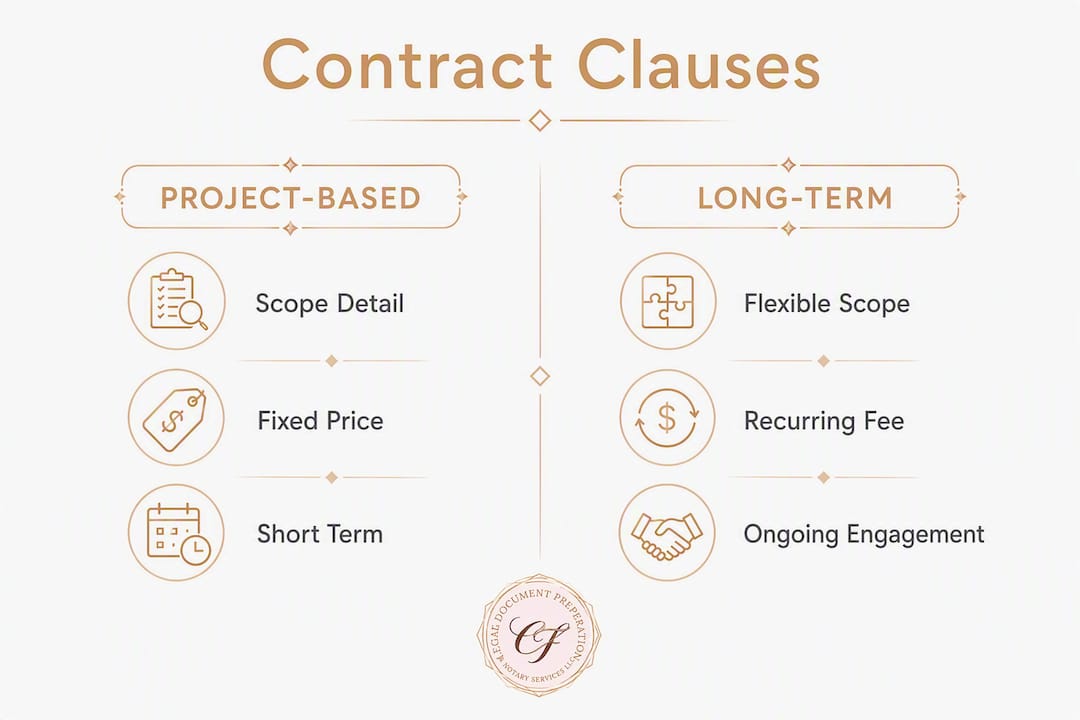
Long-term vs. project-based: which clauses to tighten
| Clause | Project-based engagement | Long-term / recurring engagement |
|---|---|---|
| Scope of work | Detailed, fixed deliverables | Master scope + individual SOWs per phase |
| Term and renewal | Fixed end date, no auto-renewal | Short renewal windows, 30-day notice |
| IP assignment | Single present assignment | Assignment applies to each SOW deliverable |
| Non-solicitation | Optional | Recommended |
| Insurance | Proof at signing | Annual proof of renewal required |
Pro Tip: Keep signed copies of every contractor agreement and its SOWs for at least seven years. That matches common IRS recordkeeping guidance and gives you a clean paper trail if a classification question surfaces years after the engagement ends.
How do you prepare and customize a contractor agreement?
Define the deliverable and the payment method before you open any template. Every other clause flows from those two decisions. Here is the sequence that works in practice.
-
Collect contractor information. Legal name, business entity type (sole proprietor, LLC, S-Corp), mailing address, email, and phone number.
-
Determine the contract type. A single SOW works for one-off projects. A Master Services Agreement with attached SOWs fits ongoing or multi-phase work.
-
Start with a template, then customize. Templates are helpful starting points but must be customized to reflect the actual working relationship to remain enforceable. Generic templates are skeletons, not finished products.
-
Customize the IP and confidentiality language. Adjust the IP assignment clause to name the specific deliverables (e.g., "all source code, design files, and written content"). Tailor the confidentiality definition to your actual proprietary information.
-
Set payment terms and invoicing cadence. Decide: fixed fee or hourly? Net-15 or Net-30? Milestone-based or monthly? Write it in the contract, not just in an email.
-
Add termination and remedies. Specify the notice period (commonly 14 or 30 days) and whether you owe payment for work completed but not yet invoiced at termination.
-
Collect the correct tax form before first payment. Businesses should collect a W-9 for U.S. persons or a W-8BEN for foreign individuals before or at the first payment. Payments of $600 or more to U.S. contractors in a calendar year require reporting on Form 1099-NEC.
-
Obtain signatures and store records. Use a platform that captures ESIGN consent, or sign in person. Store the executed agreement, all SOWs, and the tax form together in a secure location.
Checklist: information to collect from the contractor before signing
- Legal name and entity type (sole proprietor, LLC, corporation)
- Tax identification number (SSN or EIN)
- Completed W-9 (U.S.) or W-8BEN (foreign individual)
- Proof of insurance (general liability, professional liability if applicable)
- Deliverable milestones and acceptance criteria
- Preferred invoicing format and payment method
- Portfolio or credentials relevant to the scope
How do you avoid worker misclassification and common drafting mistakes?
A contract helps, but it does not guarantee correct classification. The IRS evaluates classification based on behavioral control, financial control, and the type of relationship, not the contract's label. Day-to-day practices carry as much weight as the written agreement.

The IRS common-law test looks at three broad factors: whether the business controls how the work is done (behavioral control), whether the business controls the financial aspects of the work (financial control), and whether the parties intend a permanent or indefinite relationship. The Department of Labor applies a separate "economic realities" test under the FLSA, which examines whether the worker is economically dependent on the hiring business. Passing one test does not guarantee passing the other.
Common mistakes that undermine your agreement:
- Requiring fixed hours or a set schedule in the SOW while the contract says the contractor controls their own time
- Supplying the contractor's primary tools, equipment, or software
- Including automatic long-term renewals that make the relationship look permanent
- Using the word "employee" anywhere in the contract or SOW
- Omitting an IP assignment clause and relying solely on work-for-hire language
- Failing to condition first payment on receipt of the correct tax form
- Letting the contractor work exclusively for your business for an extended period without a written justification
Warning: The most costly mistake is a contract that says "independent contractor" while the actual working arrangement looks like employment. Courts and auditors look at the full picture. A contradictory SOW, such as one requiring set hours while the contract claims schedule autonomy, is one of the fastest ways to lose a classification dispute.
Pro Tip: When a role is recurring or deeply integrated into your operations, use short-term SOWs with defined end dates rather than open-ended agreements. If the relationship genuinely resembles employment, converting to a W-2 arrangement is safer than trying to paper over it with contract language.
Sample clauses and a contractor agreement checklist you can use today
Before you send the agreement to the contractor, confirm you have filled in every blank below.
Pre-send checklist:
- Legal names and addresses of both parties confirmed
- Effective date and project end date entered
- Scope of work and deliverables described specifically
- Payment amount, schedule, and invoicing instructions complete
- IP assignment clause names the specific deliverable types
- Confidentiality definition covers your actual proprietary data
- Termination notice period specified
- Governing state law named
- ESIGN consent language included if signing electronically
- W-9 or W-8BEN collected and filed
Sample clause snippets (customize before use):
Independent contractor status: "Contractor is an independent contractor and not an employee of Client. Contractor is solely responsible for all taxes, withholdings, and benefits arising from this engagement."

IP assignment: "Contractor hereby assigns to Client all right, title, and interest in and to all work product created under this Agreement, including all copyrights, patents, and trade secrets. To the extent any work product qualifies as a work made for hire under 17 U.S.C. § 101, it shall be deemed a work made for hire; otherwise, Contractor assigns all rights to Client by this Agreement."
Confidentiality: "Contractor agrees not to disclose, use, or reproduce any Confidential Information of Client without prior written consent. 'Confidential Information' means any non-public business, technical, or financial information disclosed by Client."
Termination: "Either party may terminate this Agreement upon [30] days' written notice. Client shall pay for all work satisfactorily completed through the termination date."
Dispute resolution: "Any dispute arising under this Agreement shall first be submitted to non-binding mediation. If mediation fails, the parties agree to binding arbitration under the rules of [chosen arbitration body], in [governing state]."
| Quick reference | Detail |
|---|---|
| Essential clauses | 12 must-have clauses per practitioner guidance |
| Record retention | Keep signed copies for at least 7 years |
| Electronic signatures | Valid under the ESIGN Act (15 U.S.C. § 7001) with consent language |
| IP backstop | Express assignment required for software and design beyond work-for-hire categories |
| Tax form timing | Collect W-9 or W-8BEN before or at first payment |
You can access DIY filing guides and templates maintained by Cflegalformhelp to start with a structured template you can customize to your engagement.
How Cflegalformhelp can help you finalize and notarize your agreement
Using a certified document preparer to finalize and notarize your contractor agreement saves time and reduces the risk of errors that could undermine the document's enforceability. Cflegalformhelp, founded by Cristina Fernandez, a certified legal document preparer and immigration paralegal, offers a range of services that directly support contractor agreement preparation.
Services available through Cflegalformhelp:
- Document preparation: — Cflegalformhelp prepares customized contractor agreements based on your project details, ensuring the clauses reflect your actual working arrangement.
- Notarization: Both in-person and remote notarization services are available, so you can execute the agreement regardless of where you or the contractor are located.
- Certified translations: For cross-border engagements, certified translation services help ensure the agreement is enforceable in the contractor's jurisdiction.
- Recordkeeping guidance: — Cflegalformhelp advises on document storage practices aligned with IRS recordkeeping recommendations.
Understanding the role of a document preparer helps you decide when professional preparation adds real value versus when a DIY template is sufficient.
Pro Tip: Use Cflegalformhelp's services when you are hiring a Spanish-speaking contractor, when the agreement needs notarization for a financial institution or government filing, or when the contractor is based outside the U.S. and the agreement needs certified translation. These are the scenarios where a document error carries the highest cost.
Key Takeaways
A defensible independent contractor agreement requires defining scope and deliverables first, assigning intellectual property explicitly, collecting tax forms before payment, and storing signed copies for at least seven years.
| Point | Details |
|---|---|
| Define scope first | Write specific deliverables and acceptance criteria before drafting any other clause. |
| Assign IP explicitly | Include both a work-for-hire clause and an express assignment for software, design, and consulting work. |
| Collect tax forms early | Get a W-9 (U.S.) or W-8BEN (foreign) before or at the first payment to avoid 1099 reporting problems. |
| Avoid long auto-renewals | Short renewal windows with 30-day notice protect your classification position in recurring engagements. |
| Use Cflegalformhelp for complex cases | Cross-border hires, notarization needs, and Spanish-language contracts are best handled with professional document preparation. |
What most people get wrong about contractor agreements
Most small business owners treat the contractor agreement as a formality. They download a generic template, fill in the names and dollar amounts, and consider the job done. The agreement sits in a folder and never gets looked at again until something goes wrong.
The problem is not the template. The problem is the gap between what the contract says and how the work actually runs. A contract that claims the contractor controls their own schedule while your Slack messages show you assigning tasks every morning is not a protection. It is evidence against you.
The clause that gets skipped most often is the IP assignment. Work-for-hire language sounds sufficient, but the categories under 17 U.S.C. § 101 are narrow. A website, a mobile app, a brand identity system: none of these automatically qualify. Without an express assignment, the contractor may retain ownership of work you paid for, and you may not discover that until you try to sell the business or enforce a copyright.
The second most common mistake is treating the agreement as permanent. Long automatic renewals and open-ended engagements blur the line between contractor and employee. Short-term SOWs with defined end dates give you more flexibility and a cleaner classification record. If the relationship is genuinely ongoing and integrated, the honest answer is a W-2, not a longer contract.
Freelancers make their own version of this mistake. They accept a client's template without reading the IP clause, and they sign away rights to work they intended to keep in their portfolio or reuse for other clients. Read the assignment clause before you sign. If it assigns all rights broadly, negotiate a license-back for portfolio use.
The agreement is not just paperwork. It is the written record of what both parties agreed to, and it will be read by someone who was not in the room when you made the deal.
Cflegalformhelp prepares your contractor agreement from start to finish
Cflegalformhelp is the practical alternative to spending hours customizing a generic template or paying attorney rates for a straightforward document. As a certified document preparation service based in South Florida, Cflegalformhelp finalizes, notarizes, and stores your contractor agreement at a flat fee, with no hourly billing and no retainer.
The service is a strong fit when you need a customized agreement prepared accurately and quickly. Cflegalformhelp's document preparation covers the full agreement, including scope, IP assignment, confidentiality, and termination clauses, tailored to your specific project. Bilingual support in English and Spanish is included, and both in-person and remote notarization are available for agreements that require a notarized signature. For cross-border engagements, certified translation services help you meet local enforceability requirements.
To get started, visit the legal document preparation service page and submit your project details. Cflegalformhelp will prepare a customized agreement based on your engagement, ready for your review and signature.
Useful sources for further reading
The sources below back the guidance in this article and are worth bookmarking for ongoing compliance.
- IRS: Independent Contractor or Employee — The IRS classification framework covering behavioral control, financial control, and relationship type. Start here before drafting your contractor status clause.
- DOL: FLSA Misclassification — The Department of Labor's economic realities test, which applies separately from the IRS common-law factors.
- USA.gov: Job Misclassification — A plain-language overview of misclassification consequences and how to report concerns.
- IRS: About Form 1099-NEC — Filing requirements and thresholds for reporting nonemployee compensation.
- Cornell LII: Independent Contractor — Legal definition and case law context for the independent contractor classification.
- WIPO: About Intellectual Property — Background on IP rights relevant to assignment and work-for-hire clauses.
This article provides general information about independent contractor agreement preparation and is not legal advice. Confirm current IRS rules, state requirements, and classification standards with a qualified attorney or the relevant primary source before finalizing your agreement.