
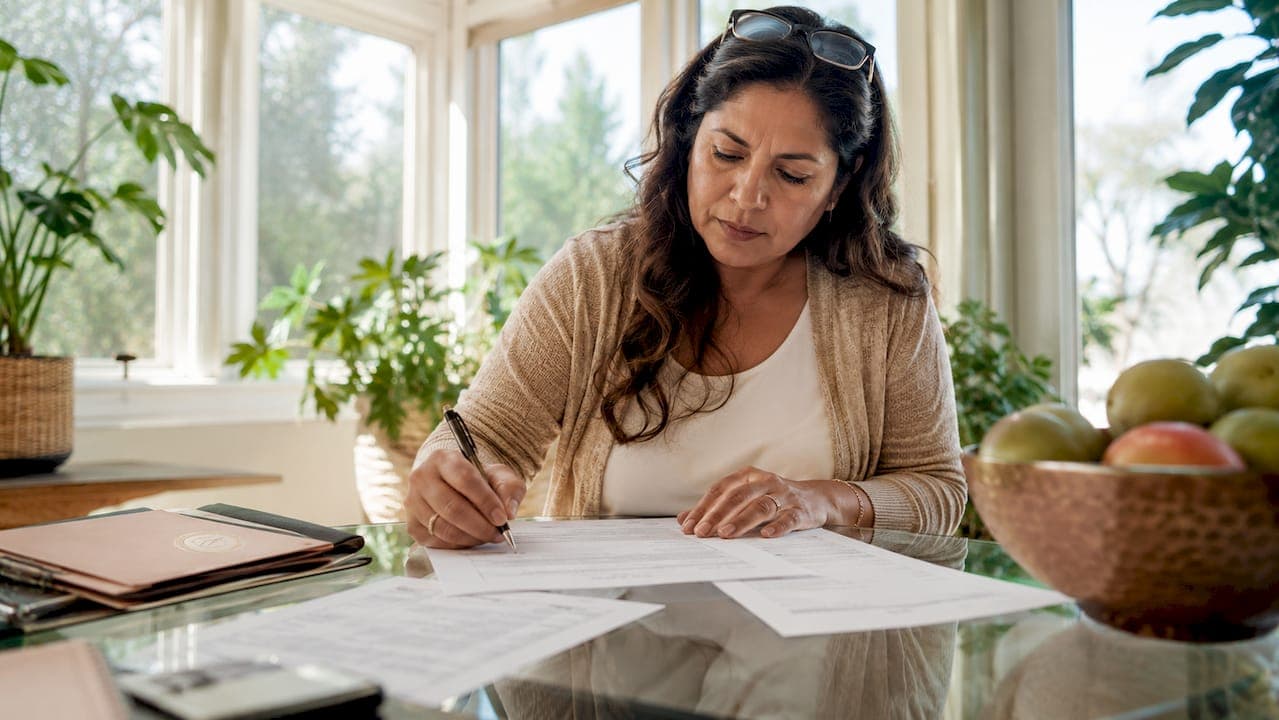
A document preparer is a trained, non-attorney professional authorized to help you complete and file legal documents based on the facts you provide, without offering legal advice. This role, formally called a legal document assistant (LDA) or certified legal document preparer (CLDP), fills a critical gap between doing paperwork entirely on your own and hiring a full attorney. If you have ever wondered que es un preparador de documentos and whether one can help you with immigration forms, an LLC filing, or a family law matter, this guide answers every question you need to ask before hiring one.
What does a document preparer do?
A document preparer completes standardized legal forms using only the factual information you supply. They do not advise you on which legal strategy to choose, predict outcomes, or represent you in court. Legal document preparation exists specifically because strict attorney licensing laws in the U.S. created a need for affordable, non-attorney help for people who represent themselves, known as pro se litigants.

Common document preparation tasks
The document preparer role covers a wide range of paperwork across multiple legal areas:
- Immigration forms: USCIS applications such as Form I-485, I-130, N-400, and related supporting documents
- Family law: Divorce petitions, parenting plans, child support worksheets, and name change filings
- Business formation: LLC articles of organization, operating agreements, and registered agent filings
- Estate documents: Simple wills, living wills, and health care surrogates (where permitted by state law)
- Probate and court filings: Petition forms, summons, and answer documents for pro se court matters
What a document preparer cannot do
Document preparers cannot provide legal advice, recommend a legal strategy, or tell you whether a particular form is the right one for your situation. That boundary is not optional. Crossing it constitutes the unauthorized practice of law (UPL), which is a criminal offense in most states. A legitimate preparer always asks you what you want to accomplish and then fills in the form accordingly. They never tell you what you should want.
Pro Tip: If a document preparer tells you which immigration benefit you qualify for or how a judge will rule on your case, stop the engagement immediately. That is legal advice, and they are not licensed to give it.
How do document preparers differ from paralegals and lawyers?
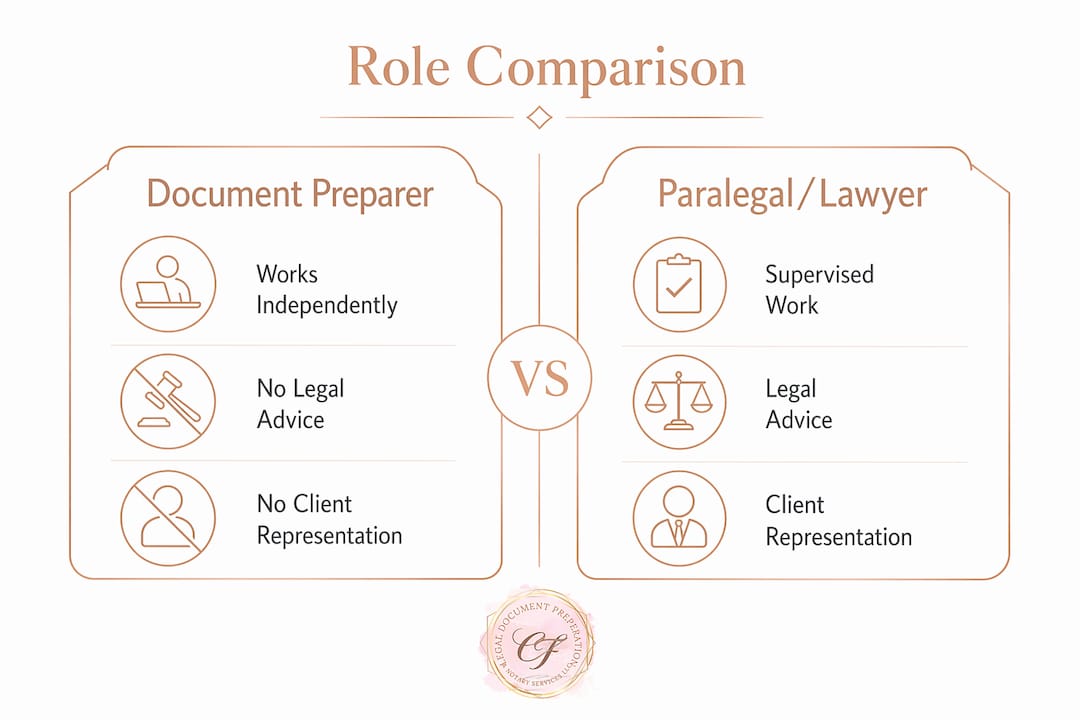
The three roles share overlapping skills but operate under completely different rules. Legal document preparers work independently and serve the public directly, while paralegals must work under attorney supervision and cannot offer services to the public on their own. Lawyers hold a state bar license, carry malpractice insurance, and can advise, strategize, and represent clients in court.
| Role | Works Independently | Gives Legal Advice | Represents Clients | Requires State License |
|---|---|---|---|---|
| Document Preparer | Yes | No | No | Varies by state |
| Paralegal | No (under attorney) | No | No | No (but supervised) |
| Attorney | Yes | Yes | Yes | Yes (state bar) |
The practical impact for you as a client is significant. If your situation is straightforward, such as forming a single-member LLC or filing an uncontested divorce, a document preparer delivers the same completed paperwork at a fraction of the attorney cost. If your case involves disputed facts, criminal history, or complex legal strategy, an attorney is the right choice. For a deeper look at how these roles compare in real scenarios, the paralegal vs. attorney breakdown at Cflegalformhelp clarifies the distinctions further.
What are the requirements to become a document preparer?
Regulations for document preparation services vary sharply by state. Two states stand out as models for consumer protection: Arizona and California.
Arizona certification requirements
Arizona requires document preparers to earn certification from the Arizona Supreme Court. The process includes a criminal background check, a written examination, and proof of relevant education or experience. Once certified, preparers must complete 20 hours of continuing education every two years to maintain their status. That ongoing education requirement matters because it keeps preparers current on form changes, court rules, and ethical standards.
California registration requirements
California uses the title "Legal Document Assistant" and requires registration with the county clerk in every county where the preparer works. California also mandates a $25,000 surety bond to protect consumers from financial harm caused by preparer errors or fraud. Beyond the bond, California law requires document assistants to enter written service contracts with every client, disclosing the preparer's specific duties and the client's consumer rights before any work begins.
States with minimal regulation
Not every state has formal licensing. Mississippi, for example, has no specific certification requirement for document preparers. That lack of oversight places more responsibility on you as the client to verify credentials, check reviews, and ask direct questions about training and experience before signing anything.
| State | Title Used | Key Requirement | Bond Required |
|---|---|---|---|
| Arizona | Certified Legal Document Preparer | Supreme Court certification, background check, exam | No |
| California | Legal Document Assistant | County clerk registration, $25,000 bond, written contract | Yes ($25,000) |
| Florida | Legal Document Preparer | No state certification; must comply with UPL statutes | No |
| Mississippi | No formal title | No specific licensing requirement | No |
Pro Tip: Before hiring any document preparer, ask for their certification number or registration proof. In Arizona, you can verify a CLDP on the Arizona Judicial Branch website. In California, check with the county clerk's office.
Should you hire a document preparer for your legal needs?
Hiring a document preparer makes strong financial and practical sense for routine, well-defined paperwork. Attorney fees for a simple LLC formation in Florida can run $500–$1,500. A certified document preparer typically charges a flat fee well below that range for the same completed documents. The savings are real, and for straightforward filings, the outcome is identical.
Key benefits of using a document preparer
- Lower cost: Flat fees replace hourly attorney billing for standard forms
- Speed: Preparers focus exclusively on document completion, so turnaround is often faster than a law firm's schedule allows
- Accessibility: Bilingual preparers serve clients who need support in Spanish or other languages, removing a barrier that stops many immigrants from filing correctly
- Accuracy: A trained preparer knows the exact fields, attachments, and supporting documents each form requires, reducing rejection rates
For small business owners, the document preparer role in business formation covers LLC articles, operating agreements, and EIN applications at a cost that fits a startup budget.
Red flags to watch for
Not every person offering document preparation services operates ethically. Dishonest preparers avoid signing the preparer section on official government forms to dodge liability. A legitimate preparer always signs where required. Equally serious, modifying client information to improve the apparent strength of a case is a federal offense that can disqualify an applicant from immigration relief entirely. If a preparer suggests changing your answers to make your application look better, walk away.
For clients who want to understand the full scope of pro se filing support, the pro se document preparer guide at Cflegalformhelp covers the process step by step.
Key takeaways
A document preparer completes legal forms using your facts, without giving legal advice, and the value lies in technical accuracy, not legal strategy.
| Point | Details |
|---|---|
| Core role definition | A document preparer fills out legal forms using client-supplied facts and never provides legal advice. |
| Legal boundary | Crossing into legal advice constitutes unauthorized practice of law, a criminal offense in most states. |
| State regulation varies | Arizona and California have strict certification and bond requirements; other states like Florida and Mississippi do not. |
| Cost advantage | Flat-fee document preparation costs significantly less than hourly attorney billing for routine filings. |
| Ethical red flags | Refuse any preparer who will not sign official forms or suggests altering your information to strengthen a case. |
What i have learned after years of preparing legal documents
People often come to me expecting cheaper legal advice. That misunderstanding is the single biggest source of frustration on both sides of the table. The real value I provide is not strategy. It is precision. I know exactly which USCIS form needs which supporting documents, which Florida court requires which cover sheet, and which LLC filing triggers a publication requirement. That technical knowledge saves clients from rejections, delays, and costly refiling fees.
The ethical line I never cross is the one between filling in what you tell me and deciding what you should tell me. I have seen preparers in this industry alter client answers to make an immigration case look cleaner. That is not just unethical. It is a federal offense that can permanently bar someone from the relief they deserve. Every form I complete gets my signature in the preparer section, every time. That signature is not a formality. It is my professional accountability on record.
My honest recommendation: verify credentials before you hand over any personal information. Ask for a written service agreement that spells out exactly what the preparer will and will not do. A trustworthy preparer welcomes that conversation. One who deflects it is telling you everything you need to know.
— Cristina
How Cflegalformhelp can help you with your documents
Cflegalformhelp, founded by Cristina Fernandez, a certified legal document preparer and immigration paralegal based in Naples, Florida, offers flat-fee legal document preparation services for individuals and small business owners across Florida. Services cover immigration form assistance, family law filings, LLC formation, notarization, and certified translations, all in English and Spanish.
Whether you need help with an immigration application or want to form a business entity without paying attorney rates, Cflegalformhelp delivers accurate, compliant document preparation with full transparency. Every engagement includes a written scope of services so you know exactly what you are getting before any work begins. Visit cflegalformhelp.com to request a consultation today.
FAQ
What is a legal document preparer?
A legal document preparer is a trained, non-attorney professional who completes legal forms using information provided by the client. They do not give legal advice, represent clients in court, or recommend legal strategies.
Can a document preparer help with immigration forms?
Yes. Document preparers regularly assist with USCIS forms such as I-485, I-130, and N-400, filling them out accurately based on the facts you provide. They cannot advise you on which immigration benefit to pursue or predict the outcome of your case.
How is a document preparer different from a paralegal?
Paralegals work under direct attorney supervision and cannot offer services to the public independently. Document preparers work directly with clients without attorney oversight, though they are also prohibited from giving legal advice.
Do i need a certified document preparer in florida?
Florida does not require state certification for document preparers, but all preparers must comply with Florida's unauthorized practice of law statutes. Choosing a preparer with formal training, verifiable credentials, and a written service agreement protects you regardless of the state's licensing gap.
What should i look for when hiring a document preparer?
Look for a preparer who signs official forms in the preparer section, provides a written service contract, discloses their training and experience, and charges a clear flat fee. Any preparer who refuses to sign forms or suggests changing your answers to improve your case is a serious liability risk.