

You likely qualify for U.S. naturalization if you're 18 or older, have held a green card for 5 years (or 3 years if married to a U.S. citizen), meet the continuous residence and 913-day physical presence rules, and can pass the English and civics tests with good moral character intact. Military service and derived citizenship offer separate paths. Once you meet the criteria, Form N-400 is the application you file.
TL;DR:
- Applicants with gaps in travel over 6 months may face challenges proving continuous residence unless they maintain strong documentation.
- Criminal history or past arrests require thorough explanation and can jeopardize good moral character assessments, especially within the 5-year lookback window.
- Evidence such as tax transcripts, lease records, and proof of family ties are crucial to support claims of continuous residence and lawful status during application.
- The 3-year spouse naturalization path starts only after both marriage and LPR status have been maintained for a full three years, not from the wedding date.
- Filing the wrong naturalization category or missing key documentation can cause delays or denials, making early preparation and expert advice highly advisable.
Table of Contents
- What are the naturalization eligibility requirements at a glance?
- Which naturalization path fits your situation?
- Continuous residence vs. physical presence: what's the real difference?
- What counts against good moral character?
- What documents do you need to file Form N-400?
- What happens after you file Form N-400?
- What if your interview gets continued or your case is denied?
- A note from Cristina Fernandez
- What actually matters when you're assessing your own eligibility
- Sources
What are the naturalization eligibility requirements at a glance?
Before you invest hours filling out paperwork, run through this checklist. It covers the baseline requirements USCIS applies to nearly every applicant under the standard path.
- Age: You must be at least 18 years old at the time you file.
- Lawful permanent resident time: 5 years as an LPR, or 3 years if you're married to and living with a U.S. citizen.
- Continuous residence: You've maintained a stable home base in the U.S. for that entire period, without long gaps abroad.
- Physical presence: You've spent at least 30 months (913 days) physically in the country during the 5-year window (18 months if on the 3-year spouse track).
- State residency: 3 months living in the state or USCIS district where you file.
- Good moral character, attachment to the Constitution, and the oath: You need to satisfy all three.
- English and civics tests: Required unless you qualify for an exemption.
An eligibility tool can give you a quick read on where you stand, but it's a preliminary check, not a decision. USCIS makes the final call once you file, so read the Form N-400 instructions closely before you submit anything.
Which naturalization path fits your situation?
Not everyone follows the same clock. USCIS recognizes several distinct eligibility categories, and picking the wrong one wastes time and filing fees.
- Standard 5-year path: You've been an LPR for 5 years, meet continuous residence and the 913-day physical presence threshold, and file once you clear both marks.
- 3-year spouse path: You've been married to and living in marital union with a U.S. citizen for at least 3 years, with 3 years as an LPR. USCIS typically expects joint evidence like shared leases, joint bank statements, or birth certificates of children in common to confirm the marriage is genuine and ongoing.
- Military naturalization: Service members follow separate timing rules, and some qualify for expedited processing depending on where and when they served.
- Derivative citizenship: If you acquired citizenship automatically through a parent, Form N-400 may not even be the right form. Form N-600 or a passport application through derivation could apply instead.
Married applicants sometimes assume the 3-year clock starts at the wedding date. It doesn't. It starts when both the marriage and your LPR status have run concurrently for 3 full years.
Continuous residence vs. physical presence: what's the real difference?
These two requirements get confused constantly, and the mix-up causes more filing delays than almost any other issue. Continuous residence asks whether you kept an ongoing home base in the U.S., meaning you didn't relocate your life abroad for an extended stretch. Physical presence is simpler. It's a literal day count: you need 913 days physically inside the country during the 5-year period.
Here's where it gets tricky. An absence over 6 months but under a year doesn't automatically break continuous residence, but it shifts the burden to you to prove you didn't abandon your U.S. home. An absence of a year or more generally does break continuity, unless you filed Form N-470 in advance to preserve it, which typically applies to specific employment situations abroad.
Documents that help you make the case include:
- IRS tax transcripts showing you filed as a U.S. resident every year.
- Lease or mortgage records covering the full period.
- Pay stubs or employment letters showing continuous U.S. work.
- Proof of family ties remaining in the country, like a spouse's or child's school and medical records.
Pro Tip: Keep a simple travel log with dates, destinations, and a photocopy of every passport stamp page. Rebuilding this from memory during your interview is far harder than tracking it as you go.
What counts against good moral character?
USCIS looks at your conduct during a 5-year lookback period (3 years for spouse-based applicants), evaluating whether you meet the good moral character standard tied to naturalization eligibility.
Certain issues raise red flags regardless of how long ago they happened, while others matter only within the lookback window.
- Common disqualifiers: certain criminal convictions, immigration fraud or misrepresentation, unpaid court-ordered child support, and existing deportation or removal orders.
- Arrests and convictions: USCIS reviews the underlying conduct, not just the outcome. Even an expunged charge usually needs to be disclosed and explained.
- Disclosure matters more than the offense itself. Failing to disclose a past arrest on Form N-400 often causes more damage than the arrest did.
- Discretionary findings: in some cases, an officer can still find good moral character despite a past issue, particularly when it falls outside the lookback period and shows genuine rehabilitation.
If you have any criminal history, however minor, talk to an immigration attorney before filing. This is one area where guessing wrong can trigger removal proceedings, not just a denial.
What documents do you need to file Form N-400?
Gathering the right evidence upfront saves you from a continued interview later. Prioritize these categories:
- Proof of permanent resident status — your green card, plus your passport pages showing every entry and exit for the statutory period.
- Joint documents for spouse-based applicants — joint bank statements, leases, and birth or adoption certificates of shared children.
- Tax records — IRS tax transcripts for every required year, showing you filed as a resident.
- Court and criminal records — certified copies of any arrest, charge, or disposition, even if resolved or expunged.
- Certified translations — for any foreign-language document, plus Form N-648 if you're requesting a medical disability exception to testing.
A document checklist built for green card holders can help you organize this before you sit down with the N-400 itself, and a certified translation guide walks through what USCIS actually accepts.
What happens after you file Form N-400?
Filing is just the start. USCIS walks every applicant through a fixed sequence once your Form N-400 lands in the system.
- Filing: submit online through myUSCIS or by paper, along with the filing fee.
- Biometrics: you're scheduled for fingerprinting and a photo, which feeds into background and security checks.
- Interview: an officer reviews your N-400 answers, then administers the English and civics tests.
- Continuance: if you fail a test the first time, USCIS typically schedules a retest rather than denying you outright.
- Decision: approval, denial, or a request for more evidence.
- Oath ceremony: the final step. You're not a citizen until you take the oath.
Interview outcomes hinge heavily on preparation. A practical guide to interview prep covers what officers actually ask beyond the standard test questions.
What if your interview gets continued or your case is denied?
A continued interview usually means missing paperwork or a failed test attempt, not a determination that you're ineligible. Retests and follow-up appointments are typically scheduled within 60 to 90 days.
- Age and residency exceptions: applicants 50 and older with 20 years as an LPR, or 55 with 15 years, may take the civics test in their native language.
- Medical exceptions: Form N-648, completed by a medical professional, can waive English and civics testing for a documented disability.
- Accommodations: requested directly with USCIS, with guidance detailed in the USCIS Policy Manual.
- If denied: you can file an appeal (Form N-336) or, in some cases, a new application. Consult an immigration attorney if the denial touches on moral character or criminal history.
Pro Tip: If you're requesting a legal name change through naturalization, flag it early. It often requires a judicial oath ceremony instead of the standard administrative one.
A note from Cristina Fernandez
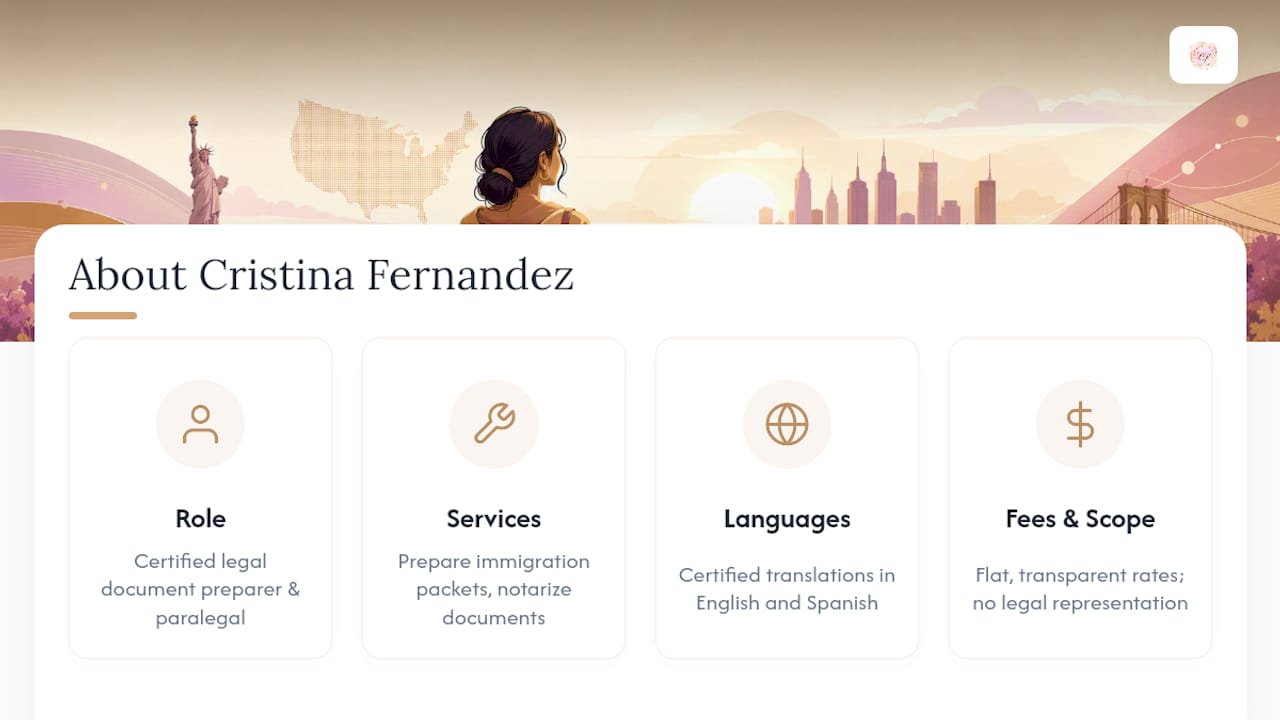
I'm Cristina Fernandez, a certified legal document preparer and immigration paralegal, and the founder of CF Legal Document Preparation & Notary Services. Our team at Cflegalformhelp works with immigrants across South Florida and beyond, helping them prepare immigration paperwork, notarize documents, and obtain certified translations in English and Spanish, all at flat, transparent rates. We don't provide legal representation. What we offer is careful, affordable help organizing the packet you bring to USCIS, so nothing gets lost in translation, literally or otherwise.
What actually matters when you're assessing your own eligibility
Most guides treat continuous residence and physical presence as one requirement. They're not, and conflating them is where I see applicants trip up most often. You can meet the 913-day count and still have a continuous residence problem if a single long trip abroad looks like you moved your life elsewhere. The day count is math. Continuous residence is a story you have to be ready to tell with paper: leases, tax filings, a kid's school records.
The conventional advice, "just check if you meet the years," undersells how much the evidence itself decides your outcome at the interview table. USCIS isn't only asking whether you're eligible on paper. It's asking whether you can prove it on demand. Prioritize the travel log and the tax transcripts before you prioritize memorizing civics questions. Testing prep is important, but it's rarely what causes a continuance. Missing documentation is.
If your situation has any wrinkle, a criminal record, a long trip abroad, a name change, don't guess your way through the N-400. Get the documentation question settled first.
— Cristina
If you'd rather have a professional assemble your naturalization packet than second-guess which documents count, Cflegalformhelp's immigration form assistance offers flat-fee, bilingual help preparing your Form N-400 evidence, from tax transcripts to certified translations, before you ever step into the interview room.
This article is general information, not a substitute for advice from a qualified lawyer. Consult a qualified legal professional about your own circumstances before acting on anything here.