
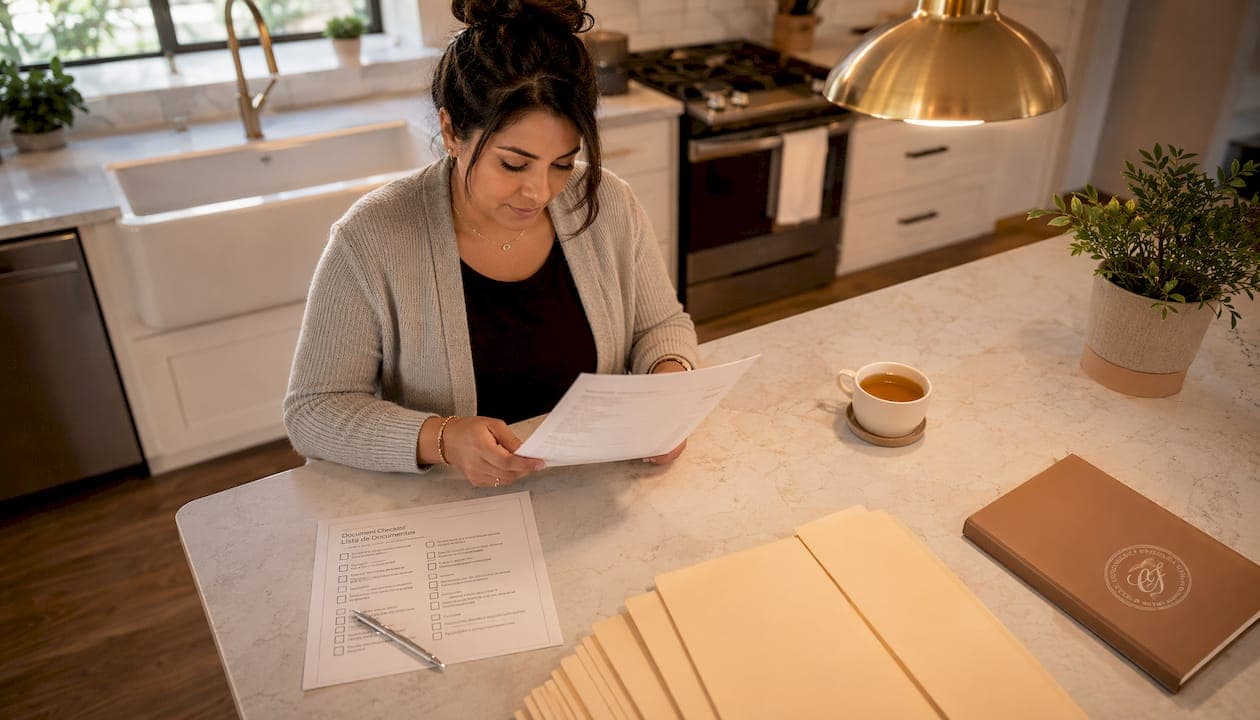
Thorough preparation for a U.S. immigration interview directly improves your credibility, prevents avoidable delays, and reduces the anxiety that comes with high-stakes questioning. The interview is not a performance test. According to USCIS guidelines, officers use it to verify your identity, confirm eligibility, and check that your oral answers match your filed forms and supporting evidence. When you walk in prepared, you give the officer exactly what they need to approve your case. Three things make the biggest difference:
- Consistency: Your spoken answers match your application forms exactly.
- Complete original documents: You bring every required original, including sealed envelopes and certified translations.
- Practiced, concise answers: You answer only what is asked, without over-explaining.
Cflegalformhelp works with applicants across South Florida to organize documents, prepare bilingual checklists, and run through common questions before interview day.
This article is general information, not legal advice. Confirm current requirements with USCIS, the Department of State, or a qualified immigration attorney for your specific situation.
Table of Contents
- Why immigration interview preparation matters for your outcome
- What actually happens at the interview, step by step
- Which documents do you actually need to bring?
- What kinds of questions will the officer ask?
- High-impact preparation tactics that actually change outcomes
- Common mistakes that trigger RFEs, delays, or denials
- What are the possible outcomes after your interview?
- Your day-before and day-of checklist
- When should you get professional help?
- Key Takeaways
- Ready to prepare with confidence? Cflegalformhelp can help
- Useful sources and where to verify requirements
Why immigration interview preparation matters for your outcome
The immigration interview is a confirmation process, not an interrogation, as explained in the role of immigration compliance in the UK. The officer already has your application. Their job is to verify that what you said on paper matches what you say in person, and that your supporting evidence holds up. Reframing the interview this way changes how you prepare and how you feel walking in.

Consistency matters more than a flawless performance. Officers compare your oral testimony to your filed forms, your travel history, and your supporting documents. A small mismatch, like listing a previous address differently than you did on your Form I-485, can prompt follow-up questions or a closer review. It does not automatically mean denial, but it creates extra work for you and the officer. Preparation removes those friction points before they arise.
Understanding the officer's role also lowers anxiety. Applicants who shift their mindset from "trick test" to "confirmation meeting" present more calmly and credibly. Calm composure reads as confidence, and confidence reads as credibility.
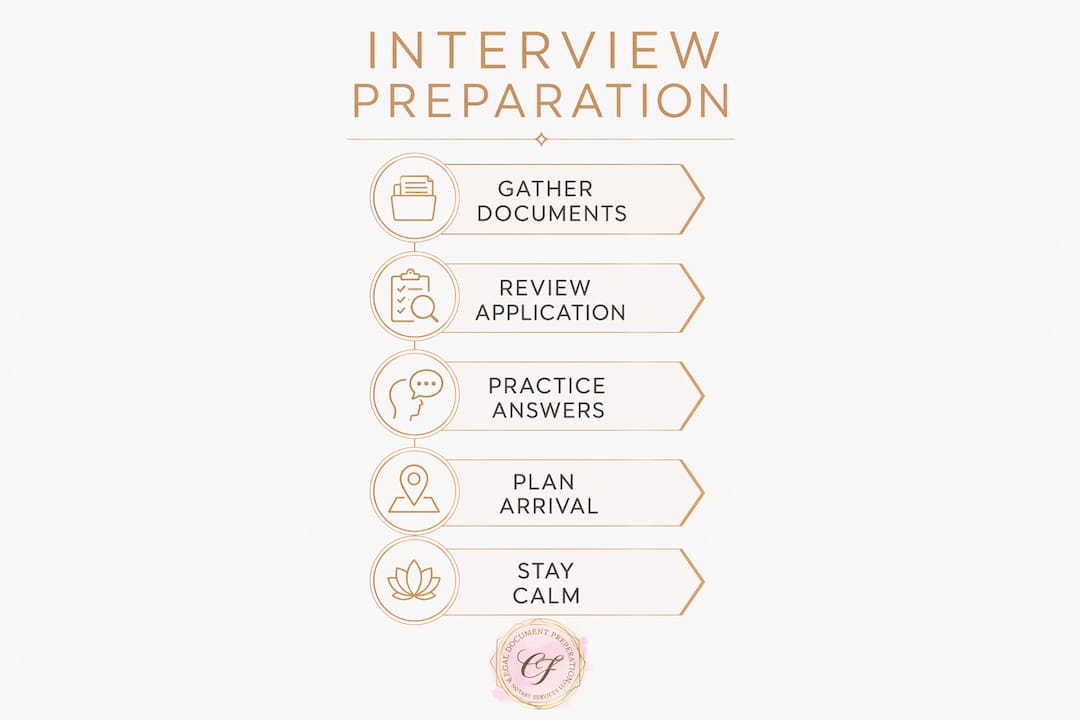
What actually happens at the interview, step by step
Knowing the sequence removes a lot of the uncertainty. Interviews typically run 20–60 minutes, though complex cases can run longer. Plan for the full window.
- Arrival and check-in. Arrive at least 30 minutes early. Bring your interview notice, passport, and government-issued ID. Security screening happens at the entrance.
- Identity verification. The officer checks your ID documents and confirms your biometrics match the record on file.
- Oath or affirmation. You swear or affirm that your answers will be truthful. This is a formal step, not a formality to rush through.
- Officer questions. The officer asks about your application, your background, your relationships (for family-based cases), and your supporting documents. Questions follow your filed forms closely.
- Document review. The officer reviews your originals against what was submitted. Missing documents or opened sealed envelopes can pause the process.
- Decision or next steps. The officer may approve on the spot, issue a Request for Evidence (RFE), continue the case for further review, or, in rare cases, deny. You will receive written notice of the outcome.
If your case involves a family member or petitioner, they may be required to attend as well. USCIS generally requires the Form I-130 petitioner to appear alongside the principal applicant for family-based adjustments.
Which documents do you actually need to bring?
Arriving with complete, organized originals is the single most controllable factor in your interview outcome. Missing one document can delay an otherwise strong case.
Priority documents for most interviews:
- Interview appointment notice
- Valid passport(s), including expired ones if relevant to your travel history
- Government-issued photo ID
- Birth certificate (with certified English translation if not in English)
- Marriage certificate or divorce decree, if applicable
- Any prior immigration documents (visas, I-94 records, prior approvals)
- Original supporting evidence referenced in your application (financial records, employment letters, sponsor documents)
Special items that require extra attention:
The Department of State specifies that medical exam results can take up to 96 hours to process, and the sealed physician envelope must arrive at the interview intact. Do not open it. If you open the envelope, the medical exam results are invalid and you will need to repeat the exam.
Certified translations must accompany any document not in English. Police certificates, if required for your case, should also be originals.
Pro Tip: Build a labeled accordion folder with two sections: originals in the front, copies behind. Add a one-page summary sheet listing your key dates, addresses, and application reference numbers. Officers sometimes ask about details from filings made years earlier, and a living summary sheet prevents you from relying on stressed memory.
Florida applicants can also reference the Florida immigration document checklist for a state-specific supplement to this national guidance.
What kinds of questions will the officer ask?
Officers work through several categories of questions, all tied to your application. Practicing these out loud before the interview is one of the most effective preparation steps you can take.
Identity and personal details
- "What is your current address?"
- "Have you ever used a different name?"
- Practice prompt: Read your application aloud and confirm every address, date, and name matches exactly.
Relationship details (marriage and family-based cases)
- "How did you and your spouse meet?"
- "Where did you go on your first date?"
- Practice prompt: Sit with your petitioner and align your answers to shared facts, not rehearsed scripts.
Employment and education
- "Who is your current employer?"
- "What are your job duties?"
- Practice prompt: Confirm your answers match your I-485 or DS-260 entries exactly.
Travel history
- "When did you last leave the United States?"
- "Have you ever been deported or removed?"
- Practice prompt: Build a simple travel log with dates and destinations from your passport stamps.
Criminal and immigration history
- "Have you ever been arrested?"
- "Have you ever overstayed a visa?"
- Practice prompt: Review every "yes/no" eligibility question on your application and know your answer and the supporting facts.
The goal is not to memorize a script. It is to know your own history well enough that your answers come out naturally and consistently.
High-impact preparation tactics that actually change outcomes
Preparation that works is specific and repeatable. Vague review the night before is not preparation.

Build a practice routine. Read your entire application aloud at least twice before the interview. Hearing your own answers helps you catch phrasing that sounds uncertain or inconsistent. Run two or three mock interviews with a trusted friend, family member, or advisor who asks questions from the categories above. Document organization, mock interviews, and message clarity are the three factors most consistently linked to better interview outcomes.
Answer only what is asked. Practitioners consistently flag over-talking as the main cause of self-inflicted complications. When you volunteer information beyond the question, you increase the chance of contradicting something in your application. A short, direct answer is always safer than a long one. If you do not understand a question, ask the officer to repeat or clarify it. That is not a sign of weakness; it is a sign of care.
Plan your arrival. Know the office address, parking, and security procedures the day before. Build in extra time. Arriving rushed raises your stress level before you even sit down.
Pro Tip: If you feel your nerves rising during the interview, pause for two seconds before answering. That brief pause lets you think clearly, and it signals to the officer that you are being thoughtful rather than reactive.
Common mistakes that trigger RFEs, delays, or denials
Most interview complications are preventable. They tend to fall into a few clear patterns.
- Inconsistent answers. Giving a different address, date, or employer name than what appears on your application is the most common trigger for follow-up. Officers are trained to notice discrepancies.
- Missing or opened sealed documents. An opened medical exam envelope invalidates the exam. Missing originals force the officer to pause or continue the case.
- Over-explaining or guessing. Winging it leads applicants to over-talk and create contradictions. If you do not know an exact date, say "I don't remember exactly" rather than guessing. A wrong guess harms credibility more than an honest "I'm not certain."
- Certain statements that contradict your filing. Saying "I'm just visiting" when your application shows immigrant intent, or "I don't have those documents" when they were listed on your application, creates an immediate credibility problem. Specific phrases can directly contradict your filings and should be avoided.
- Undisclosed prior issues. If you answered "no" to an eligibility question that should have been "yes," correct it before the interview if possible. Disclosing a correction proactively is far better than having an officer discover it.
A single inconsistency rarely causes a denial on its own, but it can shift the officer's attention and lead to an RFE or a referral for additional review. Preparation removes these risks before you sit down.
What are the possible outcomes after your interview?
| Outcome | What it means | Typical next step |
|---|---|---|
| On-the-spot approval | Officer approves the case at the interview | Wait for written notice and, for green card cases, card production |
| Request for Evidence (RFE) | Officer needs additional documents or clarification | Respond fully and on time; late or incomplete responses cause further delays |
| Case continuation or referral | Case sent for additional review (background checks, fraud review) | Monitor case status; contact counsel if no update within the expected window |
| Denial | Application does not meet eligibility requirements | Review denial notice carefully; consult an attorney about appeal or motion options |
An RFE is not a denial. Responding correctly and on time is critical to avoiding long delays. The RFE notice will specify what is needed and the deadline for your response.
For context on how your immigration case status affects timing and next steps, tracking your case online through USCIS or the Department of State portal is the most reliable way to stay current.
Your day-before and day-of checklist
Use this checklist in the 24–48 hours before your interview and on the morning of your appointment.
Day before:
- Confirm your appointment time, office address, and any specific instructions on your interview notice.
- Assemble your labeled folder: originals in front, copies behind, summary sheet on top.
- Verify that all translations are certified and that your sealed medical envelope is intact.
- Plan your route, confirm parking or transit options, and build in 30 extra minutes.
- Read your application aloud one final time and review your summary sheet.
Day of:
- Arrive at least 30 minutes before your scheduled time.
- Bring your interview notice, passport, government ID, and your complete document folder.
- Answer only what is asked. Pause before responding to each question.
- If a question is unclear, ask the officer to repeat it.
- Keep your phone silenced and your demeanor calm and cooperative throughout.
After the interview, note any documents the officer requested and any instructions given verbally. Write them down before you leave the building.
When should you get professional help?
DIY preparation works well for straightforward cases with clean immigration histories and complete, consistent paperwork. For anything more complicated, professional guidance reduces risk.
Situations that benefit from an attorney:
- Prior deportation, removal, or immigration violations
- Any criminal history, including arrests without conviction
- Suspected errors on already-filed forms
- Cases flagged for fraud review or credibility concerns
- Naturalization cases with complex travel or residency gaps
What a legal document preparer can do:
A certified legal document preparer, like the team at Cflegalformhelp, can assemble and organize your application documents, prepare certified translations, run through common interview questions with you, and flag inconsistencies in your paperwork before the interview. They cannot provide legal advice or represent you before USCIS, but they can significantly reduce the administrative errors that cause delays. Understanding the role of a document preparer helps you use their services effectively.
For applicants who need bilingual support, bilingual immigration assistance reduces the risk of miscommunication during both preparation and the interview itself. USCIS allows interpreters at adjustment interviews, but the interpreter must present valid ID and take an oath to translate word-for-word without adding their own commentary.
Pro Tip: When evaluating any document-prep service or attorney, ask three questions: Do they have experience with your specific visa or adjustment category? Do they offer mock interview preparation? Do they provide bilingual support if you need it? The answers tell you quickly whether they can actually help.
Key Takeaways
Careful preparation for a U.S. immigration interview improves credibility, prevents document-related delays, and replaces pre-interview anxiety with calm, consistent answers.
| Point | Details |
|---|---|
| Consistency is the priority | Your spoken answers must match your filed forms exactly; small mismatches trigger follow-up. |
| Bring complete originals | Missing documents or an opened sealed medical envelope can pause or delay your case. |
| Practice out loud | Running mock interviews and reading your application aloud builds the consistency officers look for. |
| Know the outcomes | Approval, RFE, continuation, and denial each require a different next step; prepare for all of them. |
| Cflegalformhelp can help | Cflegalformhelp offers document assembly, certified translations, and bilingual interview prep for applicants in South Florida. |
What preparation really changes in the room
Most applicants focus on what they will say. The bigger issue is what they have not reviewed. Officers ask about details from applications filed years earlier, and under pressure, memory is unreliable. The applicants who struggle are rarely the ones with complicated cases. They are the ones who assumed they knew their own paperwork well enough to skip the review.
The psychological benefit of preparation is concrete, not abstract. When you have read your forms, practiced your answers, and organized your folder, you walk in knowing you have done the work. That knowledge changes your posture, your pace, and your tone. Officers notice the difference between someone who is calm because they are prepared and someone who is calm because they are indifferent. Preparation signals that you take the process seriously, and that signal matters.
The checklist in this article is a starting point. If your case has any complications, use it alongside professional guidance, not instead of it.
Ready to prepare with confidence? Cflegalformhelp can help
Preparing for a U.S. immigration interview means having the right documents, in the right order, with no surprises. Cflegalformhelp gives applicants in South Florida a concrete advantage: flat-fee document preparation services that cover document assembly, certified translations, and bilingual interview preparation in English and Spanish.
Founded by Cristina Fernandez, a certified legal document preparer and immigration paralegal, Cflegalformhelp focuses on the paperwork side of interview prep: organizing your originals, flagging inconsistencies before they reach the officer's desk, and walking you through common question categories in the language you are most comfortable in. There are no monthly fees and no surprises. If you need immigration form assistance or certified translations before your interview date, schedule a document-prep session with Cflegalformhelp today.
Useful sources and where to verify requirements
Use these primary sources to confirm current requirements, office-specific instructions, and form guidance for your case:
- USCIS Interview Guidelines (Chapter 5, Policy Manual): The authoritative source on how USCIS conducts adjustment of status interviews, interpreter rules, and waiver criteria.
- U.S. Department of State — Prepare for the Interview (Step 10): Covers document requirements, medical exam handling, and consular interview logistics for immigrant visa applicants.
- Cflegalformhelp — Immigration Forms Help: Bilingual document preparation and interview checklist services for applicants in South Florida.
- Cflegalformhelp — DIY Filing Guides: Practical self-help checklists for applicants who prefer to prepare independently.
- Cflegalformhelp Blog: Ongoing guides on document checklists, interview prep, and immigration case status updates.
Always follow the specific instructions on your interview notice. Office-level requirements can differ from general guidance, and your notice takes precedence.