

The difference between paralegal abogado services is defined by one factor above all others: legal authority. An abogado is a licensed attorney authorized to give legal advice, develop case strategy, and represent clients in court. A paralegal performs substantive legal tasks such as drafting documents, conducting research, and organizing case files, but only under attorney supervision and without the authority to advise clients independently. Choosing the wrong type of support for your situation can cost you time, money, and in some cases, your legal rights entirely.
What is the difference between paralegal and abogado services?
Only abogados are licensed to provide legal advice and represent clients in court. Paralegals perform delegated legal tasks under supervision and cannot independently offer advice or representation. That single distinction shapes every aspect of how these two roles function in practice.
An abogado holds a Juris Doctor degree, has passed the bar exam, and maintains active licensure with a state or national bar association. This licensure grants the authority to counsel clients on legal options, file pleadings, appear in court, and carry professional liability for the outcomes of legal strategy. If an abogado gives bad advice, they face disciplinary action, malpractice claims, and potential loss of license. That accountability is what makes their services both more expensive and more protective.
A paralegal, by contrast, enters the field with a paralegal certificate or an associate degree and no bar admission. The National Association of Legal Assistants (NALA) defines paralegal work as tasks delegated by a supervising attorney. Paralegals cannot establish an attorney-client relationship, charge fees independently for legal services, or sign court documents on behalf of a client. Their value lies in efficiency and support, not in legal authority.

Comparing paralegal vs abogado services is not a question of quality. It is a question of scope. A skilled paralegal working under a licensed attorney can dramatically reduce the cost of legal representation by handling research, document drafting, and case organization. But that paralegal cannot replace the attorney when legal judgment is required.
What tasks can each role legally perform?
The scope of work for each role is defined by law, not preference. Here is how the responsibilities break down in practice:
What paralegals can do:
- Conduct legal research using databases like Westlaw or LexisNexis
- Draft contracts, motions, and correspondence for attorney review
- Organize case files, gather evidence, and prepare discovery documents
- Assist clients with completing forms and understanding procedural steps
- Coordinate scheduling, deadlines, and communications within a law firm
What abogados can do that paralegals cannot:
- Provide legal advice and counsel clients on their legal rights
- Develop litigation strategy and evaluate case strengths and weaknesses
- File court pleadings and appear before judges independently
- Negotiate settlements with opposing counsel
- Handle appeals and represent clients in administrative hearings
Paralegals perform extensive legal research and draft pleadings, but NALA is explicit: they must not provide legal advice or independently represent clients. All work is delegated by the supervising lawyer. This is not a technicality. It is a structural protection for the client.
There is one notable exception worth understanding. In Ontario, paralegals have held limited licenses since 2008, allowing them to independently represent clients in small claims court, landlord-tenant disputes, WSIB matters, and human rights cases. This model does not exist in U.S. states, where paralegals remain supervised professionals without independent court authority. If you are in Florida, Texas, or any other U.S. state, a paralegal cannot walk into a courtroom and argue your case.
Pro Tip: Before hiring any legal support professional, ask directly: "Are you a licensed attorney?" If the answer is no, they cannot give you legal advice or represent you in court, regardless of their title or experience.
How do education and licensing separate these two roles?
The qualifications gap between a paralegal and an abogado is significant and non-negotiable. Understanding it protects you from making a costly assumption.
| Category | Paralegal | Abogado |
|---|---|---|
| Education | Certificate, associate, or bachelor's degree in paralegal studies | Juris Doctor (J.D.) degree from an accredited law school |
| Licensing | No bar exam required; voluntary certifications available (NALA, NFPA) | Must pass state bar exam and maintain active licensure |
| Legal authority | None independently; works under attorney supervision | Full authority to advise, represent, and litigate |
| Professional liability | None for legal outcomes; attorney bears responsibility | Carries malpractice liability for legal advice and strategy |
| Court representation | Not permitted in U.S. jurisdictions | Permitted in all courts within licensed jurisdiction |
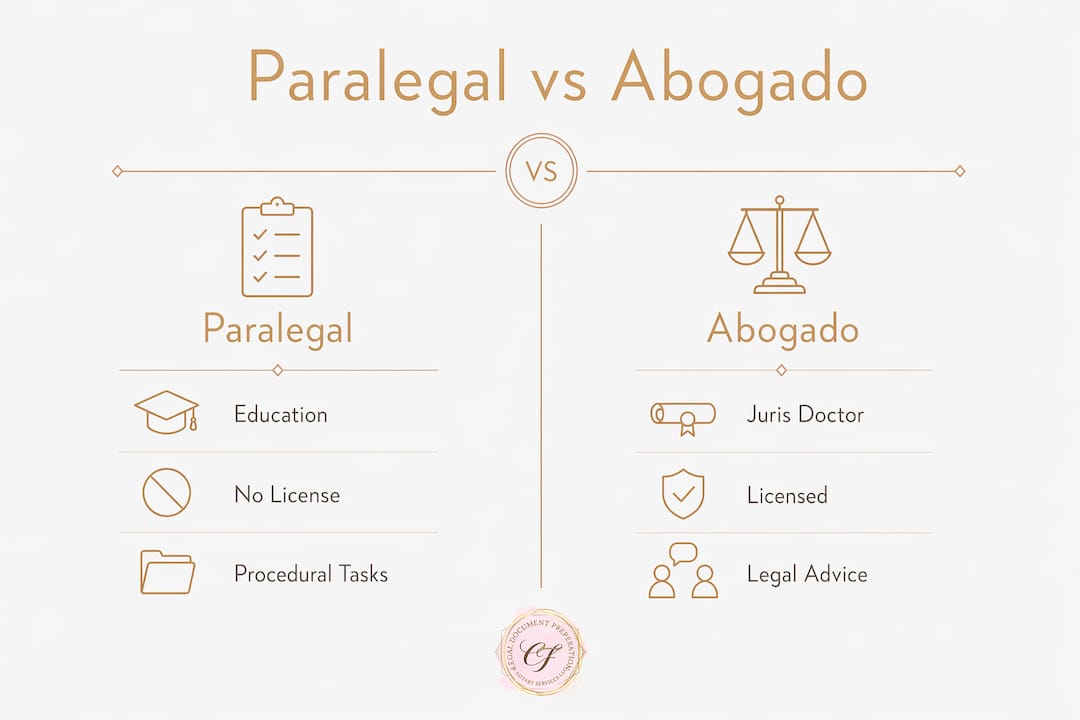
Abogados require a Juris Doctor plus bar exam passage; paralegals can enter the field with a paralegal certificate or degree. That gap represents three or more years of additional education and a rigorous licensing process. It also represents the legal system's way of ensuring that only qualified professionals carry the authority to affect someone's legal rights.
The risk of unlicensed practice is real. When someone without a law license provides legal advice, they commit unauthorized practice of law, which is a criminal offense in most U.S. states. Clients who receive that advice have no legal recourse if it proves wrong. The distinction centers on managing legal risk: abogados carry professional liability for legal outcomes, while paralegals handle operational workflow under attorney license.
Pro Tip: Voluntary paralegal certifications from NALA (Certified Paralegal) or NFPA (Registered Paralegal) signal professional commitment and training, but they do not grant any legal authority. They are quality markers, not licenses.
What do cost differences and risks look like in practice?
Cost is where many people make their most consequential mistake. The assumption that a paralegal or document preparer is simply a cheaper version of an abogado is wrong and potentially expensive.
Abogado fees run 300 to 700 euros for immigration matters compared to 150 to 300 euros for a gestoría or document preparer. That price difference is real. But the gestoría cannot file appeals, which means a client who hits a denial must then hire an abogado under time pressure, often with fewer options and higher urgency fees. The initial savings evaporate and then some.
The same pattern plays out in U.S. immigration cases. A document preparer can help you fill out a USCIS form correctly. They cannot advise you on which form to file, evaluate whether your case has complications that require a different strategy, or represent you if U.S. Citizenship and Immigration Services issues a Request for Evidence or denial. Clients who treat document preparers as cheap lawyers face delays and doubled legal costs when representation becomes necessary.
Here is a practical cost risk breakdown:
| Scenario | Paralegal or document preparer | Abogado |
|---|---|---|
| Simple form preparation | Appropriate and cost-effective | Likely unnecessary |
| Immigration application with prior denial | Insufficient; no legal advice permitted | Required for strategy and representation |
| Court hearing or appeal | Cannot appear or advise | Required by law |
| Divorce with contested assets | Document prep only; no legal counsel | Required for negotiation and court |
| Business formation documents | Appropriate with attorney review | Recommended for complex structures |
"Analysts warn that relying on administrative document preparers risks missing tight appeal deadlines, leading to legal disadvantages that cannot be reversed." — Abogado vs Gestoría Risks
The financial logic is clear: paralegal and document preparation services deliver real value for procedural tasks. The risk appears when those services are used as substitutes for legal counsel in situations that legally require it.
When should you choose paralegal services versus an abogado?
The decision framework is straightforward once you understand what each role can and cannot do. Use the following criteria to assess your situation:
-
Identify whether your matter requires legal advice. If you need someone to tell you what your legal rights are, what strategy to pursue, or how to respond to a legal challenge, you need an abogado. Paralegals and document preparers cannot answer those questions lawfully.
-
Determine if court representation is involved. Any hearing, trial, or appeal in a U.S. court requires a licensed attorney. No paralegal, document preparer, or gestoría can substitute for that.
-
Assess the complexity and stakes. A straightforward LLC formation or a simple uncontested divorce with no minor children may be handled efficiently with document preparation services and attorney review. A contested custody case, a criminal matter, or an immigration case with prior denials requires an abogado from the start.
-
Check for prior denials or legal complications. If any government agency, court, or opposing party has already taken an adverse action against you, the stakes have escalated. Paralegal support alone is no longer sufficient.
-
Consider deadlines. Legal deadlines for appeals, responses, and filings are strict. Missing them can permanently close legal options. Only an abogado can assess whether a deadline is legally significant and advise you on how to respond.
Performing a bottleneck analysis helps identify whether the bottleneck in your case is legal strategy or procedural execution. If it is procedural, a paralegal or document preparer may suffice. If it is strategic, an abogado is non-negotiable.
Pro Tip: The most cost-effective approach for many clients is a combination: hire an abogado for legal strategy and representation, then use paralegal or document preparation services for the procedural work the attorney supervises. You get legal protection without paying attorney rates for every task.
Key takeaways
Choosing between paralegal and abogado services depends entirely on whether your situation requires legal authority, court representation, or independent legal advice. Only an abogado can provide all three.
| Point | Details |
|---|---|
| Legal authority is the core difference | Abogados are licensed to advise and represent; paralegals work only under attorney supervision. |
| Education and licensing are non-negotiable | Abogados hold a J.D. and bar license; paralegals hold certificates or degrees with no bar admission. |
| Cost savings can become cost traps | Choosing a document preparer for a complex matter often doubles costs when an abogado must be hired later. |
| Jurisdiction matters | Ontario paralegals have limited court authority; U.S. paralegals do not. Know your jurisdiction's rules. |
| Combined use is often optimal | Using paralegal services for procedural tasks under attorney oversight reduces cost without sacrificing legal protection. |
What I've learned from working both sides of this line
I have spent years working as a certified legal document preparer and immigration paralegal in South Florida, and the most common misconception I encounter is that paralegals are simply affordable lawyers. They are not. That framing does a disservice to both professions and, more importantly, to the clients who rely on them.
Paralegals are skilled legal professionals who make the legal system more efficient. When I prepare a document, I am not cutting corners on legal representation. I am handling the procedural work that does not require a law license, so that clients who need attorney involvement can focus their legal budget where it matters most. The problem arises when clients skip the attorney entirely because they assume document preparation covers everything.
I have seen clients come to me after a denial, with a 30-day appeal window and no attorney relationship established. That is the scenario that keeps me direct with every client from the first conversation. If your case has complications, prior denials, or court involvement, I will tell you plainly that you need a licensed attorney. Transparency about service limitations is not a weakness. It is the foundation of trust.
The best outcomes I have witnessed come from clients who use document preparation services for what they are designed for, and who engage an abogado when legal authority is genuinely required. That combination is not a compromise. It is a smart allocation of resources. You can learn more about when to use a document preparer and how to decide when attorney involvement becomes necessary.
— Cristina
How Cflegalformhelp supports your legal document needs
Cflegalformhelp offers flat-fee, bilingual document preparation and notary services for individuals and families in Florida who need reliable procedural support without the cost of full attorney representation.
Whether you are preparing immigration forms, handling an uncontested divorce, forming an LLC, or needing certified translations, Cflegalformhelp provides affordable, transparent services designed for self-represented clients and those working alongside an attorney. Cristina Fernandez and the Cflegalformhelp team serve clients across South Florida, with particular expertise in Naples, in both English and Spanish. Explore legal document preparation services or immigration form assistance to find the right support for your specific situation.
FAQ
What is the main difference between a paralegal and an abogado?
An abogado is a licensed attorney authorized to give legal advice and represent clients in court, while a paralegal performs legal tasks such as research and document drafting only under attorney supervision. Legal authority is the defining distinction between the two roles.
Can a paralegal give me legal advice in Florida?
No. In Florida and all other U.S. states, paralegals cannot provide legal advice, establish an attorney-client relationship, or represent clients in court. Providing legal advice without a law license constitutes unauthorized practice of law, which is a criminal offense.
When do I need an abogado instead of a paralegal?
You need an abogado when your matter involves court representation, legal strategy, appeals, or situations where you have received a denial or adverse legal action. Selecting between the two depends on whether judicial defense is required versus administrative guidance.
Is it cheaper to use a paralegal or document preparer for immigration?
Document preparation services cost less upfront, but using them for complex immigration matters with prior denials or appeals can result in doubled costs when an abogado must be hired later under time pressure. Simple, straightforward applications with no complications are the appropriate use case for document preparation services.
Do paralegals have any independent legal authority anywhere?
Ontario paralegals have held limited licenses since 2008, allowing independent representation in small claims, landlord-tenant, and certain administrative matters. U.S. paralegals have no equivalent independent authority and must work under attorney supervision in all cases.