
Spanish divorce papers Florida preparation is the process of completing Florida's official court-approved dissolution forms in Spanish, meeting residency requirements, and filing correctly at your county circuit court. Florida courts accept self-represented filers, which means you can prepare and submit your own divorce paperwork without an attorney. The SOFIA portal and the Florida Courts website at flcourts.gov provide free, state-approved forms. Filing fees run approximately $409 as of 2026, and at least one notarized signature is required on key documents before the clerk will accept your packet.
What official forms are required for Spanish divorce papers in Florida?
The core document for any Florida divorce is the Petition for Dissolution of Marriage, specifically Form 12.901(b)(1) for cases without minor children or Form 12.901(b)(2) when children are involved. Both forms are available in Spanish through the SOFIA portal, which walks you through a guided interview to generate completed, plain-language forms automatically. All official Florida divorce forms are available free at flcourts.gov, including Spanish language resources.
Beyond the petition itself, you will need the following documents:
- Financial Affidavit (Form 12.902(b) or 12.902(c)): Use the short form if your income is under $50,000 annually and the long form if it exceeds that threshold. Both require notarization.
- Civil Cover Sheet: County clerks regularly reject packets that are missing this single page, even when the petition itself is complete.
- Marital Settlement Agreement: Required for uncontested divorces. This document covers property division, debt allocation, child custody, and support arrangements.
- Parenting Plan (Form 12.995): Mandatory when minor children are involved. Florida courts will not finalize a divorce affecting children without an approved parenting plan.
- Supporting documents: Your marriage certificate, social security numbers for both spouses, proof of Florida residency, and relevant financial records such as bank statements, pay stubs, and property deeds.
The SOFIA portal is the most practical tool for Spanish-speaking filers preparing divorce documents in Spanish for Florida courts. It generates forms in plain language, reduces transcription errors, and flags missing fields before you print. You still need to sign and notarize the financial affidavit in front of a commissioned Florida notary. Signing it at home and bringing it in is one of the most common reasons clerks reject packets on the spot.
Pro Tip: Print two complete copies of every form before going to the clerk's office. One set gets filed; the other gets date-stamped and returned to you as your official record.

How do you meet residency and procedural requirements for filing?
One spouse must have lived in Florida continuously for at least six months immediately before filing. This is not a flexible rule. If you cannot prove it, the clerk will not accept your petition. Valid proof includes a Florida driver's license, a voter registration card, or utility bills dated at least six months before your filing date.
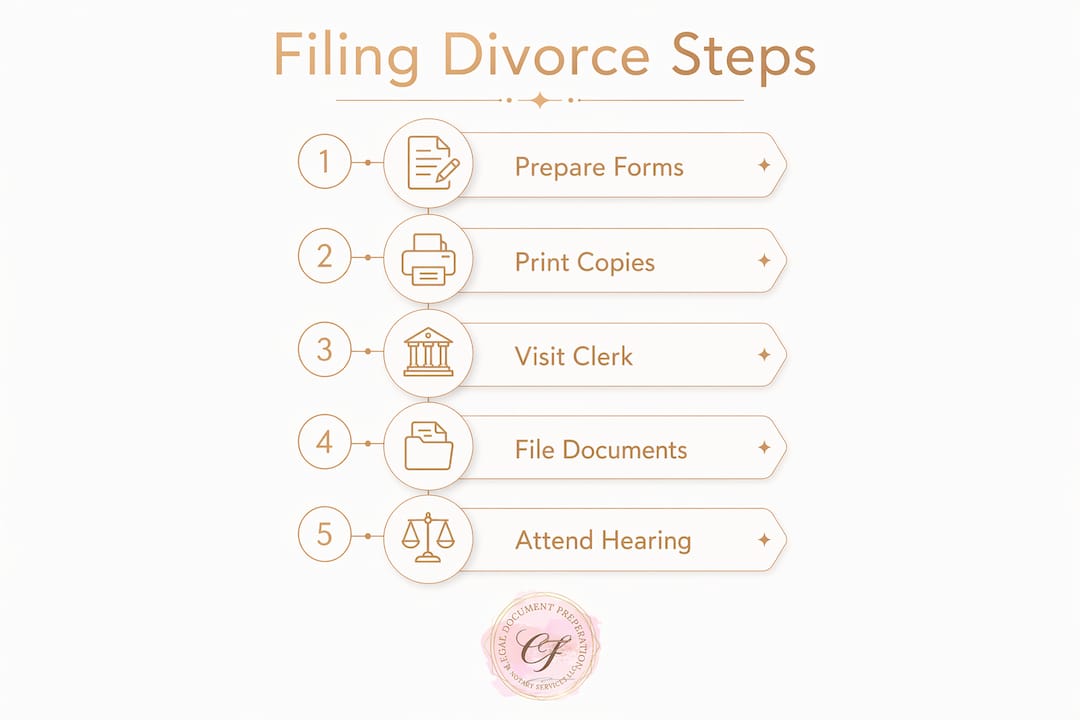
Once residency is confirmed, the procedural steps follow this order:
- File your petition at the circuit court in the county where you currently live. Bring your complete document packet and the filing fee of approximately $409. If you cannot afford the fee, request a fee waiver application under Florida's indigent status law at the clerk's window.
- Serve the respondent spouse. Florida courts require formal service of process by sheriff, process server, or a signed Waiver of Service. Improper or skipped service halts the entire case until corrected.
- Exchange financial affidavits. Both spouses must exchange financial affidavits within 45 days of service under Rule 12.285. Missing this deadline can result in sanctions from the court.
- Wait for the response period. The respondent has 20 days to file an answer after being served. If no answer is filed, you can request a default motion and move toward a final hearing.
- Attend the final hearing. For uncontested divorces, this is typically brief. The judge reviews your documents, confirms both parties agree, and signs the Final Judgment of Dissolution.
"While forms are standardized, local court customs and mediation protocols in Miami-Dade can influence case success." — Attorney Nadia Pazos, Pazos Law
Fee waivers are available for low-income filers under Florida state law. Ask the clerk specifically for the Application for Determination of Civil Indigent Status. Approval eliminates the filing fee entirely and can also cover service costs.
Step-by-step guide to completing and submitting your divorce documents
Accuracy at the document preparation stage prevents delays that can stretch your case by weeks. Follow these steps to prepare divorce documents in Florida correctly:
- Download current forms only from flcourts.gov. Outdated forms cause filing rejection and delays. Florida court forms are updated regularly, and a form printed six months ago may already be invalid.
- Complete the petition in full. Every blank must be filled. Write "N/A" in fields that do not apply to your situation. Never leave a field empty, as clerks treat blank fields as incomplete submissions.
- Draft the Marital Settlement Agreement carefully. Ambiguities in this agreement are the most common cause of post-divorce disputes. Be specific about every asset, debt, and parenting arrangement. Vague language like "shared equally" creates litigation risk later.
- Complete the financial affidavit and notarize it. Bring your unsigned affidavit to a commissioned Florida notary. Sign it in the notary's presence. This step cannot be skipped or done remotely unless you use a Florida-authorized remote online notarization service.
- Assemble your packet in order. Include the Civil Cover Sheet on top, followed by the petition, financial affidavit, settlement agreement, parenting plan if applicable, and all supporting documents.
- File in person or electronically. Most Florida circuit courts now accept e-filing through the Florida Courts E-Filing Portal. Spanish-speaking filers who are less comfortable with the portal can file in person at the clerk's office.
- Make copies and track deadlines. After filing, calendar the 20-day response window, the 45-day financial affidavit exchange deadline, and any mediation dates the court assigns.
Pro Tip: If you are filing a Simplified Dissolution of Marriage, both spouses must appear together at the clerk's office to file and again at the final hearing. Missing either appearance voids the simplified process entirely.
Common pitfalls in preparing Spanish divorce documents for Florida courts
The most preventable filing errors share a pattern: they come from using the wrong form, skipping a signature, or misreading eligibility rules. Here is what to watch for when you preparar documentos divorcio en español for a Florida court:
- Using outdated forms. Forms downloaded from unofficial websites or saved from a previous year are frequently rejected. Always download directly from flcourts.gov on the day you plan to file.
- Misunderstanding simplified dissolution eligibility. Simplified Dissolution of Marriage in Florida requires no minor children, no pregnancy, full agreement on all assets and debts, and no alimony claims. Applying for it when even one condition is unmet results in rejection and a restart.
- Missing notarized signatures. The financial affidavit must be signed before a notary. County clerks reject packets with un-notarized affidavits regardless of how complete the rest of the packet is.
- Skipping the Disclosure from Nonlawyer form. Florida law mandates Form 12.900(a) be provided before any non-attorney document preparation assistance begins. Spanish-speaking filers using informal translators or unauthorized services often miss this requirement entirely.
- Failing to prove residency. Failure to prove valid 6-month Florida residency with appropriate documentation can indefinitely delay proceedings at the clerk's office.
Pro Tip: Before submitting your packet, use the family law petition checklist to verify every required document is present, signed, and dated correctly.
When you need help beyond what free resources provide, working with a certified bilingual legal document preparer is a practical middle ground between doing it entirely alone and hiring an attorney. The key is choosing a service that complies with Florida law, provides the mandatory disclosure form, and does not offer legal advice.
Key takeaways
Accurate Spanish divorce papers Florida preparation depends on using current state-approved forms, proving six-month residency, notarizing financial affidavits, and serving the respondent correctly before any deadline begins to run.
| Point | Details |
|---|---|
| Use only current official forms | Download forms from flcourts.gov on filing day to avoid rejection from outdated versions. |
| Prove residency before filing | A Florida driver's license, voter card, or utility bills covering six months are required proof. |
| Notarize the financial affidavit | Sign Form 12.902(b) or 12.902(c) in front of a commissioned Florida notary before submitting. |
| Exchange affidavits within 45 days | Rule 12.285 requires both spouses to exchange financial affidavits within 45 days of service. |
| Verify simplified dissolution eligibility | No minor children, no pregnancy, and full asset agreement are all required before using this track. |
What I have learned preparing Florida divorce documents for Spanish-speaking clients
After working with hundreds of Spanish-speaking clients in South Florida, the single biggest obstacle I see is not the language. It is the assumption that a form downloaded from a random website is the same as the official version. I have seen clients arrive at the Collier County Clerk's office with a complete, carefully filled packet, only to be turned away because one form was a version behind. That experience is avoidable, and it is why I always tell clients: the only source that matters is flcourts.gov, accessed the same day you plan to print.
The second pattern I notice is confusion between simplified dissolution and standard uncontested divorce. Clients hear "simplified" and assume it means easier paperwork. What it actually means is stricter eligibility. If there are children, if one spouse wants alimony, or if there is any disagreement on assets, simplified dissolution is off the table. Choosing the wrong track wastes weeks.
What I find genuinely useful for clients in Miami-Dade and surrounding counties is attending mediation proactively, even when it is not yet required. Courts in that circuit move faster when parties arrive with a signed settlement agreement already in hand. It signals cooperation, and judges notice. If you and your spouse can agree on the major terms before filing, your case has a much shorter path to a final hearing.
Working with a bilingual document preparer who knows Florida court requirements is not a luxury. For someone preparing divorce documents in Spanish for the first time, it is the difference between a packet accepted on the first visit and one that bounces back twice before it is right.
— Cristina
How Cflegalformhelp supports your Florida divorce filing
Cflegalformhelp was built specifically for clients in your situation: Spanish-speaking, self-represented, and navigating a process that was not designed with you in mind.
Cristina Fernandez and the Cflegalformhelp team provide bilingual legal document preparation and notary services tailored to Florida divorce filings. Every packet is prepared using current, court-approved forms. Every financial affidavit is notarized on-site. The team also provides the mandatory Form 12.900(a) Disclosure from Nonlawyer before any work begins, keeping your filing fully compliant with Florida law. Fee waiver guidance is available for qualifying clients. Schedule your appointment at Cflegalformhelp and get your documents prepared correctly the first time.
FAQ
What forms do I need for a Florida divorce in Spanish?
The core forms are the Petition for Dissolution of Marriage (Form 12.901 variants) and the Financial Affidavit (Form 12.902(b) or 12.902(c)), both available in Spanish through the SOFIA portal at flcourts.gov. Cases involving children also require a Parenting Plan (Form 12.995).
How much does it cost to file for divorce in Florida?
Filing an uncontested divorce in Florida costs approximately $408 to $409, with fee waivers available for low-income filers under Florida state law.
How do I prove residency for a Florida divorce filing?
Valid residency proof includes a Florida driver's license, voter registration card, or utility bills showing continuous Florida residence for at least six months before the filing date.
What is the difference between simplified and uncontested divorce in Florida?
Simplified Dissolution of Marriage requires no minor children, no pregnancy, full agreement on all assets and debts, and no alimony claims. Standard uncontested divorce allows for children and support arrangements as long as both spouses agree on all terms.
Can a nonlawyer help me prepare my Florida divorce documents in Spanish?
Yes, but Florida law requires Form 12.900(a), the Disclosure from Nonlawyer, to be provided before any document preparation assistance begins. Always verify that the service you use provides this form and does not offer legal advice.