

A Florida LLC cannot practice law because state statutes and the Rules Regulating the Florida Bar restrict law firm ownership exclusively to licensed attorneys, blocking any entity with non-lawyer ownership or control from providing legal services. This restriction is not a technicality. It reflects a deliberate policy choice by the Florida Bar and the Florida Legislature to protect clients from conflicts of interest that arise when business investors control legal decisions. If you are a small business owner, an entrepreneur, or an attorney exploring entity options, understanding why LLCs can't practice law in Florida is the first step toward choosing the right structure.
Why LLCs cannot practice law in Florida: the legal framework
Florida law prohibits standard LLCs from practicing law through two overlapping authorities: the Florida Rules of Professional Conduct and Florida Statute Chapter 621. Together, they create a complete barrier against non-lawyer ownership of any entity engaged in legal practice.
Rule 4-5.4 of the Florida Rules of Professional Conduct is the central prohibition. It bars lawyers from sharing legal fees with non-lawyers and from forming partnerships or business entities with non-lawyers if any part of that entity practices law. The rule exists to preserve independent professional judgment. When a non-lawyer investor holds a financial stake in a law firm, their profit motive can pressure attorneys to settle cases quickly, overbill clients, or prioritize revenue over legal strategy.

Rule 4-5.4 also forbids fee-sharing with non-lawyers except in narrowly defined situations, such as court-awarded fees paid to qualifying nonprofit organizations. That narrow exception proves the rule: the default is a complete prohibition.
Florida Statute Section 621.051 adds the statutory layer. It requires licensed professionals to provide professional services only through a Professional Limited Liability Company (PLLC) or a Professional Association (PA), both of which restrict membership to licensed professionals in the same discipline. A standard LLC formed under Chapter 605 of the Florida Statutes does not meet that requirement. Florida Statute Section 621.051 rejects unauthorized entity formation that lacks the proper liability protections and licensing controls.
The consequences of ignoring these rules are serious:
- An attorney who practices law through a standard LLC with non-lawyer members faces Florida Bar disciplinary action, including suspension or disbarment.
- The LLC itself can be found to be engaged in the unauthorized practice of law, which is a third-degree felony in Florida.
- Contracts for legal services entered into by an unauthorized entity may be unenforceable.
- Non-lawyer members of such an LLC could face criminal charges for aiding the unauthorized practice of law.
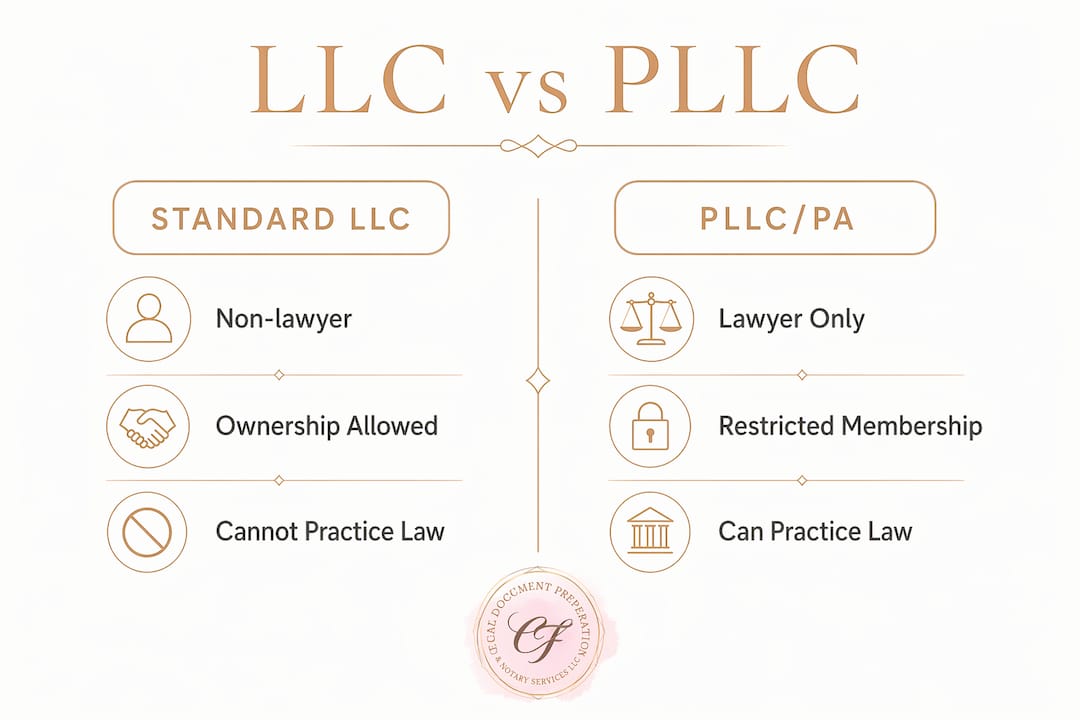
The distinction between a standard LLC and a PLLC matters enormously here. A standard LLC under Chapter 605 allows any person or entity to be a member. A PLLC under Chapter 621 restricts membership to licensed professionals only. That single difference is what separates a compliant law firm structure from an illegal one.
Why does the Florida Bar restrict non-lawyer ownership?
Preserving professional independence is the core reason the Florida Bar prohibits non-lawyer ownership of law firms. The fiduciary duty an attorney owes to a client is not compatible with a business structure where investors can override legal judgment for financial gain.
Non-lawyer financial interests create a structural conflict. An investor focused on quarterly returns may push a law firm to take on more cases than attorneys can handle competently, to avoid costly litigation that would benefit the client, or to cut corners on research. The Florida Bar treats these pressures as incompatible with the duty of loyalty attorneys owe every client.
"Non-lawyer financial interests can exert pressure undermining lawyers' independent decision-making, contrary to professional ethical duties." — Bloomberg Law analysis of Florida Bar Rule 4-8.6 amendments
Amendments to Rule 4-8.6 clarify governance limits further, affirming that non-lawyers cannot direct or regulate a lawyer's professional judgment in Florida. This is not a passive rule. The Florida Bar actively enforces it and has resisted pressure from states exploring alternative business structures that allow non-lawyer investment in law firms.
Florida's position differs from states like Arizona and Utah, which have experimented with alternative business structures allowing non-lawyer ownership. Florida has studied those models and rejected them. The Florida Bar's view is that increased capital access does not justify the ethical risks that come with investor control of legal decisions.
Pro Tip: If you are a small business owner who needs legal help, hiring a licensed Florida attorney directly is always the correct path. A document preparation service like Cflegalformhelp can help you prepare and organize your paperwork before you meet with an attorney, reducing your legal fees significantly.
How PLLCs and Professional Associations differ from standard LLCs
Florida law authorizes two entity types for licensed legal professionals: the Professional Limited Liability Company (PLLC) and the Professional Association (PA). Both differ from a standard LLC in ways that matter for compliance.
Ownership and membership rules
PLLCs and PAs require all members to be licensed professionals in the same discipline. For a law firm, that means every member must be a licensed Florida attorney. A non-lawyer spouse, a business partner from another field, or a silent investor cannot hold membership in a PLLC or PA that practices law. This rule applies even if the non-lawyer would hold only a minority interest.
| Feature | Standard LLC | PLLC or PA |
|---|---|---|
| Non-lawyer membership allowed | Yes | No |
| Can practice law in Florida | No | Yes, with licensed members only |
| Governing statute | Chapter 605, Florida Statutes | Chapter 621, Florida Statutes |
| Malpractice liability protection | Standard LLC rules | Professional liability rules apply |
| Fee-sharing with non-lawyers | Prohibited by Bar rules | Prohibited by Bar rules |
Liability and malpractice protections
PLLCs and PAs carry specific liability rules that differ from standard LLCs. Members of a PLLC are not personally liable for the malpractice of other members, but they remain personally liable for their own professional negligence. This is a meaningful protection for attorneys in multi-member firms. A standard LLC does not provide this calibrated malpractice protection because it was never designed for professional practice.
Key compliance requirements for PLLCs and PAs include:
- All members must hold an active Florida Bar license in good standing.
- The entity name must comply with Florida Bar advertising rules.
- The PLLC or PA must register with the Florida Division of Corporations and designate its professional purpose.
- Annual reports must be filed with the Florida Division of Corporations to maintain active status.
Practical guidance for attorneys and small business owners
Forming a standard LLC is not a viable path for practicing law in Florida. Attorneys who want liability protection and a formal business structure must use a PLLC or PA. Small business owners who need legal representation must hire a licensed attorney directly. Neither group can use a standard LLC as a workaround.
Here is a practical breakdown of compliant choices:
-
Attorneys forming a solo practice. Register a PLLC or PA under Chapter 621. The entity must list only your name as a licensed professional member. You cannot add a non-lawyer business partner or spouse as a co-member, even for administrative roles that involve ownership.
-
Attorneys in multi-member firms. Every member of the PLLC or PA must hold an active Florida Bar license. If one attorney loses their license, the entity's compliance status is immediately affected and must be corrected.
-
Asset protection for attorneys. Florida attorneys use holding LLCs owned as tenants by the entirety to protect non-practice assets from professional liability. The law firm operates as a PLLC, while real estate, investment accounts, or other assets sit in a separate holding entity. This structure keeps professional and personal assets legally distinct.
-
Small business owners needing legal representation. An LLC cannot represent itself in court without a licensed attorney. Even if you own 100% of your LLC, you cannot act as its legal counsel in Florida court proceedings. You must hire a licensed Florida attorney for any litigation or formal legal representation.
-
Non-lawyers needing document help. A certified legal document preparer, like those at Cflegalformhelp, can prepare, organize, and notarize legal documents for self-represented individuals and small businesses. Document preparation is not the practice of law. It is a distinct, lawful service that helps you manage paperwork without attorney fees for every step.
Pro Tip: Before forming any business entity in Florida, confirm with a licensed Florida attorney whether your intended activities constitute the practice of law. If they do, a PLLC or PA is your only compliant option. If they do not, a standard LLC may work fine. The line between legal advice and document preparation is real and matters.
Key takeaways
Florida law bars standard LLCs from practicing law because Rule 4-5.4 and Florida Statute Section 621.051 together require law firm ownership to rest exclusively with licensed attorneys, making PLLCs and PAs the only compliant structures for legal practice.
| Point | Details |
|---|---|
| LLCs cannot practice law | Florida Bar rules and Chapter 621 prohibit non-lawyer ownership in any entity practicing law. |
| Rule 4-5.4 is the core prohibition | It bars fee-sharing with non-lawyers and forming law partnerships that include non-lawyers. |
| PLLCs and PAs are the correct entities | Only these structures allow licensed attorneys to practice law with formal liability protections. |
| LLCs cannot self-represent in court | A licensed Florida attorney must represent any LLC in litigation, regardless of who owns it. |
| Asset protection requires creative structuring | Attorneys use separate holding LLCs to protect personal assets while keeping the law firm in a PLLC. |
Florida's law practice rules protect more than you might think
Working with clients who are navigating Florida's business formation rules, I have seen a consistent pattern: people assume that forming an LLC is the universal answer to every business structure question. It is not, and in the legal profession, that assumption can end a career.
What strikes me most about Florida's stance is how deliberate it is. The Florida Bar has watched other states loosen ownership rules and has chosen not to follow. That is not stubbornness. It reflects a genuine belief that the attorney-client relationship requires a level of loyalty that investor-owned firms structurally cannot guarantee. When a private equity firm owns a law firm, the firm's first obligation shifts. Florida refuses to let that happen.
For small business owners, the practical takeaway is simpler than the legal theory. You need a licensed attorney for court representation and legal advice. You need a certified document preparer for paperwork, notarization, and form preparation. Those are two different services, and confusing them costs money and creates legal risk. Understanding the role of a document preparer versus an attorney is genuinely useful knowledge for anyone running a business in Florida.
Florida's rules are strict, but they are also clear. That clarity is actually a gift for anyone willing to read them carefully.
— Cristina
How Cflegalformhelp supports Florida business owners and legal professionals
Sorting out entity formation documents and legal paperwork in Florida takes time, and the rules around PLLCs, PAs, and standard LLCs add real complexity for small business owners.
Cflegalformhelp provides flat-fee business formation assistance for individuals and small businesses across Florida, including document preparation for LLC registration, PLLC formation, and related filings with the Florida Division of Corporations. Cristina Fernandez, a certified legal document preparer and immigration paralegal based in Naples, offers bilingual support in English and Spanish. Services also include legal document preparation for a wide range of needs, from family law forms to notarization and certified translations. Cflegalformhelp does not provide legal advice or attorney representation, but it does make the paperwork side of compliance straightforward and affordable.
FAQ
Why can't an LLC practice law in Florida?
Florida Bar Rule 4-5.4 and Florida Statute Section 621.051 prohibit any entity with non-lawyer ownership from practicing law. Only PLLCs and PAs with exclusively licensed attorney members may provide legal services in Florida.
What is the difference between a PLLC and a standard LLC in Florida?
A standard LLC under Chapter 605 allows any person or entity to be a member, while a PLLC under Chapter 621 restricts membership to licensed professionals in the same field. Only a PLLC or PA can legally operate as a law firm in Florida.
Can a Florida LLC represent itself in court?
No. An LLC cannot self-represent in Florida court proceedings. A licensed Florida attorney must appear on behalf of any LLC, regardless of who owns or manages it.
Can a non-lawyer own part of a Florida law firm?
No. Florida Bar rules prohibit non-lawyer ownership or control in any law firm, including minority ownership stakes. This applies to spouses, investors, and business partners who are not licensed Florida attorneys.
What can a document preparation service do for my Florida business?
A certified document preparer can prepare, organize, and notarize legal documents for self-represented individuals and small businesses. Document preparation is not the practice of law and does not require an attorney license in Florida.