

Check your court clerk's bilingual-filing rule before you draft anything. Once you know whether the court requires English-only, bilingual, or English plus a certified translation, prepare your parenting plan in the drafting language first, then commission a certified translation using a translate, edit, review workflow. A certified legal document preparer can manage this process for you if you would rather not handle the translation logistics alone.
TL;DR:
- Ensure your parenting plan is drafted in your primary language before requesting a certified translation to avoid rejected packets and missed court dates.
- Use a coordinated, three-layer review process for translations that includes translation, editing, and final review for accuracy to meet court standards.
- Clarify whether your court accepts bilingual filings or requires a separate English and translation packet to choose the correct formatting and submission method.
- Include a certification statement confirming translation accuracy, competence, and translation date, as notarization alone does not verify content accuracy.
- Label and package all documents clearly, including source and translation files, with matching pagination, stamps, and a cover sheet to facilitate quick processing and prevent rejection.
Table of Contents
- Bilingual Parenting Plan Preparation Steps: The Full Checklist
- What Makes a Translation Court-Ready?
- Parallel or Mirror Format: Which One Do You Need?
- What Should You Ask the Clerk Before You File?
- Naming and Packaging Your Files So the Clerk Can Follow Them
- Why Packets Get Rejected, and How to Fix It Fast
- How a Certified Document Preparer Actually Handles These Filings
- Get Your Bilingual Parenting Plan Filed Right the First Time
- Sources
Bilingual Parenting Plan Preparation Steps: The Full Checklist
Preparing a bilingual parenting plan is not just a translation task. It's a filing task with its own sequence, and skipping a step usually costs you a rejected packet and a lost court date.
- Draft the substantive plan first. Write out custody, decision-making authority, holiday schedules, and relocation terms in your primary drafting language. Vague scheduling or unclear move-away language causes most parenting plan disputes, so nail down the specifics before you think about translation at all, according to LegalClarity's filing guidance.
- Choose your format. Decide between a parallel (side-by-side) layout or a monolingual mirror document, and add a governing-language clause naming which version controls if the two ever conflict.
- Order a certified translation with quality control built in. Insist on a translate, edit, review workflow rather than a single translator working alone.
- Collect the certification statement. The translator confirms in writing that the translation is complete and accurate, and notarizes it only if the receiving court or agency specifically asks.
- Package the full packet. Include every stamp, seal, handwritten note, and back page, name your files clearly, and prepare copies for the court and the other parent.
- File and serve. Submit according to your local rules, serve the other parent, and separately request interpreter services if you need one for the hearing itself.
If you're starting from scratch with the substantive terms, the step-by-step parenting plan guide walks through what belongs in each section before translation even enters the picture.
Pro Tip: Call the clerk's office before you pay for translation. Some counties accept a bilingual supplement instead of a full parallel document, which can save you the cost of translating pages the court never asked for.
What Makes a Translation Court-Ready?
A certified translation and a notarized translation are not the same thing, and confusing them is one of the fastest ways to get a packet bounced back.
Notarization authenticates the translator's signature. It confirms the person who signed is who they say they are. It says nothing about whether the Spanish or English text on the page is accurate. Courts and agencies that care about accuracy ask for a translator certification statement instead, and the two requirements sometimes overlap but rarely substitute for each other.
A solid certification statement should include:
- A statement that the translation is complete and accurate
- A statement of the translator's competence in both languages
- The date of translation
- The translator's signature and contact information
Federal agencies set the bar clearly. USCIS requires a full English translation accompanied by a certification that the translation is complete and accurate and that the translator is competent to translate, under 8 CFR 103.2(b)(3). Family courts often mirror that standard even when they don't cite the regulation directly.
The strongest translation vendors run a three-layer review: one person translates, a second edits for accuracy, and a third reviews the final document against the source. The NIWAP guide to translating legal materials recommends exactly this kind of coordinated workflow, with a tracking process that keeps terminology consistent across every page of the packet.
Parallel or Mirror Format: Which One Do You Need?
Side-by-side (parallel) formatting puts English and Spanish text in adjacent columns on the same page. Some state courts, including Washington, publish bilingual parenting-plan templates in exactly this parallel layout, which makes it easy for a judge or clerk to compare both versions line by line without flipping pages.
Monolingual mirror format produces two separate, complete documents, one per language, that match section for section. This works better when a court wants a clean English original plus a standalone certified translation, rather than one blended page.
Whichever you choose, add these details:
- A governing-language clause stating which version controls in case of a discrepancy
- Footers noting the translation date and version number
- Matching pagination between both versions
- Translated stamps, seals, and marginal notes in their original positions
A short bilingual glossary for recurring terms like custody, decision-making, or visitation schedule keeps both versions consistent, an approach Co-Parenting Guide's bilingual resources recommend for exactly this reason.
What Should You Ask the Clerk Before You File?
Every county and every court handles bilingual filings differently, and a five-minute phone call before you spend money on translation saves you real time later.
- Does this court accept bilingual filings, or does it require an English-only submission with a separate translation packet attached?
- Does the clerk require a translator affidavit, a certification statement, or full notarization?
- Is e-filing available, and if so, how should the translation be attached so its relationship to the English original is obvious?
- What are the current filing fees, and does the court offer a fee waiver for qualifying parents?
- What is the expected turnaround for review, and does that timeline change if translated documents are attached?
Once you file, you still need to serve the other parent and file proof of service. Interpreter services for the hearing itself are usually requested separately from the filing, sometimes days in advance, so ask about that deadline in the same call. If Florida rules are unfamiliar territory, the Spanish divorce papers Florida guide covers state-specific filing quirks that apply to related family law documents too.
Naming and Packaging Your Files So the Clerk Can Follow Them
Clerks handle hundreds of packets. A clearly labeled file gets processed faster than one that leaves them guessing which document belongs with which.
- Use a naming pattern that includes the party name, document type, language, and date, such as "Smith_ParentingPlan_English_2026-04-01.pdf" and "Smith_ParentingPlan_Spanish_Translation_2026-04-01.pdf."
- Keep the source document and its translation together in the same submission, never as separate, disconnected uploads.
- Add a cover sheet listing every translated page and the translator's contact information.
- Save PDFs in PDF/A format for e-filing whenever the court's portal supports it.
- For paper filings, staple the translation behind the original with the cover sheet on top, and keep a personal log of what you submitted and when.
Why Packets Get Rejected, and How to Fix It Fast
Most rejections trace back to a handful of avoidable mistakes.
- Self-translation or machine translation. Custody terms carry legal weight that automated tools routinely mishandle, so courts expect an independent, professional certified translation.
- Missing stamps, seals, or back pages. If the receiving office might consult it, translate it. Incomplete packets are a common reason for rejection, according to CertOf's guidance on foreign custody document translation.
- Assuming notarization covers certification. Check exactly what the receiving court or agency asked for before you pay for the wrong service.
- Not responding fast after a rejection. Ask the clerk precisely what needs correcting, obtain a corrected certified translation, and refile with a cover sheet explaining what changed. Notarization alone rarely resolves a translation-quality objection, so CertOf's rejection remediation guidance recommends going straight back to the certified translator, not the notary.
Pro Tip: Keep the rejection notice. Clerks often cite the exact rule you missed, and having that language in hand speeds up your corrected filing.
How a Certified Document Preparer Actually Handles These Filings
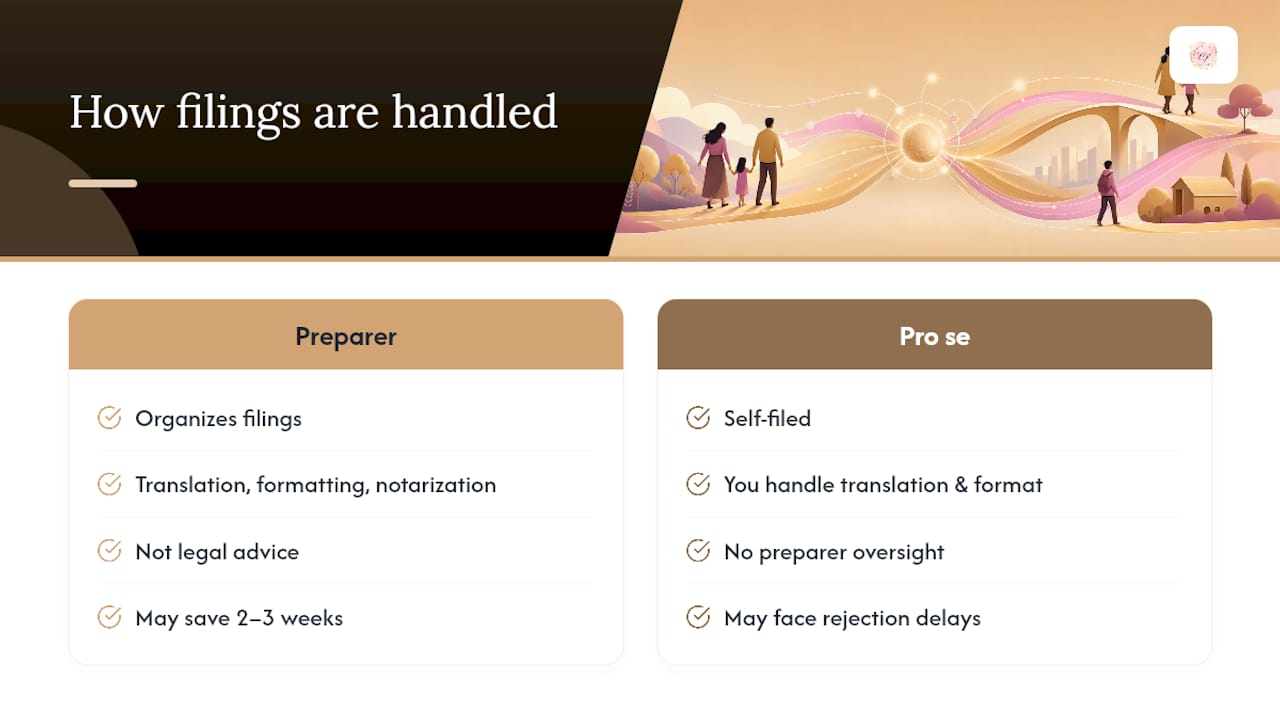
Most parents don't realize how much of this process is procedural rather than legal. Knowing the substantive custody terms you want is one skill. Knowing which clerk in which county wants a certification statement instead of notarization, or a parallel format instead of two mirrored documents, is another skill entirely, and it's the one that trips up self-represented parents most often.
As a certified legal document preparer and immigration paralegal, I coordinate translation, formatting, and notarization for bilingual filings without stepping into the role of attorney. That distinction matters: a preparer organizes and produces the paperwork; a lawyer advises on legal strategy. For a parent filing a straightforward, uncontested parenting plan, hiring a preparer usually saves the two or three weeks a rejected packet costs you. For a parent who already understands their local clerk's rules and has bilingual fluency to check the translation personally, proceeding pro se can work fine. The difference is whether you know the local quirks before you file, or find them out after a rejection notice.
— Cristina
Get Your Bilingual Parenting Plan Filed Right the First Time
There are services that help bridge the gap between knowing what your parenting plan should say and understanding how to get it translated, certified, and filed without a rejection. Some providers coordinate bilingual drafting and translation, provide a translator certification statement, and handle notarization (remote or in-person) under a flat fee.
Some document preparation services focus on paperwork rather than legal representation. They prepare documents to meet local clerk's format and certification requirements without advising on custody strategy or legal arguments. If you need help with the translation and notarization side of a bilingual filing, or you want a preparer to handle the full document preparation process from drafting through packaging, book an appointment and bring your local clerk's rules with you. That single call often saves more time than the entire translation process itself.
Sources
Confirm your local rules against primary sources, not secondhand summaries. The NIWAP guide to translating legal materials covers certification standards in depth. Washington's bilingual parenting-plan parallel form shows real parallel formatting. CertOf's self-translation and notarization risk guide explains why notarization and certification solve different problems. For scheduling language once your plan is drafted, ReplyCalmly's co-parenting communication template offers a practical starting structure.
This article is general information, not a substitute for advice from a qualified lawyer. Consult a qualified legal professional about your own circumstances before acting on anything here.
- Guide to Translation of Legal Materials (NIWAP)
- Self-Translation, Google Translate, and Notarized Translation Risks for U.S. Child Custody and Adoption Documents | CertOf™ Translation
- Washington bilingual parenting plan parallel PDF (example form)