

If you are a Spanish-speaking self-represented litigant in Florida, your single most important first step is to secure a qualified English translation with a signed translator affidavit before you file anything with the court.
Here is what to do right now:
- Check clerk assistance first. Under Florida Statutes §28.215 and §28.217, your clerk of court may offer ministerial translation help for civil cases, but this service is optional and cannot include legal advice. Call your clerk's office to confirm whether it applies to your case.
- Secure a qualified translator. Find a bilingual translator who will sign a sworn translator affidavit stating the translation is accurate and complete. This affidavit is what makes your translation court-acceptable.
- Notarize the affidavit if your local court requires it. Some circuits require a notarized jurat on the translator's affidavit. Confirm with your clerk before filing.
- File and serve correctly. Under Fla. R. Gen. Prac. & Jud. Admin. 2.560 and Rule 2.565, attach the original Spanish document, the English translation, and the affidavit together, and serve copies on the opposing party at the same time you file.
Cflegalformhelp, founded by Cristina Fernandez, a certified legal document preparer and immigration paralegal, provides bilingual document preparation, translator affidavit coordination, and notarization for Spanish-speaking pro se litigants in Florida. Visit the translations and certified services page to get started.
This article is general information, not legal advice. Confirm current requirements with your clerk of court or a licensed Florida attorney.
Key Takeaways
A compliant Spanish court document translation in Florida requires a signed translator affidavit, the original foreign-language document, and contemporaneous service on the opposing party.
| Point | Details |
|---|---|
| Translator affidavit is required | The affidavit must include translator identity, qualifications, accuracy statement, signature, and date. |
| Clerk help is optional, not guaranteed | §28.217 allows ministerial translation services, but availability varies by circuit and case type. |
| File original + translation together | Courts require the original Spanish document filed alongside the English translation and affidavit. |
| UPL boundaries are strict | Non-attorney preparers may type client-provided information only; recommending forms or explaining consequences is unlicensed practice of law. |
| Cflegalformhelp provides bilingual support | Cristina Fernandez and Cflegalformhelp coordinate translator affidavits, notarization, and document preparation for Florida pro se litigants. |
Table of Contents
- What translation help can the clerk or court actually provide?
- Which Spanish-language documents need an English translation for Florida courts?
- What does Florida actually accept as a compliant translation?
- Notarization and mandatory disclosures for bilingual notaries and document preparers
- How do you file and serve translated documents correctly?
- DIY checklist and red flags that mean you need an attorney
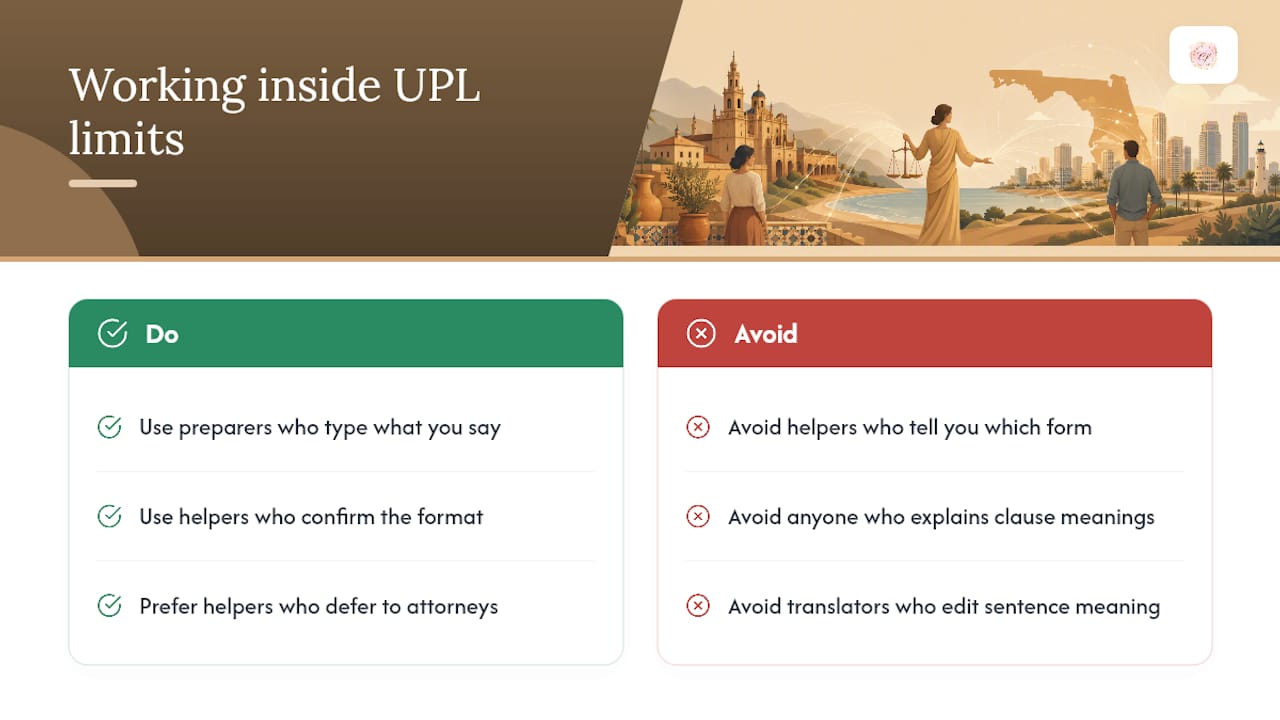
- What working inside UPL limits actually looks like in practice
- Cflegalformhelp handles the paperwork so you can focus on your case
- Useful sources for verifying the rules yourself
What translation help can the clerk or court actually provide?
Florida law draws a clear line between ministerial assistance and legal advice. Under §28.217, clerks may contract for translation services in civil cases, but the service is optional, not guaranteed, and limited to ministerial tasks. The clerk cannot tell you which documents to translate, what legal strategy to use, or how a translation affects your case.
For spoken-language interpreters at hearings, Rule 2.560 sets mandatory appointment triggers in criminal and delinquency cases. In civil matters, appointment is conditional. If the court does not appoint one, you may retain a private interpreter under Rule 2.565, which requires a verified written declaration when the interpreter is not certified or provisionally approved.
Practical timing matters here. The Eleventh Judicial Circuit asks for interpreter requests at least 7 days before a hearing. The Seventh Judicial Circuit requires at least 5 business days for Spanish. Missing these windows can delay your case.
Key rule: Clerk-provided translation is a convenience, not a right. Never assume it will be available for your specific filing. Confirm in writing, and always have your own translator affidavit ready.
Pro Tip: Call your clerk's office at least two weeks before your hearing or filing deadline. Ask specifically whether §28.217 translation services apply to your case type and what the local lead time is for interpreter requests.
Which Spanish-language documents need an English translation for Florida courts?
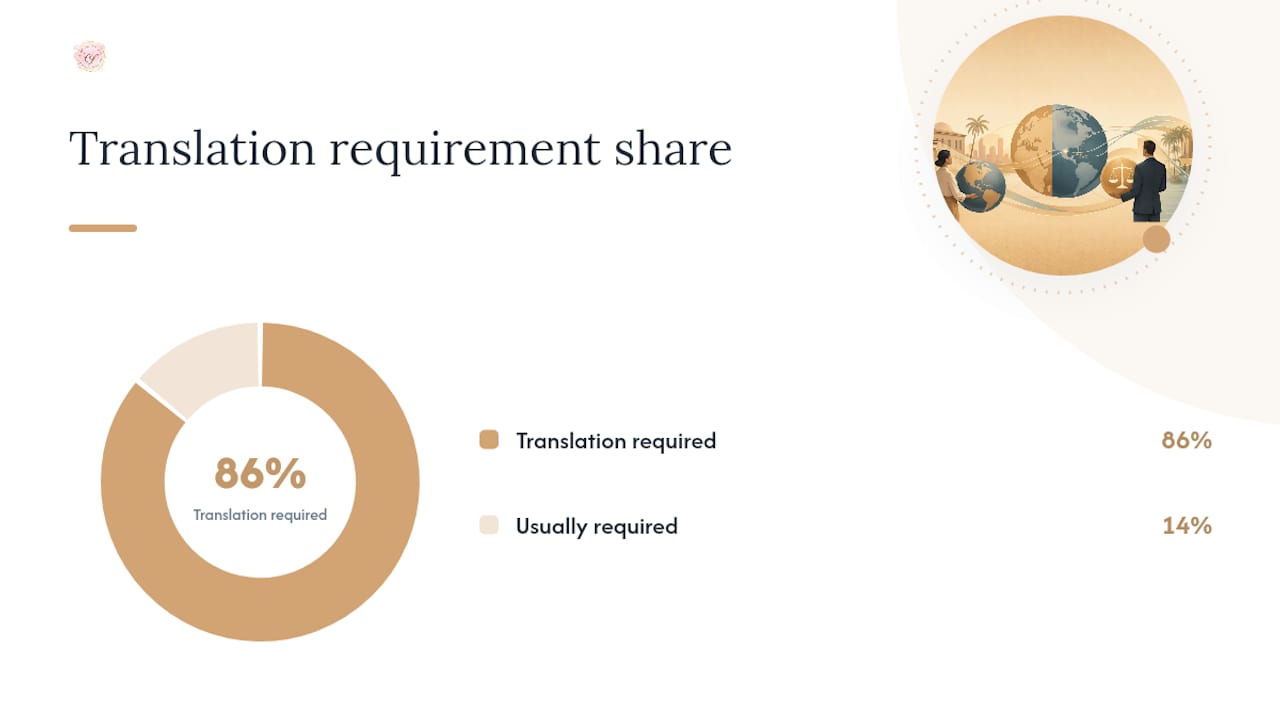
Most written evidence and pleadings submitted in a foreign language must be accompanied by an English translation. Below are the document types that most commonly require translation for pro se litigants:
- Pleadings, motions, and petitions originally drafted in Spanish
- Sworn statements and affidavits
- Contracts or agreements offered as evidence
- Police reports and incident records
- Birth, marriage, and death certificates
- Foreign court judgments or orders
- Audio and video transcripts (which must be transcribed and translated into English before hearings)
- Documentary exhibits such as leases, bank records, or correspondence
For audio and video evidence, the Tenth Judicial Circuit's administrative order makes the rule explicit: the offering party must transcribe and translate the material into English and provide it to opposing parties a reasonable time before the proceeding. Failing to do so can result in the evidence being excluded or the hearing being continued.
| Document Type | Translation Required? | Notes |
|---|---|---|
| Pleadings and motions | Yes | Must be in English for court filing |
| Birth/marriage/death certificates | Yes | Affidavit required |
| Contracts as evidence | Yes | File original + translation together |
| Audio/video transcripts | Yes | Transcribe and translate before hearing |
| Short one-page exhibits | Usually | Judge may permit sight translation at hearing |
| Divorce papers (pro se) | Yes | See Spanish divorce preparation guide |
What does Florida actually accept as a compliant translation?
Florida courts do not require a nationally accredited translator, but they do require a translator affidavit. The affidavit is what converts an ordinary bilingual translation into a document the court and opposing parties can rely on.
A compliant translator affidavit must include:
- The translator's full name and contact information
- A statement of the translator's language qualifications
- A declaration that the translation is true, accurate, and complete to the best of the translator's knowledge
- Identification of the original document (title, date, language)
- The translator's signature and the date signed
- A notary acknowledgment or jurat, if required by local rule
Why the affidavit matters: Without it, opposing counsel can object to your translation as unverified, and the court may refuse to consider it. A signed, notarized affidavit significantly reduces that risk and signals to the clerk that your filing is complete.
Some circuits also require you to file the original foreign-language document alongside the English translation and the affidavit as a single packet. Check your local clerk's filing instructions before submitting.
Notarization and mandatory disclosures for bilingual notaries and document preparers
A Florida notary may notarize a translator's affidavit, but the notary's role is limited to verifying the translator's identity and witnessing the signature. The notary does not certify the accuracy of the translation itself.
For bilingual notaries and non-attorney document preparers who advertise in Spanish, the Florida Department of State requires a specific disclosure in all non-English advertising. You may not translate "notary public" into Spanish in any advertisement, because "notario público" in Latin American legal culture implies an attorney with broad legal authority. That implication is misleading and can trigger administrative action.
Required disclosure language for Spanish-language advertising must clearly state that the notary is not an attorney and cannot give legal advice.
Beyond advertising, non-attorney document preparers must also include in every client contract:
- A written statement that they are not an attorney and cannot provide legal advice
- A clear description of the specific services being performed
- A refund policy
- A clause confirming that all information in the documents was supplied by the client
The Florida Bar is direct on this point: non-lawyers may type and sell forms, but recommending which form to use or explaining legal consequences crosses into unlicensed practice of law (UPL). The distinction matters because UPL can result in injunctions and criminal penalties.
Pro Tip: Keep a signed copy of your disclosure and scope-of-work agreement for every client. If a UPL question ever arises, that documentation is your first line of protection. For the difference between a notary and an attorney, the notary vs. attorney guide explains the distinction clearly.
How do you file and serve translated documents correctly?
Filing a translated document incorrectly is one of the most common reasons clerks reject pro se submissions. Follow this sequence:
- Attach the original Spanish-language document.
- Attach the English translation immediately after it.
- Attach the signed (and notarized, if required) translator affidavit.
- Prepare a certificate of service showing you served the same packet on the opposing party.
When serving the other party, timing matters. Translations must accompany the filing, not arrive days later. Late translations give opposing counsel grounds to request a continuance or object to the evidence.
Common filing mistakes to avoid:
- Missing the translator's name or contact information in the affidavit
- Submitting an unsigned affidavit
- Omitting the original foreign-language document from the packet
- Failing to serve the opposing party at the same time as filing
- Not confirming whether your circuit uses e-filing for translated documents or requires paper originals
For a detailed checklist of frequent errors, the common errors in Spanish legal document preparation guide covers the most frequent rejection reasons.
DIY checklist and red flags that mean you need an attorney
Use this checklist before every filing that involves a Spanish-language document:
- Identified all documents requiring translation
- Confirmed clerk/court requirements for affidavit format and notarization
- Hired a translator who will sign a sworn affidavit
- Received translation and affidavit together
- Notarized affidavit if required by local rule
- Assembled filing packet: original + translation + affidavit
- Prepared certificate of service
- Filed and served simultaneously
- Kept copies of all originals and receipts
Stop and consult a licensed attorney if you encounter any of these:
- A document preparer or translator recommends which forms to use or explains what the law means for your situation
- A translator refuses to sign an affidavit
- Two translations of the same document produce different key facts
- Your deadline is too close to complete translation and filing properly
- Your case involves contested custody, immigration consequences, criminal charges, or complex evidentiary disputes
Pro Tip: Document every interaction: dates, names, emails, and what was said. If a UPL or filing dispute arises later, a clear paper trail protects you. The Florida pro se divorce filing checklist is a useful companion for family law filings.
What working inside UPL limits actually looks like in practice
Most guides on interpreting Spanish legal documents focus on what you need to file. Fewer explain what happens when the person helping you quietly crosses the line between clerical work and legal advice, and why that distinction matters more than people realize.
The UPL boundary is not abstract. A document preparer who tells you "use this form for your situation" or "this clause means you have to pay" has just practiced law without a license. That single sentence can expose both of you to consequences: the preparer to enforcement action, and you to a filing that may later be challenged. The safeguard is not just a disclosure on paper. It is a genuine operational habit: the preparer types what you say, confirms the format, and stops there.
The same logic applies to translations. A translator who edits the meaning of a sentence to "make it clearer" rather than translating it faithfully has introduced error into a legal record. Courts rely on the affidavit as a guarantee of accuracy. When that guarantee is compromised, the damage can surface months later in a hearing, not at the filing counter.
The practical takeaway: choose people who are comfortable saying "I can't answer that, you need an attorney." That boundary is a sign of competence, not limitation.
Cflegalformhelp handles the paperwork so you can focus on your case
Preparing court documents in a second language while representing yourself is a real logistical challenge. Cflegalformhelp gives Spanish-speaking pro se litigants in Florida a clear, flat-fee path through the paperwork without the cost of full legal representation.
Cristina Fernandez and the Cflegalformhelp team provide bilingual document preparation, translator affidavit coordination, notarization (including mobile notary services), and filing assistance for common court packets. Every client receives a written scope-of-work and the mandatory non-attorney disclosure, so the boundaries of the service are clear from the start. Cflegalformhelp does not provide legal advice or legal representation.
For notarization and document preparation appointments, visit the legal document preparation services page or book a mobile notary appointment directly. Contact Cflegalformhelp today to confirm whether your documents are ready to file.
Useful sources for verifying the rules yourself
The statutes, rules, and court pages below are the primary references for everything covered in this guide.
- Prepare legal documents
- Consumer Pamphlet: Hiring the Right Person to Help Me with My Legal Problems – The Florida Bar
- Bill 1302 — Translation services and clerk ministerial assistance (Florida Senate)
- Fla. R. Gen. Prac. & Jud. Admin. 2.560 — Appointment of Spoken Language Court Interpreters
- Fla. R. Gen. Prac. & Jud. Admin. 2.565 — Retention of Spoken Language Court Interpreters
- G-2022-033-SC - Appointment of Foreign Language Court Interpreters (Seventh Judicial Circuit)
- Request Spoken Language Interpreter — Eleventh Judicial Circuit
- Administrative Order re: translation/transcription of evidence (Tenth Judicial Circuit)
| Resource | What it covers |
|---|---|
| §28.215 / §28.217 | Clerk ministerial assistance and optional translation services |
| Rules 2.560 / 2.565 | Court interpreter appointment and private retention rules |
| FL Dept. of State Notary FAQ | Disclosure requirements for bilingual notaries |
| The Florida Bar UPL Pamphlet | Limits on non-attorney document preparers |
| Circuit administrative orders | Local lead times and interpreter scheduling procedures |