

A parenting plan is a written agreement that covers parenting time, legal decision-making, and day-to-day logistics for your child — and it can be filed with the court or used privately between parents. The fastest path to a court-ready draft is to pick a state court template or online builder, fill in the required sections, and bring it to mediation or file it directly with your county clerk.
Start here:
- Download a template. Use your state court's self-help page or a free state builder. California's self-help resources and Oregon's Guide and File tool both provide ready-to-fill forms.
- Draft your parenting-time schedule. Choose a model (2-2-3, week-on/week-off, alternating weekends) and write in exact days, times, and pickup locations.
- Add a decision-making clause. State whether you share joint legal custody or one parent holds sole authority, and name a tie-breaking process.
Key Takeaways
A parenting plan that holds up in court is specific, child-centered, and answers every logistical question before a dispute arises.
| Point | Details |
|---|---|
| Start with a state template | Use your state court's free builder or self-help page to produce a draft in hours, not weeks. |
| Specify every schedule detail | Vague language like "reasonable time" creates enforcement disputes; name exact days, times, and locations. |
| Include a tie-breaker clause | A named dispute-resolution process (mediation before court) prevents minor disagreements from becoming motions. |
| Add safety clauses when needed | Supervised visitation, address redaction, and substance-abuse provisions belong in the plan from the start, not as amendments. |
| Cflegalformhelp for court-ready prep | Flat-fee document preparation, notarization, and certified translation help self-represented parents file accurately and affordably. |
Table of Contents
- What does a parenting plan creation guide actually cover?
- How do you create a parenting plan step by step?
- Which parenting-time schedule fits your situation?
- How do you write decision-making authority into the plan?
- What exchange and communication rules reduce conflict?
- How do you handle safety concerns in a parenting plan?
- How do you make a parenting plan legally binding?
- How do you modify or enforce a parenting plan?
- Copy-ready sample clauses and a fillable worksheet
- When do you need a mediator, attorney, or document-prep service?
- A document preparer's view on what actually makes plans hold up
- Cflegalformhelp helps you finish and file your parenting plan
- State court templates, self-help pages, and downloadable resources
- Sources
What does a parenting plan creation guide actually cover?
A complete parenting plan covers six core areas: parenting time, legal decision-making, exchange logistics, holiday and school-break schedules, communication rules, and a dispute-resolution process. Courts in most U.S. states will not approve a plan that skips any of these. Illinois statute 750 ILCS 5/602.10, for example, requires parents to file a proposed parenting plan within 120 days after service in allocation cases and lists minimum content items the plan must address. Most other states carry similar requirements, even when the deadline differs.
The goal of every section is to answer the questions a judge will ask: Where will the child be enrolled? Who makes medical decisions? What happens when a parent is late to pickup? A plan that answers those questions clearly is far more likely to be approved without a hearing.
How do you create a parenting plan step by step?
Step 1: Gather your information
Before you open any template, collect the child's full legal name, date of birth, school name and address, primary care physician, insurance information, and any existing court orders. Note any safety concerns — domestic violence history, substance abuse, or a parent's planned relocation — because those facts determine which template type you need and whether supervised visitation clauses are required.
Step 2: Choose your method
Four routes exist, and the right one depends on your conflict level and budget.
DIY template or state online builder. Best for parents who already agree on the basics. Oregon's Guide and File tool can produce a draft from a guided interview in a short time for routine cases. California's court self-help page offers worksheets and mediation referrals for cases that need a bit more structure. Cost: free to minimal filing fees.
Mediator. A neutral third party helps you negotiate terms and drafts a memorandum of understanding. Mediators typically charge by the hour. Best for parents who disagree on one or two issues but want to stay out of court. Mediation is often required before a contested hearing in many counties, so using it early can save time later.
Attorney. Necessary when safety concerns are serious, relocation is contested, or paternity is disputed. An attorney drafts and files on your behalf and can appear at hearings. Highest cost, but the right choice when the stakes are high.
Document-preparation service. A certified document preparer fills in court-approved forms accurately, handles notarization, and can provide bilingual support. Not legal advice, but a practical option for self-represented parents who want accurate paperwork without attorney fees.
Step 3: Draft the core sections
Work through these in order:
Legal decision-making. Decide whether both parents share joint decision-making or one holds sole authority. Write this into the plan with specific categories: education, medical care, extracurricular activities, and religious upbringing.
Parenting-time model. Pick a schedule (see Section 3 below) and write in exact days and times. Vague language like "reasonable parenting time" invites disputes.
Exchanges and transportation. Name the pickup and drop-off location, the responsible party for transportation, and what happens if a parent is more than 15 minutes late.
Holiday and school-break rules. List every major holiday, spring break, and summer schedule. Specify which parent has the child in even years versus odd years for each holiday.
Communication and dispute resolution. State the preferred communication channel, expected response time, and the first step when parents disagree (direct negotiation, then mediation, then court).
Step 4: Review and validate
Have the draft reviewed by a court facilitator, mediator, or attorney before you file. Court facilitators at your county courthouse can flag missing sections at no charge in many counties. Confirm your county's filing requirements — some require a cover sheet, a proposed order, and proof of service.
Pro Tip: Use the exact phrasing from your state's official form for decision-making clauses. Judges see hundreds of plans per year and respond well to familiar, standardized language. Deviating from that phrasing — even when your version says the same thing — can trigger a request for clarification that delays approval by weeks.
Which parenting-time schedule fits your situation?
Choosing the right schedule is one of the most consequential decisions in the plan. The wrong model creates daily friction; the right one becomes invisible because it just works.
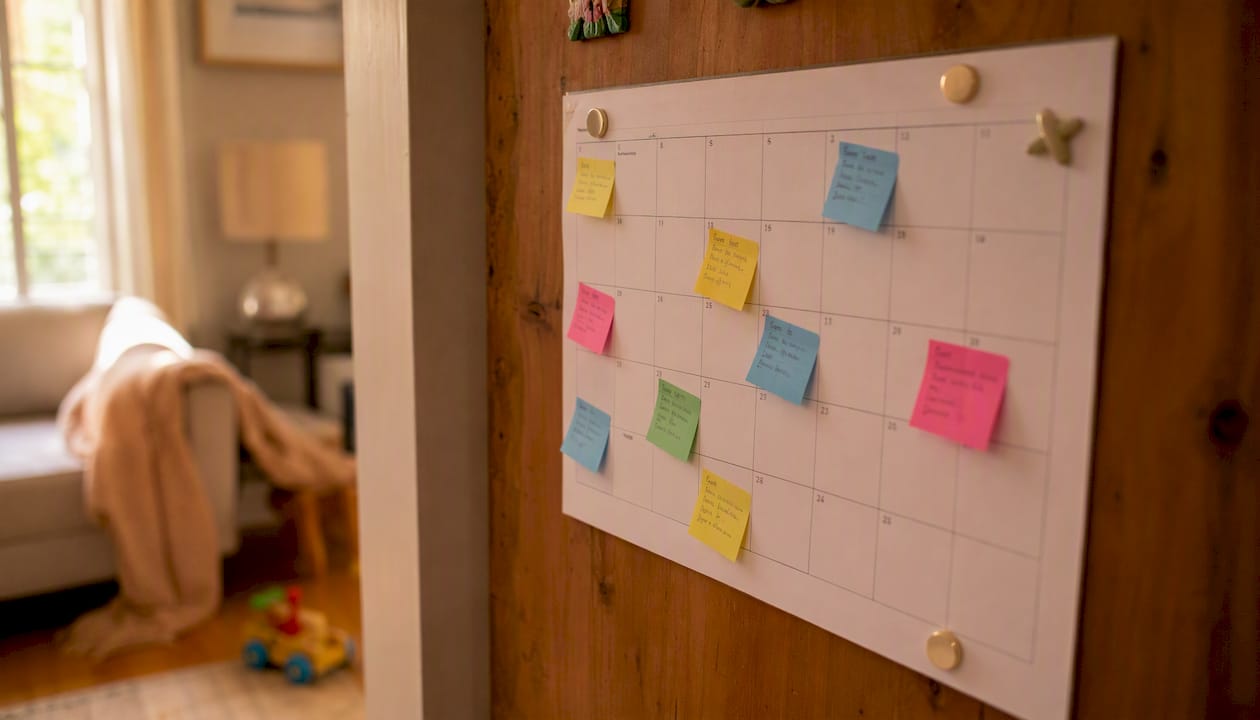
Common schedule models
2-2-3 rotation. The child spends two days with Parent A, two days with Parent B, then three days with Parent A, rotating the following week. Works well for children under 5 who benefit from frequent contact with both parents. The short intervals reduce separation anxiety but require parents who live close to each other and communicate reliably.
3-3-4-4 rotation. Three days with one parent, three with the other, then four with each. Slightly longer stretches than 2-2-3, which suits children ages 5–9 who can handle a few days apart without distress. Still requires proximity.
Week-on/week-off (7-7). The child alternates full weeks between homes. Week-on/week-off schedules require explicit exchange logistics and holiday overrides in the plan, because a standard holiday (Thanksgiving, spring break) will fall mid-week in some years and disrupt the rotation. Write in exact pickup times and a backup exchange location for every major holiday.
Alternating weekends (80/20 model). One parent has the child most weekdays; the other has alternating weekends plus one weekday evening. Common when one parent lives farther away or when a young child needs a stable school-week base. The primary parent carries most of the daily routine, so the plan should address how extracurricular decisions are shared.
Long-distance model. When parents live more than 100 miles apart or in different states, the schedule shifts to longer blocks: extended summer stays, full school breaks, and alternating holidays. The plan must address travel costs (who books flights, who pays), passport and travel consent, and a communication schedule for the non-traveling parent.
Age-appropriate guidance
Infants and toddlers (birth to 3) need short, frequent visits with both parents to build attachment. Overnight stays with the non-primary parent can begin once the child is comfortable, typically around 18 months, though this varies. The Oregon Judicial Department's Basic Parenting Plan Guide includes age-specific schedule templates, including a birth-to-3 form, that courts in many states use as a reference.
School-age children (6–12) benefit from consistency around school days. A 5-2-2-5 or week-on/week-off model works well here, provided both parents live within the same school district or close enough to manage drop-off.
Teenagers (13+) often have opinions about their schedule. Courts increasingly consider a teen's preference. Build flexibility into the plan — a clause allowing the teen to request schedule adjustments with both parents' consent avoids repeated court modifications.
Schedule comparison
Research on co-parenting outcomes consistently supports the idea that predictable, small daily connection rituals — a brief call at bedtime, a consistent handoff routine — increase a child's sense of continuity across homes. The Gottman Institute's work on connection rituals reinforces that structured, predictable rhythms reduce conflict triggers between parents and build emotional safety for children.
Sample schedule bullets you can copy into your plan:
- "The child shall reside with Parent A on Monday and Tuesday, with Parent B on Wednesday and Thursday, and with Parent A on Friday through Sunday in Week 1, rotating the following week."
- "During summer break, the child shall reside with Parent B for six consecutive weeks beginning the first Monday after the last day of school."
- "Holiday schedules supersede the regular rotation. In even-numbered years, the child shall spend Thanksgiving with Parent A and winter break with Parent B. In odd-numbered years, these assignments reverse."
How do you write decision-making authority into the plan?
Legal custody — called "decision-making authority" or "parental responsibility" in many states — is separate from physical parenting time. A parent can have equal parenting time but limited decision-making authority, or vice versa.
Joint decision-making means both parents must agree before a major decision is made. It works when parents communicate reasonably well. The plan must specify what counts as a "major decision" and what happens when they cannot agree.
Sole decision-making gives one parent final authority. Courts award this when communication has broken down, when there is a history of domestic violence, or when one parent is consistently unavailable. The other parent typically retains the right to receive information and attend school or medical appointments.
Sample decision-making clauses
- Education: "Both parents shall jointly decide the child's school enrollment, tutoring services, and participation in special-education programs. If the parents cannot agree within 14 days of a written request, the matter shall be submitted to mediation."
- Medical: "Routine medical care decisions may be made by the parent with whom the child is currently residing. Non-emergency surgical procedures and changes to prescription medication require written consent from both parents."
- Extracurriculars: "Either parent may enroll the child in extracurricular activities during their parenting time, provided the activity does not require the other parent to provide transportation or incur costs without prior written agreement."
- Relocation: "Neither parent shall relocate the child's primary residence more than 50 miles from the current address without providing 60 days' written notice to the other parent and obtaining either written consent or a court order."
- Tie-breaker: "If the parents cannot reach agreement on a major decision after a 14-day negotiation period, they shall submit the dispute to a mutually agreed-upon mediator before filing any court motion."
The tie-breaker clause is the most overlooked piece of a parenting plan. Without it, every disagreement becomes a potential court filing. A named mediator or a specific process (written notice, 14-day window, then mediation) gives both parents a clear path that stops short of litigation.
What exchange and communication rules reduce conflict?
Exchange logistics
Every exchange is a potential flashpoint. The plan should remove ambiguity entirely.
- Primary exchange location: Name a specific address (school, neutral public location, or one parent's home) and a backup location if the primary is unavailable.
- Pickup time: State the exact time, not a range. "3:30 PM" is enforceable; "after school" is not.
- Late pickup: "If a parent is more than 15 minutes late without prior notice, the other parent may return home with the child. The late parent shall reschedule within 48 hours."
- Transportation responsibility: Name which parent drives for each exchange, or state that costs are split.
- School as exchange point: Many plans use school drop-off and pickup as the exchange mechanism for weekday transitions, which eliminates direct parent contact.
Communication protocols
The plan should address how parents communicate about the child, not just with the child.
- State the preferred channel (email, a co-parenting app, text) and a response-time expectation (24 hours for non-urgent matters, 2 hours for urgent ones).
- Specify the child's right to contact the non-residing parent: "The child may call or video-chat with the non-residing parent at any reasonable time, and the residing parent shall not interfere with that contact."
- For young children, a brief daily check-in call (5–10 minutes at a set time) supports attachment. Building this into the plan as a default — rather than leaving it to negotiation — reduces friction.
Tools that help
OurFamilyWizard is a court-recommended co-parenting app used in family courts across the United States. It provides a shared calendar, a message log, an expense tracker, and a tone meter that flags hostile language before it is sent. Courts in many counties can order both parents to use it, and the message log is admissible as evidence. Other options include TalkingParents, which creates a timestamped, uneditable message record, and a shared Google Calendar for schedule visibility.
Naming a specific tool in the plan ("Both parents shall use OurFamilyWizard for all co-parenting communication") removes the argument about which channel is official and creates a built-in documentation trail.
How do you handle safety concerns in a parenting plan?
When domestic violence, substance abuse, or mental-health concerns are part of the picture, a standard template is not enough. Washington Law Help's parenting plan guide includes safety-focused forms and instructs parents to redact personal addresses when there is a domestic-violence history. Use a safety-focused template from the start rather than trying to retrofit safety clauses onto a standard form.
Safety provisions to include
- Supervised visitation: Name the supervisor (a specific individual or a licensed supervised-visitation center), the location, and the frequency. State what triggers a return to unsupervised contact, if applicable.
- Exchange in public places: "All exchanges shall occur at [named public location, e.g., a police station lobby or library parking lot] during daylight hours."
- Address redaction: If one parent has a protective order or safety concern, the plan may omit that parent's home address and substitute a P.O. box or attorney address for all communications.
- Notification requirements: "The residing parent shall notify the other parent within 24 hours of any medical emergency involving the child."
- Substance-abuse provisions: "If a parent has consumed alcohol or controlled substances within 12 hours of a scheduled exchange, that parent shall not drive the child and shall arrange alternative transportation."
- No-contact provisions: Where a protective order exists, the plan must be consistent with its terms. Never draft a parenting plan that contradicts an active protective order.
Safety checklist before proposing unsupervised time
Answer these questions honestly before agreeing to unsupervised parenting time:
- Has there been any history of physical, emotional, or sexual abuse toward the child or either parent?
- Is there a current or prior protective order?
- Has either parent had a substance-abuse issue in the past three years?
- Has either parent been diagnosed with a mental-health condition that affects parenting capacity?
- Has the child expressed fear of either parent?
If you answer yes to any of these, consult a court facilitator, a domestic-violence advocate, or a family law attorney before finalizing the plan. Court facilitators can refer you to supervised-visitation providers and parenting coordinators at no cost in many counties.
How do you make a parenting plan legally binding?
A signed parenting plan is a contract between parents, but it is not a court order until a judge approves it. Here is the standard path to enforceability.
Steps to file and get court approval
- Both parents sign the plan, ideally before a notary.
- File with the court clerk in the county where the child lives. Attach any required cover sheets, a proposed order, and proof of service on the other parent.
- Attend mediation if required. Many counties require mediation before a judge will review a contested plan. Even for agreed plans, some courts require a brief mediation confirmation. Maryland People's Law Library and similar law-help resources note that mediation is often required or strongly recommended before a contested hearing.
- Prove-up hearing: For uncontested plans, the judge may approve the plan on the papers alone or schedule a short prove-up hearing where one or both parents confirm the agreement in court. Bring a copy of the signed plan, any exhibits (school enrollment records, medical insurance cards), and a proposed order for the judge to sign.
- Receive the court order. Once signed by the judge, the parenting plan becomes a court order. Violations are enforceable by contempt.
Typical costs and timelines
State online builders like Oregon's Guide and File tool can generate a draft in roughly 10–30 minutes for routine cases. California's court self-help page lists worksheets and mediation referrals for more complex situations. Both are free starting points regardless of which state you ultimately file in.
Illinois statute requires filing within 120 days after service in allocation cases — a deadline that applies in that state and serves as a useful benchmark for how seriously courts treat timely filing. Check your own state's rules, as deadlines vary.
How do you modify or enforce a parenting plan?
Grounds for modification
Courts will modify a parenting plan when there has been a substantial change of circumstances since the original order. Common qualifying changes include:
- A parent's relocation more than a set distance (often 50–100 miles, depending on the state)
- A significant change in the child's needs (new medical diagnosis, change in school)
- A parent's change in work schedule that makes the current plan unworkable
- Evidence of abuse, neglect, or substance abuse that was not present at the time of the original order
- The child's expressed preference, particularly for teenagers
Modification process
- Meet and confer. Contact the other parent in writing and propose the change. Document the conversation.
- Mediation. If the other parent disagrees, most courts require mediation before a motion is filed.
- File a motion to modify. Attach a proposed amended parenting plan and a declaration explaining the substantial change of circumstances.
- Request temporary orders if the child's safety requires an immediate change while the motion is pending.
- Attend the hearing. Bring documentation: school records, medical records, communication logs, and any evidence supporting the change.
Enforcement when the plan is violated
When a parent consistently violates the plan, you have several options:
- Document every violation. Keep a log with dates, times, and what happened. Screenshots of messages, school pickup records, and witness statements all help.
- Send a written notice. A formal letter citing the specific plan provision that was violated creates a paper trail.
- File a motion for contempt. A court can hold a parent in contempt for willful violations, which can result in fines, makeup parenting time, or in serious cases, a change in custody.
- Request emergency relief if the child is in immediate danger. Courts can issue emergency orders within 24–48 hours in genuine safety situations.
Red flags that require immediate escalation:
- The other parent has taken the child out of state without consent
- The child reports abuse or neglect during the other parent's time
- The other parent is consistently denying court-ordered parenting time
- There is credible evidence of substance abuse around the child
Copy-ready sample clauses and a fillable worksheet
Sample clauses
Parenting-time schedule: "The child shall reside with Parent A Sunday through Tuesday and with Parent B Wednesday through Friday, with Saturday alternating weekly. This schedule shall begin on [date]."
Exchanges: "Exchanges shall occur at [school name] on school days. On non-school days, exchanges shall occur at [neutral public location] at [time]. If a parent is more than 20 minutes late, the exchange shall be rescheduled within 48 hours."
Decision-making: "The parents shall share joint legal decision-making for all major decisions affecting the child's education, health care, and religious upbringing. Neither parent shall make a unilateral major decision without first providing the other parent 7 days' written notice and an opportunity to respond."
Holidays: "In even-numbered years, the child shall spend Thanksgiving with Parent A and winter break (December 24 through January 1) with Parent B. In odd-numbered years, these assignments reverse. Holiday schedules supersede the regular rotation."
Right of first refusal: "If the residing parent requires childcare for more than 4 consecutive hours during their parenting time, that parent shall first offer the other parent the opportunity to care for the child before using a third-party caregiver."
Expense sharing: "Uninsured medical, dental, and vision expenses shall be shared equally (50/50) between the parents. Each parent shall provide receipts within 14 days of incurring an expense, and reimbursement shall occur within 30 days." Courts commonly order proportionate expense sharing based on each parent's income, so confirm your county's standard before finalizing this clause.
Dispute resolution: "If the parents cannot resolve a disagreement within 14 days of written notice, they shall submit the matter to mediation before filing any court motion. The cost of mediation shall be shared equally."
Fillable worksheet layout
Copy this into a document and fill in each field:
PARENTING PLAN WORKSHEET

Child's full legal name: ___________________________
Date of birth: ___________________________
Current school: ___________________________
Primary care physician: ___________________________

PRIMARY RESIDENCE: ___________________________
(Parent name and address, or P.O. box if safety concern)

WEEKDAY SCHEDULE:
  Monday–Tuesday: Parent ___ (pickup time: ___)
  Wednesday–Thursday: Parent ___ (pickup time: ___)
  Friday: Parent ___ (pickup time: ___)

WEEKEND SCHEDULE:
  Alternating weekends: Parent ___ (odd weeks) / Parent ___ (even weeks)
  Weekend start: ___ (day and time)
  Weekend end: ___ (day and time)

HOLIDAY SCHEDULE:
  Thanksgiving (even years): Parent ___
  Thanksgiving (odd years): Parent ___
  Winter break (even years): Parent ___
  Winter break (odd years): Parent ___
  Spring break: alternating / split equally (circle one)
  Summer: ___ weeks with Parent A / ___ weeks with Parent B

DECISION-MAKING:
  Joint / Sole (circle one)
  If joint, tie-breaker process: ___________________________

COMMUNICATION TOOL: ___________________________
EXCHANGE LOCATION: ___________________________
DISPUTE RESOLUTION: ___________________________
Completeness checklist before filing
- Parenting-time schedule covers every day of the year (including holidays and breaks)
- Exchange times and locations are specific (no vague language)
- Decision-making authority is named for each category
- Tie-breaker or dispute-resolution process is included
- Holiday schedule specifies even/odd year assignments
- Communication channel and response-time expectations are stated
- Safety clauses are included if any safety concern exists
- Both parents have signed before a notary
- County filing requirements confirmed (cover sheet, proposed order, proof of service)
When do you need a mediator, attorney, or document-prep service?
Most parents can start with a state template or online builder. The decision to upgrade depends on your conflict level, safety situation, and the complexity of your finances or living arrangements.
Signals that you need an attorney
- There is a history of domestic violence or a current protective order
- One parent plans to relocate out of state
- Paternity is disputed
- The child has significant special needs that require complex care arrangements
- The other parent has retained an attorney
What a document-preparation service can do
A certified document preparer fills in court-approved forms accurately, checks for missing sections, handles notarization, and can provide certified translations for Spanish-speaking parents. This is not legal advice, and a document preparer cannot represent you in court or advise you on legal strategy. For self-represented parents whose plan is essentially agreed upon, a document-prep service is a practical middle ground between a blank template and a full attorney engagement. The role of a document preparer is to get your paperwork right, not to negotiate your terms.
Low-cost and free options
- Court facilitators: Available at most county courthouses, free of charge. They can review your draft, explain filing steps, and refer you to mediators.
- Legal aid clinics: Income-based free legal help. Search your state bar's website for local legal aid organizations.
- Pro bono family law attorneys: Many state bar associations run pro bono programs for low-income parents in custody matters.
- State self-help pages: California's court self-help resources and Oregon's parenting plan guide are free, well-maintained, and designed for self-represented parents.
For bilingual parents, certified translation of the plan and supporting documents is often required when one parent's primary language is not English. A service that combines document preparation with certified translation removes one more step from the process.
A document preparer's view on what actually makes plans hold up
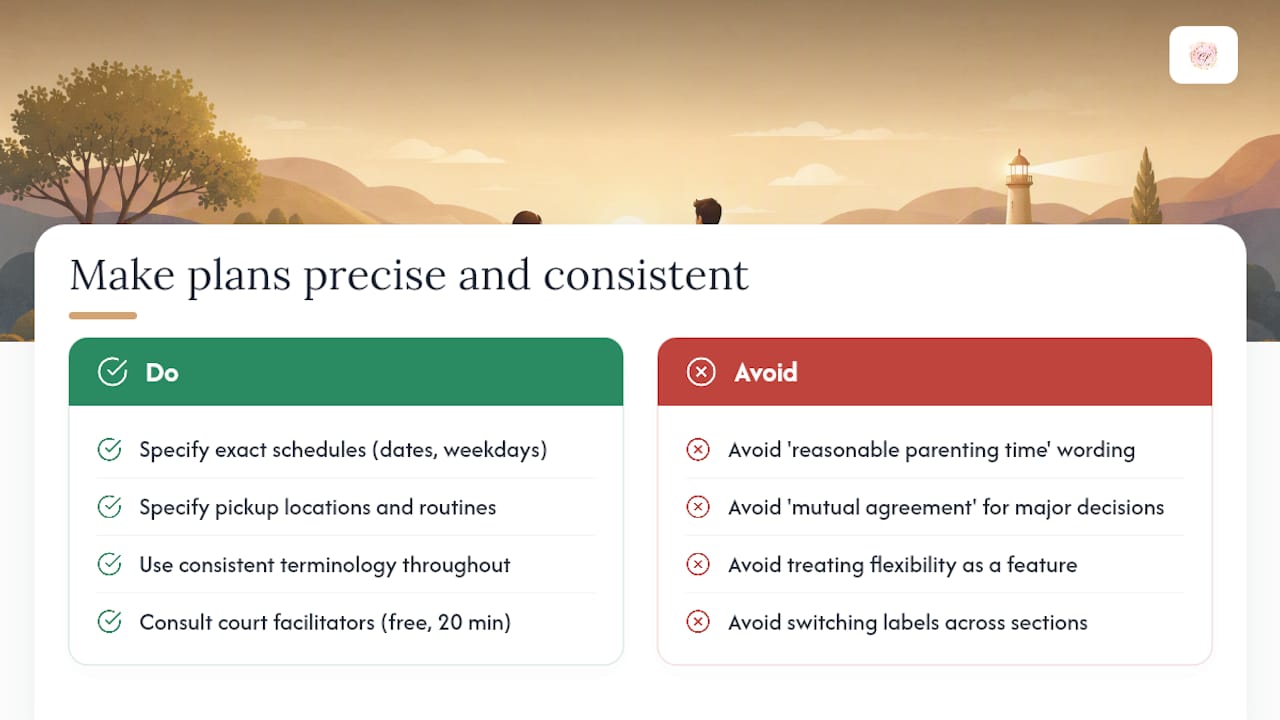
There is a pattern in parenting plans that get sent back by judges or end up back in court within a year: they are too vague. Parents write "reasonable parenting time" or "mutual agreement on major decisions" and believe that flexibility is a feature. Judges see it as an invitation to return.
The plans that hold up are the ones that answer every question a stranger would ask after reading them cold. Not a lawyer, not a judge — a stranger. If that stranger cannot tell where the child will be on the third Tuesday of November in an odd year, the plan needs more detail.
Predictability matters most to the child, not to the parents. A child who knows exactly when they will see each parent, where pickup happens, and what the routine looks like at each home carries far less anxiety than one living inside a "flexible" arrangement that shifts based on parental moods. The Gottman Institute's research on connection rituals supports building small, consistent daily rhythms into co-parenting arrangements — not because it sounds nice, but because predictability is what emotional safety looks like for a child.
One practical note from document preparation work: keep your terminology consistent throughout the plan. If you call it "Parent A" in section one, do not switch to "the mother" in section four. Inconsistent labels create ambiguity that courts flag, and ambiguity is what drives enforcement disputes. Pick your terms at the start and use them everywhere.
Use court facilitators. They are free, they know your county's preferences, and they will tell you plainly if your plan is missing something a local judge expects to see. That conversation takes 20 minutes and can save months of back-and-forth.
Cflegalformhelp helps you finish and file your parenting plan
Drafting a parenting plan is one thing. Getting it court-ready — notarized, accurately filled, and filed with the right county forms — is where self-represented parents often get stuck. Cflegalformhelp offers flat-fee legal document preparation for parenting plans, covering form preparation, review for completeness, and notarization. For Spanish-speaking parents, certified translation services are available to prepare bilingual document sets that meet court requirements.
The service is not a law firm and does not provide legal advice, but it fills the gap between a blank state template and a fully attorney-managed filing. If your plan is agreed upon and you need accurate paperwork prepared and notarized quickly, Cflegalformhelp's flat-fee model gives you a clear scope and a predictable cost. You can also access DIY filing guides and templates to start on your own and bring the draft in for a final review. Contact Cflegalformhelp to schedule a document-prep consultation and get your parenting plan ready to file.
State court templates, self-help pages, and downloadable resources
These are the highest-value free resources for building or refining your parenting plan:
- California Courts Self-Help Center — Resources to develop a parenting plan: worksheets, mediation referrals, and county-specific filing guidance for California parents.
- Oregon Judicial Department — Basic Parenting Plan Guide: downloadable master forms, age-specific schedule templates, and safety-focused forms that courts in many states use as a reference.
- Oregon Law Help — How to Create a Parenting Plan in Oregon: step-by-step guidance and access to the Guide and File online builder, which generates a draft from a guided interview.
- Washington Law Help — Parenting Plan Guide: safety-focused forms, screening questions, and instructions for redacting personal information in domestic-violence situations.
- Maryland People's Law Library — Parenting Plan: plain-language guidance on mediation, modification, and court filing steps.
- Illinois General Assembly — 750 ILCS 5/602.10: the full text of Illinois' parenting plan statute, including minimum content requirements and the 120-day filing deadline.
- Cflegalformhelp DIY Filing Guides — Templates and filing resources: downloadable guides and document-prep support for self-represented parents, including bilingual options.
- What Is a Family Law Petition? — Filing process explained: a plain-language guide to the filing terms and steps you will encounter when making a parenting plan a court order.
For safety-focused plans, start with Washington Law Help's safety forms before moving to a standard template. For long-distance plans, Oregon's master form includes a dedicated long-distance section with travel-cost and communication clauses already built in.
This article provides general information about parenting plans and is not a substitute for legal advice. Laws and filing requirements vary by state and county. Confirm current rules with your local court self-help center or a licensed family law attorney before filing.
Sources
- Resources to develop a parenting plan
- Oregon Judicial Department : Basic Parenting Plan Guide
- How to Create a Parenting Plan in Oregon
- 750 ILCS 5/602.10
- Parenting plan guide
- Week-On/Week-Off 7-7 Custody Schedule: How It Works - LegalClarity
- Parenting Plan | The Maryland People's ...
- The 777 rule for marriage | Gottman Institute