

Before you sign anything, read the definitions section and gather the complete lease package: the letter of intent, base lease, exhibits, and work letter. Those two moves surface most of the costly surprises. Stop and get counsel involved if you spot three specific red flags: uncapped CAM charges, a personal guarantee with no dollar or time limit, and no audit rights on operating expenses.
TL;DR:
- Uncapped CAM charges combined with no audit rights often lead tenants to unknowingly pay unexpected operating expenses, making legal review essential.
- Reviewing full lease exhibits and work letters is crucial, since these redefine key terms like operating expenses, tenant improvements, and removal obligations.
- Prioritize verifying the exact premises measurements, rent escalation clauses, CAM caps, and personal guarantee scope during your due diligence window.
- Lock major lease terms such as rent, TI allowances, and renewal mechanics into the LOI, and push for favorable caps on CAM, assignment rights, and guarantees.
- Implement a lease calendar immediately after signing to track renewal deadlines, audit periods, and insurance renewals, preventing irreversible scheduling errors.
Table of Contents
- Commercial Lease Agreement Review Steps: A Reproducible Checklist
- Clause-by-Clause Checklist: What to Confirm Before You Sign
- Due Diligence Checklist: Zoning, Inspections, Title, and Environmental Review
- Negotiation Priorities and Why the LOI Sets the Terms
- Closing the Review: Redline, Execution, and Your Lease Calendar
- What Small Business Owners Can Realistically Do on a Budget
- How Cflegalformhelp Can Support Your Lease Review
- A Few More Places to Check Before You Sign
- Sources
Commercial Lease Agreement Review Steps: A Reproducible Checklist
A commercial lease review works best as a sequence, not a scramble. Skipping the order (jumping to rent numbers before reading definitions, for instance) is how tenants miss the clause that changes what "rent" actually includes three pages later.
Here's the order that catches the most problems with the least wasted effort:
- Collect the full document package. You need the LOI, the base lease, every exhibit, the work letter, any subordination, non-disturbance, and attornment agreement (SNDA), the personal guaranty, and any estoppel certificate the landlord has already prepared. Reviewing a lease without its exhibits is like reviewing half a contract, because a thorough review compares the lease against the LOI and market standards before anyone drafts a redline.
- Read in this order: Definitions, then Rent, then CAM/Operating Expenses, then Defaults, then Exhibits. Definitions govern every other clause that reuses a defined term, so starting there prevents a misread rent clause or CAM formula from slipping past you.
- Run due diligence during your investigation window, typically 30 to 60 days: zoning verification, a building inspection, a title report, and an environmental screen if the property history warrants one.
- Build a redline and a one-page risk memo. Grade each issue as critical, material, or market standard. That triage tells you which fights are worth having.
- Negotiate, finalize, and calendar every deadline the moment the lease is executed, not weeks later when you've forgotten the renewal window exists.
Small businesses often try to shortcut step one because gathering exhibits feels like paperwork for its own sake. It isn't. Exhibits routinely redefine terms set in the body of the lease, and work letters carry some of the most consequential tenant obligations in the entire package, including who removes tenant improvements at lease end.
Pro Tip: Print the definitions section and the CAM clause side by side. Half the "surprise" charges tenants complain about are legal the moment you see how "Operating Expenses" was defined on page four.
Clause-by-Clause Checklist: What to Confirm Before You Sign
Every commercial lease breaks down into a handful of clause families. Reviewing lease agreements clause by clause, rather than reading front to back and hoping nothing jumps out, is what separates a real review from a skim.
- Definitions and premises: Confirm the exact square footage and whether it's measured as usable or rentable square feet. That distinction alone can shift your effective rent by a meaningful margin.
- Rent structure: Check base rent, the rent commencement date, any free rent period, and how escalations work. CPI-based increases behave very differently from fixed annual step-ups, and you want to know which one you're signing.
- Operating expenses and CAM: Verify what's included, whether there's a gross-up provision, whether a base year applies, and whether caps exist. Tenants should insist on audit rights, since most leases allow tenants a 30 to 90-day window to audit CAM reconciliations and recover verified overcharges.
- Insurance and indemnity: Confirm additional-insured requirements, policy limits, and which party bears which liability.
- Personal guarantee: Check whether one exists, whether it's capped, and whether it survives an assignment or burns off after a set period of good-faith payment.
- Assignment and subletting: Look at the landlord's consent standard, any recapture rights, and whether permitted transferees (an affiliate, for example) are carved out. This clause matters more than most tenants realize once a business needs to relocate or sell.
- Defaults and remedies: Note cure periods, acceleration language, and holdover penalties, which can run well above normal rent if you overstay the term.
- Work letter and exhibits: Confirm the TI allowance amount, how it's disbursed, and your removal obligations at lease end.
An uncapped CAM clause combined with no audit rights is one of the more common ways tenants absorb costs they never agreed to. That combination alone justifies a phone call to an attorney before you sign.
Due Diligence Checklist: Zoning, Inspections, Title, and Environmental Review
Due diligence checks often change the deal itself, not just your comfort level with it.
- Zoning and certificate of occupancy: Confirm with the municipal planning department that your intended use matches what's permitted, since a prior tenant's approved use doesn't guarantee yours will pass.
- Building inspection: Order one and clarify in writing who pays for any repairs it turns up.
- Preliminary title report: Request this early to catch liens, easements, or encumbrances that could restrict how you use the space.
- Phase I environmental assessment: Worth ordering when the property's past use (a dry cleaner, an auto shop, light industrial) suggests contamination risk. Structural and environmental surprises tend to be the most expensive ones a tenant discovers, and a Phase I during your investigation window can catch them before you're locked in.
- Site plan comparison: Match what the landlord's exhibits show against what was represented verbally during your walkthrough.
Negotiation Priorities and Why the LOI Sets the Terms
The letter of intent is where you have the most leverage, not the lease draft. Lock the headline business terms into the LOI: rent, TI allowance, free rent, term length, and renewal or termination mechanics. Once you sign an LOI, your bargaining room narrows considerably, so keep detailed legal language out of it and save that fight for the lease itself.
- Prioritize tradeoffs deliberately: a lower expense cap is often worth more over a five-year term than a slightly lower base rent.
- Push hardest on CAM caps, assignment rights, and personal guarantee limits. These affect your business long after the ink dries.
- Engage counsel when you see red-flag clauses, a complex TI work letter, or any personal guarantee with no cap.
Pro Tip: If the landlord's broker says a term is "standard," ask to see it in writing from a comparable lease. "Standard" is often shorthand for "non-negotiable, unless you push."
Closing the Review: Redline, Execution, and Your Lease Calendar
- Issue a redline paired with a short risk memo that grades each open issue as critical, material, or market standard.
- Confirm execution logistics: who signs, whether notarization is required, and secure wire instructions for any deposit.
- Build a lease calendar the day the lease is signed, with reminders for rent commencement, the renewal notice window (commonly six to twelve months out), audit deadlines, and insurance renewals.
- Verify the final executed lease and every exhibit reflect what you actually negotiated, not an earlier draft.
What Small Business Owners Can Realistically Do on a Budget
A checklist and a lease calendar cost nothing and catch most scheduling disasters before they happen. Missing a renewal window is one of the most common, irreversible mistakes tenants make, and it's entirely preventable with a calendar reminder set the day you sign. Where language is genuinely ambiguous, a personal guarantee has no cap, or a work letter is dense, that's when a targeted hour with an attorney is worth the cost. A document preparer can help you organize and understand your lease documents, but only a licensed attorney can negotiate legal terms or represent you in a dispute.
— Cristina
How Cflegalformhelp Can Support Your Lease Review
There are affordable alternatives to paying attorney hourly rates for some steps of your lease paperwork. If you're a small business owner who needs help organizing your lease package, preparing supporting documents, or getting a signature notarized correctly, some providers offer document preparation and notary services in English and Spanish for a flat fee.

This isn't a substitute for an attorney when a clause is genuinely ambiguous or a guarantee has no cap. But for organizing your document package, preparing routine business paperwork, and getting notarization done right the first time, it's a practical middle step between doing everything yourself and paying full attorney rates for every task. Reach out through the document preparation services page and have your lease documents ready to share, along with a short note on what you need reviewed or notarized, so the team can tell you quickly whether it's a fit or whether you need an attorney referral first.
A Few More Places to Check Before You Sign
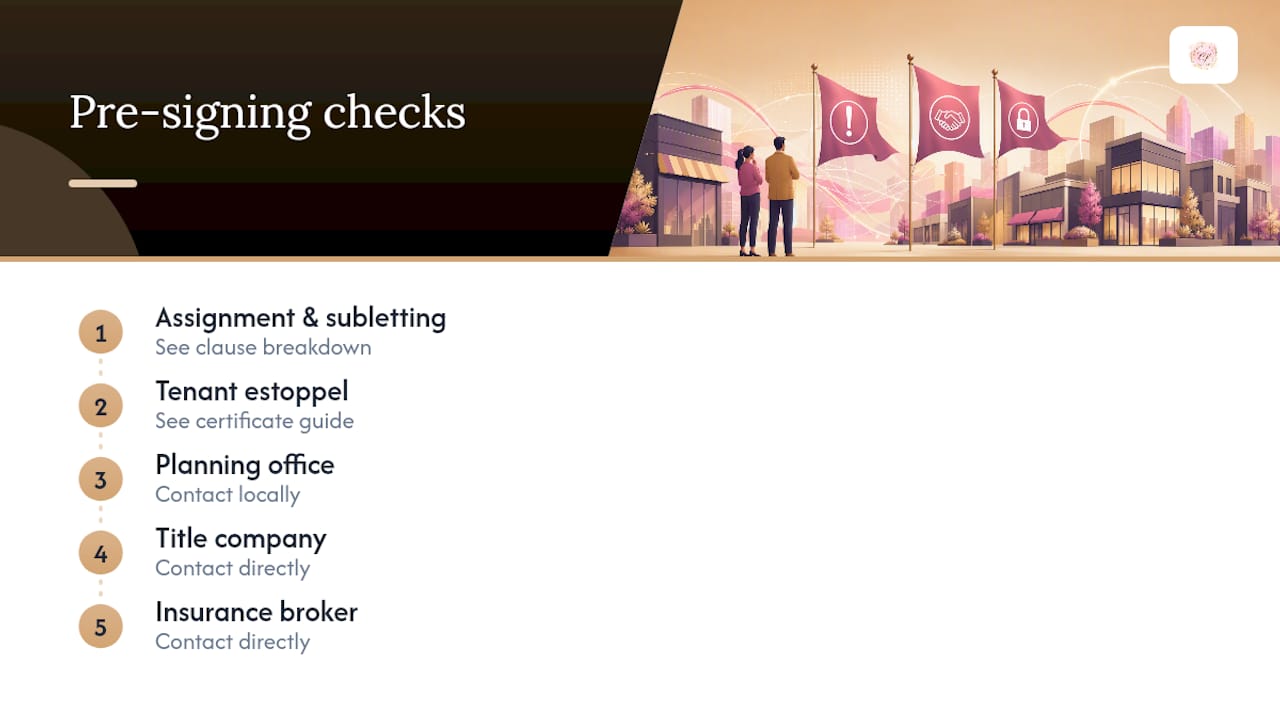
For deeper reading on specific clauses, see this breakdown of assignment and subletting rights and this guide to tenant estoppel certificates. Also contact your local planning office, a title company, and an insurance broker directly.
This article is general information, not a substitute for advice from a qualified lawyer. Consult a qualified legal professional about your own circumstances before acting on anything here.
Sources
- How to Review a Commercial Lease: Overview - Library Guides
- Commercial Lease Due Diligence Checklist for Tenants - LegalClarity
- How to read a commercial lease (tenant guide) - LeaseLens