

Every family-based visa packet breaks into seven document groups: identity, civil records, sponsor eligibility, financial evidence, application forms, medical and biometric results, and police certificates. Start by confirming your exact visa class on the official government site for your route, then pull original civil documents (birth, marriage, divorce records), and begin certified translations right away for anything not in English. U.S. petitioners also need the Affidavit of Support, Form I-864.
TL;DR:
- Civil documents such as birth, marriage, and divorce records must be original, certified, and translated by a qualified translator with a signed affidavit.
- Police certificates and medical exam results are highly time-sensitive, requiring scheduling close to the interview date to avoid expiration.
- Missing or incorrectly attested translations, failure to disclose past history, or bringing only photocopies can result in delays or denials.
- Financial evidence must include the latest tax returns, pay stubs, and bank statements, with some cases requiring a joint sponsor if income falls short.
- Building an organized, category-labeled packet aligned with official checklists and verifying document validity can prevent common delays.
Table of Contents
- The Complete Family Visa Documents Checklist by Category
- Certified Translations, Apostilles, and Notarization: Getting the Paperwork Right
- Affidavit of Support and Financial Evidence for U.S. Family Visas
- Medical Exams, Biometrics, and Police Certificates: Timing That Matters
- Mistakes That Delay or Derail a Family Visa Application
- Organizing and Presenting Your Documents for the Interview
- What to Do When You Can't Find an Original Document
- Translation Rules: Who Can Translate and What Makes It Valid
- How Long Documents Stay Valid Through Your Interview
- Building a Checklist for Your Specific Family Visa Category
- A Practitioner's View on What Applicants Miss Most
- How Cflegalformhelp Helps You Assemble a Complete Packet
- Where to Verify These Requirements
- Sources
The Complete Family Visa Documents Checklist by Category
Your packet gets built in layers, and each layer has its own paperwork. Missing one item in a category rarely sinks an application by itself, but a pattern of gaps signals to a reviewing officer that the file was assembled in a hurry.
Identity documents come first because everything else in the file gets cross-checked against them.
- Valid passport with at least six months of remaining validity beyond your expected travel date
- Previous passports, especially any that carried prior visas or entry stamps
- Passport-style photos meeting the exact specifications listed on your consulate's page
Civil documents prove who you are related to and how.
- Original long-form birth certificate (not a hospital souvenir certificate)
- Marriage certificate, if applying as a spouse
- Divorce decrees or death certificates for any prior spouse of either party
- Legal name-change documents, including court orders or marriage-based name changes
Consular officers routinely request originals and certified copies of civil documents at the interview stage, not just at initial filing.
Sponsor eligibility documents establish that the person filing the petition actually qualifies to do so.
- Proof of U.S. citizenship or lawful permanent resident status (passport, naturalization certificate, or green card)
- Proof of domicile in the United States, such as a lease, mortgage, or voter registration
- Current contact and mailing information matching what's listed on the petition
Application forms need to be complete, signed, and internally consistent.
- Form I-130, Petition for Alien Relative
- Form DS-260, the Immigrant Visa Application, filed once the case reaches the National Visa Center
- Any required local-equivalent forms if you're applying through a route outside the United States
Financial evidence gets its own detailed treatment in a later section, but the core items are the I-864 affidavit, tax returns, W-2s, pay stubs, and bank statements.
Relationship proof matters most for spouse petitions: photos with captions and dates, joint lease or mortgage documents, shared bank accounts, and a record of communication if you spent time apart.
Police and character documents, plus medical exam results, round out the packet. Both get their own sections below because timing and validity windows trip up more applicants here than almost anywhere else in the process.
Certified Translations, Apostilles, and Notarization: Getting the Paperwork Right
A translation that isn't certified is functionally the same as no translation at all in most consular reviews. Certified translations need a signed statement from the translator confirming accuracy, along with the translator's printed name, contact information, and the date the translation was completed. Guidance from Australia's Department of Home Affairs echoes this: non-English documents must go through a qualified certified translator, not a bilingual friend or an online tool.
Some countries require an extra layer. Ireland's immigration service notes that translations completed outside the EEA or Switzerland may need attestation or an apostille from the relevant Ministry of Foreign Affairs before they're accepted.
Notarized copies are not always a substitute for originals. Most consulates want the original civil document at the interview, with the certified translation attached, rather than a notarized photocopy standing in for either one.
The safest workflow: order clean copies of your originals, get a certified translation for each non-English document, add notarization or an apostille only where the destination country requires it, then assemble everything into labeled sets by category.
Pro Tip: Keep one folder of untouched originals and a separate folder of translated copies. Consular staff often want to see both side by side, and shuffling through a single mixed stack under time pressure is how people misplace pages.
Affidavit of Support and Financial Evidence for U.S. Family Visas
For U.S. family immigrant visas, Form I-864 is not optional for most categories, and the petitioner must be at least 18 years old to sign it. Alongside the signed affidavit, expect to submit:
- Most recent federal tax return, or an IRS transcript, plus W-2s
- Recent pay stubs, typically covering the last few months
- An employment verification letter stating position, salary, and length of employment
If income alone doesn't meet the threshold, the Federal Poverty Guidelines published by USCIS set the exact income bar for your household size, and assets can sometimes close the gap. Cash savings, property, or investments generally need to be worth substantially more than the shortfall, since asset value gets discounted in the calculation.
When a petitioner's income falls short, a joint sponsor can file a separate I-864 with their own tax records, pay stubs, and proof of domicile. Before submitting, double-check for the errors that cause the most bounce-backs: an unsigned form, a tax transcript from the wrong year, or a date on one document that doesn't line up with the timeline elsewhere in the packet.
Medical Exams, Biometrics, and Police Certificates: Timing That Matters
Schedule your immigration medical exam only with a physician authorized by your consulate or embassy. Book it close to your interview date. Exam results carry a validity window, and scheduling too early can mean redoing the whole exam.
- Vaccination requirements vary by country of application. Confirm the current list with your panel physician rather than relying on last year's checklist.
- Police certificates typically must come from every country where you lived for six months or longer since a set age. Most stay valid for about a year, so timing matters.
- Biometrics appointments require government-issued photo ID and the appointment confirmation. Fingerprints and photos get captured on-site.
Order these last among your document types, since they have the shortest shelf life of anything in the packet.
Mistakes That Delay or Derail a Family Visa Application
Most refusals trace back to the same handful of preventable errors.
- Uncertified translations. A translation lacking the translator's signature, date, and contact details gets rejected on sight in most jurisdictions.
- Undisclosed history. Failing to mention a prior marriage, a previous visa denial, or a past conviction almost always surfaces later and damages credibility.
- Expired documents. Police certificates and medical exams both carry validity windows that can lapse before the interview date.
- Disorganized packets. Arriving at the interview with loose, unsorted paper wastes the officer's time and yours.
- Forgetting originals. Bringing only photocopies when the original civil document was required is one of the most common last-minute scrambles.
Pro Tip: A week before your interview, lay out every document by category on a table and check each one against the consulate's official checklist item by item. It takes twenty minutes and catches nearly every gap.
Organizing and Presenting Your Documents for the Interview
Work in this order: confirm your visa route, gather sponsor eligibility documents, assemble original civil records, build your certified translation sets, then compile relationship evidence last, since it often keeps growing right up to the interview date.
- Label each folder by category (identity, civil, financial, relationship) so an officer can flip straight to what they ask for.
- Write a one-page cover sheet listing every document included, in the order it appears in the folder.
- Bring civil documents in a dedicated envelope, separate from your relationship-evidence stack, to avoid confusing officers or yourself under pressure.
- Schedule your medical exam and police certificates last, after every other document is confirmed ready, so their validity windows don't expire before your interview.
What to Do When You Can't Find an Original Document
Lost birth certificates, destroyed civil records, and countries with unreliable record-keeping systems are common realities, not rare exceptions. Most consulates have a defined process for exactly this problem, and panicking over a missing original usually wastes more time than solving it.
Start with the civil registry in the country where the event occurred. Many will issue a certified duplicate even decades later, and that duplicate carries the same legal weight as the original for visa purposes. If the registry itself has no record (common after fires, wars, or administrative gaps), request an official letter confirming the record's unavailability. This letter becomes part of your substitute evidence.
When no government replacement exists at all, secondary evidence steps in: affidavits from people with firsthand knowledge of the event, religious or school records referencing the birth or marriage, or old identity documents that indirectly confirm the fact in question. Consulates weigh secondary evidence more critically than an original, so submit as many corroborating pieces as you can find rather than relying on a single affidavit.
Document the unavailability clearly rather than simply omitting the item. A packet that explains why a birth certificate is missing and shows what was submitted instead reads very differently to an officer than a packet with a silent gap. If you're unsure whether your substitute evidence will pass, a document preparer familiar with your specific consulate's patterns can flag weak spots before submission rather than after a denial.
Translation Rules: Who Can Translate and What Makes It Valid
A certified translation is a specific legal product, not just an accurate rendering of the text. It requires a signed statement from the translator attesting that the translation is complete and accurate, plus the translator's printed name, contact information, and the date of completion. Consulates and immigration authorities routinely reject translations missing that signed statement, even when the translated content itself is correct.
Translator qualifications vary by destination. Some countries, like Australia, expect translators certified through a national accrediting body such as NAATI. Others, including most U.S. consular processing, don't mandate a specific certification body but do require the translator to be competent in both languages and to formally attest to that competence in writing. A family member can legally translate a document in many cases, but self-translation invites more scrutiny, and consulates sometimes ask for a second, independent translation if they suspect bias.
The translation affidavit itself should include the translator's full name, a statement of fluency in both languages, a certification that the translation is true and accurate to the best of their ability, their signature, and the date. Attach this affidavit directly to the translated document, and keep the original-language document paired with it, never separated into different folders. If your destination country requires an apostille or attestation on top of certification, get that step done before your interview date, not the week of.
How Long Documents Stay Valid Through Your Interview
Every document in your packet has a shelf life, and the mistake most applicants make is treating "collected" as the same thing as "valid." Civil documents themselves rarely expire, a birth certificate issued in 1995 is still your birth certificate, but supporting evidence tied to a moment in time absolutely does.
Police certificates are the clearest example. Most stay valid for about a year from issuance, and if your interview gets rescheduled or delayed, you may need a fresh one. Medical exam results carry a similarly tight window set by the panel physician, often shorter than a year, because vaccination status and health screening results are considered a snapshot rather than a permanent fact.
Financial evidence has its own version of this problem. Tax returns need to reflect the most recent filing year available, and pay stubs older than two or three months start to look stale to a reviewing officer, even if nothing about your employment has changed. Bank statements follow the same logic: a six-month-old statement showing a healthy balance doesn't tell an officer anything about your finances today.
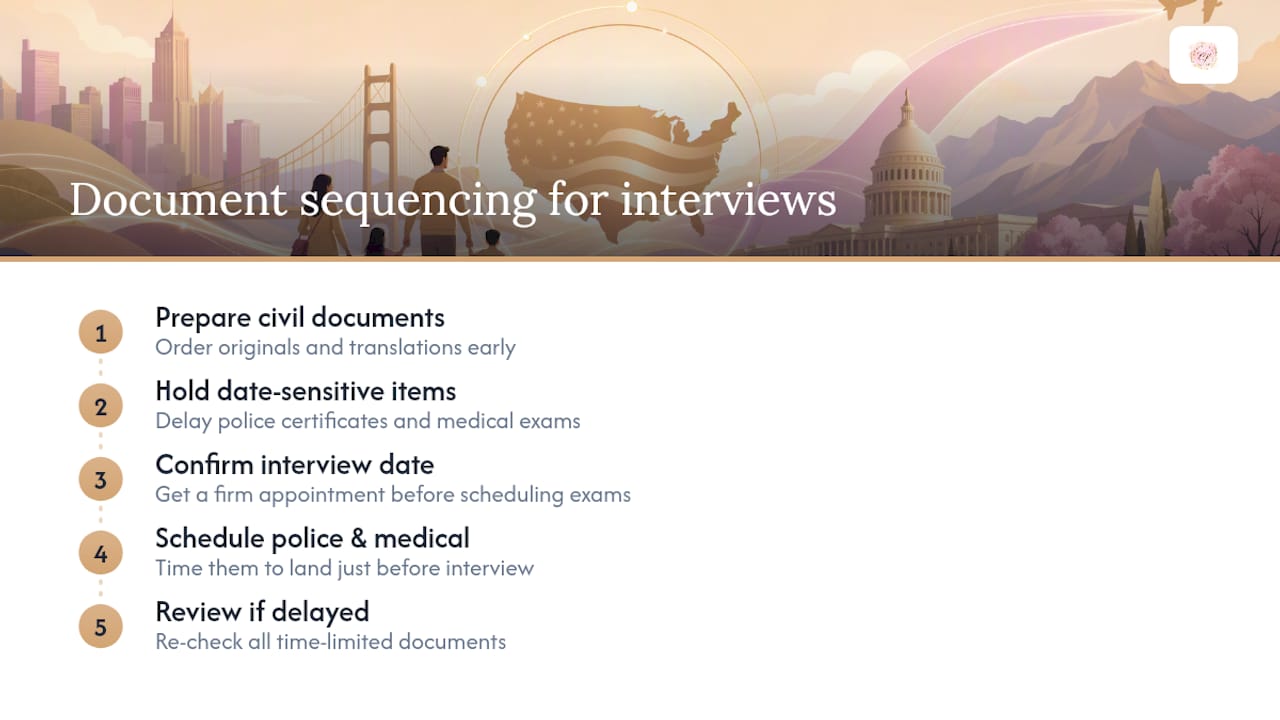
The safest approach is sequencing, not stockpiling. Order your civil documents and translations early, since those hold steady. Hold off on police certificates and medical exams until you have a confirmed interview date, then schedule them to land just before it. If your case gets delayed for any reason, treat every date-sensitive document as a checklist item to review again, not something you can assume is still good.
Building a Checklist for Your Specific Family Visa Category
A spouse visa, a child's visa, and a parent's visa share a common backbone, identity documents, civil records, sponsor proof, financial evidence, but the weight each category carries shifts depending on who's applying.
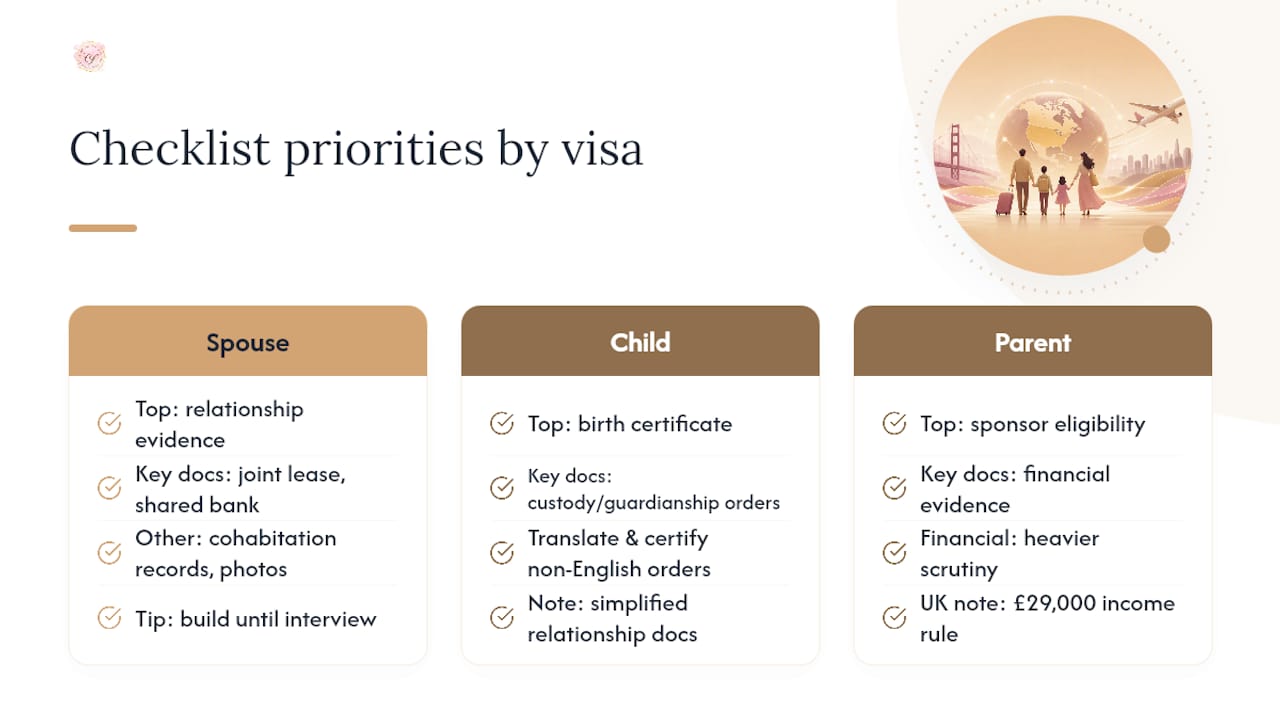
For a spouse visa, relationship evidence carries the heaviest scrutiny. Officers want a "paper trail" style proof of shared life: joint leases, shared bank accounts, and long-term cohabitation records tend to carry more weight than photographs alone. Build this category first and keep adding to it right up until your interview.
For a child's visa, the relationship documents simplify to a birth certificate establishing parentage, but custody and legal-guardianship paperwork become critical if the parents are divorced, separated, or if one parent is not part of the petition. Any prior custody order needs to be in the file, translated and certified if it wasn't issued in English.
For a parent's visa, sponsor eligibility takes center stage since many routes have age or category restrictions on who can sponsor a parent, and financial evidence tends to face heavier scrutiny because the sponsor is often supporting an additional household member with no independent income. UK-specific partner routes add another layer entirely: sponsors must meet a minimum income threshold, currently £29,000 gross annually, backed by payslips or employer letters, a requirement with no direct U.S. equivalent but a useful reminder that financial thresholds are category-specific and country-specific both.
Whatever category applies to you, build your checklist starting from the government's own published list for that exact visa class, then layer in the practical items, translations, notarizations, backup evidence, that the official list assumes you already know to include.
A Practitioner's View on What Applicants Miss Most
Cristina Fernandez, a certified legal document preparer and immigration paralegal, has spent years reviewing family visa packets before they leave a client's hands. The problems she sees most often aren't complicated: an I-864 missing a signature, a certified translation with no translator affidavit attached, a civil document that needed an apostille and didn't get one before the interview date.
Bilingual households run into a specific trap. A document written partly in English and partly in Spanish sometimes gets treated as "already translated," but consulates still expect a full certified translation covering every word on the page. Building your translation and civil-document sets side by side, rather than assuming familiarity solves the gap, catches this before it becomes a delay.
— Cristina
How Cflegalformhelp Helps You Assemble a Complete Packet
Assembling a family visa packet by yourself is entirely possible, but it takes real time to track down every civil record, format every translation correctly, and catch the small errors, an unsigned form, a missing translator statement, that cause the most delays. Document preparation services are available that offer flat-fee, bilingual support for this kind of paperwork, often without hourly billing or attorney overhead.
If your case involves non-English civil documents, a joint sponsor's financial paperwork, or a tight interview timeline, professional help pays off fastest exactly there. Cflegalformhelp's immigration form assistance covers I-130 and I-864 preparation, while its certified translation and notarization services handle the civil-document side in both English and Spanish. Reach out for a flat-fee quote before your next document deadline so your packet is ready well ahead of your interview, not the week before it.
Where to Verify These Requirements
For the most current forms and NVC processing steps, check travel.state.gov directly. UK applicants should confirm current thresholds on GOV.UK, and translation standards are covered by partners like MyNotary.
This article is general information, not a substitute for advice from a qualified lawyer. Consult a qualified legal professional about your own circumstances before acting on anything here.