

An immigrant visa is for people who intend to live permanently in the United States. A nonimmigrant visa is for temporary stays tied to a specific purpose, like tourism, study, or work on assignment. The visa itself only lets you travel to a U.S. port of entry; a Customs and Border Protection officer decides whether to admit you and for how long, so the immigrant vs. nonimmigrant visa distinction matters from the moment you choose which category to apply under.
TL;DR:
- To avoid visa denial, applicants must demonstrate strong ties to their home country unless they are in categories like H-1B or L-1 that permit dual intent.
- Overstaying a visa by more than 180 days results in a three-year reentry ban, and overstaying over a year leads to a ten-year ban, with serious repercussions for future applications.
- Visa applicants should prepare accurate, complete paperwork and avoid relying solely on self-reported ties or intentions, especially if they have prior denials or complex circumstances.
- The visa category chosen initially impacts the likelihood of approval, particularly because the presumption of immigrant intent under INA 214(b) heavily influences nonimmigrant visa outcomes.
- Final admission to the U.S. depends on Customs and Border Protection officers at ports of entry, not just on the visa granted by a consular officer abroad.
Table of Contents
- What Legally Separates a Visa, Admission, and Status
- Common Visa Categories You'll Actually Encounter
- How Officers Decide You're Not Secretly Immigrating
- Where You Apply and How Long It Takes
- What Happens If You Overstay or Break Status
- When Document Prep Help Actually Makes Sense
- Official Resources Worth Bookmarking
- Why "Just Pick a Visa" Advice Falls Short
- Sources
What Legally Separates a Visa, Admission, and Status
A visa is a travel document. Admission is the decision a CBP officer makes at the port of entry. Status is the classification you hold once you're inside the country, whether that's a lawful permanent resident (green card holder) or a nonimmigrant admitted for a set purpose. These are three separate legal moments, and confusing them is where a lot of applicants go wrong.
The framework comes from the Immigration and Nationality Act. INA 101(a)(15) defines the nonimmigrant classifications, from B-1 visitors to H-1B workers, while INA 214(b) presumes every nonimmigrant applicant intends to immigrate until they prove otherwise. The Foreign Affairs Manual builds on this, spelling out how long each nonimmigrant category can stay and what activities are permitted under it.
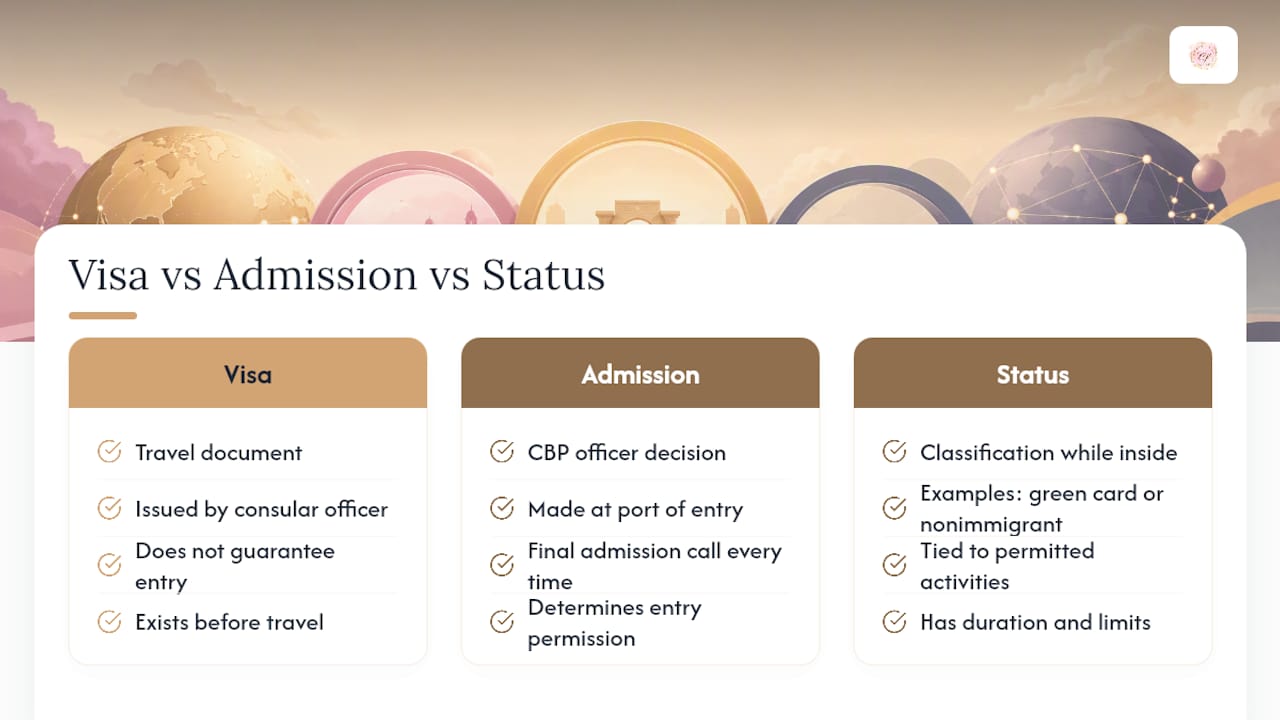
Here's the number that trips people up: having a valid visa does not guarantee entry, especially if your passport validity for international entry requirements are not met. CBP officers make the final admission call at the border, every time, regardless of what a consular officer approved months earlier.
Common Visa Categories You'll Actually Encounter
More than 30 nonimmigrant visa classes exist under U.S. law, but most applicants fall into a handful of buckets. Knowing where you land shapes everything from the paperwork you file to how a consular officer reads your intent.
Immigrant categories, all leading toward permanent residence:
- Family-sponsored: for spouses, children, parents, or siblings of U.S. citizens or permanent residents.
- Employment-based: for workers sponsored by a U.S. employer for a permanent position.
- Diversity visa: for nationals of countries with historically low U.S. immigration rates, selected by lottery.
Nonimmigrant categories, all tied to a temporary, defined purpose:
- B-1/B-2: business or tourism visits, typically capped at six months per stay.
- F-1: academic study, valid for the length of the program plus limited practical training.
- H-1B: specialty occupation work, initially granted for up to three years.
- L-1: intracompany transfers for managers or specialized employees.
- O/P: athletes, artists, and performers with extraordinary ability or achievement.
Diplomatic and international organization categories (A and G visas) sit outside this framework entirely, governed by separate treaty obligations.
How Officers Decide You're Not Secretly Immigrating
Under INA 214(b), the burden sits on you, not the officer. You have to show ties strong enough to prove you'll return home: a job waiting for you, property you own, family you support, or enrollment you'll resume. Weak or vague answers about these ties are the single most common reason nonimmigrant visas get denied.

A handful of categories break this rule entirely. H-1B and L-1 visa holders are permitted "dual intent," meaning they can pursue a green card while still holding valid nonimmigrant status, with no penalty for admitting they'd like to stay permanently. Certain K visa categories carry similar allowances since they're explicitly designed as a bridge to marriage-based permanent residence.
Before your interview, work through this:
- Gather proof of employment, property, or family ties in your home country.
- Confirm your visa category's specific purpose matches your actual travel plans.
- Prepare a clear, honest answer for why you'll return (unless your category allows dual intent).
- Bring financial documentation showing you can support your stay without unauthorized work.
Pro Tip: Don't over-rehearse your ties-to-home-country answer. Consular officers interview hundreds of applicants a day and can tell a memorized script from a genuine one almost instantly.
Where You Apply and How Long It Takes
Nonimmigrant visa applicants apply directly at a U.S. embassy or consulate abroad, typically after completing Form DS-160 and scheduling an interview. Immigrant visa applicants take a longer road: a petition first (often Form I-130 or I-140), then either consular processing abroad or adjustment of status if you're already in the U.S. legally.
Employment and family-based immigrant petitions are also subject to annual numerical limits, tracked through the Visa Bulletin, which sets your priority date and estimates your wait based on category and country of birth. Interview scheduling locations and wait times shift periodically, so check current appointment availability directly through the State Department before planning around an assumed timeline.
What Happens If You Overstay or Break Status
Overstaying a nonimmigrant visa triggers unlawful presence, and the penalties scale sharply with time. The consequences are worth knowing before you're anywhere near the deadline:
- More than 180 days unlawfully present triggers a three-year bar on reentry after you leave.
- More than 365 days triggers a ten-year bar.
- Working without authorization, even briefly, can jeopardize future visa or green card eligibility.
- Misrepresenting your intent to a consular or CBP officer, even unintentionally, can create a permanent inadmissibility finding.
If you've already been denied or your status has lapsed, don't assume the door is closed. Some denials allow a motion to reopen or reconsider, and certain overstays have narrow waiver options. This is exactly the point where immigration case status starts driving every decision that follows, and it's also the point where talking to an immigration attorney, not just a document preparer, is the right move.
When Document Prep Help Actually Makes Sense
A lot of visa applications fail on paperwork, not eligibility. Missing signatures, mismatched dates, unnotarized supporting documents. That's the gap a document preparation service fills: completing forms accurately, organizing your evidence checklist, providing certified translations, and notarizing what needs it, all without giving legal advice.
That last part matters. If your situation involves a prior denial, a criminal record, or a complicated dual-intent question, you need a licensed immigration attorney, not a document preparer. What Cflegalformhelp does well is the paperwork layer underneath that decision: bilingual support, flat-fee pricing, and immigration forms help built for people preparing their own applications without a lawyer on retainer, plus notary services for the documents that require it.
Official Resources Worth Bookmarking
Start with the State Department's visa overview for category definitions and current processing updates. CBP's admission requirements page explains the visa-versus-entry distinction directly. For the legal text itself, the Foreign Affairs Manual's nonimmigrant visa provisions lay out duration and activity rules category by category.
Why "Just Pick a Visa" Advice Falls Short
Most guides treat visa selection like a checkbox exercise: pick the category, fill the form, show up. That undersells how much INA 214(b) actually shapes outcomes. The presumption of immigrant intent isn't a formality, it's the reason otherwise-qualified applicants get denied for giving vague answers about why they'll go home.
Dual intent also gets oversold. Plenty of applicants assume any work visa lets them quietly pursue a green card. It doesn't. Outside H-1B, L-1, and a few narrow exceptions, admitting immigrant intent on a nonimmigrant application is still one of the fastest ways to get denied under 214(b).
If I had to prioritize one thing for readers weighing this decision, it's this: get your category right before you touch a form. A student who really wants employment sponsorship down the line should understand the F-1 to H-1B pathway before applying, not after a denial. That's also where the line sits between what a document preparer should handle and what needs an attorney. Paperwork accuracy is a service. Legal strategy on intent, waivers, or prior denials is not.
— Cristina
This article is general information, not a substitute for advice from a qualified lawyer. Consult a qualified legal professional about your own circumstances before acting on anything here.
Sources
- Requirements for Immigrant and Nonimmigrant Visas | U.S. Customs and Border Protection
- 9 FAM 401.1 Introduction to nonimmigrant visas and status
- nonimmigrant visa | Wex | US Law | LII / Legal Information Institute