

Florida notarization is defined as a formal act performed by a commissioned notary public who verifies signer identity, witnesses a signature or oath, and completes a legally required certificate under Florida Statutes Chapter 117. Following the correct florida notarization requirements checklist is not optional. Failure to comply with Florida notarization statutes can result in fines, suspension, or criminal charges. Whether you are signing a power of attorney, a real estate deed, or a business contract, every step in this checklist protects the legal validity of your document.
1. florida notarization requirements checklist: the full overview
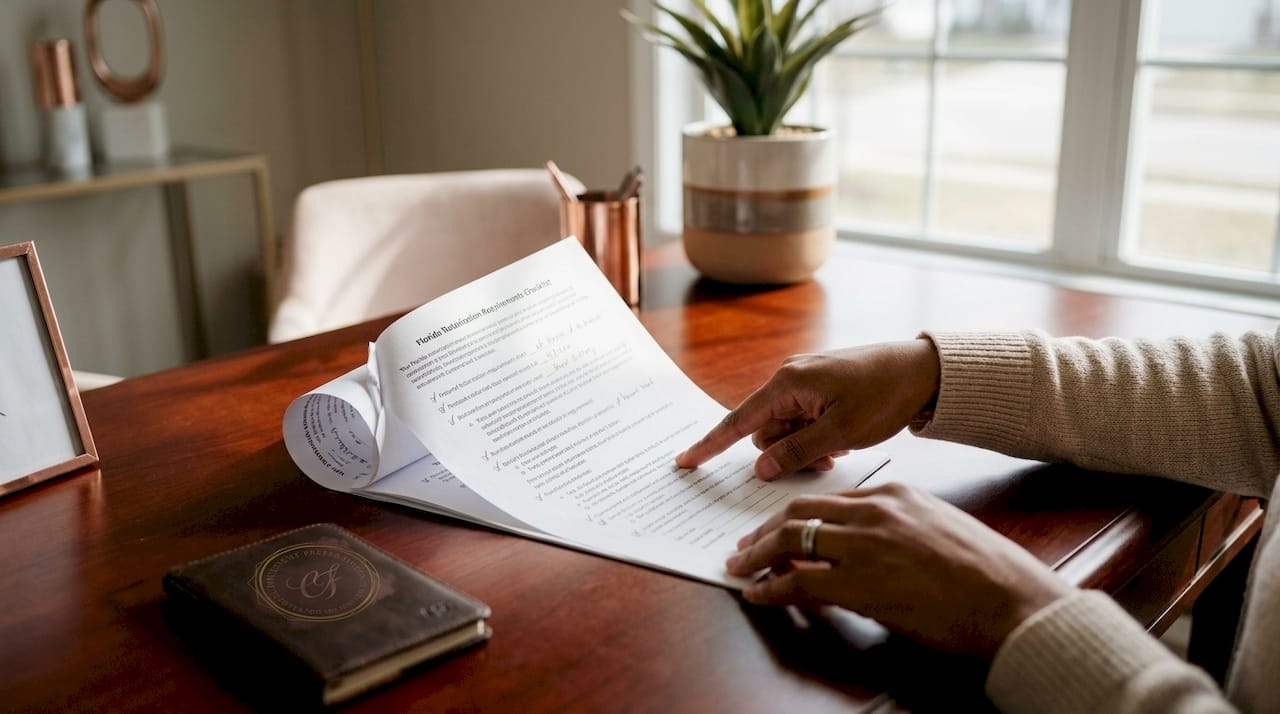
The Florida notarization requirements checklist covers six core areas: signer identity, notarial certificate, notary seal, physical or remote presence, recordkeeping, and notary commission verification. Florida notary duties require strict adherence to certificate completion, identity verification, and notarization procedures. Missing even one item can void the notarization entirely. Think of this checklist the way a pilot uses a pre-flight list. Every box must be checked before takeoff.
2. identity verification: what documents you need
Identity verification is the first legal gate in any Florida notarization. Satisfactory evidence of identity requires a government-issued photo ID, or credible witnesses if no ID is available. This rule exists because a notary who skips identity verification is personally liable for any fraud that results.
Acceptable government-issued photo IDs include:
- Florida driver's license or state ID card
- U.S. passport or passport card
- Military ID card
- Permanent resident card (Green Card)
- Foreign passport with a valid U.S. visa
What happens when you have no ID?
Florida law allows two credible witnesses who personally know the signer to substitute for a photo ID. Both witnesses must sign the notarial certificate and present their own valid ID to the notary. This option is a last resort, not a shortcut.
Pro Tip: Bring two forms of ID to any notarization appointment. If your primary ID has an outdated address or a worn photo, the notary may question its validity. A backup ID eliminates that risk entirely.
Review the mobile notary appointment guide from Cflegalformhelp for a full breakdown of what to bring to your appointment.
3. required elements on the florida notarial certificate
Florida notarial certificates must include the venue, type of act, date, signer's name, method of appearance, notary signature, printed name, and seal. Every single element is mandatory. A certificate missing the venue statement or the notary's printed name is legally defective, even if the seal is present.
Here is what each required element looks like in practice:
- Venue statement: "State of Florida, County of [Name]" written at the top of the certificate block.
- Type of notarial act: Either an acknowledgment (signer confirms they signed voluntarily) or a jurat (signer swears an oath before signing).
- Exact date: The date the notarization occurred, not the date the document was drafted.
- Signer's name: The full legal name as it appears on the signed document.
- Method of appearance: Physical presence in the same room, or Remote Online Notarization (RON) via approved audio-video platform.
- Notary's official signature: Handwritten or electronic, depending on the notarization type.
- Notary's printed name: Typed or stamped directly below the signature.
- Notary seal: Rubber stamp with black ink, photographically reproducible.
| Certificate Element | Traditional Notarization | Remote Online Notarization (RON) |
|---|---|---|
| Venue statement | Required | Required |
| Signer's appearance method | "Physically present" | "Appeared online via audio-video" |
| Notary seal | Rubber stamp, black ink | Electronic seal |
| Notary signature | Handwritten | Electronic signature |
| Journal entry | Not required | Required |
Pro Tip: Ask to review the completed notarial certificate before you leave. Notaries are human. A wrong date or a missing county name is a quick fix on the spot but a major problem after the fact.
The Florida notary block requirements also specify that the seal must include the notary's commission number, expiration date, and the words "Notary Public, State of Florida." A seal alone, without the full certificate wording, does not constitute a valid notarization.
4. the notary seal: exact specifications under florida law
The notary seal is not just a formality. The seal must be a rubber stamp using photographically reproducible black ink, and it must display the commission number, expiration date, and official state text. This requirement comes directly from Florida Statutes §117.05. A colored ink stamp, a pre-inked stamp that produces a faint impression, or an embossed seal without ink does not meet the standard. If a document is recorded at a county clerk's office or submitted to a federal agency, a non-compliant seal is grounds for rejection.
5. presence requirements: in-person vs. remote online notarization
Florida statute requires the notary to complete the notarial act in the physical presence of the signer, with strict separate rules for Remote Online Notarization. This is one of the most commonly misunderstood points in Florida notary law. A notary cannot notarize a document that was signed before the appointment and simply handed over for stamping. The signing must happen in front of the notary.
For RON, the signer must appear live via an approved audio-video platform. The notary must be able to see and communicate with the signer in real time. Florida law does not permit asynchronous or pre-recorded video for RON. Review the Florida remote notary guide for a complete list of acceptable documents and platform requirements.
6. journal and recordkeeping: traditional vs. RON
Florida does not require journals for traditional in-person notarizations, but it mandates journal entries and audio-video recordings for all Remote Online Notarizations. This distinction matters if you ever need to prove a notarization occurred or dispute a fraudulent document.
For traditional in-person notarizations:
- No journal is legally required under Florida law
- Keeping a personal log is still a best practice for your own protection
- Retain copies of notarized documents in your own files
For Remote Online Notarizations (RON):
- The notary and the RON technology provider must both retain journal entries
- Audio-video recordings must be retained and made available to authorized requesters
- Records must be kept for a minimum period set by Florida law
- Signers may request copies of their RON session records
The National Notary Association notes that documentation rules for RON are stricter than for traditional notarizations, reflecting evolving legal expectations for electronic notarizations. That stricter standard signals where Florida notary law is heading overall.
7. verifying the notary's commission before you sign
Confirming a notary's active commission is a step most people skip and later regret. A notarization performed by an expired or suspended notary is void. Here is how to verify before you proceed:
- Check the Florida Department of State database: Search the notary's name at the Division of Corporations and Notaries website to confirm active commission status.
- Confirm education completion: First-time Florida notary applicants must complete a minimum of three hours of interactive education before receiving their commission. Ask when they were commissioned and whether they completed the required training.
- Distinguish traditional from RON-authorized notaries: Not every commissioned Florida notary is authorized to perform RON. RON requires additional registration with an approved technology provider.
- Check the commission expiration date on the seal: The seal itself displays the expiration date. If it has passed, the notarization is invalid.
For Florida business compliance purposes, small business owners should keep a record of the notary's commission number and expiration date for every document notarized on behalf of the company.
8. applying the checklist to common florida notarization scenarios
The checklist applies differently depending on the document type and notarization method. Here is a practical comparison of the four most common scenarios Florida residents and small business owners face:
| Scenario | Key Checklist Focus | Common Pitfall |
|---|---|---|
| Traditional in-person notarization | Valid photo ID, physical presence, complete certificate | Signer brings unsigned document but forgets to sign in front of notary |
| Remote Online Notarization (RON) | Live audio-video, RON-authorized notary, electronic journal | Using a notary not registered with a Florida-approved RON platform |
| No ID available | Two credible witnesses with their own valid IDs | Witnesses are related to the signer, which disqualifies them |
| Real estate closing documents | Correct venue, acknowledgment wording, compliant seal | Wrong county listed in venue statement on deed |
For real estate transactions specifically, review the real estate closing notarization guide from Cflegalformhelp. A single error on a deed can delay recording at the county clerk's office by weeks.
Key takeaways
A valid Florida notarization requires correct identity verification, a fully completed notarial certificate, a compliant seal, and an authorized notary, with stricter recordkeeping rules applying to Remote Online Notarizations.
| Point | Details |
|---|---|
| Identity verification is mandatory | Bring a government-issued photo ID or arrange two credible witnesses before your appointment. |
| Certificate elements are all required | Venue, date, signer name, act type, appearance method, signature, printed name, and seal must all appear. |
| Seal specifications are strict | Use only a rubber stamp with black photographically reproducible ink that includes commission number and expiration date. |
| RON has extra recordkeeping duties | Journal entries and audio-video recordings are required for remote notarizations and must be retained for authorized access. |
| Verify the notary's commission first | Confirm active status, education completion, and RON authorization through the Florida Department of State before signing. |
What i've learned after years of florida notarizations
The mistake I see most often is not a missing ID or a wrong date. The most common problem is a notary who stamps a document without completing the full certificate block. Clients bring me documents where the notary signed and sealed but left the venue blank or wrote the wrong county. That document is legally defective, and the signer has no idea until it gets rejected.
My honest advice: read the notarial certificate yourself before you leave the table. You do not need a law degree to spot a blank line. If the county is missing, the date is absent, or the notary's printed name is not there, ask for a correction on the spot.
The RON rules are the other area where I see confusion. Many people assume any Florida notary can perform a remote notarization. That is not true. The notary must be separately registered with a Florida-approved technology provider. If you are using RON for an immigration document or a business contract, confirm that authorization before you schedule the session. A voided RON notarization wastes time and money for everyone involved.
The checklist approach works because it removes guesswork. Every item has a clear yes or no answer. Either the ID is valid or it is not. Either the venue is written or it is blank. Use the checklist every time, and you will not need to redo a notarization.
— Cristina
Get your florida documents notarized correctly the first time
Cflegalformhelp provides mobile notary and loan signing services across South Florida, including Naples, with flat-fee pricing and bilingual support in English and Spanish. Whether you need a power of attorney notarized, a business contract witnessed, or a full real estate closing handled, the team at Cflegalformhelp follows every item on the Florida notarization checklist so your documents are accepted the first time.
Cflegalformhelp also offers legal document preparation for individuals and small businesses who need more than a notary stamp. From LLC formation paperwork to immigration forms, every document is prepared in compliance with Florida law. Schedule your appointment today and skip the guesswork.
FAQ
What ID is required for notarization in florida?
Florida requires satisfactory evidence of identity, typically a government-issued photo ID such as a driver's license, U.S. passport, or military ID. If no ID is available, two credible witnesses who personally know the signer may substitute under specific statutory conditions.
Does florida require a notary journal for in-person notarizations?
Florida does not require a journal for traditional in-person notarizations. However, journal entries and audio-video recordings are mandatory for all Remote Online Notarizations under Florida law.
What must appear on a florida notarial certificate?
A valid Florida notarial certificate must include the venue statement, type of notarial act, exact date, signer's full name, method of appearance, notary's signature, notary's printed name, and a compliant rubber stamp seal with commission number and expiration date.
Can any florida notary perform remote online notarization?
No. A Florida notary must complete additional registration with a state-approved RON technology provider before performing remote online notarizations. A standard notary commission alone does not authorize RON.
How do i verify a florida notary's commission is active?
Search the notary's name through the Florida Department of State's notary commission database to confirm active status and expiration date. Also check that the commission number on the notary's seal matches the official record.