

To sponsor an immigrant to the United States, you must be at least 18 years old, a U.S. citizen or lawful permanent resident, and domiciled in the United States. You also need to meet an annual household income of at least 125% of the Federal Poverty Guidelines for your household size. Once you sign Form I-864, the Affidavit of Support, you enter a legally binding contract with the U.S. government. That obligation continues until a specified termination event occurs, such as naturalization, completion of sufficient work credits, permanent departure, or death.
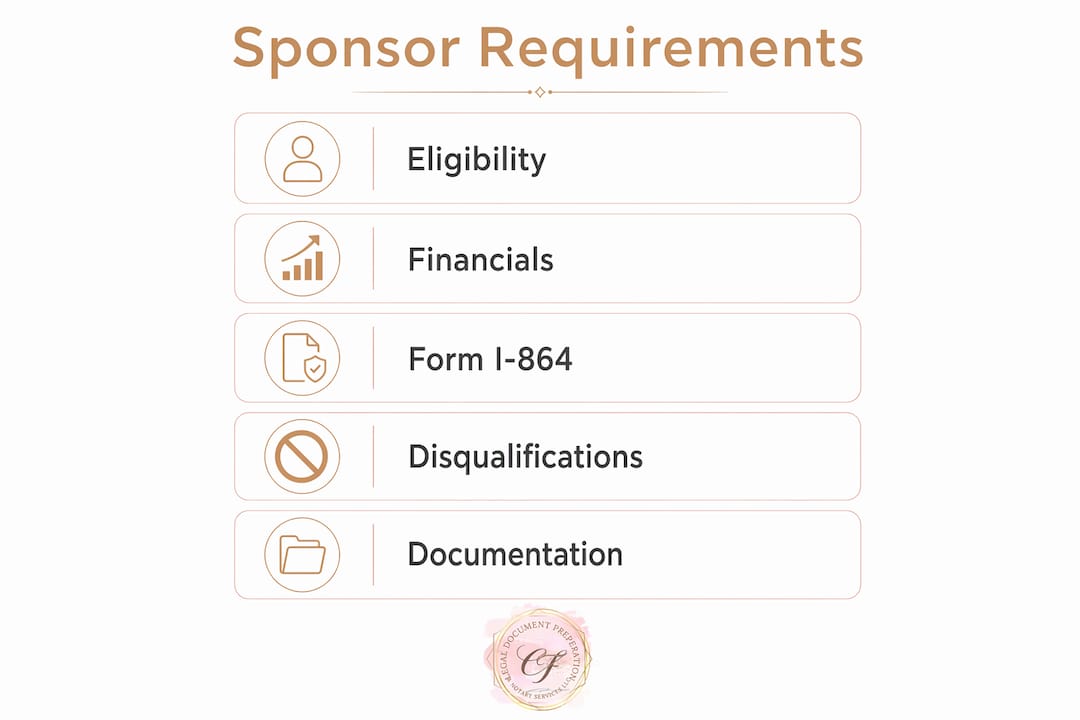
Here is a quick summary of what sponsorship requires:
- Minimum age requirement
- U.S. citizenship or lawful permanent resident (LPR) status
- Domicile in the United States or a U.S. territory
- Household income meeting or exceeding the Federal Poverty Guidelines threshold
- Completion and signing of Form I-864, Affidavit of Support
- Ongoing financial responsibility until one of the qualifying termination events occurs
1. Who qualifies as a sponsor under USCIS rules?
Eligibility for immigration sponsorship is more specific than most people expect. You must meet every requirement, not just most of them, before USCIS or a consular officer will accept your Affidavit of Support.
- Age: You must be at least 18 years old at the time you sign Form I-864.
- Status: You must be a U.S. citizen, U.S. national, or lawful permanent resident.
- Domicile: You must be domiciled in the United States, meaning you live here with the intent to remain. Temporary absence abroad does not disqualify you, provided you can show concrete ties to the U.S., such as an active U.S. bank account, voter registration, or property ownership.
- Domicile evidence: Acceptable proof includes U.S. bank account statements, a property deed, voter registration records, or a U.S. driver's license.
- Joint sponsors: A joint sponsor must independently meet all the same age, status, and domicile requirements. The joint sponsor does not need to be related to the immigrant, but they cannot combine their income with yours to reach the threshold.
- Substitute sponsors: If the original petitioner has died after petition approval, a substitute sponsor may step in. That person must be a qualifying relative of the immigrant, at least 18 years old, a U.S. citizen or LPR, and domiciled in the U.S.
One point that catches sponsors off guard: if you live abroad, you may still qualify, but only if you can prove your residence overseas is temporary and your U.S. domicile is actively maintained. Showing a bank account alone may not be enough. Voter registration, a U.S. lease, or a U.S. employer letter all strengthen the case considerably.
2. What are the financial requirements for sponsors?
The financial side of sponsorship requirements for immigration is where most applications run into trouble. The income threshold is set at 125% of the Federal Poverty Guidelines for your total household size, and that size includes you, your dependents, any relatives living with you, and the immigrants you are sponsoring.
- Income threshold: Your household income must equal or exceed 125% of the Federal Poverty Guidelines for your household size.
- Household size calculation: Count yourself, all dependents listed on your tax return, any relatives living with you, and every immigrant you are sponsoring.
- Using household member income: If your own income falls short, you can add income from household members who sign Form I-864A, the Contract Between Sponsor and Household Member.
- Joint sponsor option: A joint sponsor who independently meets the 125% threshold can file a separate Form I-864 to cover the gap. You cannot pool your income with theirs.
- Assets as an alternative: If income alone is insufficient, you may use assets such as savings accounts, stocks, bonds, or real estate. The net value of those assets must equal five times the difference between your household income and the 125% threshold. For a spouse or adult child of a U.S. citizen, that multiple drops to three times the difference.
- Military exception: Active duty U.S. Armed Forces members sponsoring a spouse or child only need to meet 100% of the Federal Poverty Guidelines, not 125%.
Pro Tip: Check the Federal Poverty Guidelines currently in effect at the time you file, not the prior year's figures. USCIS updates these guidelines annually, and using outdated numbers is one of the most common reasons for processing delays.

3. What does Form I-864 actually obligate you to do?
Form I-864 is not a formality. It is a legally enforceable contract between you and the U.S. government, and USCIS is explicit about the consequences of failing to honor it.
- Duration: Your obligation lasts until the sponsored immigrant becomes a U.S. citizen, accumulates 40 qualifying quarters of work (roughly 10 years), departs the U.S. permanently and loses LPR status, or until either of you dies.
- Means-tested benefits: If the immigrant receives federal, state, or local means-tested public benefits, the agency providing those benefits can demand repayment from you. If you refuse, they can sue you and recover legal fees on top of the benefit costs.
- Primary petitioner's role: Even when a joint sponsor or household member income is used, the primary petitioner must still file their own Form I-864. That obligation cannot be delegated away.
- Joint sponsor responsibility: Each joint sponsor is individually responsible only for the immigrants named on their specific Form I-864. If you are coordinating sponsorship for multiple family members, each joint sponsor's liability is limited to the people listed on their affidavit.
- Long-term commitment: Divorce does not end the obligation. A change in your financial situation does not end it either. The contract remains in force regardless of your relationship with the immigrant after they receive their green card.
The enforceability of Form I-864 is something USCIS stresses directly. Sponsors who are not prepared for a decade or more of potential financial responsibility should think carefully before signing. Understanding sponsor legal responsibilities before committing is a step that protects both parties.
4. What can disqualify you from sponsoring an immigrant?
Several situations can prevent a sponsorship application from moving forward, and some are more avoidable than others.
- Failing the income threshold: Not meeting 125% of the Federal Poverty Guidelines is the most common disqualifier. Using outdated guidelines or miscounting household size both lead to the same result.
- Domicile problems: If you cannot demonstrate a genuine U.S. domicile, your Form I-864 will not be accepted. Living abroad without clear evidence of intent to return is a frequent issue for sponsors working overseas.
- Incomplete or inaccurate Form I-864: Missing pages, unsigned sections, or incorrect household size calculations will result in rejection. Consular officers will not accept incomplete forms.
- Missing tax returns: Failure to provide your most recent federal income tax return, or a written explanation for why you were not required to file, will delay or deny the application.
- Misunderstanding joint sponsorship rules: Some sponsors assume they can combine their income with a joint sponsor's income to reach the threshold. They cannot. The joint sponsor must independently meet the requirement.
- Outstanding obligations from prior sponsorships: If you have an unresolved debt from a previous sponsorship where the immigrant received means-tested benefits and you failed to repay, that history can complicate a new application.
Delays caused by outdated income guidelines are particularly frustrating because they are entirely preventable. USCIS publishes updated Federal Poverty Guidelines each year, and verifying the current figures before filing takes only a few minutes.
5. What documents do you need to prove sponsorship eligibility?
Gathering the right paperwork before you file saves time and reduces the risk of a request for additional evidence. The documentation requirements cover both your identity and your financial capacity.
- Federal income tax returns: Provide your most recent year's return. Submitting up to three years of returns is recommended when your income has varied or you want to build the strongest possible case.
- W-2s and 1099s: Include all W-2 and Form 1099 documents for the years you submit. Self-employed sponsors should also include Schedule C, D, E, or F from their most recent return.
- Pay stubs: Recent pay stubs from the last six months support your current income claim.
- Employment letter: A letter from your employer confirming your position, salary, and employment status adds credibility to your income documentation.
- Proof of citizenship or LPR status: U.S. citizens submit a birth certificate, U.S. passport, or Certificate of Naturalization. Lawful permanent residents submit a copy of both sides of their Form I-551 (Green Card).
- Form I-864 and Form I-864A: The primary petitioner always files Form I-864. Any household member whose income you are using must sign a separate Form I-864A.
- Domicile evidence: Bank statements, property deeds, voter registration cards, or a U.S. driver's license all serve as domicile proof.
- Asset documentation: If you are using assets to supplement income, provide records showing the asset's location, ownership, acquisition date, current value, and any liens or liabilities against it.
- Joint sponsor documents: A joint sponsor submits their own Form I-864 along with proof of income, tax returns, and proof of citizenship or LPR status.
A Florida immigration document checklist can help you organize these materials if you are filing from Florida or supporting an immigrant who will be adjusting status there.
6. Expert tips for preparing your sponsorship paperwork
Getting the paperwork right the first time matters. Requests for additional evidence add months to a case, and errors in Form I-864 can result in denial.
Pro Tip: Organize all documents chronologically and label each item clearly. A consular officer or USCIS adjudicator reviewing a well-organized packet moves faster and asks fewer follow-up questions.
- Verify current Federal Poverty Guidelines: Always use the guidelines in effect on the date you file, not the prior year's figures. USCIS publishes Form I-864P with updated thresholds.
- Explain any unfiled tax years: If you were not required to file a return in a given year, include a written statement explaining why. Leaving this blank without explanation causes delays.
- Document assets thoroughly: For each asset, show ownership, current market value, and any outstanding liens. Assets must be convertible to cash within 12 months to count.
- Double-check Form I-864 for completeness: Every required field must be filled in, including your Social Security number, address, and signature. Missing any of these fields will result in rejection at the lockbox.
- Prepare for follow-up requests: Even a well-prepared packet can trigger a request for additional evidence. Keep copies of everything you submit so you can respond quickly.
- Use a legal document preparation service: A certified legal document preparer familiar with USCIS requirements can review your Form I-864 and supporting documents for accuracy before you file. The benefits of immigration document preparation services include catching errors that are easy to miss when you are managing the process alone.
7. How does sponsoring an immigrant affect your credit and finances?
Signing Form I-864 does not appear on your credit report as a debt, and it does not directly lower your credit score. However, the financial exposure it creates is real and can affect your borrowing capacity in indirect ways.
When you apply for a mortgage or a large loan, lenders may ask about contingent liabilities. If you disclose your sponsorship obligation, a lender may factor the potential repayment risk into their assessment of your debt-to-income ratio. This is especially relevant if the sponsored immigrant is receiving or likely to receive public benefits.
The more direct financial risk is the repayment obligation itself. If the immigrant receives means-tested federal benefits and the granting agency pursues you for reimbursement, that demand becomes a real financial liability. Unpaid reimbursement demands can escalate to lawsuits, and court judgments do affect your credit. The practical takeaway: sponsorship is a long-term financial commitment that deserves the same careful consideration you would give to co-signing a loan.
8. How do sponsorship rules differ by immigrant category?
The sponsorship requirements for immigration vary depending on whether the immigrant is entering through a family-based or employment-based pathway.
Family-based sponsorship is the most common scenario. All immediate relatives of U.S. citizens, including spouses, parents, and unmarried children under 21, require a Form I-864 from the petitioner. The same applies to relatives qualifying under the four family preference categories, which cover adult unmarried children of U.S. citizens, spouses and children of permanent residents, married children of U.S. citizens, and siblings of adult U.S. citizens.
Employment-based sponsorship works differently. Most employment-based immigrants do not require a Form I-864 from a personal sponsor. The exception applies when a U.S. citizen or permanent resident relative filed the Form I-140 petition, or when such a relative holds a significant ownership interest (5% or more) in the petitioning employer. In those cases, that relative must complete Form I-864. For the employment-based process, the employer typically files Form I-140 with USCIS after obtaining any required labor certification from the Department of Labor.
For family-based cases, the petitioner starts the process by filing Form I-130 with USCIS. Each sponsored family member requires a separate petition. The Affidavit of Support comes later, once the case moves to the National Visa Center or the immigrant files for adjustment of status.
9. Can you end your sponsorship obligation early?
The short answer is: rarely, and not by choice alone. The sponsorship obligation created by Form I-864 does not have an opt-out provision. You cannot simply withdraw or cancel it after the immigrant has received their green card.
The obligation ends automatically under four conditions: the immigrant naturalizes as a U.S. citizen, the immigrant accumulates 40 qualifying quarters of work credit under Social Security (which generally takes about 10 years), the immigrant permanently departs the United States and loses lawful permanent resident status, or either the sponsor or the immigrant dies.
Divorce does not terminate the obligation. A falling-out with the immigrant does not terminate it. Even if the immigrant moves across the country and you have no contact, your Form I-864 remains enforceable. One narrow exception exists: if the original petitioner dies before the immigrant receives their green card, a substitute sponsor can take over the obligation, effectively releasing the deceased petitioner's estate from future liability.
If you are concerned about the long-term exposure, the most practical step is to understand the conditions thoroughly before you sign. Consulting with a legal document preparation service that specializes in immigration forms can help you review the full scope of what you are committing to before the contract becomes binding.
How Cflegalformhelp can help you get this right
Preparing a complete and accurate sponsorship packet takes time, attention to detail, and a clear understanding of what USCIS expects. Cflegalformhelp, founded by Cristina Fernandez, a certified legal document preparer and immigration paralegal based in Naples, Florida, assists sponsors with the preparation of Form I-864, Form I-864A, and all supporting documentation. Services are available in both English and Spanish, with flat-fee pricing and no hidden costs.
If you are ready to move forward or want a professional review of your documents before filing, visit Cflegalformhelp immigration services to get started.
Key Takeaways
Sponsoring an immigrant to the U.S. requires meeting strict eligibility, income, and documentation standards under a legally binding contract that can last a decade or more.
| Point | Details |
|---|---|
| Core eligibility | You must be at least 18, a U.S. citizen or LPR, and domiciled in the United States. |
| Income threshold | Household income must reach at least 125% of the Federal Poverty Guidelines for your household size. |
| Form I-864 is binding | The Affidavit of Support is a legally enforceable contract; failing to meet it can result in lawsuits and repayment demands. |
| Obligation duration | Sponsorship ends when the immigrant naturalizes, earns 40 work quarters, departs permanently, or either party dies. |
| Documentation depth | Submit up to three years of tax returns, W-2s, 1099s, pay stubs, and proof of citizenship or LPR status to build the strongest case. |