

A notary verifies a signer's identification to confirm the person signing a document is exactly who they claim to be. This step is the foundation of why notary checks signer identification, and it is not optional. Without confirmed identity, a notarized document has no legal standing. The National Notary Association and state laws across the U.S. treat identity verification as a core legal duty, not a formality. Skipping it exposes the notary to civil liability, commission revocation, and surety bond claims up to $50,000 depending on the state. For individuals and small business owners, understanding this process means fewer delays, fewer rejected documents, and stronger legal protection.
Why notary checks signer identification: the legal foundation
Signer identity verification is the process by which a notary confirms that the person in front of them matches the individual named in the document being notarized. The notary's seal signals to courts, banks, and government agencies that identity was rigorously confirmed. That assurance is what gives notarized documents their legal weight in property deeds, estate plans, business contracts, and immigration forms.
The importance of notary ID verification goes beyond paperwork. When a notary places their seal on a document, they are making a sworn statement that the signer appeared before them and was properly identified. If that identification step is skipped or done carelessly, the document can be challenged, voided, or used as evidence in a fraud case. Courts treat a notary's failure to verify identity as a serious breach of duty.
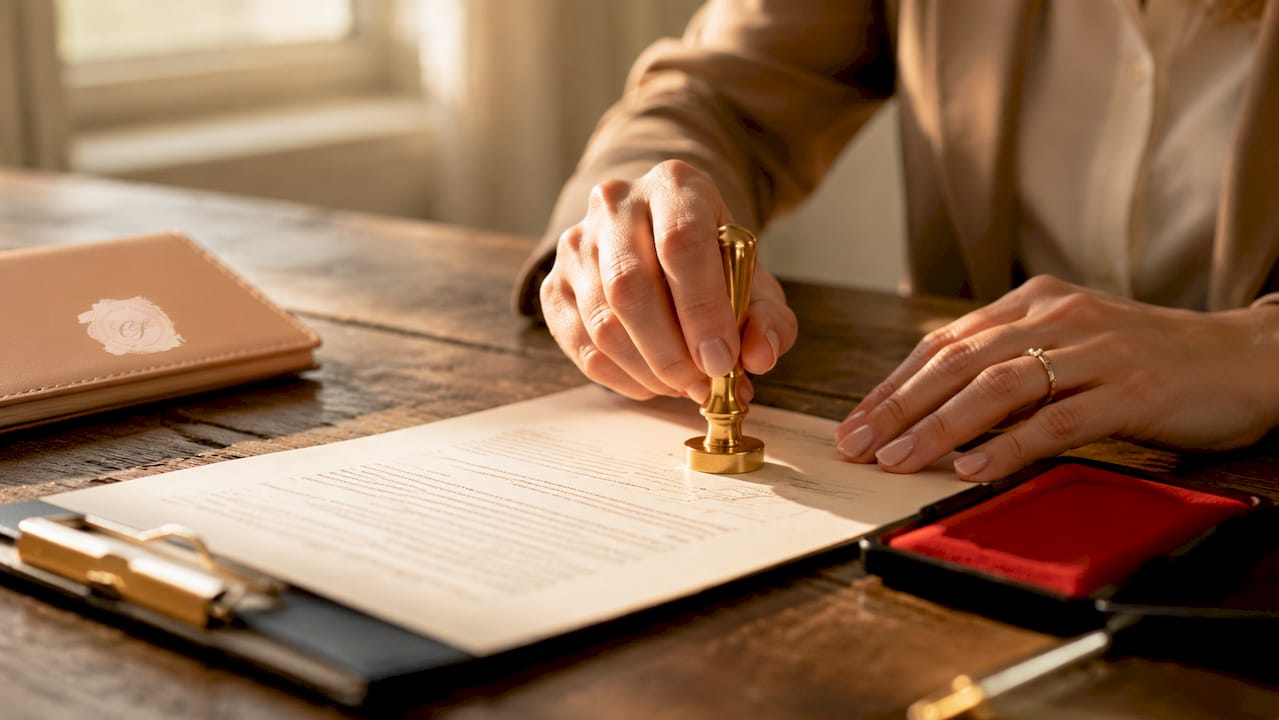
State laws set the specific rules, but the principle is universal across all U.S. jurisdictions. Florida, Texas, California, and Washington each have statutes that define acceptable ID types, the conditions for using personal knowledge, and the rules for credible witnesses. The role of identification in notarization is therefore both a legal requirement and a public trust obligation.
What methods do notaries use to verify signer identification?
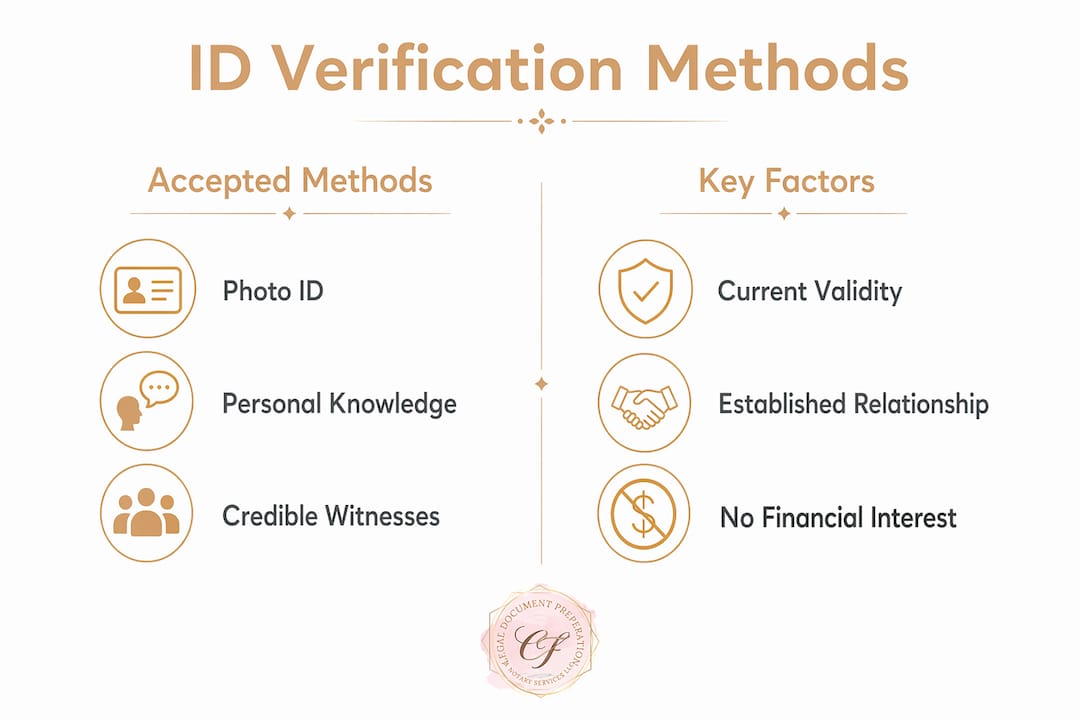
Notaries verify identity through one of three accepted methods: a valid government-issued photo ID, established personal knowledge of the signer, or a credible witness who personally knows the signer and provides their own ID.
Government-issued photo ID
A government-issued photo ID is the most common and straightforward method. The ID must be current, not expired, issued by a U.S. federal or state authority, and contain both a photograph and a signature. Acceptable examples include a driver's license, a U.S. passport, a military ID, or a permanent resident card. The notary checks the photo against the person standing in front of them, confirms the name matches the document, and verifies the expiration date.
Personal knowledge
Personal knowledge requires a well-established, long-standing relationship between the notary and the signer. Casual familiarity is not enough. The notary must be prepared to testify under oath about the nature of that relationship and the signer's identity. This method is rarely used in professional notary settings because the legal bar is high and the personal liability is significant.
Credible witnesses
A credible witness is a third party who personally knows the signer, has no financial interest in the document, and can provide their own valid ID. Credible witnesses must swear an oath before the notary that the signer is who they claim to be. If the witness fails to meet these criteria, the notary must refuse the notarization.
| Method | Best used when | Key requirement | Risk level |
|---|---|---|---|
| Government-issued photo ID | Signer has current, valid ID | Photo, signature, not expired | Low |
| Personal knowledge | Notary has long-term relationship with signer | Ability to testify under oath | High |
| Credible witness | Signer lacks acceptable ID | Witness has no financial interest, provides own ID | Medium |
Pro Tip: Always bring two forms of ID to a notary appointment. If your primary ID has a minor discrepancy, a backup document can prevent a wasted trip.
Why is signer ID checked: legal and ethical responsibilities
A notary who fails to verify identity properly faces serious consequences. Failure to verify identity can result in civil liability, administrative penalties, and surety bond claims that reach up to $50,000 depending on the state. That figure reflects the financial exposure a notary accepts every time they place their seal on a document. It is a strong incentive to get the identification step right every single time.
Beyond financial penalties, a notary's commission can be suspended or permanently revoked. State commissioning authorities actively monitor notary complaints, and increased authentication requests have led to greater scrutiny of how notaries handle identity checks. A single complaint about a notarization done without proper ID verification can trigger a full investigation.
The ethical dimension is equally significant. The notary's seal is a public trust instrument. When banks accept a notarized mortgage, when courts accept a notarized affidavit, and when immigration agencies accept a notarized translation, they rely on the notary's confirmation that the signer's identity was verified. That trust collapses if identity checks are treated as optional. For small business owners signing contracts or property documents, a notarization that later gets challenged can delay deals, void agreements, and create costly legal disputes.
Personal appearance before the notary is a non-negotiable requirement in all U.S. states. Notarizations performed without the signer physically present are routinely challenged and frequently result in formal complaints. This rule exists precisely because identity cannot be confirmed remotely without specific legal protocols in place.
What challenges affect signer identification in notarization?
Signer identity verification is not always clean or simple. Real-world appointments frequently surface complications that notaries must handle carefully and consistently.
Name discrepancies are among the most common issues. A driver's license might show a middle name that does not appear in the document, or a married name that differs from a maiden name on an older record. Minor discrepancies such as a missing middle name may require additional proof or a correction to the document before the notary can proceed.
Expired or altered IDs require an immediate refusal. A notary has no authority to accept an expired government ID, regardless of how recently it expired. Signs of alteration, such as a photo that appears lifted or laminate that is bubbled, are red flags that require the notary to stop the appointment.
Jurisdictional differences add another layer of complexity. California, for example, places strict limits on when personal knowledge can be used as an identification method. Florida has its own rules for remote notarization that require specific technology and identity verification steps not used in traditional in-person appointments.
Here are the most common preparation mistakes that cause notarization delays:
- Bringing an expired driver's license or passport
- Presenting an ID with a name that does not match the document
- Assuming a foreign-issued ID will be accepted without checking state rules
- Arriving without a credible witness when no valid ID is available
- Failing to disclose a name change before the appointment
Pro Tip: Check your ID expiration date at least one week before your notary appointment. Renewing an ID takes time, and an expired ID will result in a refused notarization regardless of the circumstances.
Remote notarizations introduce a different set of challenges for signer identity verification. Florida allows remote online notarization under specific statutes, but the notary must use an approved identity verification platform that checks government ID through credential analysis and knowledge-based authentication questions. The Florida notarization requirements for remote sessions are more detailed than those for in-person appointments, and signers should review them before scheduling.
How do notaries ensure thorough and secure identification checks?
A careful notary does not simply glance at an ID and move on. The inspection process is deliberate and follows a specific sequence to catch fraud before it reaches the document.
- Check the photo. The notary compares the ID photo directly to the person present. Differences in age, hair color, or facial structure that cannot be explained by time are grounds for refusal.
- Verify the expiration date. An expired ID is not acceptable under any circumstances. The notary checks the date on the face of the ID and confirms it has not passed.
- Inspect for signs of alteration. Notaries use tools like UV flashlights and magnifying glasses to check security features, including holograms, microprinting, and UV-reactive ink. These tools serve both a security function and a deterrent function when used visibly in front of the signer.
- Confirm name consistency. The name on the ID must match the name on the document. Any discrepancy triggers additional scrutiny or a request for supplemental documentation.
- Assess signer behavior. Nervousness alone is not a red flag, but a signer who cannot confirm basic details from their own ID, hesitates when asked to state their name, or presents an ID that does not match their physical description raises legitimate concerns.
ID authenticity checks go beyond the photograph. A notary trained in fraud prevention looks at the entire document, not just the face. This level of diligence is what separates a professional notary from someone who simply stamps whatever is placed in front of them. For individuals and small business owners, working with a trained notary means your documents carry real legal weight.
Key Takeaways
A notary checks signer identification because it is a legal requirement that prevents fraud, protects all parties, and preserves the evidentiary value of every notarized document.
| Point | Details |
|---|---|
| Identity verification is legally required | Notaries must verify identity before notarizing; failure risks civil liability and commission revocation. |
| Three accepted methods exist | Government-issued photo ID, personal knowledge, and credible witnesses are the only valid options. |
| Surety bond exposure is real | Depending on the state, a notary's surety bond can face claims up to $50,000 for improper notarizations. |
| Name discrepancies cause delays | Minor differences between ID and document names require additional proof or document correction before proceeding. |
| Physical inspection tools matter | UV flashlights and magnifiers help notaries detect altered IDs and demonstrate professional due diligence. |
What I have learned from years of ID verification at the notary table
After years of notarizing documents for individuals, families, and small business owners across South Florida, I can tell you that the ID check is the moment that separates a valid notarization from a legal liability. I have seen signers arrive with expired passports, IDs that do not match their legal name on the document, and even cases where a family member tried to sign on behalf of someone who was not present. Every single one of those situations required me to stop the appointment.
The part that surprises most people is how often these issues come from good-faith mistakes rather than intentional fraud. Someone forgets their license expired three months ago. A recently married client brings an ID with their maiden name but a document with their married name. These are not criminal situations, but they still require the notary to refuse or pause until the discrepancy is resolved. The law does not make exceptions for good intentions.
What I tell every client before their appointment: treat your ID the way you treat your passport before an international flight. Check it early, confirm the name matches your document exactly, and bring a backup if you have one. A prepared signer moves through the notarization process without delays and leaves with a document that will hold up in any court, agency, or financial institution.
The notary's job is not to make your life harder. The ID check exists to protect you as much as it protects the notary. A document signed by the wrong person, or a document where identity was never confirmed, can be challenged years later at the worst possible moment. Strict ID verification is the single best protection against that outcome.
— Cristina
Notary services that get your documents right the first time
Proper identity verification is only one part of a valid notarization. The document itself must be complete, correctly formatted, and appropriate for its intended use before a notary ever picks up a seal.
Cflegalformhelp provides professional mobile notary and loan signing services for individuals and small business owners across South Florida. Every appointment follows Florida's current notarization standards, including proper ID verification and personal appearance requirements. Cflegalformhelp also offers legal document preparation to make sure your paperwork is accurate and complete before you sign. Services are available in English and Spanish, with flat-fee pricing and no hidden costs. Whether you need a single document notarized or a full set of business formation papers prepared and signed, Cflegalformhelp handles it correctly.
FAQ
Why does a notary ask for ID?
A notary asks for ID to confirm the signer is the person named in the document, which prevents fraud and validates the notarization under state law.
What ID is acceptable for notarization?
A current, government-issued photo ID with a signature is required. Acceptable forms include a driver's license, U.S. passport, military ID, or permanent resident card.
Can a notary use personal knowledge instead of ID?
Yes, but only when the notary has a well-established, long-standing relationship with the signer and can testify under oath about that relationship. Casual familiarity does not qualify.
What happens if a signer cannot provide acceptable ID?
The notary must refuse the notarization. Proceeding without proper identification can result in commission suspension or revocation under state law.
Does remote notarization require the same ID verification?
Remote notarization requires identity verification through an approved platform that uses credential analysis and knowledge-based authentication, which is often more rigorous than in-person ID checks.