

If you have held a green card for the required period, meet residence and physical-presence rules, and can demonstrate good moral character, you can file Form N-400 now. The single biggest shift heading into 2026 is the civics test: applications filed on or after October 20, 2025 draw from a 128-question pool, with 20 asked and 12 correct required to pass. Older filings still use the previous 100-question format.
TL;DR:
- Filing on or after October 20, 2025, requires passing a 20-question civics test from a 128-question pool, with 12 correct answers needed.
- Applicants must prove continuous residence and physical presence in the U.S., with absences over six months risking eligibility; supporting evidence is essential.
- Disclosing all arrests, citations, and tax issues, along with obtaining civil document translations and proper documentation, prevents delays and continuances.
- Online filing is encouraged but cannot support fee waivers; preparing all necessary documents and evidence beforehand reduces the risk of rejection.
- The primary cause of case delays is paperwork issues rather than test performance; thorough evidence gathering and full disclosure are key to approval.
Table of Contents
- Eligibility checklist: the nine statutory requirements to confirm before you file
- Continuous residence and physical presence: how trips and absences affect your eligibility clock
- Good moral character: what USCIS looks for and common non-criminal pitfalls
- How to file Form N-400 in 2026: online vs paper, fees, and practical filing tips
- Documents checklist: exactly what to submit and what to bring to your biometrics and interview
- Civics and English testing in 2026: which test you take and how it works
- Biometrics and the USCIS interview: what to expect and how to avoid a continued application
- Processing times and timeline: realistic expectations and how to monitor your case
- After approval: the oath ceremony, certificate of naturalization, and immediate next steps
- Preparing your application without costly mistakes
- What actually separates a clean approval from a continued case
- Get help preparing your N-400 the right way
- Sources
Eligibility checklist: the nine statutory requirements to confirm before you file
Before you spend a single dollar on Form N-400, run through the eligibility requirements USCIS lists in its own N-400 instructions. Missing even one means a denial or a long delay, so treat this as a pass/fail filter, not a suggestion.
- You must be at least 18 years old when you file.
- You need lawful permanent resident status for the standard required period, or a shorter period if you are married to and living with a U.S. citizen.
- You must show continuous residence in the United States for the required period, without a break long enough to reset the clock.
- You need physical presence in the country for at least half of the required qualifying period.
- You must have lived in the state or USCIS district where you're filing for a minimum period immediately before applying.
- You must be a person of good moral character during the statutory period.
- You need attachment to the principles of the U.S. Constitution.
- You must be willing to take the Oath of Allegiance.
- You must pass the English and civics tests, unless you qualify for an age-based or disability-based exception.
That last point matters more than most applicants assume. If a medical condition prevents you from learning English or civics, Form N-648 lets a licensed medical professional document the disability so USCIS can waive the testing requirement.
Continuous residence and physical presence: how trips and absences affect your eligibility clock
Two clocks run simultaneously, and confusing them causes more filing mistakes than almost anything else on this list.
- Continuous residence breaks if you leave the U.S. for one year or more. A trip of six months to a year does not automatically break it, but you'll need to prove you kept ties here (a job, a lease, tax filings) during that absence.
- Physical presence is simpler math: you need to have physically been in the U.S. for at least half the qualifying period, which works out to roughly 913 days within the five-year window, or 548 days within the three-year spouse window, according to the Form N-400 instructions.
- Early filing is allowed up to 90 days before you hit your five-year (or three-year) anniversary, but only if you've already satisfied continuous residence and physical presence by the projected filing date. File too early and USCIS will reject the application outright.
Gather boarding passes, passport stamps, and employment records now. They're the evidence that turns a shaky timeline into a clean approval.
Good moral character: what USCIS looks for and common non-criminal pitfalls
USCIS evaluates good moral character across the entire statutory period, right up through the day you take the Oath of Allegiance. Most applicants assume this standard is only about criminal history. It isn't.
- Unpaid federal or state taxes, especially with no payment plan in place, can sink an otherwise clean application.
- Unpaid child support obligations raise the same red flag, even absent any court order for enforcement.
- Failing to register for Selective Service (for men who were 18 to 25 and living in the U.S.) is a recurring, avoidable problem.
- Any past immigration violations, including unauthorized work or prior removal proceedings, need full disclosure.
Every arrest or citation, including ones that were expunged or happened when you were a minor, must be disclosed on Form N-400 with the court disposition attached. USCIS policy guidance treats nondisclosure as a candor problem that often does more damage than the underlying incident. Bring IRS transcripts, proof of a tax payment plan, or child-support payment receipts to close the gap before an officer asks about it.
Pro Tip: If you have an old citation you think doesn't matter, disclose it anyway and attach the court record. Omitting it, not the incident itself, is usually what turns a routine case into a denial.
How to file Form N-400 in 2026: online vs paper, fees, and practical filing tips
You can file Form N-400 either through a USCIS online account or by paper mail. USCIS encourages online filing because it gives you a dashboard to track your case, upload evidence, and receive electronic notices, a real advantage over waiting on postal mail for a biometrics letter.
There's one hard rule to know before you pick a lane: if you're requesting a fee waiver or a reduced fee, you must file by paper. Online accounts don't currently support those requests. Confirm the current fee schedule directly on the USCIS fee page before submitting, since amounts periodically adjust and an underpayment causes an immediate rejection.
- Create your account at USCIS's naturalization application portal so you can save drafts instead of losing progress.
- Double-check every evidence item against the checklist before submission; missing documents trigger a Request for Evidence that adds months.
- Biometrics are generally required, though some military-affiliated applicants may qualify for exceptions.
- Save your receipt number the moment you get it. You'll need it for every processing-time and status check going forward.
Documents checklist: exactly what to submit and what to bring to your biometrics and interview
Continuances happen for a boring reason more often than a legal one: applicants show up without the right paper. Build a folder now and keep both originals and copies.
- Identity documents: green card (front and back), current passport(s), and a certified translation of your birth certificate if it isn't in English.
- Civil documents: marriage certificates, divorce decrees, death certificates if a prior spouse died, and your spouse's proof of citizenship if you're filing under the three-year rule.
- Residence and presence evidence: tax transcripts, lease or mortgage statements, pay stubs, school records, and passport pages showing travel stamps.
- Special-category evidence: arrest reports and dispositions, Selective Service registration proof, and Form N-648 if you're requesting a disability exception.
Continued cases are common, not rare, and they typically stem from exactly this kind of gap; USCIS treats a continuance as a second chance to supply what's missing, but it adds months to your timeline. A parallel green card document checklist can help you cross-reference what USCIS already has on file for you. If any civil document is in a language other than English, a certified translation needs to accompany the original, not replace it.
Civics and English testing in 2026: which test you take and how it works
Your filing date decides which civics test you take, and getting this wrong wastes weeks of study time.
- If you filed on or after October 20, 2025, you're tested from the updated 128-question pool. The officer asks 20 questions and stops once you reach 12 correct answers or 9 incorrect ones, whichever comes first.
- If you filed before that date, the older 100-question test still applies to your case.
- The English test covers speaking (assessed throughout your interview), reading, and writing, unless you qualify for an age or residency-based exception, or a disability exception under Form N-648.
Study directly from USCIS's own civics flash cards and the official question list rather than third-party apps with outdated pools. The jump to 128 questions increased the study burden meaningfully, so verify your filing date before you memorize the wrong set.
Biometrics and the USCIS interview: what to expect and how to avoid a continued application
After filing, most applicants get a biometrics appointment to capture fingerprints and a photo for background checks. The interview comes later, and it moves through your N-400 answers, the civics and English tests, and a review of your original documents.
- The officer confirms your identity and reviews your application for accuracy against your testimony.
- You take the civics and English tests unless exempted.
- The officer verifies original documents against the copies you submitted with your application.
- You receive one of three outcomes: granted, continued, or denied.
Missing your appointment notice or forgetting original documents is the most common reason for a continuance, not a failed test.
Pro Tip: Print your appointment notice even if you have it saved digitally. Some field offices won't accept a phone screen as proof of your appointment.
Processing times and timeline: realistic expectations and how to monitor your case
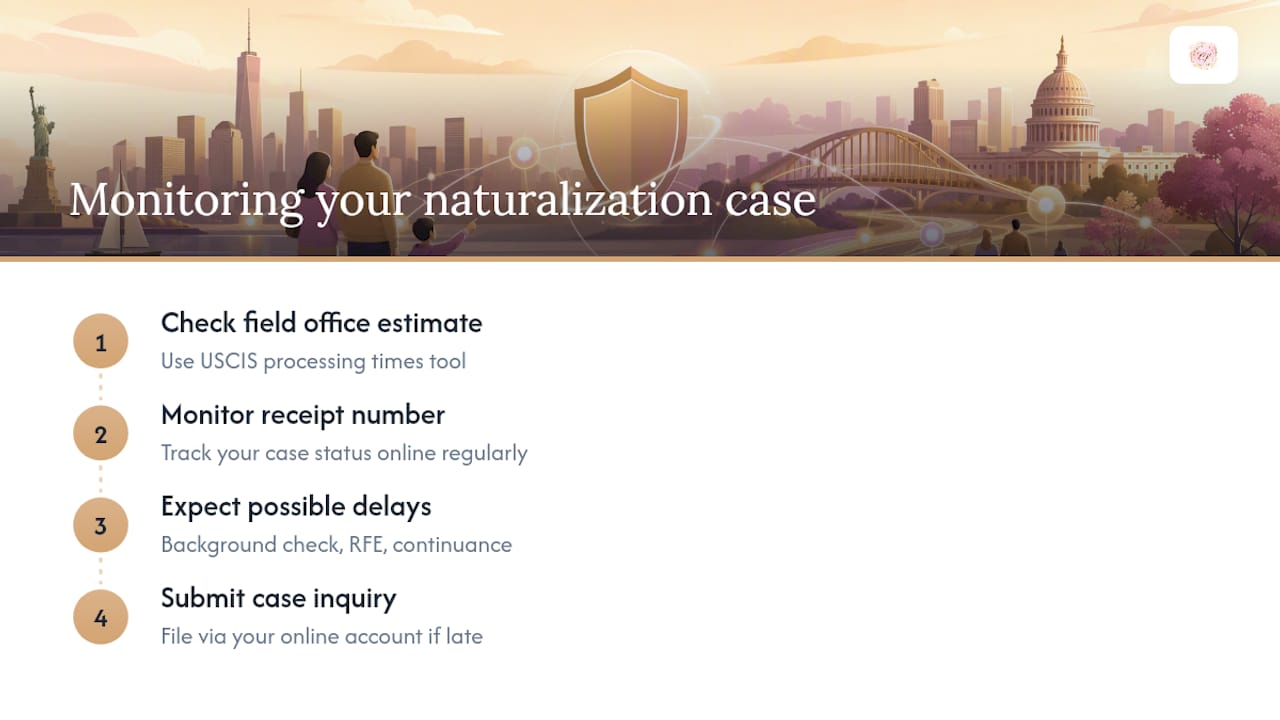
Naturalization timelines vary widely by field office, and background checks, Requests for Evidence, or a continuance can each add months. Check your specific field office's current estimate using USCIS's processing times tool and your receipt number. If your case runs past the posted time, submit a case inquiry through your online account rather than waiting indefinitely.
After approval: the oath ceremony, certificate of naturalization, and immediate next steps
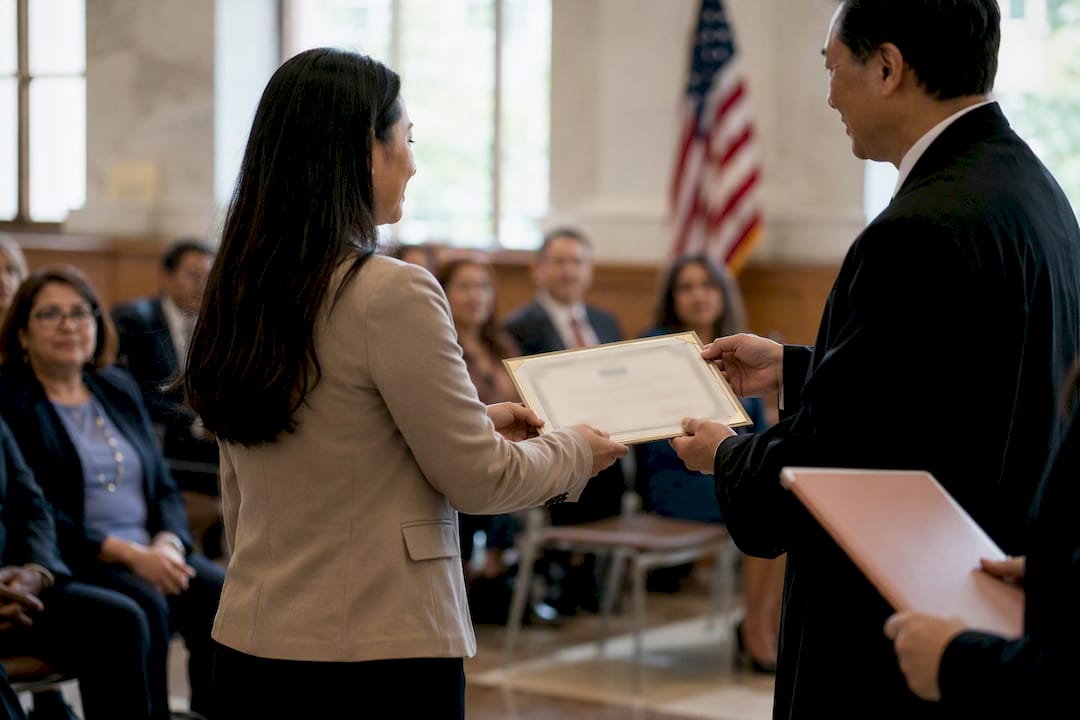
At the oath ceremony, you'll surrender your green card and receive your Certificate of Naturalization. Apply for a U.S. passport and update your Social Security record soon after. Register to vote if you choose, and store extra copies of your certificate. A replacement, if you ever need one, comes through USCIS Form N-565.
Preparing your application without costly mistakes
Cristina Fernandez, a certified legal document preparer and immigration paralegal, built her practice around one recurring pattern: most delays trace back to paperwork, not eligibility.
- Certified translations and notarized copies prevent the document mismatches that trigger continuances.
- Tax transcripts and payment-plan proof, gathered before filing, head off good-moral-character questions.
- If your case involves prior immigration violations, an old citation, or a disability exception, get a second set of eyes before you submit.
What actually separates a clean approval from a continued case
Most naturalization guides spend their word count on the civics test, and that's understandable given the 2025 change to a 128-question pool. But the test rarely sinks a well-prepared applicant. What sinks cases is paperwork friction: a missing translation, an undisclosed citation, a tax balance nobody addressed before the interview.
The conventional advice tells you to "study hard" and "gather your documents." That's true but incomplete. The sharper advice is to treat good moral character as an evidence-building exercise, not a background check you passively wait out. Pull your IRS transcripts before you file, not after an officer asks. Disclose every citation, even the ones you think don't matter, because the disclosure itself protects you more than the underlying fact ever could.
If you take one thing from this guide, prioritize document readiness over test anxiety. The civics pool expanded, yes, but it's a memorization problem with a known answer key. Your tax history, your travel record, and your civil documents are the parts of your case that actually determine whether you get approved on the first pass or spend an extra six months in continuance.
— Cristina
Get help preparing your N-400 the right way
Cflegalformhelp is the practical alternative to hiring an attorney for routine N-400 preparation. Instead of paying hourly legal fees for paperwork you can complete with guided support, you get flat-fee, bilingual assistance built specifically for self-represented applicants navigating immigration form help in English or Spanish.
That includes certified document translations, notarization for civil records like marriage or divorce certificates, and a document-check pass that catches the gaps that cause continuances, before USCIS ever sees your file. If your civil documents are in Spanish, Cflegalformhelp's certified translation services keep your originals paired correctly with English versions USCIS will accept. For applicants who also need general legal document preparation beyond immigration forms, flat pricing means you know the cost before you start. Reach out today to get your N-400 documents reviewed before you file.
This article is general information, not a substitute for advice from a qualified lawyer. Consult a qualified legal professional about your own circumstances before acting on anything here.