

File Form I-751 during the 90-day window before your conditional status expires, if you're still married and filing jointly. If your marriage ended in divorce, your spouse died, you experienced abuse, or removal would cause extreme hardship, you can file individually under a waiver, often without waiting for that 90-day window. Either way, a properly submitted I-751 receipt commonly extends your status and work or travel authorization while USCIS reviews your case.
TL;DR:
- Filing the I-751 within the 90-day window before your second anniversary is crucial unless you're eligible for a waiver due to divorce, death, abuse, or extreme hardship.
- Proper documentation of your marriage should include financial, residence, family, and social proof, organized with a detailed exhibit list and indexed pages.
- Filing jointly requires spouse cooperation and signature, while waivers need specific evidence and can be submitted at any time before your conditional status ends.
- Responding promptly and thoroughly to any USCIS requests, including RFEs and interviews, is essential for maintaining your case’s progress.
- Missing the filing deadline can lead to termination of your conditional status, but emergencies with proper evidence may justify late filing under "good cause" exceptions.
Table of Contents
- Steps for Removal of Conditions Green Card Filing
- What Documents Prove Your Marriage Was Genuine?
- Should You File Jointly or Request a Waiver?
- What Happens After You Submit Your I-751?
- What If You Miss the 90-Day Filing Window?
- Practitioner Tips That Prevent RFEs and Delays
- Why a Clean First Filing Beats Fixing Problems Later
- Sources
Steps for Removal of Conditions Green Card Filing
Getting this filing right comes down to sequence. Skip a step or file out of order, and you risk a Request for Evidence or a denial that lands you in removal proceedings. Here's the order that works.
- Check your card's expiration date and calculate your window. The filing window runs immediately before your second anniversary as a conditional resident. USCIS's When to File Your Petition to Remove Conditions page includes a filing date calculator that removes the guesswork.
- Decide your filing path now, not later. Joint filers need their spouse's cooperation and signature. Waiver filers need documentation specific to their situation, death certificate, divorce decree, or evidence of abuse, so start collecting it early.
- Complete the current version of Form I-751 accurately. Old form editions get rejected outright. Sign it, attach the filing fee or an approved fee waiver request, and double check every A-Number listed.
- Build your exhibit packet in chronological order. Number every page and attach an index page at the front listing what each exhibit proves.
- Submit to the correct address or through your USCIS online account, then keep a full copy of everything you sent along with your mailing receipt or confirmation.
Two things trip people up more than anything else at this stage:
- Filing with an expired form edition downloaded from an old bookmark instead of the current version on uscis.gov.
- Forgetting the fee waiver documentation when claiming financial hardship, which stalls the entire filing.
Pro Tip: Print your exhibit index on colored paper and place it as the very first page after your form. It sounds minor, but it gives an adjudicator an instant road map instead of forcing them to flip through hundreds of pages guessing what's what.
What Documents Prove Your Marriage Was Genuine?
USCIS decides these petitions on a preponderance of the evidence standard, meaning your documentation just needs to make your marriage's authenticity more likely true than not. That's a lower bar than "beyond doubt," but it still requires real paper, not a handful of photos from your wedding day. The USCIS Policy Manual outlines the categories that carry the most weight.
- Financial records: joint bank statements, joint tax returns, shared insurance policies, and any loans or mortgages held together.
- Residence proof: a lease or mortgage listing both names, utility bills, and mail addressed to both spouses at the same location.
- Family evidence: children's birth certificates and joint medical or school records where applicable.
- Social and relationship proof: dated, captioned photos spanning the marriage, travel records, and affidavits from people who know the couple, complete with contact information.
Organize all of it behind a one-page exhibit list with tabbed sections by category. Translate any non-English documents and attach certified copies where originals aren't practical. If your children are included as derivative applicants, list their A-Numbers clearly on the cover sheet so nothing gets misfiled.
Pro Tip: Coverage matters as much as volume. A stack of documents all dated within the same three months looks thinner to an adjudicator than a smaller set spanning your entire marriage.
Should You File Jointly or Request a Waiver?
Joint filing is the default path and it only works if you're still married to the same spouse who sponsored your conditional status. It has one hard rule: submit within the 90-day window before expiration, no exceptions for convenience.
A waiver removes that timing rule but requires you to prove one of several specific grounds:
- Spouse's death: a certified death certificate.
- Divorce: a final divorce decree, not just a filing or pending case.
- Abuse: police reports, medical records, protective orders, or affidavits from advocates or counselors.
- Extreme hardship: documentation showing what removal would actually cost you, medically, financially, or otherwise.
Waiver petitions can be filed anytime after you receive conditional status, as long as it's before that status is terminated, which gives you more breathing room than joint filers get. If divorce or abuse is your basis, gather court orders and supporting records before you file rather than scrambling afterward.
What Happens After You Submit Your I-751?
Once USCIS receives your petition, you'll get a receipt notice first. That notice matters more than most applicants realize: a properly filed I-751 extends your card's validity and your work and travel authorization while the case sits in the queue, per USCIS guidance on removing conditions. Some petitioners receive an extension that runs well beyond a year past their card's printed expiration date, so don't panic if your case is still pending after your card technically expires.
From there, expect a possible biometrics appointment, and in some cases an RFE or an in-person interview. Timing varies significantly by field office and caseload, so two petitioners filing the same week can see very different schedules.
- Respond to any RFE completely and by the stated deadline. Partial responses often trigger denial rather than a second request.
- Bring original documents to any interview. Copies alone can raise questions you don't need to answer.
- Missing an interview without rescheduling can lead straight to denial and referral to removal proceedings.
- Track your case through your USCIS online account using your receipt number, and keep every notice along with your exhibit list on hand at all times.
What If You Miss the 90-Day Filing Window?
Missing the window is serious. Late joint filing can terminate your conditional status and open the door to removal proceedings, and USCIS does not automatically extend leniency just because you meant to file on time.
That said, "good cause" exceptions exist for real emergencies: a serious medical crisis, a natural disaster, incarceration, or similarly extenuating circumstances. Document whichever applies with medical records, official reports, or other evidence created close to the time it happened, not written up after the fact.
When filing late, include a clear written explanation alongside your supporting documentation. Don't wait to gather perfect evidence before submitting. File as soon as you can with the explanation you have, since delay only compounds the risk.
Practitioner Tips That Prevent RFEs and Delays
An indexed, tabbed physical packet still helps, even in an era of online filing. Adjudicators review a high volume of cases, and a submission with a clear exhibit list and numbered pages gets through review faster than a loose stack of documents. Practitioners commonly prepare both a paper original and a searchable digital copy for their own records.
The most common errors seen in document preparation work aren't complicated: unsigned forms, missing filing fees, petitions sent to the wrong address, and documents that arrive incomplete or untranslated. Every one of those is avoidable with a checklist.
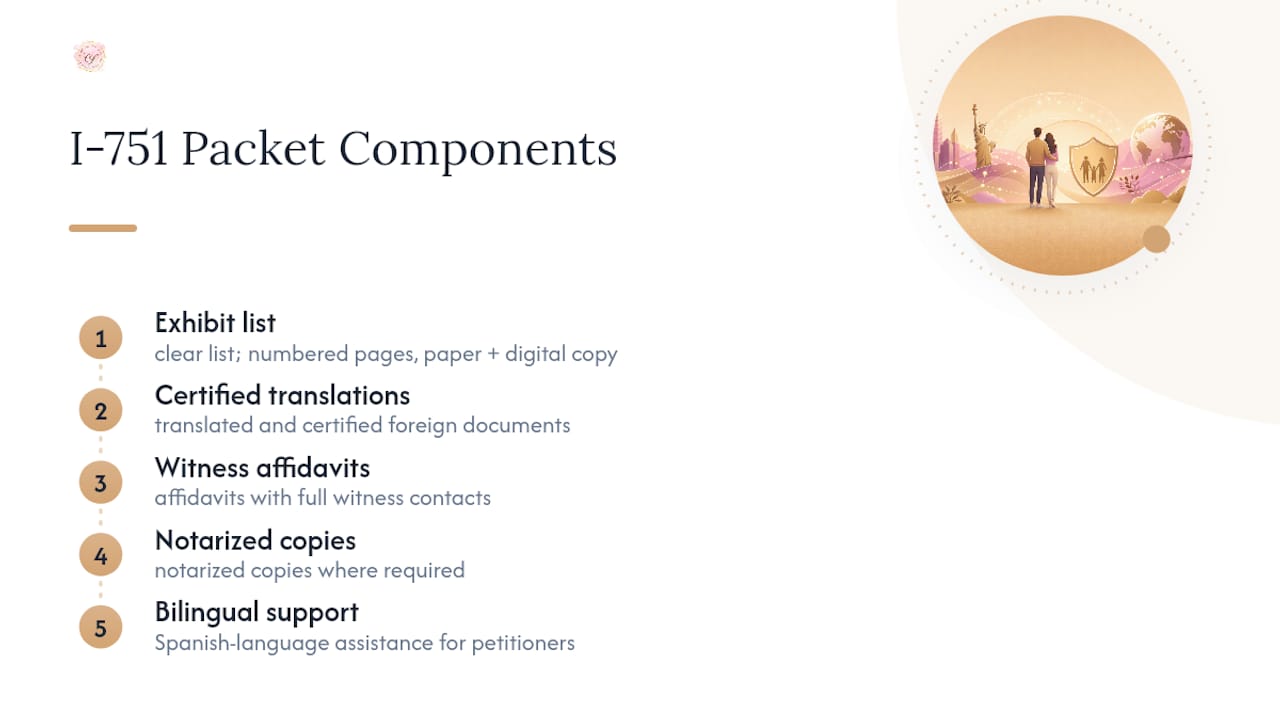
A solid preparation checklist includes an exhibit list, translated and certified copies of foreign documents, affidavits with full witness contact information, notarized copies where required, and bilingual support for petitioners more comfortable working in Spanish. Cflegalformhelp's green card documents checklist walks through exactly what belongs in that packet, and the Florida immigration document checklist covers translation and notarization requirements in more detail.
Pro Tip: If your case involves a denial risk or you're heading toward removal proceedings, get in front of it early. A judicial review resource like MNS Solicitors can outline what post-decision options actually look like before you're forced to react under pressure.
Why a Clean First Filing Beats Fixing Problems Later
Most guidance on this topic treats I-751 filing as a paperwork exercise: fill out the form, attach some documents, mail it in. That undersells what's actually happening. USCIS puts the burden of proof entirely on the petitioner, and if that first filing gets denied, the case can move into removal proceedings where the burden shifts to the government instead, a much harder position to recover from.
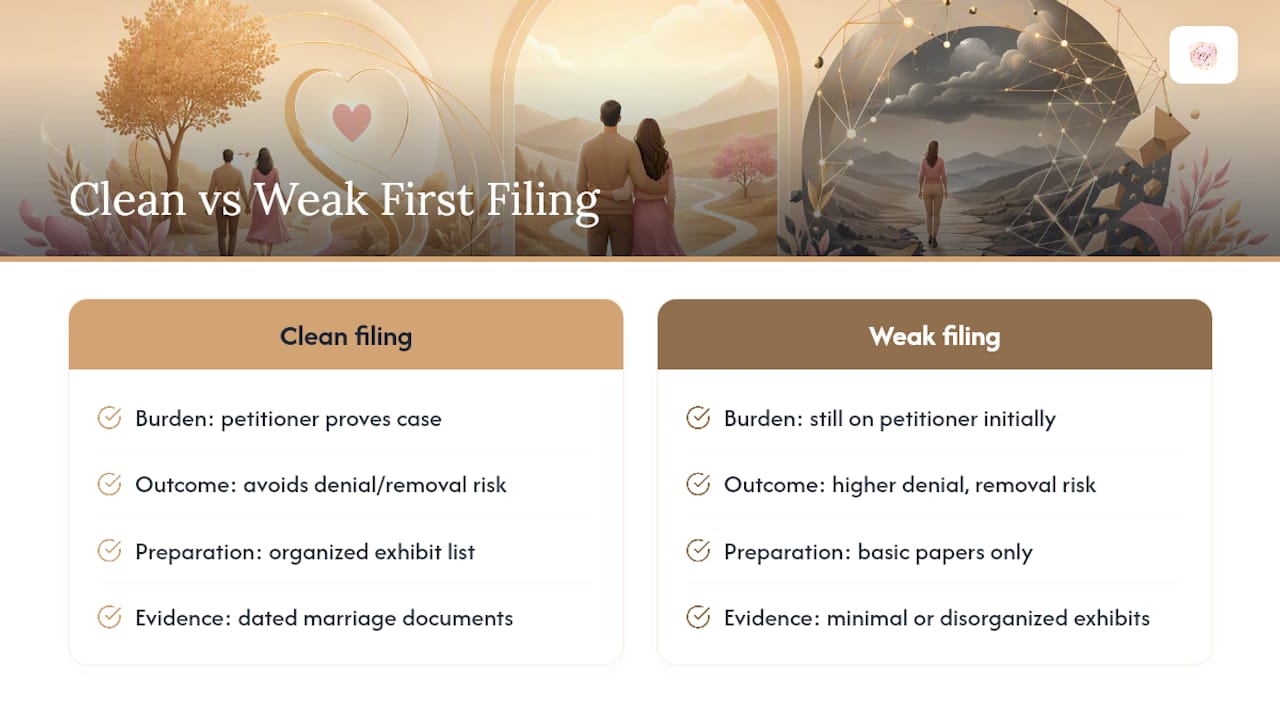
That's why I push back on the common advice to "just file the basics and respond to the RFE if one comes." A weak initial packet doesn't just risk a delay. It risks a much worse outcome down the line. The petitioners who avoid trouble aren't the ones with the most dramatic love story. They're the ones who treat organization as part of the evidence itself, dated documents spanning the full marriage, a clear index, and every exhibit doing specific work to answer a question an adjudicator hasn't even asked yet.
If you take one thing from this guide, let it be this: spend your effort upfront on the exhibit list and document organization, not on hoping the interview goes well. By the time you're sitting across from an officer, the packet has usually already made the decision.
— Cristina
This article is general information, not a substitute for advice from a qualified lawyer. Consult a qualified legal professional about your own circumstances before acting on anything here.
Sources
- I-751, Petition to Remove Conditions on Residence
- USCIS Policy Manual: Petition to Remove Conditions on Residence