
Search Osceola Clerk's Official Records browser for deeds and recorded documents, and use the Ninth Judicial Circuit case query for court case dockets. Most records display free online; certified copies require a formal request. For direct help, call the Osceola Clerk at 407-742-3500 or visit the main office at 2 Courthouse Square, Kissimmee, FL 34741.
TL;DR:
- Searching both the Official Records browser and the court case query helps ensure you find all relevant records, especially since some documents may appear in one database but not the other.
- Certified copies require a formal request through the Clerk’s portal and typically incur fees, especially if extensive staff review is needed or documents are not available online.
- Many Osceola records are accessible for free online, but sealed or restricted records under Florida law cannot be accessed without proper legal procedures or court authorization.
- Making sure your request is directed to the correct custodian, such as the Clerk, Sheriff, or County Office, reduces delays and prevents unnecessary fees.
- Professional services can assist non-English speakers or those unfamiliar with legal forms to prepare and submit accurate requests for public records and notarizations.
Table of Contents
- How to Search Osceola County Court Records Online
- How Do You Request Certified Copies From the Clerk?
- Which Office Actually Holds the Record You Need?
- Visiting in Person or Using Remote Clerk Services
- Why Are Some Osceola Court Records Restricted?
- How CF Legal Helps With Records and Notarization
- Need Help Preparing Your Records Request?
- Sources
- FAQ
How to Search Osceola County Court Records Online
You have two main tools, and picking the right one first saves you a lot of clicking. The Official Records browser, sometimes called PERCH Search, covers recorded instruments: deeds, mortgages, liens, satisfactions, and similar documents filed with the Clerk's Official Records. The Ninth Judicial Circuit case query is where you go for actual court cases, both civil and criminal, including hearing dates and docket entries, through the Ninth Judicial Circuit's public case query.
Here's how to search effectively on either platform:
- Start with the party's last name, then narrow with a first name or middle initial if you get too many hits.
- If you already have a case number, use it. Case numbers are unique and skip the guesswork entirely.
- Try common spelling variants, especially for Hispanic surnames with two-part last names or accented characters that sometimes get dropped in the database.
- Filter by document type (deed, judgment, notice) when searching Official Records, since one property can generate dozens of filings over the years.
- Check the date range field if you know roughly when the document was filed. It narrows results fast.
Because indexing isn't always consistent across systems, a document tied to a foreclosure or a divorce might show up in one database but not the other. Searching both the Official Records browser and the case query is often the only way to confirm you've found everything connected to a matter.
Once you locate a result, most entries link to a document image or a docket summary you can view immediately. A viewable PDF is usually fine for personal reference, insurance, or informal verification. If a court, lender, or government agency needs an official certified copy bearing the Clerk's seal, viewing the file online isn't enough. You'll need to request it formally.
How Do You Request Certified Copies From the Clerk?
Certified copies carry the Clerk's raised seal and signature, and they're what courts, title companies, and government agencies typically require. Uncertified copies work fine for your own records or general reference. Here's the process:
- Check Official Records or the case query first. If the document is already viewable online, print it if uncertified is fine.
- Submit a formal request through the Clerk's Records Request portal (built on JustFOIA) if the record isn't posted online or you need a certified version.
- Wait for staff review. Simple requests with a case number often process quickly; requests needing extensive file review take longer.
- Receive a written estimate if fees apply. The Clerk provides a cost estimate in writing before any substantial clerical work begins.
- Pick up in person or receive by mail, depending on how you submitted the request.
Fee note: Many Osceola records are free to view online, but certified copies and requests requiring significant staff time can carry per-page or research charges. The Clerk's office will not surprise you with a bill. Florida's public-records framework under Chapter 119 requires custodians to provide cost estimates upfront when clerical work is extensive.
If you're in a hurry, calling the records staff directly at 407-742-3500 before submitting can clarify whether same-day pickup is realistic for your specific document.
Which Office Actually Holds the Record You Need?
Misdirected requests are the number one cause of delay, and Osceola County's own guidance backs this up: confirming the correct custodian before requesting saves both time and fees. Not every "official record" lives with the Clerk.
- Clerk of Court holds court case files, judgments, official recorded documents (deeds, liens), marriage licenses, and probate records.
- Osceola County BOCC (Board of County Commissioners) holds county administrative records, permits, contracts, and meeting minutes.
- Osceola County Sheriff's Office holds incident reports, arrest records, and law enforcement case files, separate from court dockets.
- Circuit Court (within the Clerk's system) handles felonies, juvenile matters, and civil cases over a certain dollar threshold.
- County Court handles misdemeanors and criminal traffic violations, a distinction the Clerk's own criminal division outlines.
If your matter involves an active prosecution, the State Attorney's office, not the Clerk, controls evidence and investigative files. For arrest reports or incident narratives, the Sheriff's office is your custodian, not the courthouse.
Visiting in Person or Using Remote Clerk Services
The Kissimmee main office sits at 2 Courthouse Square, Kissimmee, FL 34741, and the Poinciana branch operates at 4547 Pleasant Hill Road, Kissimmee, FL 34759. Both are reachable at 407-742-3500 for questions before you drive over.
Before heading in, gather what you'll need:
- A government-issued photo ID for certified copy requests.
- The case number or party names, written down exactly as they appear in your search.
- Payment for any applicable fees (check with staff on accepted methods).
- Any prior correspondence or estimate the Clerk sent you, if this is a follow-up visit.
Pro Tip: Join the virtual queue online or by QR code before you leave home. It holds your spot in line remotely, so you're not standing in the lobby waiting for your number to come up.
Hours and available services occasionally shift for holidays or staffing changes, so a quick call ahead confirms you're not making a trip for a service that's temporarily paused.
Why Are Some Osceola Court Records Restricted?
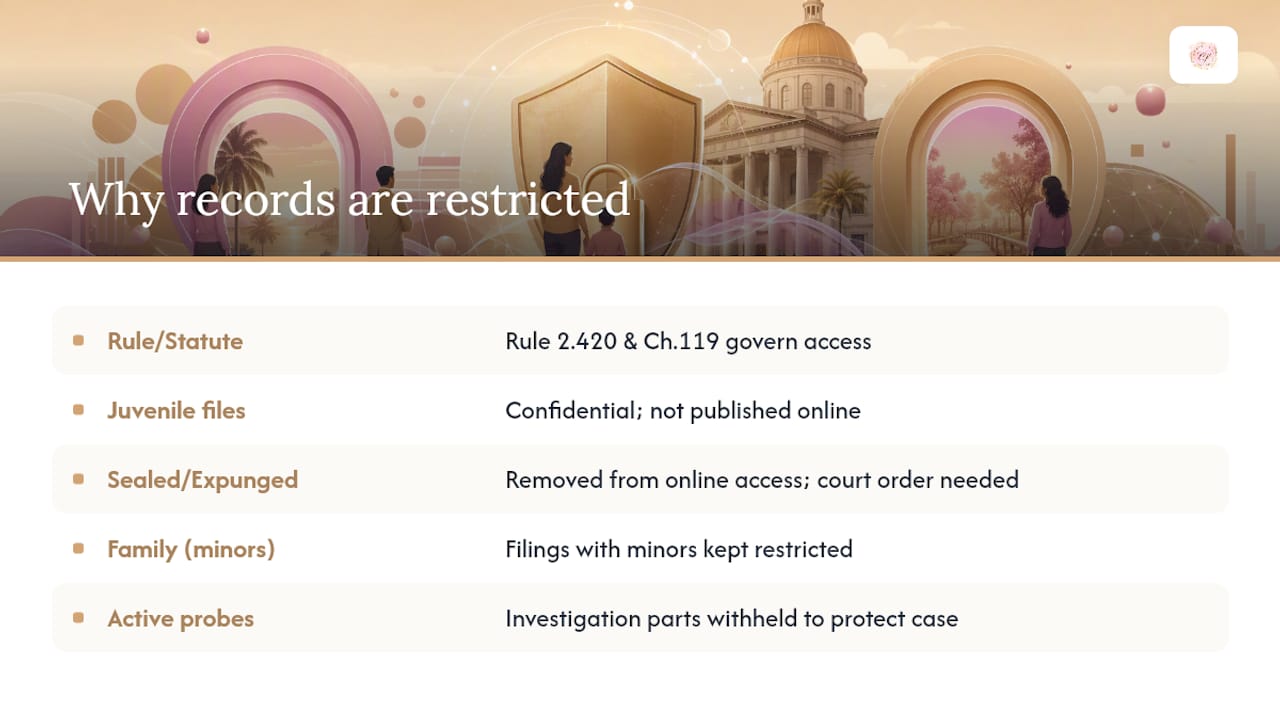
Not everything filed with the court is public, and that's by design, not oversight. Florida Rule 2.420 sets confidentiality standards for court filings, while Chapter 119 governs public records generally and lists specific exemptions.
Common restricted categories include juvenile case files, sealed or expunged criminal records, certain family law filings involving minors, and portions of active criminal investigations that could compromise a case if released. If a record is sealed under Rule 2.420, the Clerk won't publish it online, and viewing it usually requires a court order or direct involvement in the case, since sealed records require following formal court procedures to unlock access.
If you're a party to a case and believe a record was wrongly restricted, or you need access for a legitimate legal reason, that request goes through the court, not a simple records desk inquiry.
How CF Legal Helps With Records and Notarization
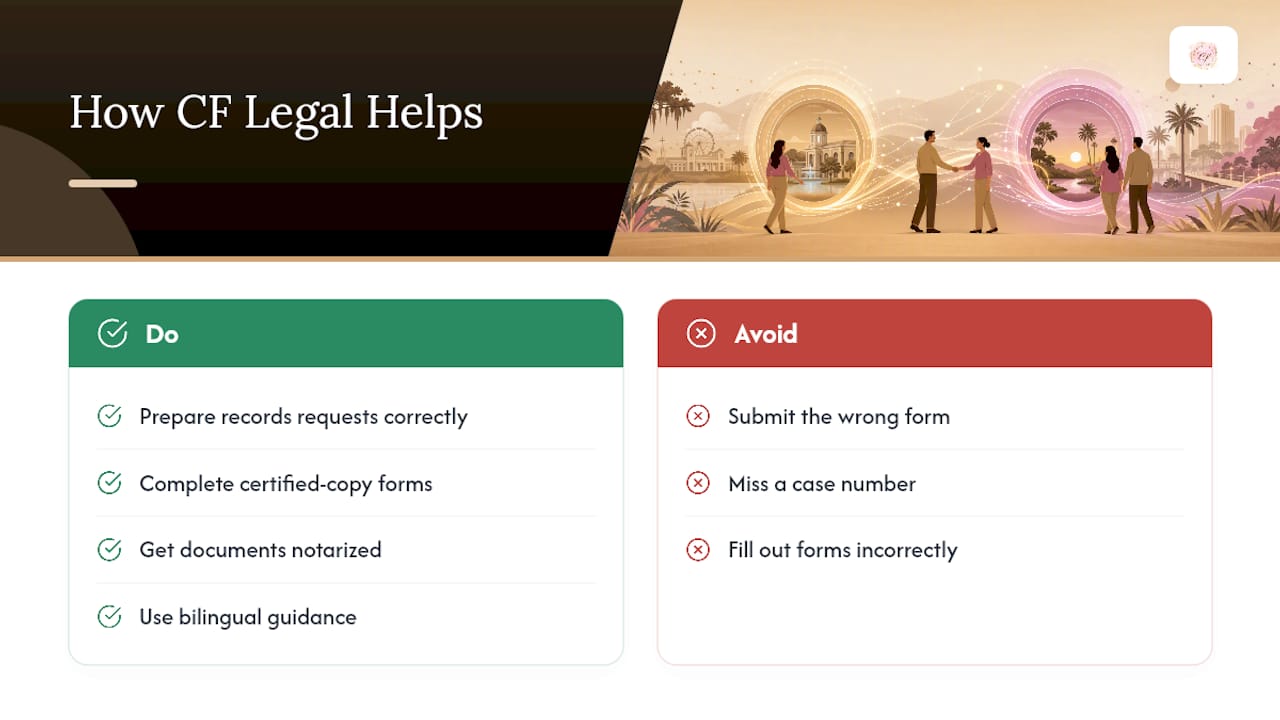
Cristina Fernandez, a certified legal document preparer and immigration paralegal, built Cflegalformhelp around a simple problem: many Spanish-speaking residents stumble on request forms not because the records are hard to find, but because the paperwork itself is confusing. Filling out a Records Request incorrectly, missing a case number, or submitting the wrong form to the wrong office adds weeks to a process that should take days.
Cflegalformhelp helps clients prepare public-records requests correctly, complete certified-copy forms, and get documents notarized once they're ready using a convenient divorce document notarization service. For readers comfortable navigating portals themselves, doing it solo works fine. For those juggling language barriers or unfamiliar legal terminology, professional guidance often prevents costly resubmissions.
Need Help Preparing Your Records Request?
If you've tried the Clerk's portals and still feel stuck on a form, a certified translation, or getting a document notarized correctly, Professional services handle the gap between "the record exists" and "I have the properly prepared paperwork in hand." Unlike a general attorney retainer, these services offer flat, transparent fees and bilingual support, so you know the cost before you commit.
Cflegalformhelp's legal document preparation services cover everything from filling out a records request form correctly the first time to preparing supporting paperwork for family law or business filings that often intersect with court records. Need a document notarized on the spot, maybe for a certified copy affidavit or a loan signing tied to a property record? The mobile notary and loan signing service comes to you.
DIY works when you're comfortable with forms and have time to spare. When a deadline is close, English isn't your first language, or the form itself is the obstacle, booking a flat-fee session with Cflegalformhelp is the faster route. Reach out today to get your records request or certified-copy paperwork prepared correctly the first time.
Sources
- Chapter 119, Florida Statutes (2025)
- Request a Public Record — Osceola Clerk
- Official Records — Osceola Clerk
- Case Query — Ninth Judicial Circuit of Florida
FAQ
How Can I Access Court Records in Osceola County?
Use the Ninth Judicial Circuit case query for court cases and the Official Records browser for recorded documents like deeds; both are free to search online.
How Do I Obtain Public Records From the Osceola Clerk?
Submit a request through the Clerk's Records Request portal, and staff will provide a written cost estimate if the request requires extensive clerical work.
Can I Access Public Records for Free in Florida?
Yes, most Florida public records, including many Osceola court filings, are viewable online at no cost, though certified copies and time-intensive research requests may carry fees.
How Do I Look Up Someone's Court Records in Florida?
Search the person's name through the Ninth Judicial Circuit case query for Osceola County matters, or check that circuit's respective clerk portal if the case was filed elsewhere in Florida.
What if I Can't Find a Record Online?
The record may be sealed under Florida Rule 2.420, held by a different agency like the Sheriff or BOCC, or simply not yet digitized, in which case a formal request to the correct custodian is your next step.