

A notary public and an attorney are not interchangeable, and confusing the two can lead to serious legal problems. The core difference between a notary and an attorney comes down to legal authority: a notary verifies identity and witnesses signatures to deter fraud, but cannot offer legal advice or represent anyone in court. An attorney is licensed to advise clients, draft legal documents, and argue cases before a judge.
Here is a quick breakdown of what each professional can and cannot do:
- Notary public: Witnesses signatures, verifies signer identity, administers oaths, certifies document copies. Cannot give legal advice, draft legal documents, or represent clients.
- Attorney: Provides legal counsel, drafts and interprets contracts and legal documents, represents clients in court and negotiations. Requires a law degree and bar admission.
- Key legal boundary: A notary who gives legal advice commits unauthorized practice of law, a prosecutable offense in every U.S. state.
- Why it matters: Choosing the wrong professional for your situation can result in improperly executed documents, wasted money, or legal liability.
Understanding this distinction protects you when you are handling real estate closings, immigration paperwork, estate documents, or any other matter where both a signature and legal judgment may be involved.
What does a notary public actually do?
A notary public is a state-appointed official whose job is narrow by design. Their primary function is to verify that the person signing a document is who they claim to be, that the signing is voluntary, and that the signer appears to understand what they are signing. That is the full scope of the role.
Typical notarial duties include:
- Verifying signer identity using government-issued photo ID
- Witnessing signatures on affidavits, powers of attorney, real estate deeds, and loan documents
- Administering oaths and affirmations
- Certifying copies of certain documents
- Confirming the signer is not under duress or incapacitated
What a notary cannot do is equally clear. Notaries cannot draft legal documents, offer opinions on document contents, or advise you on whether a contract protects your interests. A notary's seal confirms the signing process was legitimate. It does not confirm that the document itself is legally sound or that its contents are true.
Becoming a notary requires meeting minimal eligibility requirements: U.S. citizenship, minimum age of 18, state residency, and in some states a background check or short exam. No law degree is required. The training reflects the limited scope of the role.

What authority does an attorney have?
An attorney's authority goes far beyond witnessing a signature. Attorneys are licensed by the state bar to give legal advice, draft and interpret legal documents, negotiate on a client's behalf, and represent clients in court proceedings. That combination of skills and legal authority is what separates them from every other document professional.
Common attorney services include:
- Drafting contracts, wills, trusts, and business agreements
- Representing clients in civil and criminal court
- Advising on family law matters such as divorce and child custody
- Handling estate planning and probate
- Providing immigration legal counsel
- Negotiating settlements in disputes
Becoming an attorney requires completing a four-year undergraduate degree, a three-year Juris Doctor program, and passing a state bar exam. Most states also require ongoing continuing legal education to maintain licensure. That rigorous path reflects the breadth of legal authority attorneys carry.
Attorneys can interpret laws, analyze risk, and tailor legal strategies to your specific situation. A notary cannot do any of those things, regardless of how experienced they are.

How do notaries and attorneys compare directly?
The difference between notary and attorney roles becomes clearest when you place them side by side across the dimensions that matter most for your decision.
| Dimension | Notary Public | Attorney |
|---|---|---|
| Core role | Witnesses signatures, verifies identity | Advises clients, drafts documents, represents in court |
| Legal advice | Cannot provide legal advice | Licensed to provide full legal counsel |
| Document drafting | Cannot draft legal documents | Drafts contracts, wills, trusts, and filings |
| Court representation | Not permitted | Core function |
| Education required | Minimal; no law degree | Law degree plus bar exam |
| Licensing body | State government commission | State bar association |
| Typical cost | Low per-signature fee | Hourly or flat-fee, generally higher |
| Best for | Simple authentication, fraud prevention | Complex legal matters, disputes, advice |
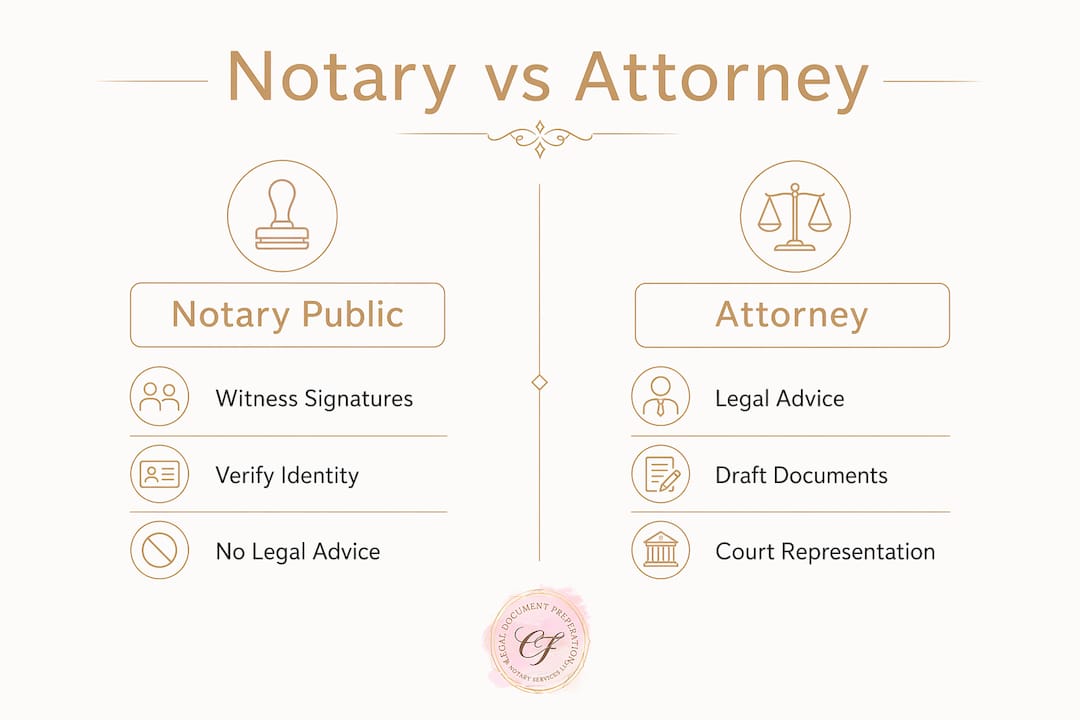
A notary's seal authenticates the signing process but does not validate the document's legal content. That responsibility stays with the signer and the document's creator. If you need someone to confirm the document is legally correct, that is an attorney's job.
The cost gap between the two reflects the difference in training and authority. Notary fees are typically modest, charged per signature or per document. Attorney fees vary by complexity, but the investment covers legal judgment that a notary simply cannot provide.
When should you hire a notary versus an attorney?
The right choice depends on what your document actually needs. If you only need a signature authenticated, a notary is sufficient. If you need someone to tell you what a document means, whether it protects you, or how to handle a dispute, you need an attorney.
Situations where a notary is the right call:
- Signing a power of attorney form you have already reviewed
- Notarizing an affidavit for a court filing you prepared yourself
- Authenticating a real estate deed or loan document at closing
- Certifying a copy of a passport or other official document
- Completing vehicle title transfers
Situations that require an attorney:
- Drafting or reviewing a contract before you sign it
- Filing for divorce or negotiating a custody arrangement
- Creating a will or trust that reflects your specific wishes
- Facing a lawsuit, criminal charge, or immigration hearing
- Forming a business and structuring ownership agreements
When you are unsure whether notarization alone is enough, consult an attorney first. A brief consultation can clarify whether your situation requires legal advice or just a witnessed signature. For civil disputes or contract matters, a civil litigation attorney can assess your exposure quickly and tell you exactly what level of help you need.
Can an attorney also be a notary?
Yes, and many attorneys do hold notary commissions. However, the two roles remain legally separate even when the same person holds both credentials. Attorneys can be commissioned as notaries by meeting their state's requirements, but obtaining a notary commission does not expand their legal authority beyond what their bar license already grants.
When an attorney acts as a notary, they must follow notary laws and maintain impartiality, just as any other notary would. They cannot simultaneously provide legal advice during the notarization act itself. The roles must stay distinct to avoid conflicts of interest.
A few practical points on attorney-notaries:
- They can notarize documents for clients, but must be careful not to notarize documents in which they have a personal financial interest
- Their notary seal carries no more legal weight than any other commissioned notary's seal
- Being a notary does not make an attorney more qualified to notarize; it simply means they have met the state's basic commission requirements
The reverse is not true. A notary who is not also a licensed attorney cannot perform any attorney functions, regardless of experience or knowledge of legal documents.
Common misconceptions about notaries you should know
The most persistent misconception is that a notary is a "lite" version of a lawyer. Notaries are not a pared-down version of attorneys. Their role is strictly limited to witnessing and identity verification. A notary who offers legal advice, prepares immigration forms with guidance, or claims to practice law is operating outside their authority and potentially breaking the law.
The "notario publico" confusion is a serious consumer protection issue. In many Latin American countries, a notario publico is a highly trained legal professional who can draft documents, give legal advice, and settle disputes. That title does not translate to the U.S. context. A U.S. notary public has none of those powers, yet the shared terminology leads many Spanish-speaking consumers to assume otherwise. The Pennsylvania Department of State and other regulatory agencies actively warn against this confusion because it enables fraud.
Other common misconceptions:
- "A notary stamp makes a document legal." The stamp confirms the signing process, not the document's legal validity or accuracy.
- "A notary can help me with my immigration paperwork." Notaries can notarize specific forms like the Affidavit of Support (I-134 or I-864), but only an attorney or USCIS-accredited representative may prepare or file immigration applications.
- "If a notary is experienced, they can answer my legal questions." Experience does not grant legal authority. Answering legal questions without a license is unauthorized practice of law, regardless of how long someone has worked as a notary.
Regulatory agencies across states prohibit notaries from advertising legal services or using the title "notario" in their marketing. In Colorado, for example, doing so violates state statute and can result in prosecution.
Pro Tip: Before working with any legal professional, verify their credentials. For attorneys, check your state bar's online directory. For notaries, confirm their commission through your state's notary database. Never sign documents you do not understand, and never pay for legal advice from someone who is not a licensed attorney.
How much does a notary typically cost?
Notary fees are regulated by state law, which keeps them low. Most states cap the fee a notary can charge per notarial act, meaning per signature or per document. In Florida, for example, the maximum fee is $10 per notarial act for traditional in-person notarizations. Remote online notarization may carry a higher allowable fee depending on the state.
Attorney fees follow a different structure entirely. Attorneys may charge by the hour, by the task, or as a flat fee for defined services. Simple document review may cost a few hundred dollars. Complex litigation or estate planning can run into the thousands. The difference in cost reflects the difference in legal authority and professional liability.
For document preparation services that fall between these two options, certified legal document preparers like those at Cflegalformhelp can assist with completing and organizing forms at a flat, transparent fee, without providing legal advice. That middle ground suits many self-represented individuals who know what they need but want help getting the paperwork right.
How do jurisdictional boundaries affect notary and attorney authority?
Both notaries and attorneys are licensed at the state level, and their authority does not automatically cross state lines. A notary commissioned in Florida can only perform notarial acts within Florida, unless they hold a commission in another state. Attorneys admitted to one state's bar must seek pro hac vice admission or separate bar admission to practice in another state.
For documents intended for use in another country, the process adds another layer. Many foreign governments require an apostille, a certification that authenticates the notary's authority for international use. You can learn more about notarizing documents for overseas use to understand what that process involves.
The jurisdictional gap between U.S. notaries and their foreign counterparts, particularly notarios publicos in Latin America, creates real complications for international transactions. A document notarized in the U.S. does not carry the same legal weight abroad as one prepared by a notario publico, who functions more like a civil law attorney. Understanding state vs. federal notary documents is also relevant when your paperwork crosses federal agency requirements.
Unauthorized practice of law by notaries is a prosecutable offense across U.S. jurisdictions. The penalties can include fines, loss of notary commission, and criminal charges. That legal boundary exists to protect consumers, and it applies regardless of how well-intentioned the notary may be.
How Cflegalformhelp can help you with document preparation and notarization
Cflegalformhelp offers professional document preparation and notary services for individuals and small businesses across Florida. Founded by Cristina Fernandez, a certified legal document preparer and immigration paralegal, the service is built for people who need accurate, properly completed paperwork without the cost of full attorney representation.
Services include immigration form assistance, family law document preparation, LLC formation support, mobile and remote notarization, loan signing, and certified translations, all at flat, transparent fees. Bilingual support in English and Spanish is available throughout.
Cflegalformhelp does not provide legal advice and is not a law firm. For situations that require an attorney, the team will tell you clearly. For everything else, you get reliable, affordable help getting your documents done right.
Key Takeaways
A notary public authenticates signatures and deters fraud; an attorney provides legal advice, drafts documents, and represents clients in court. These roles are legally distinct and cannot substitute for each other.
| Point | Details |
|---|---|
| Notary authority is limited | Notaries verify identity and witness signatures but cannot give legal advice or draft legal documents. |
| Attorneys hold broad legal authority | Attorneys advise clients, draft contracts and wills, and represent clients in court after passing a bar exam. |
| Unauthorized practice is a crime | A notary who provides legal advice commits unauthorized practice of law, a prosecutable offense in every U.S. state. |
| "Notario publico" does not translate | In Latin America, a notario publico is a legal professional; in the U.S., a notary public has no such authority. |
| When in doubt, consult an attorney | For complex or high-stakes matters, a brief attorney consultation clarifies whether notarization alone is sufficient. |