

Yes, you can file for divorce in Florida without an attorney. Filing pro se (self-represented) is a recognized right under Florida law, and thousands of Florida residents do it every year. To start, you need to confirm that at least one spouse has lived in Florida for a continuous six months immediately before filing, per Florida Statute § 61.021. Once residency is confirmed, your next moves are:
- Confirm residency. Gather a Florida driver's license, state ID, or voter registration showing an issue date at least six months prior to filing.
- Choose your petition type. Decide between a simplified dissolution (no children, no unresolved debts, full written property agreement) and a regular dissolution.
- Assemble your Financial Affidavit and supporting documents. Tax returns, pay stubs, and bank statements are required before you file.
- Plan service of process. Decide how the other spouse will be served and who will do it.
- Prepare for fees or a fee waiver. The base filing fee is several hundred dollars plus statutory surcharges; a fee waiver is available if you qualify.
Top forms to have ready at filing:
| Form | Description |
|---|---|
| Form 12.901 | Petition for Dissolution of Marriage |
| Form 12.902(b) or (c) | Family Law Financial Affidavit (short or long) |
| Notice of Social Security Number | Required for all parties |
| Summons | Issued by the clerk after filing |
| Form 12.995 | Parenting Plan (if minor children) |
| Marital Settlement Agreement | If both parties have reached full agreement |
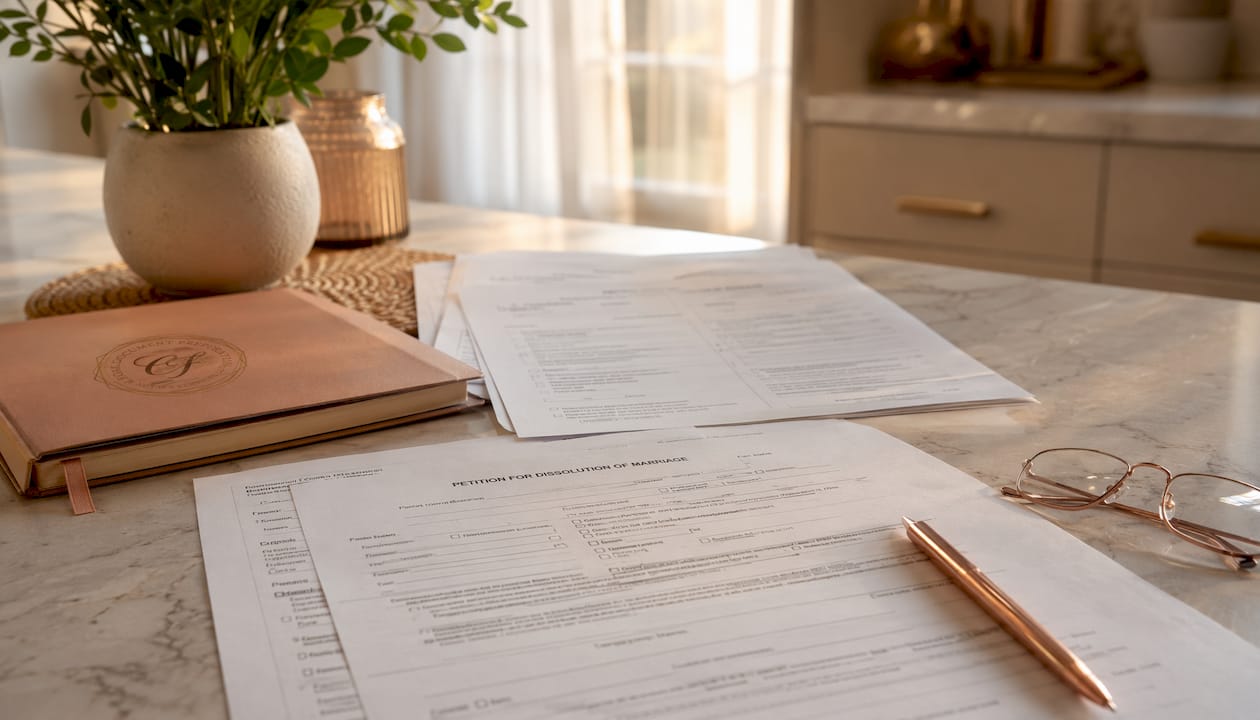
Under § 61.19, the court cannot enter a final judgment until at least 20 days after the petition is filed. Plan your timeline around that floor, not the ceiling.
Table of Contents
- What "pro se" means in Florida and who qualifies
- Your pro se divorce filing checklist for Florida: forms and documents
- How to file in Florida: clerk locations, e-filing, fees, and service of process
- If you have children: parenting plan, child support, and mandatory education
- Common mistakes pro se filers make and when to get professional help
- Protecting your privacy and organizing your records before and during filing
- How long a pro se Florida divorce takes and what to expect at the final hearing
- Where to get official Florida forms and county self-help resources
- Key Takeaways
- Why this checklist was built for pro se filers
- Cflegalformhelp makes pro se filing more accurate and less stressful
- Useful sources
What "pro se" means in Florida and who qualifies
"Pro se" is a Latin phrase meaning "for oneself." In Florida family court, it means you represent yourself without a licensed attorney. Clerk staff and court self-help centers can answer procedural questions and point you to the right forms, but they cannot give legal advice, review your strategy, or tell you whether your settlement is fair. That distinction matters.
Residency under Florida Statute § 61.021
At least one spouse must have resided in Florida continuously for six months immediately before filing. County clerks commonly check whether your Florida ID or driver's license has an issue date at least six months prior. If your ID is newer than that, you can supplement it with voter registration, a lease or mortgage statement, or a corroborating witness affidavit. That affidavit comes with its own requirements: the witness must have personal knowledge of your residency and typically must present their own Florida ID with an issue date that satisfies the same six-month lookback. Clerks frequently reject filings where the witness's ID is missing or the dates do not align.
You file in the circuit court of the county where either spouse currently resides, or where the couple last lived together.
Simplified dissolution: strict limits
Simplified dissolution is faster and involves fewer forms, but the eligibility rules are rigid. You do not qualify if:
- Minor children exist from the marriage or the wife is pregnant.
- Either party has unresolved financial obligations from the marriage.
- Both parties have not already agreed in writing on how to divide all property and debts.
If you file as simplified when you do not qualify, the clerk will reject the filing or the case may face procedural complications later. When in doubt, prepare the regular petition instead.
When pro se is not the right choice
Pro se works well for straightforward, uncontested cases. If your situation involves contested time-sharing or child support, complex assets like a business or pension, allegations of domestic violence, or a spouse who may be hiding assets, the risk of a costly mistake outweighs the savings on attorney fees. In those cases, at minimum consult an attorney before filing.
Your pro se divorce filing checklist for Florida: forms and documents
Use this as your packing list. Check off each item before you walk into the clerk's office or submit through the e-filing portal.
Court forms
- Petition for Dissolution of Marriage (Form 12.901) — the foundational filing document; choose the version that matches your situation (with or without children, with or without property).
- Family Law Financial Affidavit — Form 12.902(b) if your gross annual income is under $50,000; Form 12.902(c) if $50,000 or more. All figures must be converted to monthly amounts.
- Summons — prepared at filing; the clerk issues it after you pay the fee.
- Notice of Social Security Number — required for all parties; kept confidential by the court.
- Certificate of Compliance with Mandatory Disclosure (Form 12.932) — confirms you have exchanged the required financial documents under Rule 12.285.
- Parenting Plan (Form 12.995) — required in every case involving minor children; must address time-sharing, decision-making, transportation, and holiday schedules.
- Child Support Guidelines Worksheet — required when children are involved; calculated from both parties' income figures.
- Marital Settlement Agreement — if both parties agree on all terms, this document memorializes the deal and becomes part of the final judgment.
Supporting financial documents
- Tax returns — last two to three years, both federal and state.
- Pay stubs — most recent three months for each employed party.
- Bank and credit card statements — 12 months for all accounts.
- Retirement and investment account statements — most recent quarterly statements; note that dividing a 401(k) or pension requires a Qualified Domestic Relations Order (QDRO), which is a separate court order.
- Mortgage deed or lease agreement — for any real property owned or rented.
- Vehicle titles — for all cars, boats, or other titled vehicles.
- Life insurance policies — showing coverage amounts and named beneficiaries.
- Business records — profit and loss statements, ownership documents, and recent valuations if either party owns a business.
Identity and residency documents
- Valid Florida driver's license or state ID — issue date must satisfy the six-month residency lookback.
- Voter registration card or utility bills — as supplemental residency proof if needed.
- Corroborating witness affidavit — only if your ID alone does not satisfy residency; the witness must bring their own Florida ID.
Special items
- Parent Education and Family Stabilization Course certificate — required before final judgment in cases with minor children; the petitioner must complete the course within 45 days of filing.
- Children's birth certificates and Social Security cards — needed for the parenting plan and child support worksheet.
- Proof of health insurance coverage — for any dependent children.
Pro Tip: Make at least three copies of every document before you file: one for the clerk, one for the other party, and one for your own indexed binder. Organize the binder in the same order as the clerk's checklist for your county. This single habit prevents the most common reason for clerk returns.
Pull your credit report before filing. Reviewing it helps you identify joint debts you may have forgotten, which strengthens your Financial Affidavit and reduces surprises during settlement talks.
How to file in Florida: clerk locations, e-filing, fees, and service of process
Where to file
File with the circuit court clerk in the county where you or your spouse currently resides, or where you last lived together as a couple. Most counties have a Family Law or Civil Division at the main courthouse. Florida also offers statewide electronic filing through MyFloridaCourtAccess, which accepts most family law filings. Some counties still require in-person filing for initial petitions or when original signatures are needed, so call ahead or check the clerk's website before assuming e-filing covers everything.
Filing fees
| Item | Amount |
|---|---|
| Petition for Dissolution of Marriage (filing fee) | several hundred dollars |
| Statutory surcharges (approximate total) | several hundred dollars plus statutory surcharges |
| Fee waiver application | Application for Determination of Civil Indigent Status |
If you cannot afford the filing fee, ask the clerk for the Application for Determination of Civil Indigent Status. Approval waives the filing fee; the clerk will walk you through the form.
Service of process
After filing, the other spouse must be formally served. Acceptable methods in Florida include:
- Sheriff's service — the most straightforward; the clerk sends the summons to the sheriff's office in the county where the respondent lives.
- Certified process server — a private, court-approved process server; often faster than the sheriff.
- Waiver of service — if the respondent agrees to sign a written acknowledgment, formal service may be waived; this is common in cooperative uncontested cases.
Once served, the respondent has 20 days to file a written response. That 20-day period also starts the clock on the mandatory waiting period under § 61.19. Proof of service (a Return of Service from the sheriff or process server, or a signed acknowledgment) must be filed with the clerk.
County-specific requirements
Many circuits require supplemental forms that are not part of the standard Supreme Court packet. The 10th Judicial Circuit, for example, requires a pro se cover sheet and a Notice of Related Cases. Check your county clerk's family law or self-help page, or call the self-help line, before printing your final packet. Missing a local cover sheet is one of the most common reasons clerks return filings on the same day.
Practical notes on signatures and copies
Most Florida family law forms require notarization, including the Financial Affidavit. Bring a government-issued photo ID to your notary appointment. Ask the clerk how many conformed (stamped) copies you need; most offices require at least two beyond the original.
If you have children: parenting plan, child support, and mandatory education
Cases involving minor children carry additional mandatory requirements. Missing any one of them will prevent the court from entering a final judgment.
Parenting plan requirements
Every dissolution involving minor children must include a court-approved parenting plan. Form 12.995 must address:
- The time-sharing schedule, including weekdays, weekends, and overnights.
- Decision-making authority for education, healthcare, and extracurricular activities.
- Transportation arrangements between households.
- Holiday, school break, and vacation schedules.
- Communication methods between the child and each parent.
The court will not approve a parenting plan that is vague. Specific dates, times, and procedures are expected.
Child support
Florida uses an income-shares model. Both parties must complete the Child Support Guidelines Worksheet using verified income figures. You will need:
- Pay stubs and tax returns for both parties.
- Childcare costs (daycare, after-school programs).
- Health insurance premiums for the child.
- Any extraordinary medical or educational expenses.
Parent Education and Family Stabilization Course
Under § 61.21, this course is mandatory in every dissolution involving minor children. The petitioner must complete it within 45 days of filing; the respondent within 45 days of being served. The course is a minimum of four hours and must be from a provider approved by the Department of Children and Families. The Certificate of Completion must be filed with the clerk before the court will schedule a final hearing.
Mandatory financial disclosure timeline
Under Florida Family Law Rule of Procedure 12.285, both parties must exchange financial disclosure documents and file the Certificate of Compliance (Form 12.932) within 45 days of service. This deadline applies regardless of whether the case is contested or uncontested.
Child-related document checklist
- Birth certificates for all minor children.
- Social Security cards for all minor children.
- Proof of current health insurance coverage.
- School enrollment records and recent report cards (useful for establishing the child's home county).
- Documentation of any special medical or educational needs.
Common mistakes pro se filers make and when to get professional help
The most frequent errors in pro se Florida divorce filings fall into a predictable pattern. Knowing them in advance saves you time and money.
Filing in the wrong county. Venue must be the county where either spouse currently resides or where the couple last lived together. Filing in the wrong county results in a transfer or dismissal.
Missing local supplemental forms. Circuit courts vary in what they require at intake. A Notice of Related Cases, a standing order, or a local cover sheet may be mandatory in your circuit. The standard Supreme Court packet does not include these.
Incomplete Financial Affidavit. Leaving income sources blank, using annual figures instead of monthly amounts, or omitting retirement accounts are the most common errors. Courts take financial disclosure seriously; an incomplete affidavit can delay the case or, in extreme cases, expose a party to sanctions.
Incorrect service. Serving the respondent by text message or informal email does not satisfy Florida's service requirements. Use the sheriff, a certified process server, or a signed written waiver.
Using simplified dissolution when ineligible. Attempting to file as simplified when minor children exist or financial obligations remain unresolved leads to rejection. Confirm eligibility early.
Failing to disclose retirement or business interests. Omitting a 401(k), pension, or business ownership from the Financial Affidavit can result in a judgment being set aside later for fraud on the court.
Red flags that call for an attorney
- Either party owns a business, a pension, or significant investment accounts.
- There are allegations of domestic violence or a protective order is in place.
- One spouse may be hiding assets or income.
- The parties disagree on time-sharing or child support.
- A QDRO is needed to divide a retirement plan.
Options when you need targeted help
You do not have to choose between full attorney representation and doing everything alone. A certified document preparer can review your forms for accuracy and completeness without charging attorney rates. Mediation is available for negotiated disputes on property or parenting. For specific tasks like drafting a QDRO or handling a business valuation, limited-scope attorney representation lets you hire a lawyer for that one task only.
Pro Tip: If you realize you have made a filing error, address it immediately. Contact the clerk's self-help line or a document preparer the same day. Errors caught before the final hearing are almost always correctable. Errors discovered after a judgment is entered are significantly harder and more expensive to fix.
Protecting your privacy and organizing your records before and during filing
Security and recordkeeping are the steps most free guides skip entirely. They matter more than most pro se filers expect.
Set up a private communication plan
- Open a new email address on a device only you control, dedicated solely to divorce-related communications.
- Avoid using shared family computers, tablets, or accounts for any case-related correspondence.
- Set up a secure mailing address (a P.O. box or a trusted family member's address) if you are concerned about mail being intercepted.
- Log all communications about asset division or parenting in a dated notes file.
Preserve documents and evidence
- Take screenshots or PDF exports of all bank and investment account balances on the day you decide to file.
- Archive text messages and relevant social media content to a private, password-protected folder. Do not delete messages that may later be required as evidence; instead, archive them privately.
- Preserve receipts and transaction histories that document marital spending patterns.
- Practitioners advise creating a private communication plan and careful document preservation before filing, because shared accounts can create unintended evidence and complicate negotiations.
Organize your court-ready file
- Use a chronological folder structure: one folder per month, labeled by date.
- Maintain a single-page assets-and-debts ledger listing every account, its current balance, and whose name is on the title.
- Keep a one-page monthly income and expense summary updated as the case progresses; this feeds directly into your Financial Affidavit.
- Build an indexed exhibit binder with tabs matching the clerk's checklist for your county.
Privacy best practices
- Remove auto-backup settings that sync to shared cloud accounts (Google Photos, iCloud family sharing).
- Use strong, unique passwords for all accounts you open or change during the process.
- Be cautious about discussing case details near children or mutual friends who may be called as witnesses.
Pro Tip: Pull your credit report from AnnualCreditReport.com before filing. Joint accounts and debts you have forgotten will appear there. Knowing the full picture before you complete the Financial Affidavit prevents the most common disclosure errors.
How long a pro se Florida divorce takes and what to expect at the final hearing
Typical timelines
| Case type | Typical duration |
|---|---|
| Simplified dissolution (eligible and cooperative) | within 45 days |
| Uncontested regular dissolution | 4–6 months |
| Contested with children or complex property | 12–18 months |
These ranges account for the mandatory 20-day waiting period under § 61.19, the 45-day financial disclosure deadline under Rule 12.285, and typical court scheduling delays. They are not guarantees; your county's docket load affects actual scheduling.
Key deadlines to track
- Day 0: File the petition; the 20-day waiting period begins.
- Day 20: Earliest possible date for a final judgment (rarely this fast in practice).
- Day 45 (petitioner): Deadline to complete the Parent Education Course (if children).
- Day 45 (respondent, from service): Deadline for mandatory financial disclosure and Parent Education Course completion.
What to expect at the final hearing
Bring the following to your final hearing:
- Court-stamped copies of all filed documents.
- Original government-issued photo ID.
- Signed and notarized Marital Settlement Agreement (if applicable).
- Parenting Plan (if children are involved).
- Certificate of Completion for the Parent Education Course.
- Proof of financial disclosure compliance (Form 12.932).
Judges in uncontested cases typically ask both parties to confirm their identities, confirm the marriage is irretrievably broken, and verify that the settlement agreement was signed voluntarily. The hearing is usually brief, often under 15 minutes, when all paperwork is in order.
Simplified dissolution hearings
In a simplified dissolution, both parties appear together and present their IDs. The judge confirms eligibility, reviews the written property agreement, and enters the final judgment. The process is straightforward when both parties are prepared and cooperative.
Where to get official Florida forms and county self-help resources
Primary sources for official forms
The Florida Courts website publishes all Supreme Court-approved family law forms, including every form referenced in this checklist. These are the authoritative versions; do not use forms downloaded from unofficial sources, as outdated forms are a common reason for clerk rejections.
The DIY Florida portal on the Florida Courts website provides guided interviews that help you complete forms step by step. It is free to use and designed specifically for self-represented litigants.
The MyFloridaCourtAccess e-filing portal handles electronic submission for most family law filings statewide.
County-specific requirements
Before printing your final packet, check your county clerk's family law or self-help page for:
- Local cover sheets or pro se checklists.
- Standing orders that govern temporary relief or discovery in your circuit.
- A Notice of Related Cases form, required in many circuits.
- Any county-specific filing instructions for the Family Division.
Call the clerk's self-help line if the website is unclear. Local rules are not optional, and missing a supplemental form on filing day means returning to the courthouse.
Parent Education Course providers
The Department of Children and Families maintains the approved provider list for the Parent Education and Family Stabilization Course. Access it through the Florida Courts dissolution of marriage page. Courses are available online and in person; costs vary by provider.
Keep your downloads organized
Save every form as a PDF in a labeled folder before completing it. Keep blank originals separate from completed drafts. When the clerk stamps your copies, scan them immediately and add them to your digital folder.
Key Takeaways
Filing pro se in Florida requires meeting the six-month residency requirement, selecting the correct petition type, assembling complete financial disclosure documents, and following county-specific filing procedures to avoid clerk rejections.
| Point | Details |
|---|---|
| Confirm residency first | At least one spouse must have lived in Florida continuously for six months before filing, per § 61.021. |
| Choose the right petition type | Simplified dissolution has strict limits; if any children or unresolved debts exist, file the regular petition. |
| Complete financial disclosure | Use Form 12.902(b) under $50,000 income or Form 12.902(c) at $50,000 or more; file within 45 days of service. |
| Check county requirements | Local supplemental forms and standing orders vary by circuit; verify with your county clerk before filing. |
| Cflegalformhelp can assist | Cflegalformhelp prepares petitions, Financial Affidavits, and parenting plans with notarization and bilingual support for pro se filers in Florida. |
Why this checklist was built for pro se filers
As a certified legal document preparer and immigration paralegal based in South Florida, I have seen the same filing errors repeat across hundreds of cases: wrong Financial Affidavit form, missing local cover sheet, incomplete disclosure, or a corroborating witness affidavit that the clerk rejects because the witness forgot their ID. This checklist was built to close those gaps. Cflegalformhelp serves a diverse clientele, including Spanish-speaking and bilingual clients, and offers flat-fee document preparation so you know the cost before you start. The goal is accurate, county-compliant filings, not just filled-in forms.
CF Legal provides document-preparation services, not legal representation. For complex asset division, contested parenting, or any situation where legal strategy matters, please consult a licensed Florida attorney.
Cflegalformhelp makes pro se filing more accurate and less stressful
Filing your own divorce paperwork in Florida is entirely possible, but the gap between a completed form and a court-ready filing is where most pro se filers lose time and confidence. Cflegalformhelp offers flat-fee legal document preparation for petitions, Financial Affidavits, parenting plans, and marital settlement agreements, with notarization handled in the same appointment. Every filing is reviewed against your county's specific requirements, not just the statewide Supreme Court packet, so local cover sheets and supplemental forms are included.
Bilingual support in English and Spanish is available throughout the process, which matters when legal terminology needs to be clearly understood before you sign. You can also access DIY filing guides and printable checklists to work through the process at your own pace.
When your case involves a QDRO, a business valuation, or a contested parenting dispute, Cflegalformhelp will tell you directly that limited-scope attorney help is the right call. For everything else, reach out through cflegalformhelp.com to request document-preparation assistance or a form review.
CF Legal Document Preparation & Notary Services LLC provides document-preparation services only and does not provide legal representation or legal advice. Consult a licensed Florida attorney for legal guidance specific to your situation.
Useful sources
Use these primary sources to verify statutes, download official forms, and confirm local filing requirements:
- Florida Statute § 61.021 (residency requirement) — available at leg.state.fl.us
- Florida Statute § 61.19 (20-day waiting period before final judgment) — same statutes portal
- Florida Statute § 61.21 (Parent Education and Family Stabilization Course requirement) — same statutes portal
- Florida Statute § 61.075 (equitable distribution of marital assets and liabilities) — same statutes portal
- Florida Courts family law forms — flcourts.gov/Services/Family-Courts/domestic-relations-court-resources/family-law-forms
- Florida Courts dissolution of marriage guidance — flcourts.gov/Services/Family-Courts/domestic-relations-court-resources/dissolution-of-marriage-divorce
- DIY Florida guided filing portal — flcourts.gov/Courts-System/florida-courts-help/diy-florida
- FloridaLawHelp.org family law self-help — floridalawhelp.org/families-children/divorce-separation-annulment
- Your county clerk's family law or self-help desk — search "[your county] clerk of court family law" for local supplemental forms, standing orders, and filing instructions specific to your circuit.