

If you are filing for a green card or immigrant visa and any of your medical records are in a language other than English, you must submit a complete English translation alongside a signed translator certification. USCIS, the State Department, and the civil surgeon process governed by Form I-693 all require it. Under USCIS Form I-693 instructions and 8 CFR 103.2(b), every foreign-language page must be accompanied by a verbatim English translation and a signed certification from a competent translator. The immediate next step: gather every foreign-language medical document, order certified English translations, and confirm each translation carries an individual signed certificate before you file.
Key takeaways
Certified English translations with individual signed certifications are required for every foreign-language medical document submitted to USCIS, and missing or incomplete translations are among the most common causes of RFEs and processing delays.
| Point | Details |
|---|---|
| Translation is mandatory | Every foreign-language medical page must have a verbatim English translation and a signed translator certificate. |
| Individual certificates required | Each document needs its own signed certificate; a blanket certificate covering multiple records triggers RFEs. |
| PHI security matters | Use a HIPAA-aware vendor with a BAA; mishandled PHI can carry fines up to $2.1 million per incident under HHS guidance. |
| Keep I-693 sealed | Never open the civil surgeon's sealed envelope; an opened envelope requires a new medical exam. |
| Cflegalformhelp | Coordinates certified translations and reviews immigration filing packages for compliance before you submit. |
Table of Contents
- Why medical record translation is required for U.S. immigration
- Which medical records you typically need to translate for immigration
- Who may translate your records and what a valid certification must include
- How to prepare and submit your translated medical records
- What can go wrong when translations are missing or inaccurate
- Typical costs and turnaround times for certified medical translations
- How to choose a translator or service for immigration medical records
- HIPAA, PHI, and privacy: what you and your translator need to know
- What immigration paralegals see most often go wrong
- Cflegalformhelp handles certified translation coordination and I-693 prep
- Sources
Why medical record translation is required for U.S. immigration
USCIS does not accept foreign-language documents on their own. The rule is straightforward: any document not in English must be accompanied by a full English translation and a signed certification from the translator. This applies to medical records submitted as part of your immigration case, whether you are adjusting status inside the United States or going through consular processing abroad.
For adjustment of status applicants, the central medical document is Form I-693, the Report of Immigration Medical Examination and Vaccination Record. A USCIS-designated civil surgeon completes and signs Form I-693, then places it in a sealed envelope. You submit that sealed envelope with Form I-485 when required. Any supporting medical records the civil surgeon reviews or that you attach separately must follow the same translation rule.
For consular applicants, the State Department's medical examination FAQs explain that medical eligibility requirements are grounded in INA Sections 212(a) and 221(d), and that failing to provide required medical information may delay or deny your immigrant visa.
The translator certification must include, at minimum: the translator's full printed name, signature, date, contact information, a statement of competency in both languages, and an attestation that the translation is complete and accurate. A blanket certificate covering multiple documents in a single statement is a common source of RFEs. Each document should carry its own individual certificate.
Pro Tip: Keep the sealed I-693 envelope unopened. If you open it, USCIS will reject it and you will need a new medical exam.
Which medical records you typically need to translate for immigration
Not every page in your medical history requires translation, but the list of commonly requested documents is longer than most applicants expect. The CDC's immigrant and refugee health medical exam FAQs clarify which exam outputs are relevant to immigration medical screening and therefore most likely to require translation.
Documents that commonly require certified English translation:
- Form I-693 supporting records: Vaccination booklets, titer results, and lab reports the civil surgeon reviews during your exam. If these are in a foreign language, they need translation before the civil surgeon can properly document findings.
- Immigration medical exam reports from panel physicians: For consular applicants, panel physician reports may be issued in the local language and need translation for U.S. consular review.
- Vaccination records: These are among the most frequently requested items in RFEs. If your vaccination booklet is in Spanish, Portuguese, Arabic, or any other language, a certified English translation is required.
- Hospital discharge summaries: Relevant when your medical history includes prior hospitalizations that a civil surgeon or adjudicator needs to evaluate for admissibility grounds.
- Lab results and serology titers: Required to verify immunity to certain communicable diseases. If the lab report is not in English, it must be translated verbatim, including reference ranges and units.
- Prescriptions and medication records: Needed when a civil surgeon or officer needs to assess current treatment, drug interactions, or controlled-substance use.
- Physician letters and specialist reports: Relevant for waiver applications, asylum medical evidence, or cases where a medical condition affects admissibility.
- Psychiatric evaluations: Required in cases involving grounds of inadmissibility related to mental health under INA 212(a)(1).
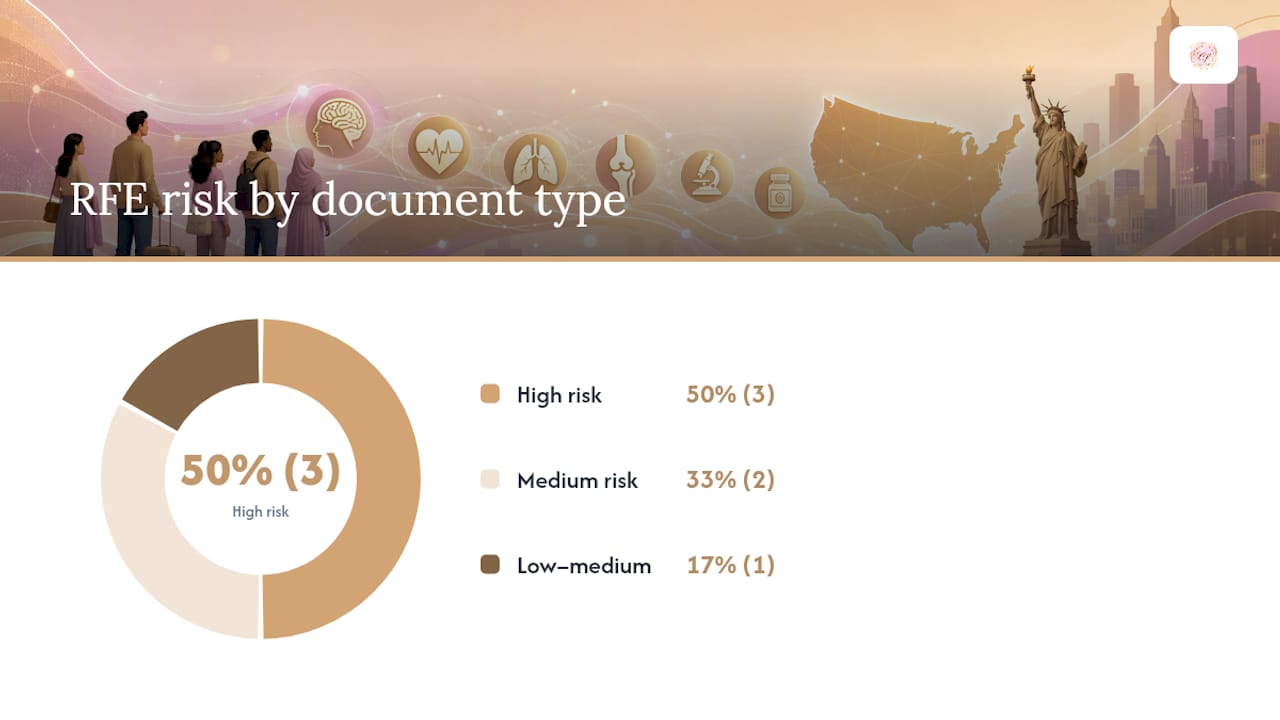
The table below shows which document types are most commonly tied to RFEs and why:
| Document Type | Why It's Requested | RFE Risk if Untranslated |
|---|---|---|
| Vaccination record | Verify immunization compliance | High |
| Lab titer results | Confirm immunity to communicable diseases | High |
| Hospital discharge summary | Assess prior conditions for admissibility | Medium |
| Physician/specialist letter | Support waiver or asylum medical claim | Medium |
| Prescription records | Evaluate current medications | Low to medium |
| Psychiatric evaluation | Admissibility review under INA 212(a)(1) | High when applicable |
Pro Tip: Scan the front and back of every page. Stamps, marginal notes, and handwritten entries on the reverse side must all be translated. If a section is illegible, the translator should mark it explicitly as "illegible" rather than skip it.
Who may translate your records and what a valid certification must include
USCIS does not require a licensed or accredited translator. What it does require is a signed certification from someone who is competent to translate from the source language into English. In practice, that standard matters more than it sounds: a family member who speaks both languages but has no experience with medical terminology creates real risk, because a single mistranslated drug name or dosage can trigger an RFE or, worse, a clinical error.
The certification statement itself must contain specific elements. Here is a model that meets USCIS expectations:
Every element in that model is required. Missing a contact address or omitting the competency statement are among the most common reasons USCIS issues an RFE on translation submissions.
Beyond the certification wording, the credentials that matter most for medical and immigration translation work are:
- Demonstrated experience with medical terminology (ICD-10 codes, pharmaceutical nomenclature, clinical lab values)
- HIPAA-aware workflows when handling protected health information (PHI), including a Business Associate Agreement (BAA) if the vendor qualifies as a business associate
- Native-speaker fluency or a subject-matter reviewer for the source language
- Membership in a professional body such as the American Translators Association (ATA) as an optional but meaningful trust signal
- An individual signed certificate per document, not a blanket certificate covering a batch
The translator should also retain work files, original document images, and a copy of the signed certificate for chain-of-custody purposes. If USCIS questions the translation later, that documentation supports the record.
| Credential or Practice | Why It Matters |
|---|---|
| Medical terminology experience | Prevents mistranslation of diagnoses, drug names, dosages |
| HIPAA-aware workflow / BAA | Protects PHI and reduces regulatory exposure |
| Individual certificate per document | Aligns with USCIS expectations; avoids RFEs |
| ATA membership | Optional trust signal; not required by USCIS |
| Work file retention | Supports chain of custody if translation is questioned |
How to prepare and submit your translated medical records
Getting the translation right is only half the job. How you prepare, label, and submit the documents determines whether USCIS can process them without issuing an RFE. For a practical overview of what the immigration medical exam itself involves, see this immigration medical exam preparation guide.
-
Collect all original documents. Gather every foreign-language medical record relevant to your case. Check front and back of each page. Include vaccination booklets, lab reports, discharge summaries, and any physician letters.
-
Scan at 300 DPI or higher. USCIS online filing systems require clear, readable scans. Low-resolution images are a common upload rejection reason. Save files as PDF or JPEG per USCIS upload specifications.
-
Label files clearly. Use a consistent naming convention: LastName_FirstName_DocumentType_Date (e.g., Garcia_Maria_VaccinationRecord_2024). This reduces processing errors and makes it easier to match translations to originals.
-
Order certified translations. Provide the translator with high-resolution scans. Confirm the translator will produce a verbatim, line-by-line translation of every visible element, including stamps and marginal notes. Request an individual signed certificate for each document.
-
Review the translations before filing. Check that names, dates of birth, and document dates match exactly between the original and the translation. A name spelled differently in the translation than on your passport is enough to trigger a request for clarification.
-
Prepare the I-693 sealed envelope correctly. If you are filing Form I-485 and the civil surgeon has completed Form I-693, do not open the sealed envelope. Submit it as received. Any supporting translated records that are not inside the sealed envelope should be included as separate attachments.
-
For online filings: Upload translated documents as separate files from originals. USCIS's online system allows you to label each upload. Follow the file-type and size limits posted on the USCIS website at the time of filing.
-
Retain originals. Never submit original documents unless USCIS specifically requests them. Keep originals and certified translations together in a secure file.
Pro Tip: Build in at least five business days between receiving translations and your filing deadline. That window lets you catch name inconsistencies, missing pages, or certification errors before they become an RFE.
What can go wrong when translations are missing or inaccurate
The consequences of submitting untranslated or poorly translated medical records range from procedural delays to outright denial, and in some cases, to patient safety risks that extend well beyond the immigration process.
On the administrative side:
- Requests for Evidence (RFEs): USCIS issues an RFE when a required translation is missing, incomplete, or lacks a proper certification. Resolving an RFE typically adds a few months to your processing timeline, and you must respond within the deadline USCIS sets or risk abandonment of your application.
- Application delays: Even a minor error, such as a missing translator address or a summarized rather than verbatim translation, can pause adjudication.
- Denial: Repeated or uncorrected deficiencies, particularly in cases where medical admissibility is already at issue, can result in denial.
- Added costs: An RFE may require a new medical exam, new translations, or both, multiplying your original costs.
On the clinical side, the risks are just as serious. Peer-reviewed research published in PMC documents that inconsistent translation protocols create patient safety problems, including misinterpreted allergies, incorrect dosage instructions, and missed diagnoses. A civil surgeon who cannot read a foreign-language lab result accurately cannot make a fully informed clinical determination.
The regulatory dimension adds another layer. When a translator or vendor handles your protected health information (PHI) without HIPAA-compliant workflows, both you and the vendor face exposure. HHS enforcement guidance notes that HIPAA violations related to mishandled PHI can carry fines up to $2.1 million per incident. That figure applies to covered entities and their business associates, which includes translation vendors who handle medical records without a proper BAA in place.
A practical example: an applicant submits a vaccination record translated by a bilingual family member. The translation omits a handwritten note on the reverse side indicating a prior adverse reaction. The civil surgeon, working from the translation, does not flag the reaction. The omission surfaces later during a medical review, triggering both an RFE and a follow-up exam. The delay costs the applicant several months and the expense of a second civil surgeon visit.
Typical costs and turnaround times for certified medical translations
Pricing for certified medical translations varies based on document complexity, language pair, page count, and how quickly you need the work done. Understanding the cost structure helps you avoid surprise fees and gives you leverage when comparing providers.
Most services price medical translations by the page or by the word. Per-page rates for standard medical documents generally reflect the density and complexity of the content. Rush fees apply when turnaround is compressed, and handwritten documents, uncommon language pairs, or records requiring notarization push costs higher.
Add-ons that affect your total cost:
- Certification fee: Some providers charge separately for the signed translator certificate.
- Notarization: Not required by USCIS for most immigration translations, but some state agencies or courts may require it. Confirm before ordering.
- Formatting: If the translated document must replicate the visual layout of the original (common for diplomas or official forms), expect a formatting surcharge.
- Revision rounds: Providers with a clear revision policy protect you if USCIS questions the translation. Confirm this before signing off.
When requesting a quote, ask for an itemized breakdown and a sample of the translator's certification wording. A provider who cannot show you a sample certificate before you pay is a red flag.
Pro Tip: Ask specifically whether the quote includes an individual signed certificate for each document. Some providers issue a single blanket certificate for a batch of records, which does not meet USCIS expectations and can trigger an RFE.
How to choose a translator or service for immigration medical records
The decision comes down to four factors: medical accuracy, PHI security, certification quality, and turnaround reliability. Here is a practical checklist and the questions you should ask before hiring anyone.
Decision checklist:
- Demonstrated experience translating medical records for immigration (not just general documents)
- HIPAA-aware workflows and willingness to sign a BAA if they will handle your PHI
- Individual signed certificate per document, not a blanket certificate
- Native speaker of the source language or a subject-matter reviewer
- Clear revision policy in writing
- Ability to show a sample certificate before you commit
Questions to ask a provider:
- "Do you provide an individual signed certificate for each document, or one certificate for the batch?"
- "Do you sign a Business Associate Agreement if you are handling protected health information?"
- "Can you show me a sample of your certification wording before I place an order?"
- "What is your revision policy if USCIS questions the translation?"
- "Do your translators have experience with medical terminology and immigration filings specifically?"
Red flags to avoid:
- Family member or friend translations, even if they are bilingual
- Unsigned or undated certificates
- Blanket certificates covering multiple documents under a single statement
- Refusal to provide a sample certificate
- No stated PHI-handling policy
For straightforward cases with common language pairs (Spanish, Portuguese, French) and typed documents, a vetted freelance translator with medical experience can be a cost-effective option. For complex cases involving handwritten records, uncommon languages, psychiatric evaluations, or high-volume document sets, an accredited agency with dedicated medical translators and documented HIPAA procedures reduces risk. You can also review how professional document preparation services reduce RFE risk in this overview of immigration document preparation benefits.
HIPAA, PHI, and privacy: what you and your translator need to know
When you hand a medical record to a translator, you are sharing protected health information. HIPAA governs how that information must be handled, and the rules apply not just to your doctor but to any vendor who processes your PHI on behalf of a covered entity.
A translation vendor who receives your medical records qualifies as a business associate under HIPAA when they work with a covered entity. That means a Business Associate Agreement (BAA) is required before they handle your records. The BAA obligates the vendor to use your PHI only for the translation, maintain appropriate security controls, and report any breach. If a vendor declines to sign a BAA, that is a compliance gap you should take seriously.
Practical steps for protecting your PHI during the translation process:
- Send records via encrypted file transfer, not unprotected email attachments.
- Confirm the vendor uses audit logging to track who accessed your records and when.
- Ask about their data retention policy: how long do they keep your scanned records, and how are they deleted?
- For cross-border workflows (vendors outside the United States), ask how they handle data under applicable privacy laws, since U.S. HIPAA protections do not automatically extend to foreign vendors.
The intersection of HIPAA and immigration is also relevant for civil surgeons. CDC guidance on immigrant and refugee health clarifies what exam outputs are part of the immigration medical screening process, and those outputs are PHI from the moment they are created. Any translation of those records carries the same privacy obligations.
For applicants, the practical takeaway is straightforward: treat your medical records with the same care you would treat your passport. Share them only with vendors who can demonstrate HIPAA-compliant workflows, and request written confirmation of how your records will be stored and deleted after the translation is complete.
What immigration paralegals see most often go wrong
The most preventable translation errors are not complex linguistic mistakes. They are administrative oversights that a quick pre-submission review would catch.
The three mistakes that most reliably produce RFEs are: submitting a translation without any certification at all, submitting a blanket certificate that covers multiple documents under a single statement, and submitting a summarized translation rather than a verbatim one. USCIS expects every visible element on the page to be translated, including stamps, headers, footers, and handwritten notes. A translation that renders only the narrative text and skips the institutional stamp at the bottom is incomplete by USCIS standards.
A pre-submission checklist you can run yourself before filing:
- Does every foreign-language document have its own individual signed certificate?
- Does the certificate include the translator's full name, signature, date, address, and competency statement?
- Does the translation include every visible element on the page, front and back?
- Do the names and dates of birth in the translation match exactly what appears on your passport and other filed documents?
- Is the I-693 sealed envelope still sealed?
One point that often surprises applicants: USCIS does not require a licensed or credentialed translator, but that flexibility does not mean any translation will pass. A third-party signed certification and demonstrated competence are expected in practice. A family member's translation, even a well-intentioned one, carries real risk because it lacks the professional distance and medical vocabulary that immigration officers and civil surgeons rely on. For a broader look at how translation accuracy affects immigration outcomes, the police record translation guide covers parallel issues in a related document type.
Cflegalformhelp handles certified translation coordination and I-693 prep
Certified medical translation for immigration is not just a language task. It is a compliance task, and the details matter: correct certification wording, individual certificates per document, verbatim translations, and proper I-693 envelope handling. Cflegalformhelp, founded by Cristina Fernandez, a certified legal document preparer and immigration paralegal, coordinates certified translations and reviews your documents for consistency before you file.
The service includes reviewing translations for name and date consistency across your full filing package, checklisting your medical documents against USCIS requirements, and assisting with sealed I-693 envelope handling so nothing gets opened by mistake. Bilingual support in English and Spanish is available throughout. Flat-fee pricing means you know the cost before you start, with no surprise add-ons.
If you are preparing a Form I-485 or an immigrant visa application and need help getting your medical records translation-ready, visit the immigration forms help page to get started or reach out directly for a document review.
Sources
The rules around medical record translation for immigration come from several official sources. Each one below covers a distinct piece of the compliance picture:
- HHS — HIPAA Compliance and Enforcement
- Report of Immigration Medical Examination and Vaccination Record | USCIS
- Travel
- Translation and cultural competence in health care — PMC (journal article)
This article is general information, not a substitute for advice from a qualified lawyer. Consult a qualified legal professional about your own circumstances before acting on anything here.