

Police-record translations determine whether an immigration officer correctly understands your criminal-history evidence. Submit an incomplete, uncertified, or inaccurate English translation and you risk a Request for Evidence (RFE), a credibility finding, or an outright denial. The standard is set by U.S. Citizenship and Immigration Services (USCIS): every foreign-language document in your filing must be accompanied by a full English translation and a signed certification from the translator confirming accuracy and competence. The American Translators Association (ATA) and Cflegalformhelp both reinforce that meeting this standard is not optional.
Three immediate steps to take right now:
- Gather your original police records, including every page, attachment, and continuation sheet.
- Order a certified translation from a professional with immigration-document experience.
- Attach the translator's signed certification statement to the translated copy before submitting.
Table of Contents
- When does immigration require a certified translation of police records?
- What must a certified translation of a police record contain?
- Who can translate your police records for immigration?
- What happens when a translation is poor, incomplete, or machine-generated?
- How does the translation process work, and what should you expect to pay?
- How do you choose the right translation provider for immigration filings?
- How Cflegalformhelp supports certified police-record translations
- Key Takeaways
- What most applicants get wrong about police-record translations
- Cflegalformhelp makes certified translation straightforward
- Useful sources
When does immigration require a certified translation of police records?
USCIS and U.S. consular posts require certified English translations whenever a foreign-language document is part of an immigration filing. For police records specifically, that requirement surfaces across several common application types.
| Filing Type | Form or Process | Why Police Records Appear |
|---|---|---|
| Adjustment of status | Form I-485 | Applicant must disclose criminal history |
| Naturalization | Form N-400 | Good moral character review |
| Immigrant visa | Consular processing packet | Background clearance requirement |
| Asylum | — | Country-condition and personal history review |
| Waiver applications | — | Evidence of rehabilitation or mitigating factors |
USCIS immigration forms list the supporting document requirements for each application type, and the translation rule applies across all of them. Consular posts operated by the Department of State may add their own requirements on top of USCIS standards, so always check the specific post's instructions before submitting.
"USCIS requires that any foreign-language document submitted be accompanied by a full English translation and a certified statement from the translator that they are competent to translate between the languages and that the translation is complete and accurate." — ATA client assistance guidance on USCIS certified translations
Immigration document translation requirements extend to civil records, court records, and police certificates. A filing that omits a translated police record is treated as incomplete, which stops processing and triggers delays.
What must a certified translation of a police record contain?
A certified translation is not just a translated text. It is a package. USCIS and consular reviewers expect every element below to be present before they will accept the document.
Checklist for a complete certified translation:
- An exact, verbatim English rendering of every word in the original, including headers, footers, stamps, and case numbers
- Faithful translation of all legal and procedural terminology (charges, dispositions, dates, officer names, agency names)
- A translator certification statement signed by the translator, with their printed name, date, and contact information
- A clear copy of the original foreign-language document attached to the translation
- Matching page numbers and continuation sheets if the original spans multiple pages
- Translator notes labeled as such if any term requires clarification
Pro Tip: Preserve stamps, official seals, and case reference numbers exactly as they appear in the original. These details are cross-referenced by adjudicators. If a seal is illegible in the copy, note that in a labeled translator's note rather than omitting it.
The certification statement itself must contain specific language. Here is a ready-to-adapt sample:
Each clause matters. "Competent to translate" addresses the USCIS competence requirement. "True and accurate" addresses completeness. The date and signature create an auditable record. Missing any clause gives an adjudicator grounds to question the translation's validity.
Certification and notarization are separate things. Certified translation addresses the accuracy and completeness of the translation itself. Notarization addresses the identity of the person signing. Some institutions request both; confirm with the receiving authority before submitting.
Who can translate your police records for immigration?
USCIS does not require a credentialed or ATA-certified translator. Any competent translator may sign the certification. The catch is that the burden of proving competence falls entirely on the applicant, not on the translator.
"While the law does not require a credentialed translator, the applicant bears the burden of proving the translator's competence. Hiring a professional reduces the risk of RFEs and credibility challenges." — ATA client assistance guidance
That burden matters in practice. If an adjudicator questions the translation's accuracy, you will need to demonstrate that the person who translated it was qualified. A professional with documented immigration-translation experience is far easier to defend than a bilingual friend or family member.
Family-member translations carry specific risks. Even a perfectly accurate translation from a relative can invite questions about bias, particularly when the document contains information that could affect admissibility. Some immigration authorities go further: Canada's IRCC guidance, for example, explicitly prohibits translations by family members and requires a certified translator. USCIS does not impose that same prohibition, but the practical risk of an RFE is real.

Pro Tip: For police records specifically, use a professional translator. Legal terminology, disposition language, and procedural terms vary significantly between legal systems. A bilingual speaker without legal-translation experience may render "dismissed without prejudice" in a way that reads as an admission. That kind of error is difficult to correct after submission.
For bilingual immigration assistance that includes professional translation coordination, working with a document-preparation service experienced in immigration filings reduces this risk considerably.
What happens when a translation is poor, incomplete, or machine-generated?
The consequences range from inconvenient to case-ending. An RFE is the most common outcome, but it is not the only one.
"Police reports are often treated as true by immigration decision-makers. Mistranslations can therefore unfairly prejudice a case, even when the underlying facts are unverified." — NIJC policy brief, Prejudicial and Unreliable
Common consequences of a flawed translation:
- RFE: — USCIS requests a corrected or re-certified translation, pausing your case until you respond.
Machine translation tools like Google Translate and DeepL are not acceptable for immigration filings. They drop negations, misrender legal terms, and produce inconsistent terminology across a multi-page document. A police report that says "no charges were filed" can become "charges were filed" through a dropped negation. That single error, in a document an adjudicator treats as factual, can create a presumption of criminality where none exists.
Immigration practitioners report that ambiguous translations, particularly those that omit "dismissed" or use generic words like "resolved," are among the fastest routes to RFEs and adverse credibility findings. The impact of police records on immigration outcomes is direct: adjudicators read these documents as factual accounts, and a translation error becomes a factual error in the record.

How does the translation process work, and what should you expect to pay?
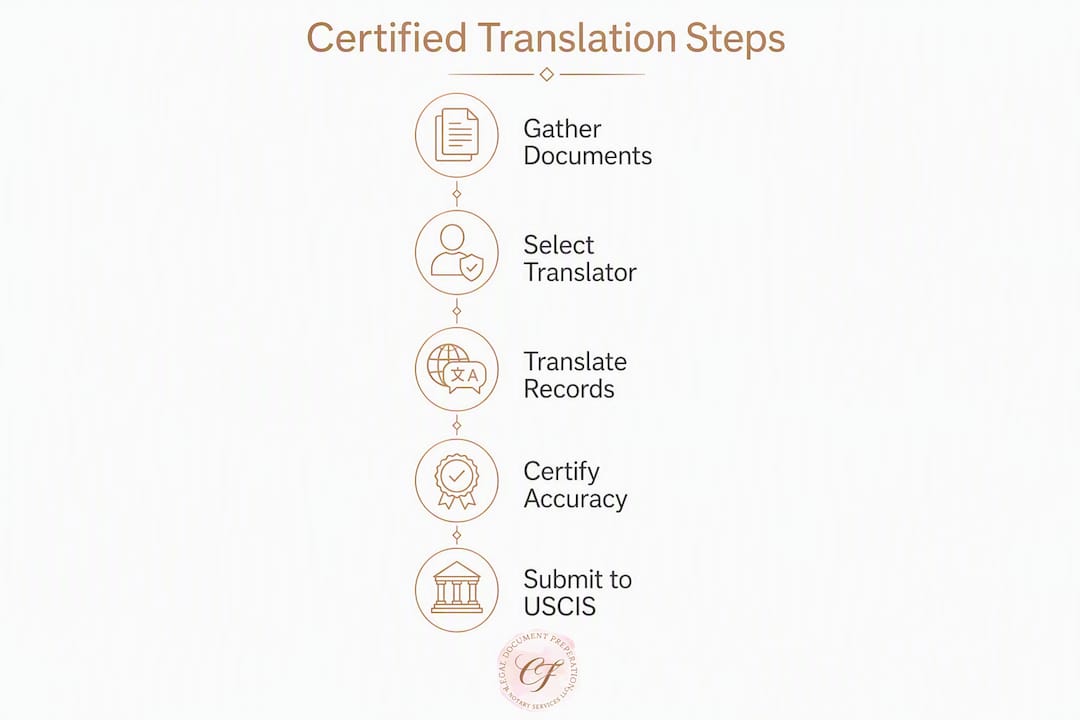
The process follows a clear sequence. Understanding each step helps you plan your filing timeline and avoid last-minute problems.
- Gather the original. Collect every page of the police record, including attachments, stamps, and any continuation sheets. Mismatched page counts are a common RFE trigger.
- Submit to a qualified translator. Provide a clean, legible copy. If the original is handwritten or partially illegible, note that in your request.
- Translator completes the translation. A professional will render the text verbatim, including all legal terminology, and prepare the certification statement.
- Review the draft. Some providers allow a client review period. Confirm that names, dates, case numbers, and dispositions match the original exactly.
- Receive the certified copy. The final package includes the translated document, the signed certification, and a copy of the original attached.
- File with your application. Keep a second complete copy for your records before submitting.
Typical turnaround and cost ranges:
| Document Type | Standard Turnaround | Expedited Turnaround |
|---|---|---|
| Simple police clearance certificate (1–2 pages) | 2–3 business days | — |
| Multi-page investigative report (5+ pages) | 4 business days | 2–3 business days |
| Complex record with legal annotations | 7 business days | 3–5 business days |
Cost factors include the language pair (rare languages cost more), page count, legal complexity, and whether you need notarization or apostille services in addition to translation. Rush fees typically add to the base rate. Confirm pricing upfront and ask for a flat-fee quote rather than a per-word estimate when possible.
Practical scheduling advice:
- Order translations as early as possible in your filing timeline.
- Build in buffer time for RFEs or requests for clarification.
- Check the Florida immigration document checklist if you are filing from Florida to confirm all supporting documents are accounted for.
How do you choose the right translation provider for immigration filings?
Not every translation service is equipped for immigration documents. Police records contain legal terminology, procedural language, and disposition codes that require specific expertise. Here is how to evaluate a provider before you commit.
Questions to ask before ordering:
- Do you provide a signed translator certification that meets USCIS requirements?
- Can you identify the specific translator who will handle my document?
- Do you offer notarization or apostille assistance if the receiving authority requires it?
- What is your revision policy if USCIS questions the translation?
- How do you handle confidential documents?
Red flags to watch for:
- Vague or templated certification language that does not identify the translator by name
- Inability to tell you who translated the document
- No stated quality-control process
- Unusually low pricing with no references or sample work
Trust signals that indicate a reliable provider:
- A sample certified translation available on request
- A clear privacy policy covering document handling
- Willingness to supply the translator's contact details if an adjudicator requests clarification
- Demonstrated experience with USCIS and consular filings specifically
Pro Tip: Ask for a sample certification statement before you order. A provider who cannot produce one, or who offers a vague version that omits the competence and accuracy language, is not ready for immigration work.
Document-preparation services that specialize in immigration filings understand USCIS standards and can flag problems before they reach an adjudicator's desk.
How Cflegalformhelp supports certified police-record translations
Cflegalformhelp, operating as CF Legal Document Preparation & Notary Services, provides certified translation coordination, translator certification drafting, and notarization support for immigration filings. The firm's bilingual English/Spanish capabilities are particularly useful for applicants whose police records originate from Spanish-speaking countries, where legal terminology and procedural language differ significantly from U.S. equivalents.
Services relevant to police-record translation:
- Certified translation coordination with translators experienced in immigration documents
- Translator certification statement drafting and review
- Notarization and document-preparation assistance for complete filing packages
- Bilingual support for English/Spanish filings from intake through submission
Flat-fee pricing removes the uncertainty that often comes with per-word or per-page billing. Confidentiality safeguards protect your documents throughout the process. For applicants preparing Form I-485, N-400, or consular processing packets, Cflegalformhelp's immigration forms help service covers the full document-preparation workflow, including translation coordination.
The practical next step: gather your police record originals and contact Cflegalformhelp for a translation readiness check before you file.
Key Takeaways
A certified, verbatim English translation of your police record, with a signed translator certification attached, is required by USCIS for every foreign-language document in your immigration filing.
| Point | Details |
|---|---|
| Certified translation is required | USCIS requires a full English translation and signed translator certification for every foreign-language document. |
| Attach the original | Include a copy of the original police record with the translation; mismatched pages trigger RFEs. |
| Use a professional translator | The applicant bears the burden of proving translator competence; a professional reduces RFE risk. |
| Order translations early | Build buffer time into your filing schedule for revisions, RFEs, or additional requests. |
| Cflegalformhelp assists with the process | CF Legal coordinates certified translations, drafts certification statements, and provides bilingual support for immigration filings. |
What most applicants get wrong about police-record translations
The most common mistake is treating a police-record translation as a formality rather than a legal document. Applicants often assume that any bilingual person can sign a certification, or that a machine-translated summary is close enough. Neither is true, and both create problems that are harder to fix after submission than before.
Police reports record an officer's initial impressions, not legal findings. A translation that drops qualifiers, negations, or respondent disclaimers changes the document's meaning in ways that can look deliberate to an adjudicator. "No charges were filed" and "charges were filed" are one dropped word apart. In a document that USCIS treats as factual, that difference can shift an entire admissibility determination.
What I consistently see in immigration document preparation is that applicants who invest in a proper certified translation early in the process rarely face translation-related RFEs. Those who cut corners, whether by using a family member, relying on a machine translation, or submitting a summary rather than a verbatim rendering, spend far more time and money correcting the record later. A well-prepared translation package, with the original attached, the certification signed, and every page accounted for, moves through adjudication cleanly. That is not a coincidence.
The checklist I recommend to every client preparing a police record for immigration submission:
- Confirm the original is complete (all pages, stamps, and attachments)
- Order a verbatim certified translation, not a summary
- Verify the certification statement includes competence language, accuracy language, translator name, and date
- Attach the original to the translation before filing
- Keep a second complete copy before the package leaves your hands
Cflegalformhelp makes certified translation straightforward
Getting your police record translated correctly the first time is the single most direct way to protect your immigration filing from delays. Cflegalformhelp offers a concrete alternative to piecing together a translation on your own: flat-fee certified translation coordination, bilingual document preparation, and notarization support, all handled by an immigration paralegal who understands what USCIS reviewers actually look for.
The service covers the full workflow: from reviewing your original police record to coordinating a certified translation, drafting the translator certification statement, and preparing the complete filing package. Bilingual English/Spanish support is available throughout. There are no per-word surprises; the flat-fee structure means you know your cost before you start.
If you are preparing an I-485, N-400, or consular processing packet and need a police-record translation that meets USCIS standards, start with CF Legal's document preparation services to get your translation package ready before your filing deadline.
Useful sources
| Source | What it covers |
|---|---|
| USCIS certified translation requirements — ATA client assistance | USCIS rule on full English translations, translator certification language, and competence standards |
| Prejudicial and Unreliable — NIJC policy brief | Research on how police reports are used in immigration adjudication and the risks of mistranslation |
| What Documents Need Translation for Immigration Applications? — OCNJ Daily | Practical filing guidance on which documents require certified translations and common RFE triggers |
| USCIS all forms — uscis.gov | Official list of USCIS forms and supporting document requirements |
| Certified Immigration Document Translation Services — Stepes | Industry guidance on certification vs. notarization and translation workflows for immigration documents |
| IRCC police certificate translation guidance | Comparative authority on family-member translation restrictions (Canada); useful context for U.S. applicants |
| CF Legal certified translations and notary services | CF Legal's certified translation and notary service overview |
This article provides general information about immigration document requirements and is not legal advice. Confirm current USCIS and consular requirements with the relevant authority or a qualified immigration professional before filing.