

A deed notarization requirement is the compulsory official acknowledgment by a notary public that confirms the signer's identity and the legitimacy of their signature on a property deed. Florida adds a layer most states skip entirely: two disinterested witnesses must also observe the signing alongside the notary. Understanding what is a deed notarization requirement matters whether you are transferring a family home in Naples or recording a commercial property in Miami. Get it wrong, and the county recorder sends the deed back. Get it right the first time, and the title transfers cleanly.
What are the legal requirements for notarizing a deed in Florida?
Florida is one of only five states requiring two subscribing witnesses in addition to a notary public for a real estate deed to be legally valid. The other four states with this rule are Connecticut, Georgia, Louisiana, and South Carolina. That fact alone separates Florida from the majority of the country, where a single notary acknowledgment is enough.
The requirements for deed notarization in Florida break down into three distinct roles:
- The grantor (signer): Must appear before the notary, present valid government-issued photo ID, and sign the deed voluntarily.
- Two disinterested witnesses: Must physically observe the grantor signing. Disinterested witnesses cannot have a financial interest in the property, and the grantee's close family members are disqualified. Both witnesses must then sign the deed themselves.
- The notary public: Verifies the signer's identity, confirms the signing is voluntary, completes the notarial certificate with the correct language, and affixes the official seal.
A common and costly mistake is having the grantor sign the deed before the notary and witnesses are present. That single error voids the notarization entirely. Florida law requires all parties to be present at the same time during execution.
The Revised Uniform Law on Notarial Acts (RULONA) provides model standards that standardize key notarization procedures across many states, including Florida. RULONA adoption means Florida notaries follow defined protocols for identity verification, certificate language, and seal requirements. Knowing these standards helps you confirm your notary is following the correct procedure.

Pro Tip: Ask your witnesses to bring their own government-issued photo ID to the signing. Some county recorders request witness identification details on the deed, and having it ready prevents last-minute delays.
How does the deed notarization process work step by step?
The deed notarization process follows a specific sequence. Skipping or reordering any step creates grounds for rejection at the county recorder's office.
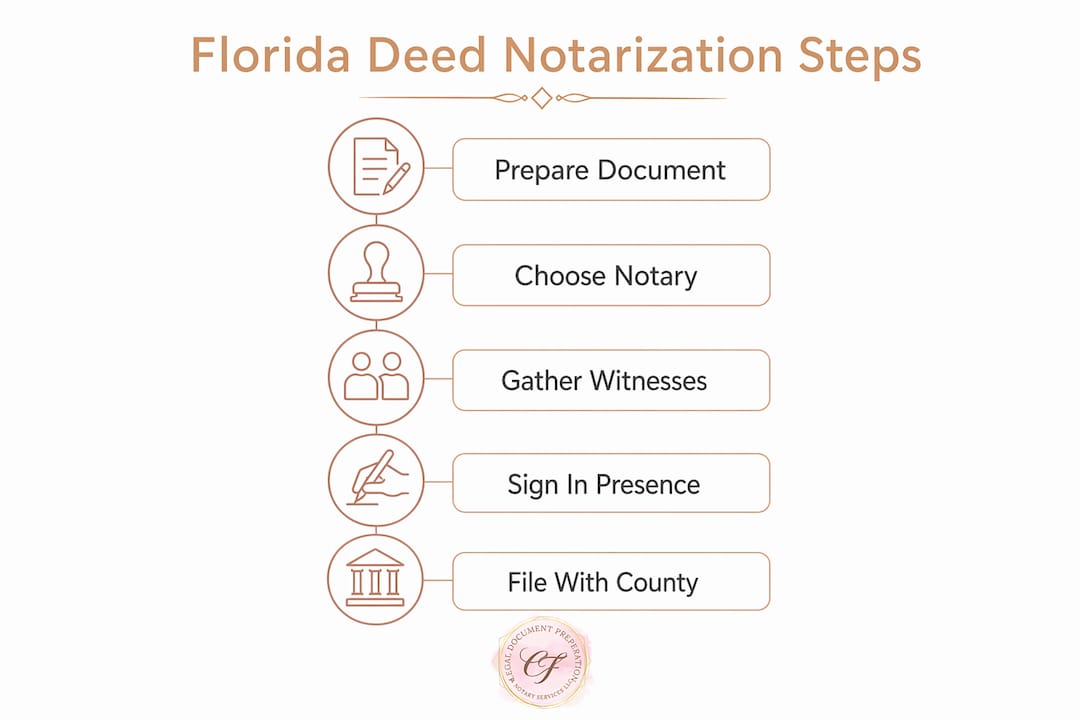
- Prepare the deed correctly. The deed must include the grantor's and grantee's full legal names, the legal property description, and the correct notarial certificate language for Florida. Missing any of these elements causes rejection before the notary even signs.
- Gather all parties. The grantor, two disinterested witnesses, and the notary must all be present at the same time and place. Remote arrangements require specific compliance steps covered below.
- Verify identity. The notary checks the grantor's government-issued photo ID. This step is non-negotiable. Review the notary ID verification process to understand what forms of ID Florida notaries accept.
- Sign the deed. The grantor signs in the presence of both witnesses and the notary. The witnesses then sign. The order matters: the grantor signs first.
- Complete the notarial certificate. The notary fills in the acknowledgment certificate, signs it, and stamps the official seal. Most deeds use an acknowledgment rather than a jurat. An acknowledgment allows the grantor to have signed earlier but requires appearing before the notary to confirm the signature was made voluntarily. A jurat requires signing in the notary's presence and swearing an oath, which is less common for deeds.
- Record the deed. Submit the notarized deed to the county recorder's office in the county where the property is located, along with the applicable recording fee.
Remote online notarization in Florida
At least 45 states and Washington D.C. allow remote online notarization as of early 2025. Florida is among them. Remote online notarization (RON) lets the grantor and notary connect via live audio-video technology instead of meeting in person. However, Florida's two-witness rule still applies during RON sessions. The witnesses can participate remotely, but the technology platform must meet Florida's specific security and identity-proofing standards. Check the Florida remote notary guidelines before scheduling a remote session for a deed.
Pro Tip: Confirm your RON platform is approved under Florida Statutes Chapter 117 before your session. Not every online notarization service meets Florida's requirements for real estate deeds.
What are the consequences of failing to meet deed notarization requirements in Florida?
County recorders reject deeds when the notarial certificate contains errors or is missing required elements. Rejection is not a minor inconvenience. It triggers a chain of problems that cost time and money.
The most common consequences include:
- Outright rejection at recording. The deed comes back unfiled. The property transfer does not happen until a corrected deed is submitted.
- Corrective deed costs. Failing to meet witness or notarization requirements means filing a brand-new corrective deed, paying additional notarization fees, gathering all parties again, and resubmitting to the recorder.
- Title clouds. An improperly executed deed that somehow gets recorded creates a "cloud on title." This is a defect in the chain of ownership that must be resolved before the property can be sold or refinanced. Clearing a title cloud often requires a quiet title lawsuit.
- Delayed closings. In real estate transactions, a rejected deed can push back the closing date, triggering contract penalties or even deal cancellations.
Errors in notarial certificates, such as a missing seal or incorrect certificate language, are the most common reason county recorders reject deeds. One missing element can unravel an entire property transfer, regardless of how correctly everything else was done.
The Florida notarization requirements checklist is a practical tool for verifying every element before submission. Using it before you walk into the recorder's office eliminates the most preventable errors.
How do notarization requirements for deeds compare to other Florida documents?
Florida applies different notarization rules depending on the document type. Real estate deeds carry the strictest requirements. The table below compares the notarization standards for common Florida legal documents.
| Document type | Notary required | Witnesses required | Witness count |
|---|---|---|---|
| Real estate deed | Yes | Yes | 2 disinterested witnesses |
| Last will and testament | No (self-proving requires notary) | Yes | 2 witnesses |
| Durable power of attorney | Yes | Yes | 2 witnesses |
| Healthcare surrogate designation | No | Yes | 2 witnesses |
| Mortgage or deed of trust | Yes | Yes | 2 witnesses |
The pattern is clear: Florida consistently requires two witnesses across its most critical legal documents. The difference with real estate deeds is that the notary is mandatory, not optional. A will can be valid without a notary if properly witnessed, but a deed without a notary is not recordable.
Remote online notarization applies differently across document types. Florida allows RON for deeds and mortgages, but certain documents, such as wills executed under traditional Florida Statutes requirements, may face additional scrutiny when executed remotely. The state versus federal notary document rules explain where state law governs and where federal standards intersect.
Notary fees for deed notarization are generally capped between $2 and $25 per signature in states with statutory limits. Florida maintains a statutory cap, so confirm the current rate with your notary before your appointment. Mobile notary services may charge a separate travel fee on top of the per-signature fee.
Key Takeaways
Florida's deed notarization requirement is one of the strictest in the country, mandating a notary public plus two disinterested witnesses for every valid real estate deed execution.
| Point | Details |
|---|---|
| Florida's dual witness rule | Two disinterested witnesses must observe and sign every deed alongside the notary. |
| Acknowledgment vs. jurat | Most deeds use an acknowledgment, allowing prior signing but requiring appearance before the notary. |
| RON is available but conditional | Remote online notarization is permitted in Florida, but the two-witness rule and platform approval requirements still apply. |
| Errors cause rejection | Missing seals, incorrect certificate language, or absent witnesses lead to county recorder rejection and corrective deed costs. |
| Document type matters | Deeds carry stricter notarization rules than wills or healthcare documents in Florida. |
What I have learned from years of deed notarization work in Florida
Working with Florida deed notarization every day, the mistake I see most often is not a missing seal or wrong certificate language. It is the witness problem. People show up with a spouse or adult child of the grantee as a witness, not realizing that disqualifies the entire execution. The deed looks complete, gets submitted, and then comes back rejected weeks later. That delay can cost a client a real estate closing.
My honest advice: treat witness selection as seriously as you treat the notary appointment. Choose two people who have zero financial connection to the property and no close family relationship to the grantee. Neighbors, coworkers, and friends work well. Confirm their availability before the signing date, not the morning of.
The second thing I tell every client is to review the notarial certificate language before the appointment. Florida requires specific acknowledgment wording. If the certificate on your deed form uses outdated or incorrect language, the notary cannot fix it by crossing things out. You need a corrected document. Catching that before the signing saves everyone time.
Remote online notarization is genuinely useful for clients who cannot travel, but it adds complexity to deed signings. The witnesses must also participate remotely, and the platform must meet Florida's technical standards. For straightforward deed transfers, an in-person signing with a qualified mobile notary is still the most reliable path to a clean recording.
— Cristina
Deed notarization help for Florida property owners
Florida's deed notarization rules leave little room for error. One missing witness, one incorrect certificate, and the county recorder sends the deed back.
Cflegalformhelp provides legal document preparation and notary services specifically for Florida clients, including deed preparation, witness coordination, and mobile notary appointments. The team handles the details that trip people up: correct certificate language, disinterested witness guidance, and proper recording submission. For clients who prefer remote appointments, Cflegalformhelp also offers mobile notary and loan signing services that meet Florida's RON standards. Services are available in English and Spanish, with flat-fee pricing and no hidden costs.
FAQ
What is a deed notarization requirement in Florida?
A deed notarization requirement in Florida is the legal mandate that a real estate deed be signed before a notary public and two disinterested witnesses to be valid for recording. All three parties must be present at the same time during execution.
Can a family member serve as a witness on a Florida deed?
A close family member of the grantee cannot serve as a disinterested witness on a Florida deed. Witnesses must have no financial interest in the property and no disqualifying relationship to the grantee.
What happens if a deed is notarized incorrectly in Florida?
An incorrectly notarized deed is rejected by the county recorder's office. The grantor must execute a new corrective deed with proper notarization and witnesses, paying additional fees and restarting the recording process.
Does Florida allow remote online notarization for deeds?
Florida allows remote online notarization for real estate deeds, but the two-witness requirement still applies. The RON platform must also meet Florida's technical and identity-proofing standards under Chapter 117 of the Florida Statutes.
How much does deed notarization cost in Florida?
Notary fees in Florida are subject to a statutory cap, generally within the range of $2–$25 per signature. Mobile notary services may charge an additional travel fee, so confirm the full cost before scheduling.