
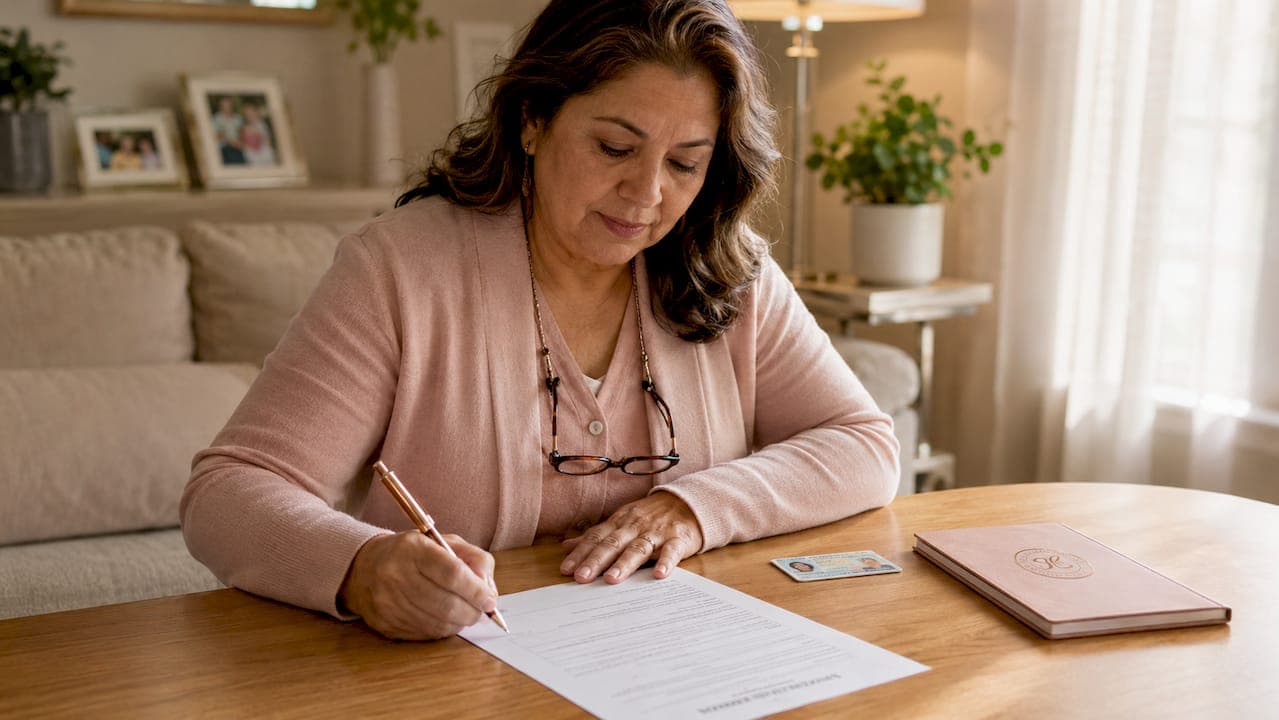
A financial power of attorney in Florida is legally valid only when the principal signs it, two adult witnesses observe that signing, and a Florida notary acknowledges it. This formal legal instrument, known in standard practice as a durable power of attorney or financial POA, gives a trusted agent authority to manage bank accounts, real estate, and other financial matters on your behalf. Under Florida Statutes Chapter 709, skipping any one of those three steps gives banks, title companies, and government agencies full legal grounds to reject the document outright. Understanding why financial power attorney notarized Florida requirements exist protects you from a crisis when you need the document most.
Why does Florida require a financial power of attorney to be notarized?
Florida requires notarization because it is the primary legal safeguard against fraud and coercion. A notary's acknowledgment confirms that the person signing is who they claim to be, that they signed voluntarily, and that they had legal capacity at the time of signing. Without that verification, any document granting broad financial authority over someone's assets is a liability for every institution that accepts it.
Florida Statutes §709.2105 mandates all three execution steps: principal signature, two witnesses, and notarization. Skipping any one of them allows financial entities to refuse to honor the POA, with rejection rates approaching certainty. That is not a technicality. It means your agent cannot access your bank account, pay your mortgage, or manage your investments during a medical emergency.
Without a valid POA, families face court-appointed guardianship, which is both costly and time-consuming. A properly notarized financial POA allows immediate, trusted management of financial affairs the moment incapacity occurs. That speed and certainty is the entire point of the document.
"A financial power of attorney grants control to a trusted agent, preserving personal control far better than courts assigning guardians." — Winblade Law
What are Florida's legal requirements for notarizing a financial power of attorney?
Florida Statutes §709.2105 sets out a specific execution ceremony. Every step must happen in a single, continuous event. You cannot sign the document at home and bring it to the notary later.
The required steps are:
- Principal signs in the presence of two adult witnesses and the notary. All parties must be physically present at the same time, or connected via approved audio-video technology for remote notarization.
- Two subscribing witnesses sign the document. These witnesses must be adults who are not named as the agent in the document. They confirm they observed the principal sign willingly.
- The notary acknowledges the principal's signature. The notary verifies identity, confirms the signing was voluntary, and affixes their seal and signature.
- The notary cannot serve as one of the two witnesses. These are legally distinct roles. Combining them creates an execution defect that institutions use to reject the document.
Banks follow strict legal protocols to reject POAs with even minor technical defects. Their refusal is not obstruction. It is a legal risk management practice that protects the principal from fraud. A document that looks valid but was improperly executed is a liability, not an asset.
Pro Tip: Bring a government-issued photo ID to every notarization appointment. Florida notaries are required to verify your identity, and a missing or expired ID can halt the entire ceremony.
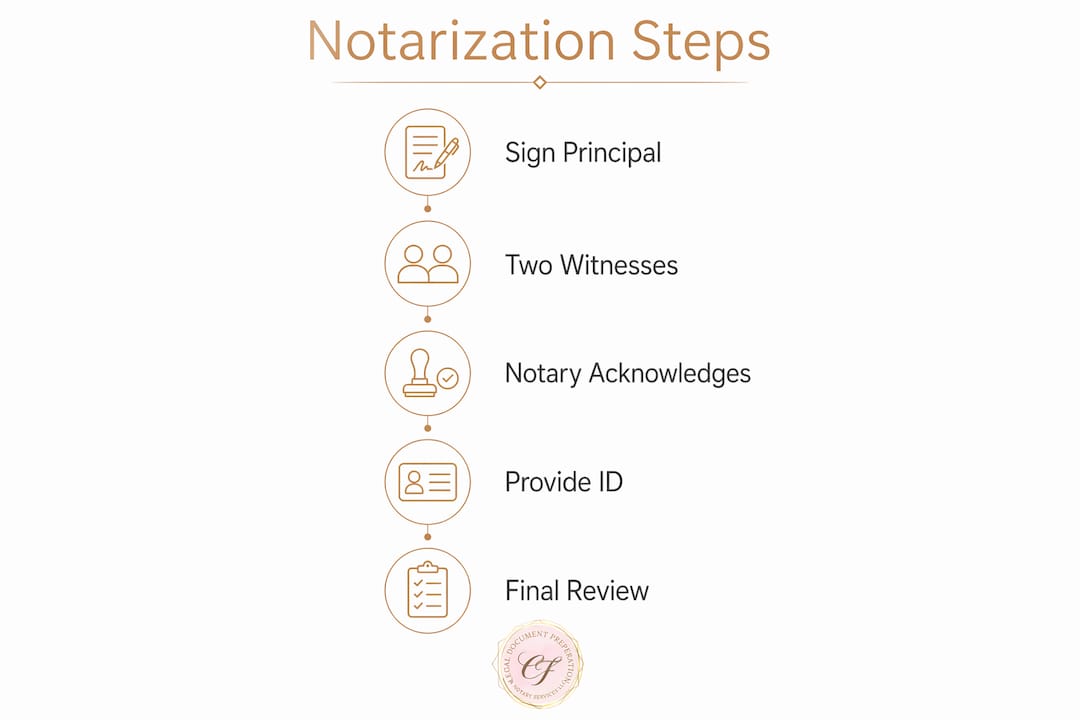
Review the full Florida notarization requirements checklist before your appointment to confirm you have every element in place.
Why is notarization critical for a financial power of attorney in Florida?
Notarization does three things that no other step in the process can replicate. First, it authenticates identity. Second, it creates a public record that the signing occurred under lawful conditions. Third, it signals to every third party that the document meets Florida's statutory standards.

Institutions legally can deny POAs missing required notarization or witnessing due to their own risk management policies. Banks, title companies, and government agencies all operate under this standard. A financial POA without a notary seal is treated as an unsigned contract. It carries no legal weight at the counter.
The stakes are highest during a medical emergency. If you become incapacitated and your POA has a defect, your agent cannot act. Your bills go unpaid, your mortgage falls behind, and your family has no legal authority to intervene without going to court. That process can take months and cost thousands of dollars in legal fees.
Old POA documents with "springing" clauses are no longer recognized following Florida's 2011 statutory overhaul. Only POAs that take effect immediately upon signing and are properly notarized are accepted today. If you have a document drafted before 2011, it may already be invalid regardless of how carefully it was notarized at the time.
What are common mistakes when notarizing a Florida financial power of attorney?
Execution errors are the leading reason institutions reject financial POAs in Florida. Most of these mistakes are avoidable with basic preparation.
- Using the notary as one of the two required witnesses. This role conflict creates an authenticity defect. The notary and both witnesses must be three separate people.
- Signing before the notary arrives. The principal's signature must be acknowledged before the notary during one continuous ceremony. Pre-signing invalidates the document, even if the notary later affixes their seal.
- Using outdated or generic online templates. Florida law requires the principal to initial each "superpower" such as gifting assets, changing beneficiaries, or creating trusts. Templates downloaded from general legal websites often omit these initialing fields entirely. A document missing those initials will be rejected for those specific powers even if it is otherwise properly notarized.
- Failing to meet remote online notarization standards. Florida Statutes §117.201 requires real-time audio-video connection and approved identity-proofing technology for remote notarization. Using a standard video call without a compliant platform does not satisfy the statute.
- Storing the original document carelessly. Banks and title companies require the original notarized document or a certified copy. A photocopy alone is not accepted.
Pro Tip: After notarization, make certified copies and store the original in a fireproof location. Give your agent a certified copy and tell your bank in advance that a POA exists. Some banks allow you to register the document proactively, which speeds up access during an emergency.
For a detailed walkthrough of each step, the guide on how to notarize a POA in Florida covers the most common missteps and how to avoid them.
How does remote online notarization work for financial POAs in Florida?
Remote online notarization, commonly called RON, is fully legal in Florida under Florida Statutes §117.201. It allows the principal, witnesses, and notary to complete the entire execution ceremony over a secure audio-video platform without meeting in person. Florida was among the first states to codify RON, and its standards are among the most detailed in the country.
RON requires real-time audio-video and strict identity verification to comply with statutory standards. Identity-proofing typically involves knowledge-based authentication questions drawn from credit and public records, plus credential analysis of a government-issued ID. The notary must use a Florida-approved technology platform. Not every video conferencing tool qualifies.
Florida also requires RON notaries to carry a $25,000 surety bond and errors and omissions insurance to perform remote notarizations. That requirement protects the principal if a notary makes a procedural error. It is a meaningful consumer protection that in-person notarization does not always require.
| Feature | In-person notarization | Remote online notarization |
|---|---|---|
| Location required | Same physical space | Anywhere with internet access |
| Identity verification | Government ID, visual check | Knowledge-based authentication plus ID scan |
| Witnesses | Must be physically present | Can appear via audio-video |
| Legal validity in Florida | Full statutory validity | Full statutory validity under §117.201 |
| Acceptance by third parties | Universal | Accepted by most institutions; confirm in advance |
Third-party acceptance is the one area where RON requires extra attention. Most Florida banks and title companies accept remotely notarized POAs, but some institutions have internal policies that still prefer in-person documents. Confirm acceptance with your bank before choosing RON for a financial POA you plan to use immediately.
Learn more about which documents qualify under Florida's remote notary rules to confirm your POA meets current 2026 standards.
Key takeaways
A financial power of attorney in Florida is legally enforceable only when it is signed, witnessed by two adults, and notarized in a single continuous ceremony under Florida Statutes §709.2105.
| Point | Details |
|---|---|
| Three-step execution is mandatory | Principal signature, two adult witnesses, and notarization must all occur together. |
| Notary and witness roles are separate | The notary cannot serve as one of the two required witnesses. |
| Pre-signing voids the document | The principal must sign in front of the notary, not before the appointment. |
| Initialing superpowers is required | Florida law requires the principal to initial each special authority such as gifting or changing beneficiaries. |
| RON is legally valid in Florida | Remote online notarization under §117.201 is fully accepted when using an approved platform and identity-proofing. |
What I have learned from watching families get this wrong
After years of helping Florida residents prepare and notarize legal documents, the pattern I see most often is not ignorance. It is overconfidence. People assume that because they found a POA form online and got it notarized at a UPS Store, the job is done. Then a bank rejects it six months later during a crisis, and the family has no legal recourse.
The 2011 Florida statutory overhaul changed everything. Documents prepared before that year, or prepared using templates that have not been updated since, are frequently invalid. I have seen families discover this only after a parent becomes incapacitated. At that point, the only option is guardianship court, which takes months and costs far more than proper document preparation would have.
The detail that surprises people most is the initialing requirement for special powers. A document can be perfectly notarized, properly witnessed, and still be rejected by a title company because the principal never initialed the real estate authority section. That is not a minor technicality. It is a complete block on the agent's ability to act.
My recommendation is straightforward. Treat notarization as a legal ceremony, not a clerical step. Use a current Florida-compliant form. Bring two witnesses who are not your agent. Sign only in front of the notary. And if you have any doubt about the form you are using, get professional document preparation help before the appointment, not after. The cost of getting it right the first time is a fraction of what guardianship proceedings cost.
— Cristina
Your Florida financial POA deserves professional preparation
Getting a financial power of attorney right in Florida means more than finding a form and a notary. It means using a current, statute-compliant document, executing it correctly, and confirming it will be accepted by the institutions that matter to you.
Cflegalformhelp provides legal document preparation and notarization services tailored to Florida's specific requirements. Whether you need in-person notarization in the Naples area or a fully compliant remote session, Cflegalformhelp reviews your documents for execution errors before the ceremony begins. Flat-fee pricing means no surprises, and bilingual support in English and Spanish is available for every client. Schedule your mobile or remote notary appointment and get your financial POA done correctly the first time.
FAQ
Does a financial power of attorney have to be notarized in Florida?
Yes. Florida Statutes §709.2105 requires the principal's signature to be witnessed by two adults and acknowledged before a notary. A POA without notarization is not legally valid and will be rejected by banks and other institutions.
Can the notary also serve as a witness on a Florida POA?
No. Florida law requires two witnesses who are separate from the notary. Using the notary as one of the two witnesses creates an execution defect that invalidates the document.
What happens if my Florida POA is not properly notarized?
Institutions will refuse to honor it. Without a valid POA, your family may need to pursue court-appointed guardianship, which is a lengthy and expensive legal process.
Is remote online notarization valid for a Florida financial power of attorney?
Yes. Florida Statutes §117.201 authorizes remote online notarization using approved audio-video platforms and identity-proofing technology. Most Florida banks and title companies accept RON-notarized POAs, but confirming acceptance in advance is advisable.
How often should I update my Florida financial power of attorney?
Review your POA any time Florida law changes or your personal circumstances shift. Documents drafted before Florida's 2011 statutory overhaul are likely invalid and should be replaced with a current, properly executed version.