

Florida small claims court filing is the process of submitting a Statement of Claim to your county clerk to resolve money disputes up to $8,000, excluding costs and attorney fees, under simplified procedural rules designed for people without lawyers. The Florida Small Claims Rules, effective 2026, govern every step from filing to trial. These rules exist specifically to make the court accessible to self-represented litigants, also called pro se filers. If someone owes you money for unpaid rent, a bad contractor job, or a returned check, small claims court is your most direct path to a legal resolution.
What are the requirements for Florida small claims court filing?
Florida small claims court handles civil money claims up to $8,000 in dispute, not counting court costs or attorney fees. That limit covers the most common disputes individuals bring: security deposit returns, property damage, unpaid loans, and breach of contract. You file in the county where the defendant lives or where the contract was performed, not necessarily where you live.
Documents you need to prepare
The core document is the Statement of Claim, a short written summary of who owes you money, why, and how much. Official small claims forms exist for common claim types, and you may modify them to fit your specific facts. If no standard form fits your situation, you can fall back to a full civil complaint form. Supporting documents strengthen your case: contracts, receipts, text messages, photos, and invoices all count as evidence.

Filing fees and fee waivers
Filing fees in Florida small claims court vary based on the amount you are claiming. The table below shows the general fee tiers.
| Claim Amount | Approximate Filing Fee |
|---|---|
| $100 or less | $55 |
| $101–$500 | $80 |
| $501–$2,500 | $175 |
| $2,501–$5,000 | $300 |
| $5,001–$8,000 | $400 |
If you cannot afford the filing fee, you can submit an Application for Determination of Civil Indigent Status alongside your Statement of Claim. The court reviews the application and may waive your fees entirely. This process removes a significant financial barrier for low-income filers.
Pro Tip: Bring two copies of every document you file. The clerk keeps one set and stamps the other as your official record. You will need that stamped copy later.
How do you file a small claims case step by step in Florida?
The Florida Small Claims Rules allow you to file in person at the courthouse, by mail, or through an electronic filing portal, depending on your county. Most counties in Florida now offer e-filing through the Florida Courts E-Filing Portal. Check your specific county clerk's website to confirm which options are available.
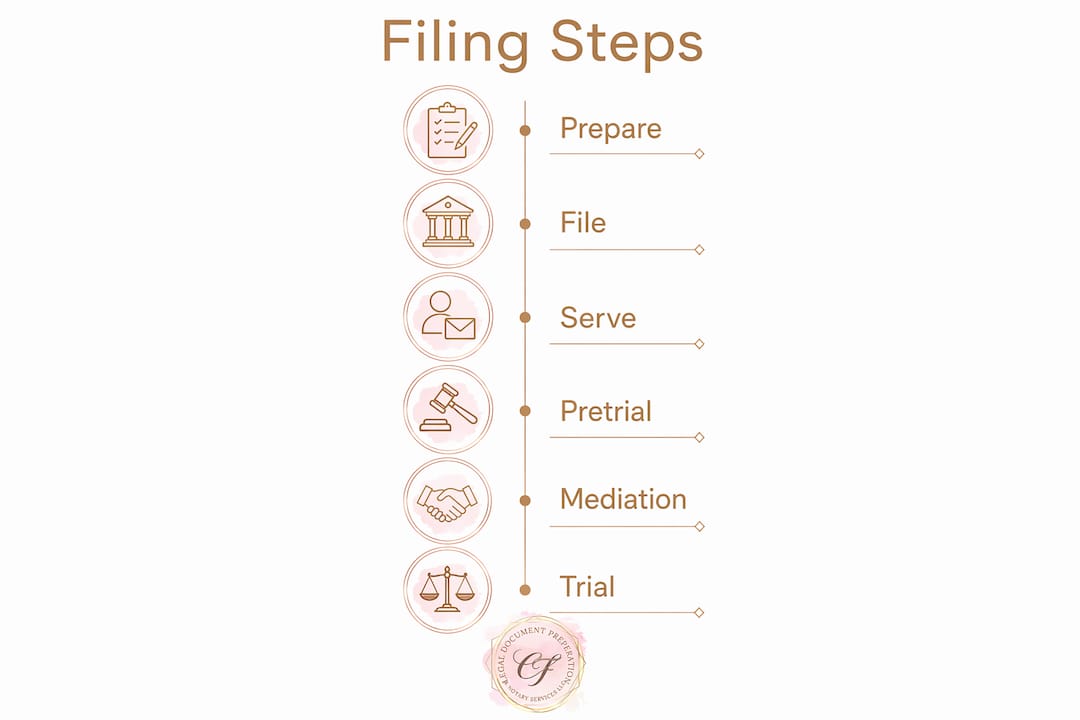
Here is the complete filing sequence:
-
Complete your Statement of Claim. Write a clear, factual summary of your dispute. State the defendant's full legal name, their address, the amount owed, and why you believe they owe it. Keep it factual and specific.
-
Attach supporting documents. Include copies of contracts, invoices, receipts, or any written communication that supports your claim. Do not submit originals at this stage.
-
Submit your filing. Bring or mail your completed Statement of Claim and supporting documents to the county clerk's office. If filing electronically, upload through the approved portal.
-
Pay the filing fee. Pay at the clerk's window or online. If you are applying for a fee waiver, submit your indigent status application at the same time.
-
Arrange service of process. The court issues a summons, and you must make sure the defendant receives it. Timely service of process is your responsibility as the plaintiff. Common methods include certified mail or service by the county sheriff.
-
Confirm your pretrial conference date. The clerk will assign a pretrial conference date, typically within 50 days of filing. Write it down and plan to attend.
Pro Tip: Do not skip the service step. If the defendant is not properly served, the court will cancel your pretrial conference and delay your entire case. Follow up with the sheriff's office or process server to confirm delivery.
The clerk of court has a legal duty to assist pro se litigants in preparing their Statement of Claim and initial papers. That assistance does not extend to complex procedures like substituted service or discovery, but it covers the basics. Ask questions at the clerk's window. That is what the staff is there for.
What happens after filing: pretrial conference, mediation, and trial?
Most Florida small claims cases resolve within 45–90 days of filing, with a hard maximum of 110 days from filing to trial. That timeline is faster than most people expect. The court moves quickly because the rules are designed to keep cases simple.
The pretrial conference
The pretrial conference is the first major event after filing. The court schedules it within 50 days of your filing date. Both parties must appear in person unless attorneys file a written stipulation waiving attendance. Written defensive pleadings are generally not required before this stage, which keeps the process accessible for defendants too.
At the pretrial conference, the judge or magistrate focuses on four things: simplifying the legal issues, getting admissions of fact, limiting the number of witnesses, and exploring settlement. Many cases settle at this stage without ever going to trial.
Mediation
Pretrial conferences often lead to mediation, a structured negotiation session that typically lasts 20–60 minutes. A neutral mediator helps both sides reach a voluntary agreement. Mediation is faster, less stressful, and more predictable than a trial. If you reach a settlement in mediation, the court records it as a binding agreement.
Trial scheduling and what to expect
If mediation does not resolve the case, the judge schedules a trial. The timeline below shows the key stages.
| Stage | Typical Timing |
|---|---|
| Filing | Day 1 |
| Pretrial conference | Within 50 days |
| Mediation (if needed) | At or after pretrial conference |
| Trial | Within 110 days of filing |
At trial, you present your evidence and explain your claim directly to the judge. There is no jury in small claims court. Bring all your original documents, organized and ready to hand to the judge. Speak clearly, stick to the facts, and answer questions directly.
Common mistakes to avoid when representing yourself in Florida small claims court
Self-represented filers make the same errors repeatedly. Knowing them in advance puts you ahead of most people who walk into that courthouse.
- Skipping verification requirements. You do not need to notarize or formally verify your Statement of Claim for it to be valid. Courts do not dismiss claims simply because a phone number is missing or the form lacks a notary seal.
- Ignoring service of process. Failing to serve the defendant properly is the single most common reason cases stall. Improper service forces the court to cancel the pretrial conference and restart the clock.
- Expecting the clerk to do everything. The clerk helps you prepare your initial papers. They cannot advise you on strategy, help you serve a defendant through substituted service, or assist with discovery requests.
- Bringing disorganized evidence. Judges in small claims court see dozens of cases per session. A clear, organized folder of labeled documents makes a stronger impression than a stack of loose papers.
- Missing the pretrial conference. Failing to appear results in your case being dismissed or a default judgment against you if you are the defendant.
"The pretrial conference is not a formality. It is your best opportunity to resolve the dispute quickly, save time, and avoid the uncertainty of a trial. Come prepared to negotiate, not just to argue."
Pro Tip: Before your pretrial conference, write a one-page summary of your claim: what happened, what you are owed, and what evidence you have. Judges appreciate clarity, and having it written down keeps you focused under pressure.
The role of a document preparer is worth understanding before you file. A certified document preparer can help you complete your forms accurately without providing legal advice, which is exactly the kind of support most pro se filers need.
Key Takeaways
Florida small claims court filing requires a completed Statement of Claim, proper service of process, and attendance at a mandatory pretrial conference within 110 days of filing.
| Point | Details |
|---|---|
| Claim limit is $8,000 | Florida small claims court handles money disputes up to $8,000, excluding costs and fees. |
| Fee waivers are available | Submit an indigent status application with your claim to request a full filing fee waiver. |
| Service of process is your job | As the plaintiff, you must confirm the defendant is properly served or face delays. |
| Pretrial conference is mandatory | Both parties must appear within 50 days of filing; many cases settle here through mediation. |
| Clerk assistance has limits | Clerks help with initial paperwork but cannot advise on complex service or discovery issues. |
What I have learned from helping clients file small claims in Florida
After working with self-represented filers across South Florida, I have seen one pattern repeat itself: people underestimate how much preparation matters before they ever walk into the courthouse. The rules are genuinely accessible. The court staff is helpful. But none of that saves you if your Statement of Claim is vague or your evidence is scattered.
The clients who do best come in with a clear, written account of what happened and a folder of organized documents. They show up on time to their pretrial conference ready to negotiate, not just to vent. Mediation works far more often than people expect, and it almost always produces a faster, less stressful outcome than a trial.
One thing I tell every client: do not be afraid to ask the clerk for help with your initial paperwork. That assistance is built into the rules for a reason. Use it. Where I see people struggle is when they assume the clerk can guide them through the entire process. That is not the clerk's role, and expecting it leads to frustration.
The 110-day timeline sounds generous, but it moves fast once you are in the system. Get your documents ready before you file, not after. And if you are unsure whether your claim falls within the $8,000 limit or which county has jurisdiction, get that answered first. Filing in the wrong venue wastes time and money.
— Cristina
How Cflegalformhelp can support your small claims filing
Filing a small claims case is manageable when your paperwork is accurate and complete from the start. Cflegalformhelp specializes in legal document preparation for self-represented individuals across Florida, including Statement of Claim preparation, supporting document organization, and notarization when required.
Cflegalformhelp offers flat-fee, bilingual services in English and Spanish, with no hidden costs and no attorney involvement required. Whether you need help completing your initial filing documents or want a professional review before you submit, the team at Cflegalformhelp is ready to assist. You can also explore the DIY filing guides on the website for step-by-step support at your own pace. Reach out today to get your documents right the first time.
FAQ
What is the maximum claim amount in Florida small claims court?
Florida small claims court handles disputes up to $8,000, not counting court costs or attorney fees. This limit applies to the amount you are seeking to recover.
How long does a Florida small claims case take to resolve?
Most cases resolve within 45–90 days of filing, with a maximum timeline of 110 days from filing to trial. Many cases settle even earlier at the pretrial conference through mediation.
Do I need a lawyer to file a small claims case in Florida?
No. The Florida Small Claims Rules are specifically designed for self-represented litigants. The clerk of court is required to help you prepare your initial paperwork.
What happens if I cannot afford the filing fee?
You can submit an Application for Determination of Civil Indigent Status alongside your Statement of Claim. If approved, the court waives your filing fee entirely.
What if the defendant is not served before the pretrial conference?
The court will cancel the pretrial conference if the defendant has not been properly served. You will need to request a new summons and complete service before the case can proceed.