

A Spanish language power of attorney, formally known as a poder notarial, is a notarized legal instrument that authorizes a designated agent to act on behalf of a principal in legal and financial matters governed by Spanish law. Rooted in Articles 1709–1739 of the Código Civil español, this document creates a legally binding relationship between two parties: the poderdante (principal) and the apoderado (agent). For anyone managing property, business dealings, or personal affairs in Spain from abroad, understanding what is a Spanish language power of attorney is the first step toward protecting your interests. Cflegalformhelp assists bilingual clients with exactly this kind of document preparation.
What is a Spanish language power of attorney and how does it work?
A poder notarial grants an agent the legal authority to sign contracts, manage bank accounts, sell property, or handle government filings on the principal's behalf. The principal does not need to be physically present in Spain for transactions to proceed once the document is properly executed. That makes this instrument especially valuable for expatriates, immigrants, and business owners with cross-border obligations.
The Spanish Civil Code defines the relationship as one of mandato, or mandate, meaning the agent must act strictly within the boundaries the principal sets. Any action taken outside those boundaries carries no legal weight. This is why the scope of authority written into the document matters as much as the document itself.

What legal and procedural requirements must be met for a valid Spanish power of attorney?
Validity depends on meeting several formal requirements, and skipping any one of them can render the document useless before Spanish authorities.
- Notarization: The document must be signed before a notary public. A Spanish notary or an authorized official at a Spanish consulate abroad can perform this function.
- Apostille certification: Any power of attorney signed outside Spain requires Hague Apostille certification for recognition in Spain. Signing before a Spanish embassy or consulate abroad can eliminate this requirement.
- Sworn translation: If the original document is in a language other than Spanish, a sworn professional translation into Spanish is mandatory. Unofficial translations are not accepted.
- Bilingual drafting: Some notaries offer bilingual versions that pair the Spanish legal text with the principal's native language. This does not replace the Spanish operative text but helps the principal understand what they are signing.
- Costs: Notarized powers of attorney in Spain typically cost between €40 and €250. General powers tend to fall in the €100–€150 range, while specific powers often cost less.
The apostille step catches many people off guard. Signing abroad demands legalization that adds time and cost to the process. Planning ahead avoids delays when a transaction has a firm deadline.
Pro Tip: If you are outside Spain, contact the nearest Spanish consulate before scheduling a notary appointment. Consular execution can save you the apostille process entirely and reduce total preparation time.
What types of Spanish powers of attorney exist and how do they differ?
Three main types cover most personal and business situations, and choosing the wrong one creates real legal exposure.
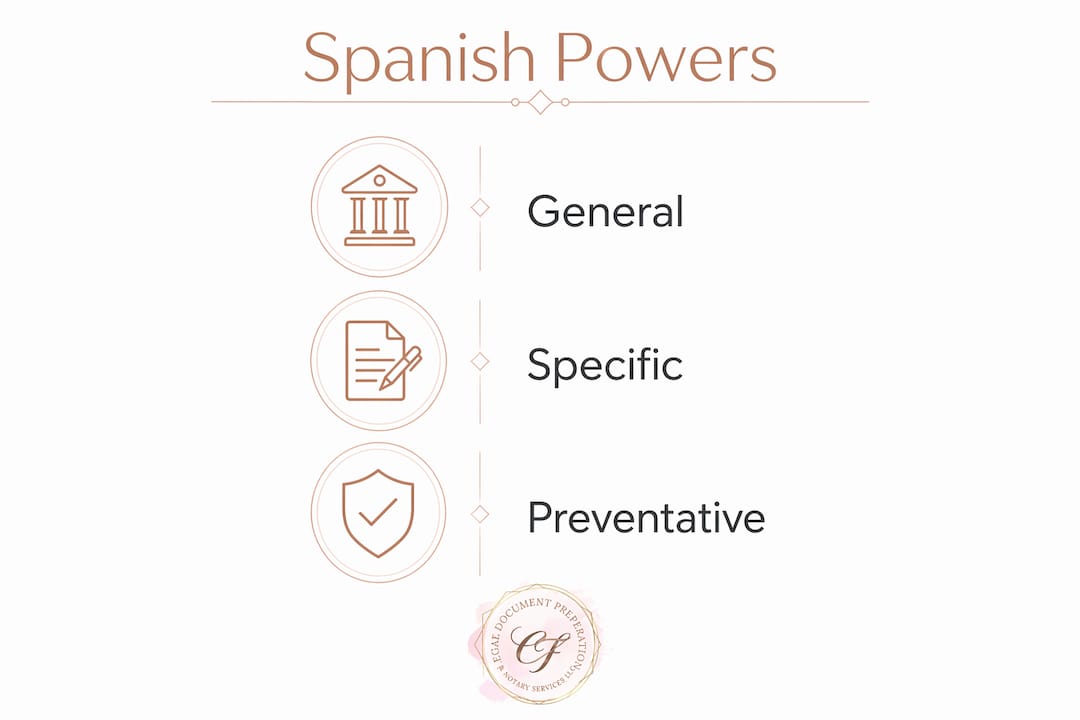
General power of attorney
A general power grants virtually full authority over financial and legal matters. This type suits long-term arrangements where the agent must handle a wide range of tasks without returning to the principal for approval on each one. The tradeoff is significant risk. Legal experts recommend limiting authority to the minimum necessary, because a general power in the wrong hands can result in unauthorized transactions that are difficult to reverse.
Specific power of attorney
A specific power limits the agent to one defined act or category of acts, such as completing a single property sale or managing one bank account. This is the preferred type for one-time transactions. The narrower the scope, the lower the risk of misuse.
Preventative power of attorney
A preventative power is designed to remain valid if the principal becomes incapacitated. Standard powers of attorney in Spain terminate automatically upon the principal's incapacity unless special provisions are included. This type requires careful drafting and is particularly relevant for estate planning and long-term care situations.
Acts that cannot be delegated
Certain acts cannot be delegated via any power of attorney under Spanish law. Making a will, recognizing a child, and entering into marriage are personal acts that require the principal's direct participation. No clause in a power of attorney can override this restriction.
Pro Tip: For property transactions, use a specific power limited to that single sale or purchase. Name the property by address and registry number in the document. This prevents the agent from acting on any other asset.
| Type | Scope | Best use case |
|---|---|---|
| General | Broad financial and legal authority | Long-term representation abroad |
| Specific | One defined act or category | Single property sale, one-time banking |
| Preventative | Remains valid during incapacity | Estate planning, long-term care |
How does translation and bilingual drafting affect validity?
Translation is not optional when the original document is in English or any other language. Foreign-language documents cannot be used directly in Spain without a formal sworn Spanish translation. This rule applies to notaries, land registries, banks, and all public bodies.
Only certified sworn translations, known in Spanish legal practice as traducción jurada, are accepted. These must be produced by translators authorized by Spanish authorities. Using an unofficial translation, even a high-quality one, risks rejection by Spanish public bodies and can delay or void a transaction entirely.
Bilingual drafting solves a different problem. It combines the Spanish legal operative text with the principal's native language in a single document. The principal can read exactly what authority they are granting without relying on a separate translation. International legal practitioners treat bilingual drafting as best practice for clients with Spanish legal needs who are not native Spanish speakers.
Common pitfalls to avoid:
- Submitting a notarized translation from a country other than Spain without verifying Spanish authority recognition
- Assuming a bilingual document removes the need for the Spanish operative text
- Using machine-generated translations for any part of the sworn translation process
- Failing to update translations when the original document is amended
A bilingual power of attorney checklist can help you track each requirement before submission.
What practical steps should you follow when using a Spanish power of attorney?
Execution is only the beginning. Managing the document correctly over time protects both the principal and the agent.
- Define the scope precisely. Write the agent's authority in specific terms. Vague language invites disputes and can be interpreted broadly by third parties.
- Choose your agent carefully. General powers grant full authority and require absolute trust. Verify the agent's reliability before signing anything.
- Register the document when required. Property transactions in Spain require the power of attorney to be presented at the land registry. Banking institutions may require their own internal verification.
- Revoke formally when the need ends. Revocation requires a notarized deed and formal notification to the agent. Failing to revoke officially leaves the power active and exposes the principal to continued risk.
- Review periodically. Consumer organizations emphasize active review of powers of attorney to protect principals from outdated or overly broad grants of authority.
Typical uses include property purchases and sales, opening or managing Spanish bank accounts, filing tax returns with the Spanish tax authority, and registering a business entity. Each use case benefits from a specifically tailored document rather than a catch-all general power.
Pro Tip: Keep a certified copy of the power of attorney and the notarial deed number on file. Spanish institutions frequently request the original deed reference when verifying authority, and having it ready prevents delays.
Understanding why a financial power of attorney must be notarized gives additional context on why the notarization step carries so much legal weight across jurisdictions.
Key Takeaways
A valid Spanish power of attorney requires notarization, a sworn Spanish translation for foreign-language originals, and careful scope definition to protect the principal from agent misuse.
| Point | Details |
|---|---|
| Notarization is mandatory | Every Spanish power of attorney must be executed before a notary or authorized consular official. |
| Apostille for foreign execution | Documents signed outside Spain require Hague Apostille certification unless signed at a Spanish consulate. |
| Sworn translation required | Only certified sworn translations are accepted by Spanish authorities; unofficial versions cause rejection. |
| Choose the right type | Match the power type (general, specific, or preventative) to the actual task to limit risk. |
| Revoke formally | Revocation requires a notarized deed and agent notification; informal cancellation has no legal effect. |
What I have learned working with Spanish powers of attorney
The single most common mistake I see is clients signing a general power of attorney because it feels convenient. They want to hand everything off and not think about it again. That instinct is understandable, but it creates real exposure. A general power gives an agent authority over virtually every financial and legal decision. If that relationship sours, unwinding the damage is far harder than drafting a narrower document from the start.
The second issue I encounter regularly is the translation gap. Clients assume that because a document was notarized in the United States, it carries the same weight in Spain. It does not. The apostille and sworn translation requirements exist precisely because Spanish authorities cannot verify foreign notarial acts on their own. Skipping either step means the document will be rejected at the worst possible moment, usually when a property closing is already scheduled.
Bilingual drafting is the detail that makes the biggest practical difference for my clients. When someone can read their own power of attorney in their native language alongside the Spanish text, they understand what they are signing. That clarity reduces disputes, builds confidence, and makes the whole process feel less opaque. It is not just a courtesy. It is a protection.
The importance of power of attorney in Spanish legal matters cannot be overstated for anyone managing assets or obligations across borders. The law is clear, the requirements are fixed, and the consequences of getting it wrong are serious. Getting it right the first time is always the better investment.
— Cristina
How Cflegalformhelp can assist with your Spanish power of attorney
Cflegalformhelp provides bilingual legal document preparation and notarization services for clients who need Spanish legal documents prepared correctly the first time.
Cflegalformhelp handles the full preparation process, from drafting to notarization, with flat-fee pricing and bilingual support in English and Spanish. The team assists with sworn translation coordination, apostille guidance, and document review to meet Spanish legal standards. Whether you need a specific power for a single property transaction or a preventative power for long-term planning, professional document preparation through Cflegalformhelp keeps the process clear and compliant. For clients who need notarization outside a traditional office setting, mobile notary services are also available. Contact Cflegalformhelp to get started with a document that holds up under Spanish legal scrutiny.
FAQ
What is a Spanish language power of attorney?
A Spanish language power of attorney, or poder notarial, is a notarized legal document that authorizes an agent to act on behalf of a principal in legal and financial matters under Spanish law.
Does a Spanish power of attorney need to be notarized?
Yes. Spanish law requires execution before a notary public. Documents signed abroad must also carry a Hague Apostille unless signed at a Spanish consulate.
Can I write a Spanish power of attorney in English?
No. The operative legal text must be in Spanish. A sworn translation by an authorized translator is required for any document originally drafted in another language.
How do I revoke a Spanish power of attorney?
Revocation requires a formal notarized deed and direct notification to the agent. Without these steps, the power remains legally active regardless of the principal's intent.
What is the difference between a general and a specific power of attorney in Spain?
A general power grants broad authority over financial and legal matters, while a specific power limits the agent to one defined act, such as a single property sale or bank account management.