

The difference between notary state and federal documents is defined by one factor: which government authority issued the document and which authentication process governs it. State notaries are commissioned officials who operate under state law. Federal documents follow a separate authentication chain managed by federal agencies. Confusing the two causes delays, rejections, and wasted money. Whether you are an immigrant preparing paperwork, a small business owner filing corporate records, or a legal professional handling cross-border transactions, knowing which path applies to your document is the first step to getting it accepted.
What is the difference between notary state and federal documents?
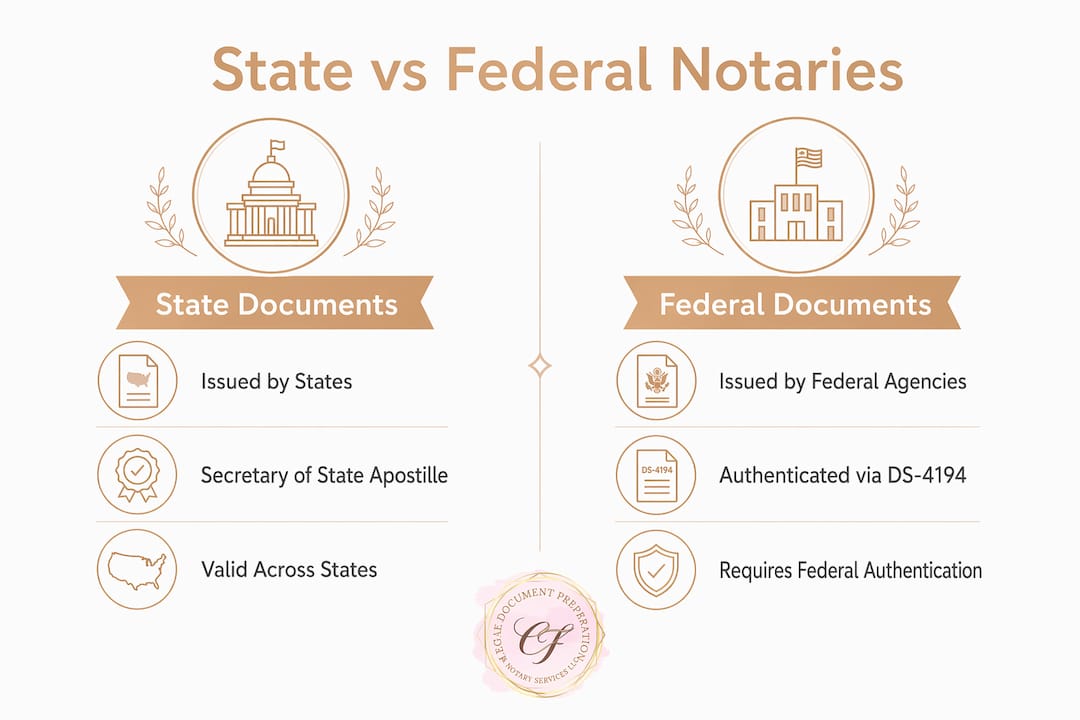
The core distinction is not about the notary. It is about the document's origin. A state-appointed notary is a public official commissioned by a state government to witness signatures, administer oaths, and deter fraud. The National Notary Association confirms that notaries act under state statutes to perform these functions. That means their authority is defined entirely by the laws of the state that commissioned them.
Federal documents, by contrast, are issued by federal agencies. An FBI background check, an FDA certificate, or a document from the U.S. Department of Homeland Security originates at the federal level. These documents do not go through a state Secretary of State for authentication. They go through the U.S. Department of State's Office of Authentications. That is a completely different chain of authority.

The practical implication is significant. If you send a federal document to a state office for an apostille, it will be rejected. The state has no jurisdiction over federal records. Knowing the issuing authority before you start any authentication process saves you time and money.
How state notaries work and what documents they handle
State notaries are commissioned by their state government, and their authority ends at the state border. A Florida notary, for example, can only perform notarial acts while physically present in Florida. That boundary is non-negotiable.
Common state documents that require notarization include:
- Deeds and real estate transfers
- Powers of attorney
- Affidavits and sworn statements
- Wills and trusts
- Birth certificates (for domestic use)
- Corporate formation papers and LLC agreements
When these documents need to be used abroad, the state Secretary of State issues an apostille. An apostille is a standardized certificate recognized by countries that signed the Hague Convention of 1961. State apostilles cover vital records and corporate papers and are the correct path for documents like birth certificates or powers of attorney going overseas.
The Full Faith and Credit Clause of the U.S. Constitution means a notarization performed in Florida is valid across states. Other states must recognize it. However, some agencies or courts may request a Certificate of Authority confirming the notary's commission was active at the time of signing.
Pro Tip: Always confirm the receiving agency's requirements before notarizing. Some federal agencies and foreign consulates have specific form requirements that go beyond a standard notarial certificate.
How does federal document authentication work?
Federal document authentication is a separate process that most people never encounter until they need it. The U.S. Department of State's Office of Authentications handles this process, not the Secretary of State of any individual state.
The standard workflow for authenticating a federal document for international use follows these steps:
- Obtain the original federal document from the issuing agency (for example, the FBI for a background check).
- Submit Form DS-4194 to the U.S. Department of State's Office of Authentications along with the document and the required fee.
- Receive a certificate of authentication from the federal office. This is not an apostille. It is a separate federal authentication certificate.
- For non-Hague countries, take the authenticated document to the destination country's embassy or consulate in Washington, D.C., for further legalization.
Form DS-4194 governs federal authentication and is the required submission for documents like FBI background checks going abroad. This process is entirely separate from the state apostille workflow. Sending a federal document to a state Secretary of State is one of the most common and costly mistakes in document preparation.
Pro Tip: Check whether the destination country is a Hague Convention member before starting authentication. If it is not, you will need embassy legalization after the federal authentication step. Skipping this check adds weeks to the process.
Notarization itself does not control international acceptance. Authentication is often required beyond a standard notarial act for documents used in foreign jurisdictions. The notary verifies identity and deters fraud. The authentication chain certifies the notary's authority to the receiving country.
Common myths about federal notaries and unsworn declarations
The most persistent myth in notarization is that a "federal notary" exists. There is no federal notary commission. Notarization authority comes from state commissions regardless of whether the document is state or federal in origin. A state-commissioned notary can notarize a federal form. The document's origin does not change who performs the notarization.
What does exist at the federal level is an alternative to notarized affidavits: the unsworn declaration under 28 U.S.C. § 1746. This statute allows a person to substitute a signed declaration under penalty of perjury for a notarized affidavit in federal proceedings. No notary is required. No identification is presented to a third party.
Key facts about unsworn declarations:
- They are valid for federal matters only. State courts generally require notarized affidavits and do not accept § 1746 declarations as substitutes.
- They save time and money. No notary appointment is needed, which reduces cost and scheduling friction.
- The signer bears full responsibility. Without a notary verifying identity, the authenticity of the declaration rests entirely on the signer.
- They do not work for international legalization. Foreign authorities require notarized and authenticated documents. A § 1746 declaration will not satisfy an embassy or foreign court.
For immigrants and small business owners, this distinction matters practically. Filing a declaration with a federal agency like USCIS or the IRS may accept a § 1746 form. Filing the same document in a Florida state court will not. Understanding when to use sworn statements versus unsworn declarations prevents rejection and protects legal standing.
How venue and cross-state notarizations affect document validity
The venue line on a notarial certificate is a legal assertion, not a formality. It states where the notarization physically occurred. That location must fall within the notary's commissioning state. A venue mismatch causes acceptance problems in other jurisdictions and can invalidate the entire notarization.
| Scenario | Who handles authentication | Key requirement |
|---|---|---|
| State document used domestically | State notary | Valid commission, correct venue |
| State document used abroad (Hague country) | State Secretary of State | Apostille via state office |
| Federal document used abroad (Hague country) | U.S. Department of State | Form DS-4194, federal certificate |
| Federal document used abroad (non-Hague country) | U.S. Department of State + embassy | Federal certificate plus legalization |
| Unsworn declaration in federal proceeding | No notary required | § 1746 language, signer's signature |
The Full Faith and Credit Clause protects notarizations across state lines for domestic use. A deed notarized in Georgia is valid in Florida courts. However, that protection does not extend internationally. For documents going overseas, the authentication process for overseas use follows a specific chain that depends entirely on whether the document originated at the state or federal level.
A Certificate of Authority is sometimes requested by receiving agencies to confirm the notary's commission was active and legitimate at the time of signing. This is especially common in real estate transactions and immigration filings where document integrity is scrutinized closely.
Key Takeaways
The critical distinction in notarization is the document's issuing authority: state documents go through state offices, and federal documents require federal authentication through the U.S. Department of State.
| Point | Details |
|---|---|
| State vs federal origin | The issuing authority determines the correct authentication path, not the notary's location. |
| Federal authentication uses Form DS-4194 | Federal documents like FBI background checks go through the U.S. Department of State, not a Secretary of State. |
| No federal notary commission exists | State-commissioned notaries handle all notarizations, including those on federal forms. |
| Venue line is legally binding | The venue on a notarial certificate must match the notary's commissioning state or the document risks rejection. |
| § 1746 declarations are federal only | Unsworn declarations substitute for notarized affidavits in federal matters but are not accepted by most state courts. |
What working with these documents has taught me
After years of helping clients in South Florida prepare and notarize documents, the single biggest source of confusion I see is people assuming that a notary is a notary is a notary. They bring me an FBI background check and expect it to go through the Florida Secretary of State. When I explain that it needs to go to the U.S. Department of State in Washington, D.C., the reaction is almost always the same: genuine surprise.
The second mistake I see constantly is clients who skip the venue check. They get a document notarized by a friend or a mobile notary from another state, and the venue line is wrong. That document gets rejected, and now they are starting over. The venue line is not a technicality. It is a legal assertion that courts and agencies take seriously.
My advice for immigrants especially: know whether your document is state-issued or federally issued before you do anything else. A birth certificate from a foreign country goes through a completely different process than an FBI background check. Mixing those up costs weeks. For small business owners, the same logic applies to corporate filings. A Florida LLC operating agreement notarized in Florida is fine for domestic use. The moment you need it abroad, the apostille comes from Tallahassee, not Washington.
The clients who move fastest are the ones who ask one question first: who issued this document? Everything else follows from that answer.
— Cristina
Cflegalformhelp can handle your state and federal notarizations
Sorting out whether your document needs a state apostille, a federal authentication, or a standard notarization takes experience. Cflegalformhelp provides mobile notary and loan signing services across South Florida, along with flat-fee document preparation for both state and federal filings.
Whether you need a power of attorney notarized, an FBI background check authenticated for overseas use, or help preparing immigration forms, Cflegalformhelp offers bilingual support in English and Spanish. The team at Cflegalformhelp also provides legal document preparation for clients who need accuracy without the cost of an attorney. Contact Cflegalformhelp directly to confirm which authentication path applies to your specific document before you spend time or money on the wrong process.
FAQ
What is a notary public and what can they notarize?
A notary public is a state-commissioned official authorized to witness signatures, administer oaths, and verify identity on legal documents. The National Notary Association confirms that notaries act under state statutes, meaning their authority is defined and limited by the state that commissioned them.
Can a state notary notarize federal documents?
Yes. A state-commissioned notary can notarize federal forms such as USCIS applications or IRS declarations. There is no federal notary commission; all notarization authority comes from state commissions regardless of the document's origin.
What is the difference between a state apostille and a federal authentication?
A state apostille is issued by the state Secretary of State for state-originated documents like birth certificates and corporate papers. Federal authentication is handled by the U.S. Department of State's Office of Authentications using Form DS-4194 for federally issued documents like FBI background checks.
What is a 28 U.S.C. § 1746 unsworn declaration?
A § 1746 declaration is a signed statement under penalty of perjury that substitutes for a notarized affidavit in federal proceedings. It does not require a notary but is generally not accepted by state courts or foreign authorities.
Does a notarization done in one state work in another state?
Yes. The Full Faith and Credit Clause of the U.S. Constitution requires states to recognize notarizations performed in other states. However, the venue line on the certificate must correctly identify where the notarization occurred, and some agencies may request a Certificate of Authority to confirm the notary's commission was active.