

A notary public does not have the legal authority to provide legal advice unless they are also a separately licensed attorney. This is the core reason why notary cannot give legal advice: the role is defined by law as ministerial, meaning it is limited to specific verification tasks with no room for legal judgment or guidance. Understanding this distinction protects you from relying on the wrong source for critical decisions about your documents.
Why notaries cannot give legal advice under the law
A notary public is a ministerial officer, not a legal advisor. That distinction is not a technicality. It is the foundation of every state's notary statute. Ministerial means the notary follows a fixed procedure without exercising personal discretion or judgment. The moment a notary interprets a document, recommends a course of action, or explains what a legal clause means for your specific situation, they have crossed into the practice of law.
Unauthorized practice of law by a notary covers any application of legal knowledge to an individual's specific facts, regardless of whether money changes hands. That definition is broader than most people expect. It means even a well-intentioned explanation of what a contract term "really means" is a violation.
States including Pennsylvania, New York, and Texas have statutes that treat this seriously. Penalties in these states include imprisonment, fines, and permanent removal from office for unauthorized legal practice by notaries. These are not rare edge cases. They are the standard enforcement tools written into law.
Notaries also face strict advertising restrictions. In states with large Spanish-speaking populations, non-attorney notaries must display clear disclaimers that they are not attorneys and cannot give legal or immigration advice. This rule exists because the confusion is real and the harm is documented.
Pro Tip: Before signing any document with a notary, confirm that any legal questions you have are directed to a licensed attorney, not the notary. The notary's job is to verify your identity and witness your signature, nothing more.
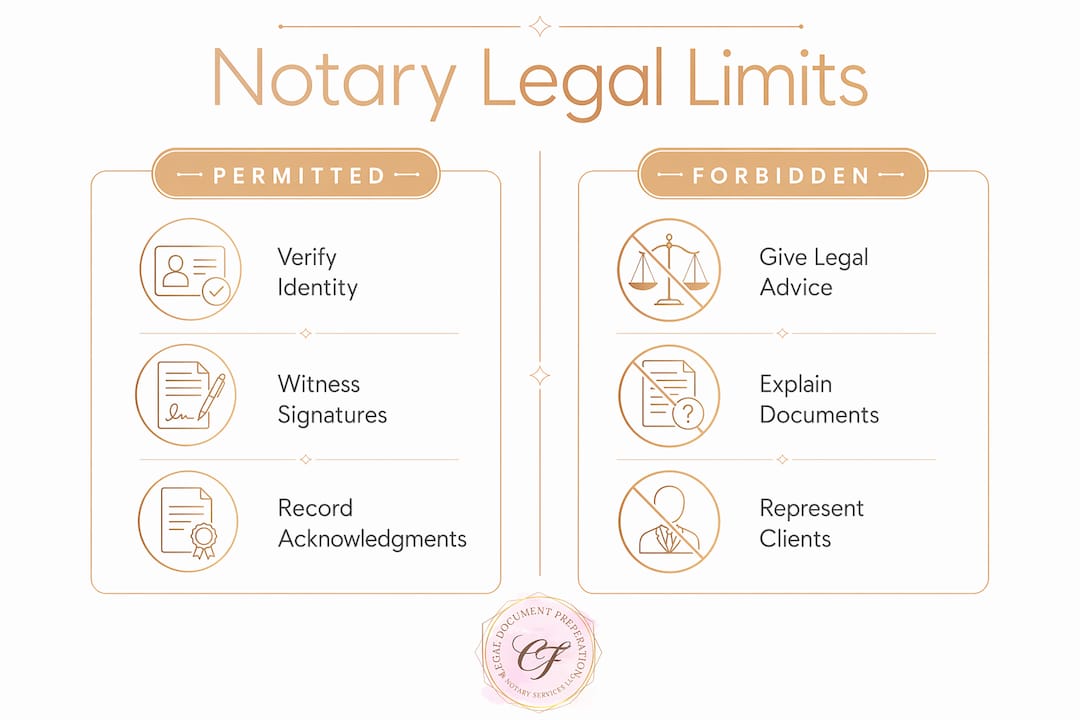
The key notary public limitations that define this role include:
- Verifying the identity of signers
- Confirming that signers are acting voluntarily
- Witnessing signatures on documents
- Administering oaths and affirmations
- Certifying copies of certain documents
None of these tasks involve legal judgment. That is by design.
Why giving legal advice harms both notaries and signers
Crossing the line from witnessing to advising does not just create a legal risk for the notary. It undermines the entire purpose of notarization. A notary's authority rests on their impartiality. Notaries lose that impartiality the moment they become an advocate for one party's interpretation of a document. When impartiality is gone, the notarization itself can be challenged or invalidated.
"A notary's ministerial status means they must mechanically verify identity and witnessing without discretion. Personal interest or advising invalidates notarization and exposes notaries to sanctions."
The risks fall on both sides of the table. For the signer, acting on incorrect informal advice from a notary can mean signing a document that does not reflect their actual legal rights. For the notary, the consequences include civil fines, commission removal, and criminal charges. The National Notary Association warns that notaries lack malpractice insurance and the ethical oversight that attorneys carry. There is no safety net when a notary gives bad advice.
Immigrant communities face a specific and serious version of this risk. When someone unfamiliar with the U.S. legal system asks a notary for guidance on an immigration form, they may trust that guidance completely. Acting on it can result in a rejected application, a missed deadline, or worse. The harm is not hypothetical.
The categories of harm from notary advice overreach include:
- Document invalidation due to compromised notarial impartiality
- Criminal or civil penalties for the notary
- Financial and legal damage to the signer from acting on incorrect guidance
- Exploitation of vulnerable clients who do not know the notary's limits
Common misconceptions about notaries and legal advice
The most persistent misconception comes from a language problem. In many Latin American countries, a "notario público" is a licensed attorney with broad legal powers, including drafting contracts and providing legal counsel. That role does not exist in the United States. A U.S. notary public holds a much narrower commission. The confusion between these roles leads directly to fraud and exploitation, particularly in immigrant communities where the term "notario" carries a different meaning.
Here are the most common mistakes people make when dealing with notaries:
- Asking the notary to explain what a document means. A notary can confirm that a document exists and that you signed it. They cannot tell you what the legal effect of that signature is.
- Assuming a notary can help select the right form. Choosing the correct legal form for a situation requires legal judgment. Helping fill legal blanks or selecting forms is classified as unauthorized practice of law.
- Believing a bilingual notary can give immigration advice. Speaking Spanish does not give a notary any additional legal authority. Many states require Spanish-language advertising by notaries to include explicit disclaimers about this.
- Thinking a notary's experience equals legal expertise. A notary may have processed thousands of documents. That experience does not create legal authority to advise you.
Pro Tip: If a notary volunteers legal advice without being asked, treat that as a warning sign. A professional notary knows their limits and will refer you to an attorney instead.
The notario fraud issue is serious enough that Pennsylvania's Department of State has a dedicated program addressing it. Other states with large immigrant populations have similar enforcement efforts.
What can a notary legally do when asked for advice?
The only legally safe response for a notary who receives a legal question is to politely decline and refer the person to a licensed attorney. That is not rudeness. It is professional compliance. Responding to legal questions constitutes unauthorized practice of law, even when the notary's intent is entirely helpful.

Notaries can act as scriveners, meaning they can type dictated text onto a form. That is clerical work and it is permitted. What they cannot do is choose which form to use, interpret what a clause requires, or recommend a legal strategy.
| Permitted notary activity | Forbidden notary activity |
|---|---|
| Verifying signer identity | Explaining what a document legally means |
| Witnessing a signature | Recommending which document to sign |
| Administering an oath | Advising on immigration options |
| Typing dictated text onto a form | Selecting or drafting legal forms |
| Certifying a copy of a document | Interpreting contract clauses |
The distinction between notary and attorney roles is not about education level or experience. It is about legal authority. An attorney is licensed by a state bar, carries malpractice insurance, and operates under ethical rules that govern their advice. A notary holds a commission that authorizes specific ministerial acts only.
When you need legal guidance, the right referral is always a licensed attorney. For document preparation assistance that stays within legal boundaries, a certified document preparer can help you organize and complete forms without crossing into legal advice.
How do state laws enforce notary advice restrictions?
State enforcement of notary limitations follows a consistent pattern across the country. Statutes define the scope of notarial acts, prohibit unauthorized practice of law, and set penalties for violations. Professional organizations add another layer of guidance.
| Enforcement mechanism | Details |
|---|---|
| State statutes | Define permitted notarial acts and prohibit legal advice |
| Criminal penalties | Imprisonment and fines for unauthorized practice of law |
| Commission removal | Permanent loss of notary commission for violations |
| Advertising rules | Mandatory disclaimers in non-English advertising |
| Bar association oversight | Referrals for prosecution of unlicensed legal practice |
Pennsylvania law mandates that non-attorney notaries advertising in non-English languages display prominent disclaimers stating they are not attorneys and cannot give legal or immigration advice. That requirement exists because the state recognized that language access without legal clarity creates exploitation risk.
The National Notary Association provides professional guidance reinforcing these boundaries. Their position is direct: notaries who interpret documents or suggest changes face career-ending consequences. The absence of malpractice insurance means a single mistake carries full personal liability.
Misuse of the notary seal carries serious consequences because the seal confers legal weight on a document. That legal weight demands strict compliance with role boundaries. A seal on a document prepared with unauthorized legal advice does not protect the signer. It can actually make the problem worse by giving false legitimacy to flawed guidance.
Key Takeaways
A notary public is legally prohibited from giving legal advice because their ministerial role requires impartiality and limits them to specific verification tasks, not legal judgment.
| Point | Details |
|---|---|
| Notaries are ministerial officers | Their authority covers identity verification and witnessing only, not legal guidance. |
| Unauthorized practice is broadly defined | Even explaining a document's meaning to a signer qualifies as unauthorized legal practice. |
| Penalties are serious | Violations can result in fines, criminal charges, and permanent loss of commission. |
| "Notario" confusion is a real risk | U.S. notaries are not attorneys, unlike notarios in many Latin American countries. |
| The safe referral is always an attorney | For any legal question, a licensed attorney is the only appropriate source of advice. |
What I've learned from years at the intersection of notary work and document prep
Working with clients every day, I see the same confusion repeat itself. Someone comes in with a stack of documents, sits down, and within two minutes asks me what a clause means or whether they should sign. The question is natural. The trust behind it is real. And that is exactly why the boundary matters so much.
The clients who get hurt are not the ones who ask too many questions. They are the ones who got answers from someone who should have stayed quiet. I have seen people act on informal guidance from a notary, sign documents that did not serve their interests, and then face consequences that took months to untangle. The notary meant well. That did not help.
What I tell every client is simple: my job is to make sure your signature is properly witnessed and your identity is verified. If you have a question about what you are signing, you need an attorney before you sign, not after. That referral is not a brush-off. It is the most useful thing I can do for you.
The immigrant community deserves particular attention here. The word "notario" carries real authority in many home countries. When someone walks into a U.S. notary office expecting that same authority, the gap between expectation and reality can cause serious harm. Clear disclaimers, bilingual communication, and honest referrals are not bureaucratic formalities. They are protections.
— Cristina
Cflegalformhelp: document preparation done right
Knowing what a notary cannot do is the first step. Knowing where to get proper help is the next one.
Cflegalformhelp provides certified document preparation and mobile notary services across South Florida, with bilingual support in English and Spanish. Every service stays within the legal boundaries that protect you. Cristina Fernandez, a certified legal document preparer and immigration paralegal, leads the team with a clear commitment: prepare your documents correctly, refer legal questions to attorneys, and never cross the line. For individuals, families, and small businesses who need reliable legal document preparation without the cost of full legal representation, Cflegalformhelp offers flat-fee services built on transparency and compliance.
FAQ
Can a notary ever give legal advice?
A notary can give legal advice only if they are also a separately licensed attorney. Without a law license, any legal guidance from a notary constitutes unauthorized practice of law.
What happens if a notary gives legal advice illegally?
Penalties include civil fines, criminal charges, and permanent removal from the notary commission. States like Pennsylvania, New York, and Texas enforce these consequences under their notary statutes.
Why is the "notario público" confusion dangerous?
In Latin American countries, a notario público is a licensed attorney with broad legal powers. U.S. notaries hold a much narrower commission, and the title confusion leads to exploitation, particularly in immigrant communities.
What should I do if I need legal advice during a notarization?
Stop the process and consult a licensed attorney before signing. A notary is required to refer you to an attorney for any legal question and cannot answer it themselves.
Can a notary help me fill out a legal form?
A notary can type text you dictate onto a form, which is clerical work. Selecting the correct form, interpreting its clauses, or advising on how to complete it legally crosses into unauthorized practice of law.