

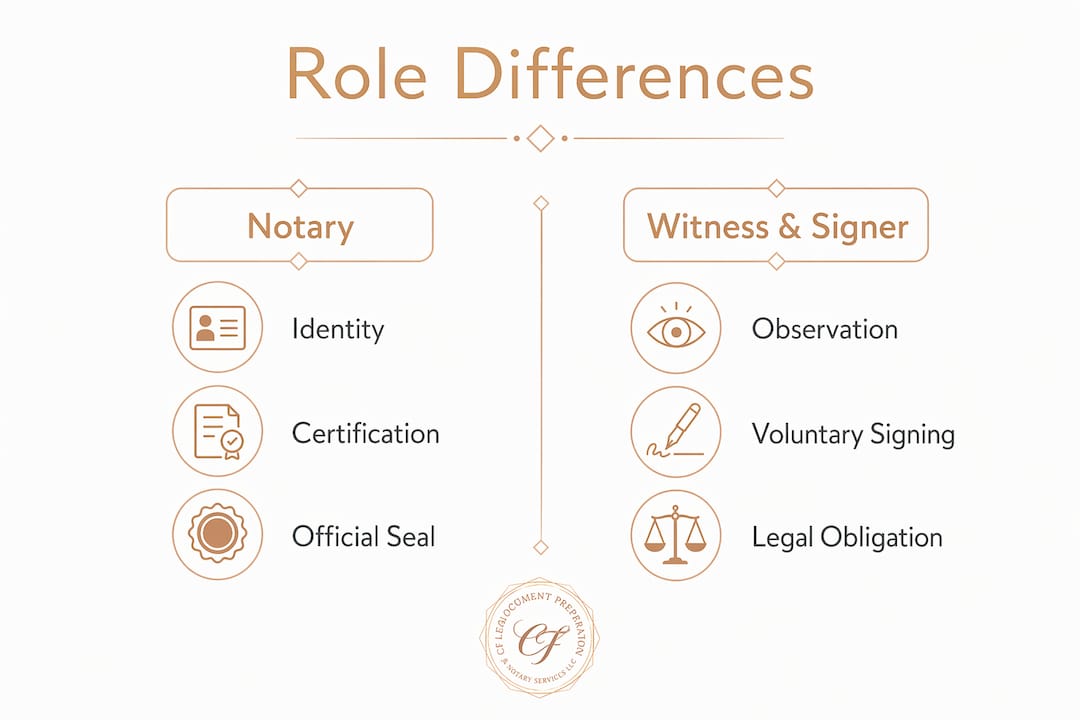
A signer legally commits to a document by signing it, a witness observes and confirms the signing was voluntary, and a notary public verifies identity and certifies the document with an official seal. These three roles define the difference between notary, witness, and signer roles in American legal practice. Confusing them creates real problems. A rejected deed, a disputed will, or a voided contract can all trace back to one person filling the wrong role. Understanding each function protects you before you ever pick up a pen.
What is the difference between notary, witness, and signer roles?
The signer is the person whose legal rights and obligations change because of the document. The witness confirms the signing happened voluntarily. The notary certifies the signer's identity and the document's authenticity. Each role carries a different level of legal weight, and none of them is interchangeable.
The signer's legal position
A signer's primary responsibility is to have the legal authority to bind themselves or their organization to the agreement, including fiduciary duties to review and comply with its terms. That authority can come from a board resolution, corporate bylaws, or a formal power of attorney. Signing without that authority does not just void the document. It can expose the individual to personal liability.
Signatories often treat signing as a formality, but it legally binds them and can create personal liability if authority is exceeded or terms are not fully understood. A corporate officer who signs a lease beyond their delegated spending limit, for example, may personally owe the difference. The signature is the legal act, not the paperwork around it.
The witness's evidentiary function
A witness confirms that the signer placed their signature voluntarily and in the witness's direct presence. Witnessing is an evidentiary act requiring direct observation; mere knowledge of the signer is not enough. The witness does not verify identity the way a notary does. The witness simply attests that the signing happened and was not coerced.
The notary's official authority
A notary public is a state-commissioned official who verifies identity, confirms voluntariness, and applies an official seal that certifies the document. That seal carries legal weight no witness signature can match. Notarization attaches legal effect through state-commissioned authority, setting it apart from witnessing, which is informal and more limited in legal impact.

What are the responsibilities and liabilities of a signer?
Signers carry the heaviest legal burden of the three roles. Their signature transfers binding obligations and, in many cases, financial liability. Before signing any significant document, a signer must confirm they have the proper authority to do so.
Common signer responsibilities include:
- Confirming authority. Individual signers bind themselves personally. Corporate signers must verify their delegated authority through board resolutions or bylaws before signing.
- Reviewing terms. Signatories must perform risk assessment and review obligations before signing, since the act transfers binding legal responsibility.
- Maintaining documentation. Written proof of authority, such as a board resolution or power of attorney, is critical for high-stakes agreements.
- Signing in the correct capacity. Signing as an individual when you intend to sign on behalf of a company, or vice versa, creates legal ambiguity that courts often resolve against the signer.
- Understanding personal liability exposure. Unauthorized signing can cause personal liability and disputes that outlast the original transaction.
Pro Tip: Always carry a copy of your authorization document, such as a board resolution or power of attorney, to any signing appointment. A notary may ask to see it, and having it ready prevents delays.
Real estate closings illustrate this well. A buyer signs a mortgage note, a deed of trust, and a closing disclosure. Each document creates a separate legal obligation. Signing one without reading it does not reduce the liability it creates.
What is the role of a witness during document signing?
A witness serves as living proof that a signature was made freely and in their presence. That proof matters most when a document's validity is challenged in court or during probate.
Who qualifies as a witness?
Witnesses must be disinterested parties. That means they have no personal stake in the document's outcome. A beneficiary named in a will generally cannot serve as a witness to that will. A spouse of a party to a contract is typically disqualified in many states. The witness must also be a legal adult, usually 18 or older, and mentally competent.
When are witnesses required?
| Document type | Witness typically required | Notes |
|---|---|---|
| Last will and testament | Yes, usually two | Most states require two disinterested witnesses |
| Real estate deed | Varies by state | Florida requires two witnesses plus notarization |
| Power of attorney | Often yes | Requirements vary widely by state |
| Healthcare directive | Often yes | Usually two witnesses or a notary |
| Standard contract | Rarely | Witnesses add evidentiary value but are not always required |
Witnesses become especially critical in two specific situations. The first is signature by mark, where a signer who cannot write uses an X or other mark. The second is proxy signing, where someone signs on behalf of a signer who is physically unable to do so. Witnessing demands firsthand knowledge of the signing act in both cases, and failure to have a qualified witness can cause document rejection.
Pro Tip: Before a signing appointment, confirm that your witnesses meet your state's disinterested party requirement. In Florida, for example, a witness to a deed cannot be the same person as the notary on that document.
A witness can also serve as a credible identifying person for a notary. A credible identifying witness may vouch for a signer's identity if personally known to both the signer and the notary, which can ease notarization when the signer lacks standard ID.
What does a notary public do and how does notarization differ from witnessing?
Notarization is a formal act of certification. A notary public verifies the signer's identity, confirms the signer is acting voluntarily and understands the document, and then applies an official seal. That process gives the document a level of legal credibility that a witness signature alone cannot provide.
Core notary duties
- Identity verification. The notary checks government-issued photo ID and records the details in a notary journal.
- Voluntariness confirmation. The notary asks the signer directly whether they are signing freely and without coercion.
- Seal and signature. The notary applies an official seal and signs the certificate, creating a public record of the notarial act.
- Oath administration. For sworn documents like affidavits, the notary administers a verbal oath.
Notaries are legally state-commissioned officials distinct from witnesses. Witnesses confirm voluntary signing but do not certify identity or apply seals. That distinction is the core of the notary vs witness roles debate.
Documents that commonly require notarization
| Document | Notarization required | Witness also required |
|---|---|---|
| Real estate deed (Florida) | Yes | Yes, two witnesses |
| Affidavit | Yes | No |
| Vehicle title transfer | Yes | No |
| Last will and testament | Varies by state | Usually yes |
| Loan closing documents | Yes | Sometimes |
Some states explicitly prohibit notaries from serving simultaneously as witnesses to avoid conflicts of interest. Others permit it. Best practice is to use separate individuals for each role to eliminate any question of impropriety.
Pro Tip: For mobile or remote notarization appointments, confirm in advance whether your state requires witnesses to be physically present or whether remote witnesses are accepted. Florida allows remote online notarization with electronic witnesses under specific conditions.
How do notary, witness, and signer roles interact in practice?
These three roles do not always appear together. The document type and state law determine which roles are required and how they interact.
Scenarios by document type
Real estate transactions in Florida require both notarization and two witnesses on a deed. The signer signs in front of both witnesses and the notary. The notary certifies identity. The witnesses confirm the signing was voluntary. All three roles are active simultaneously.
Standard business contracts rarely require a notary or a formal witness. The signer's signature alone creates the binding obligation. Adding a witness increases evidentiary value but is not legally required in most states.
Estate planning documents like wills typically require two witnesses but may not require notarization in every state. However, a self-proving affidavit, which is notarized, can prevent the witnesses from having to testify in probate court later.
When a witness can help the notary
Correct use of witnesses and notaries avoids common failure points in document acceptance, especially when signers cannot be physically present. When a signer cannot appear before a notary, a proof of execution allows a subscribing witness who observed the original signing to testify in place of the signer. The subscribing witness signs the document and may be required to testify if the document is challenged.
Experts emphasize that witnesses and notaries serve separate but complementary evidentiary roles. Witnessing assures a voluntary signature. Notarization confirms identity and applies legal certification for higher acceptance.
Common mistakes and best practices for signers, witnesses, and notaries
Most document rejections trace back to a small set of preventable errors. Knowing them in advance saves time, money, and legal headaches.
- Using a disqualified witness. A beneficiary, spouse, or party to the document cannot serve as a witness in most states. Always verify witness eligibility before the appointment.
- Signer lacking proper authority. A corporate signer who does not have a current board resolution or delegation letter creates a document that can be challenged or voided.
- Notary acting as witness on the same document. In states that prohibit dual roles, this invalidates the notarization. Check your state's rules before the appointment.
- Incomplete notarial certificate. A notary who forgets to fill in the date, county, or expiration date on their seal creates a defective certificate that courts may reject.
- Signing out of sequence. Witnesses must observe the actual signing. A witness who signs after the fact, without seeing the original act, has not legally witnessed anything.
Pro Tip: Prepare a short authority packet for any corporate or fiduciary signing. Include the board resolution, the signer's ID, and any delegation letters. Hand it to the notary at the start of the appointment to prevent delays.
Confusing these roles causes real problems in real estate and estate planning documents where both notarization and witnessing may be required by law. A rejected filing can delay a property closing by weeks or trigger a probate dispute that costs far more than the original document preparation.
Key Takeaways
The notary, witness, and signer each serve a distinct legal function, and substituting one for another creates document defects that courts and recorders will not overlook.
| Point | Details |
|---|---|
| Signer carries legal liability | Signing transfers binding obligations; unauthorized signing can create personal liability. |
| Witness confirms voluntary signing | A witness must directly observe the signing and have no personal stake in the document. |
| Notary certifies identity and document | A state-commissioned notary applies an official seal, giving the document higher legal weight than a witness alone. |
| Dual roles create risk | Some states prohibit a notary from also serving as a witness; always use separate individuals when possible. |
| Document type determines required roles | Florida deeds require both two witnesses and a notary; affidavits require only a notary. |
Why I think most people get this wrong until it costs them
After years of working with clients on document preparation and notarization in South Florida, I have seen the same pattern repeat. People assume that getting a notary stamp is the same as having a witness, or that any friend can serve as a witness on any document. Neither is true.
The confusion is understandable. Both roles involve a third party observing a signature. But the legal effect is completely different. A witness provides evidentiary support if the document is challenged. A notary provides official state-backed certification that the signer was who they claimed to be. Conflating the two is like assuming a receipt is the same as a contract.
What I find most concerning is the proxy and mark-signing situation. When a signer cannot physically sign, the witness requirements become stricter, not looser. Most people do not know this until a document comes back rejected. Remote notarization has added another layer of complexity, since not every state accepts remote witnesses for every document type.
My advice: before any significant signing, check your state's specific requirements for that document type. Florida has detailed rules on notarization requirements that differ from what you might find in other states. When in doubt, use a qualified professional who knows the rules for your jurisdiction.
— Cristina
Cflegalformhelp makes proper document signing straightforward
Getting the right people in the right roles for a legal signing is not always simple, especially when state rules vary and documents have strict requirements.
Cflegalformhelp provides mobile notary and loan signing services across South Florida, with expertise in Florida's specific witness and notarization requirements. Whether you need a notary for a real estate closing, an affidavit, or an estate planning document, Cflegalformhelp coordinates the process so signers, witnesses, and notaries are all properly in place. Services are available in English and Spanish, with flat-fee pricing and no hidden costs. Reach out to schedule an appointment and get your documents executed correctly the first time.
FAQ
What is the main difference between a notary and a witness?
A notary is a state-commissioned official who verifies identity and certifies a document with an official seal. A witness only confirms that the signing was voluntary and observed, without verifying identity or applying any official certification.
Can a notary also serve as a witness on the same document?
Some states permit it, but others explicitly prohibit it to avoid conflicts of interest. Best practice is to use separate individuals for each role to prevent any question of impropriety.
What happens if a witness is not qualified?
A document signed before a disqualified witness, such as a beneficiary or interested party, can be rejected by courts or recording offices. In estate planning, it can invalidate a will entirely.
Does every document need both a notary and a witness?
No. Document requirements vary by type and state. A Florida deed requires both two witnesses and a notary. An affidavit typically requires only a notary. A standard contract usually requires neither.
What authority does a signer need before signing a legal document?
A signer must have the legal authority to bind themselves or their organization, confirmed through personal capacity, a power of attorney, or a corporate authorization such as a board resolution.