

The 1961 Hague Convention (formally, the Convention Abolishing the Requirement of Legalisation for Foreign Public Documents) lets Florida public documents be accepted in other member countries by adding a single apostille certificate from the Florida Department of State. If your destination country is one of the 130 Contracting Parties, that apostille is all the authentication you need — no embassy stamp, no consular chain.
Your immediate next steps:
- Check the destination country. Use the HCCH status table to confirm membership.
- Prepare your document. Obtain a certified copy or notarized original from the correct Florida public office.
- Request the apostille. Florida-issued public documents go to the Florida Department of State (Authentication Section). Federal documents go to the U.S. Department of State.
- Get help if needed. Cflegalformhelp (CF Legal Document Preparation & Notary Services LLC) can handle notarization, certified copies, and courier submission on your behalf.
Table of Contents
- What the 1961 Hague (Apostille) Convention does
- Which Florida documents can receive an apostille
- How to confirm the destination country is a Contracting Party
- Step-by-step process to get a Florida apostille
- Special cases: federal documents, other states, and non-Contracting countries
- How remote notarization and electronic signatures affect apostilles
- Translations, certified translations, and country-specific requirements
- How Cflegalformhelp helps Florida clients with apostilles
- Key Takeaways
- What practitioners see that most guides miss
- Cflegalformhelp's apostille and notary services for Florida clients
- Useful sources and next steps
What the 1961 Hague (Apostille) Convention does
Opened for signature on October 5, 1961, and drafted by the Hague Conference on Private International Law (HCCH), the Convention replaced the old diplomatic legalization chain with a single standardized certificate: the apostille. Before the Convention, getting a Florida document accepted abroad could require notarization, state-level authentication, U.S. Department of State certification, and then a foreign consulate stamp — each step adding cost and weeks of delay.
An apostille verifies the authenticity of a signature, the capacity in which the signer acted, and, where appropriate, the identity of the seal or stamp on a public document. It does not certify the truth of the document's contents — only that the official who signed or sealed it had the authority to do so.
The HCCH also launched the electronic Apostille Programme (e-APP) in 2006, allowing some Competent Authorities to issue and verify apostilles electronically. The Convention has 130 Contracting Parties.
Key scope limits:
- Covers most public documents: vital records, court documents, notarial acts, official certificates
- Excludes documents executed by diplomatic or consular agents
- Excludes administrative documents dealing directly with commercial or customs operations
Which Florida documents can receive an apostille
Most Florida-issued public documents qualify. Common examples include:
- Birth, marriage, and death certificates issued by the Florida Department of Health
- Court-certified copies of judgments, decrees, and orders
- Notarial acts performed by a Florida-commissioned notary public
- Corporate filings and certificates of status from the Florida Division of Corporations
- Diplomas and transcripts when accompanied by a notarized statement from a school official
Some documents require a pre-certification step before the apostille can be attached. A document signed by a county clerk, for example, may need the clerk's signature verified by the Florida Department of State before the Authentication Section will issue the apostille. Check the accepted document types for your specific situation.
Documents that do not qualify:
- Documents executed by U.S. consular or diplomatic agents (these go through federal authentication)
- Purely private documents with no public official's signature or seal
- Administrative documents dealing directly with customs or commercial transactions
Pro Tip: Before you request an apostille, confirm whether your document needs a state-issued certified copy or just a notarization. Submitting the wrong version is one of the most common causes of rejection.
How to confirm the destination country is a Contracting Party
Not every country has joined the Convention, and membership status matters before you pay for anything.
- Go to the HCCH status table.
- Search for your destination country by name.
- Check for any territorial limitations or objections listed alongside the country's entry — some bilateral relationships have active objections that affect whether the apostille will be recognized.
- Verify whether the receiving country accepts apostilles for your specific document type; some countries have category-level restrictions.
- If the country is not listed, proceed to consular legalization (see Section 6).
Step-by-step process to get a Florida apostille
Step 1: Obtain the correct version of your document
Vital records need a certified copy from the Florida Department of Health. Court documents need a certified copy from the clerk of court. Notarial acts need the original notarized document with the notary's live signature and seal.
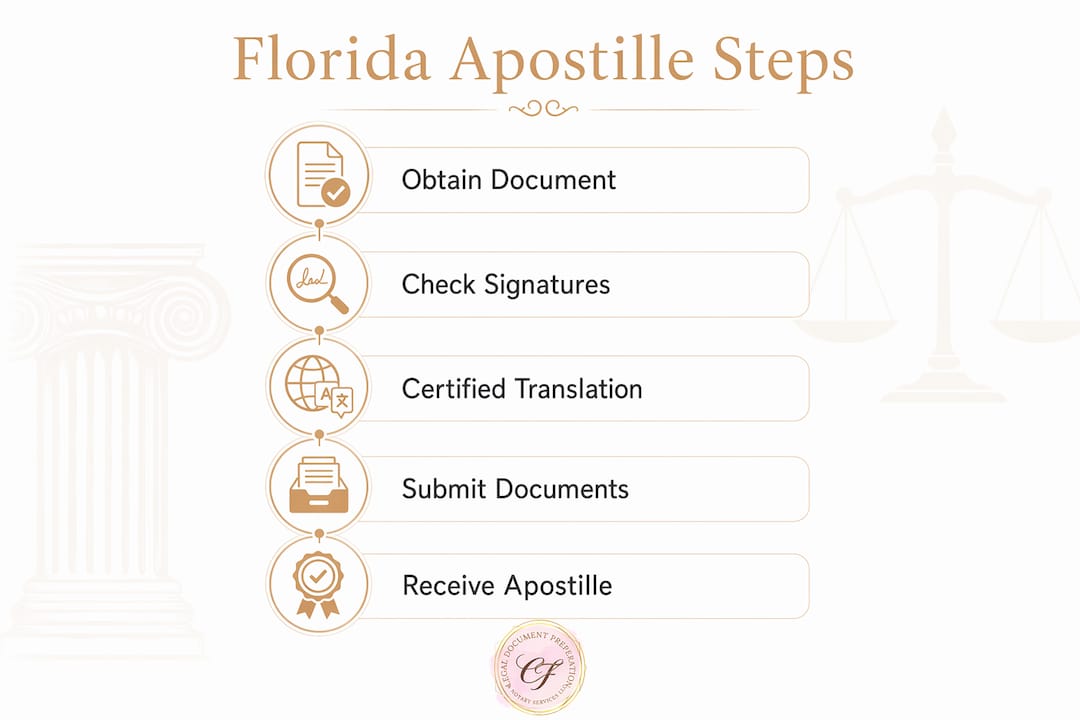
Step 2: Confirm signatures and seals are current
The Authentication Section will reject documents if the notary's commission has expired or if a clerk's signature is not on file. Notarizing documents for overseas use requires attention to these details before submission.

Step 3: Arrange certified translations if required
Some destination countries require a certified translation before or alongside the apostille. Confirm this with the receiving authority or embassy before you submit.
Step 4: Submit to the Florida Department of State (Authentication Section)
You can submit in person, by mail, or through an authorized third-party courier. Include a cover letter with your name, contact information, document type, destination country, and return shipping instructions. Check the current fee schedule on the Florida Department of State website, as fees are subject to change.
Step 5: Receive and verify the apostille
Once issued, the apostille is attached directly to your document or placed on an allonge (an attached sheet). The destination country's receiving authority can verify the apostille's authenticity through the issuing Competent Authority.
Pro Tip: Cflegalformhelp offers mobile notary services and can coordinate courier submission to the Florida Department of State Authentication Section, which saves you at least one trip and reduces the risk of a rejected submission.
Special cases: federal documents, other states, and non-Contracting countries
Federal documents
Documents issued by a U.S. federal agency — such as FBI background checks, federal court records, or documents signed by a federal official — require authentication from the U.S. Department of State, not a state apostille. The Florida Department of State has no authority over federal documents. Review the state vs. federal document distinction before you submit.
Documents from other U.S. states
If your document was issued in Georgia, New York, or any other state, the apostille must come from that state's designated Competent Authority. Florida cannot apostille a document it did not issue.
Non-Contracting countries
If the destination country is not a party to the Convention, an apostille will not be recognized. You will need consular legalization: authentication by the U.S. Department of State followed by certification from the destination country's embassy or consulate in the United States.
Be cautious of third-party services that claim extra legalization steps are required when both countries are Contracting Parties. The HCCH recommends verifying membership and Competent Authority requirements before paying for any additional service.
How remote notarization and electronic signatures affect apostilles
Florida law permits Remote Online Notarization (RON), allowing a notary to perform notarizations via audio-video technology. However, not every destination country or Competent Authority accepts RON-notarized documents for apostille purposes.
- Some Florida Competent Authorities will issue an apostille on a RON-notarized document; others require an in-person notarization.
- Electronic apostilles (e-Apostilles) are available from some Competent Authorities under the HCCH e-APP, but the destination country must also be equipped to receive and verify them.
- A printed apostille on a RON-notarized document may still be rejected if the receiving country does not recognize electronic notarial acts.
Pro Tip: Before using RON for a document destined for use abroad, verify with both the Florida Department of State and the destination country's receiving authority that the electronic notarization will be accepted.
Translations, certified translations, and country-specific requirements
An apostille authenticates the document's official signature and seal — it does not translate the content. Many countries require a certified translation in addition to the apostille.
- Who can provide certified translations: court-certified translators, sworn translators recognized by the destination country, or certified translation services accepted by the receiving authority.
- Order of operations: some countries require the translation to be apostilled separately; others accept a translation attached to an apostilled original. Confirm the destination country's rules before you start.
- Cflegalformhelp provides certified translation services and can coordinate the translation and apostille steps together.
Pro Tip: Build translation time into your submission timeline from the start. A certified translation can take several business days, and submitting an incomplete package delays the entire process.
How Cflegalformhelp helps Florida clients with apostilles
Cflegalformhelp (CF Legal Document Preparation & Notary Services LLC) is a Florida-based provider founded by Cristina Fernandez, a certified legal document preparer and immigration paralegal. The firm offers bilingual (English and Spanish) support and flat-fee pricing with no hidden costs.
Services relevant to apostille work:
- Document preparation and review before submission
- In-person and mobile notary services across South Florida
- Remote Online Notarization (RON) where permitted
- Certified translations coordinated with apostille timing
- Courier and apostille facilitation to the Florida Department of State Authentication Section
- Legal document preparation for corporate filings, family law documents, and immigration forms that may require apostilles
To get a fast quote, have ready:
- Document type and issuing authority
- Destination country
- Desired turnaround time
Disclosure: Cflegalformhelp is a local Florida document preparation and notary provider. The firm facilitates the apostille process but does not issue apostilles — that authority rests solely with the Florida Department of State Authentication Section.
Key Takeaways
The 1961 Hague Convention lets Florida public documents be accepted abroad with a single apostille from the Florida Department of State, provided the destination country is a Contracting Party.
| Point | Details |
|---|---|
| Verify country membership first | Check the HCCH status table before paying for any apostille or legalization service. |
| Match document type to issuing authority | Florida documents go to the Florida Department of State; federal documents go to the U.S. Department of State. |
| Prepare the document correctly | Obtain a certified copy or notarized original before submission; the wrong version causes rejection. |
| Non-Contracting countries need consular legalization | If the destination country is not a party to the Convention, an apostille will not be recognized. |
| Cflegalformhelp facilitates the process | CF Legal handles notarization, certified copies, translations, and courier submission for Florida clients. |
What practitioners see that most guides miss
Most articles about the Apostille Convention focus on the happy path: both countries are members, you get the apostille, done. The real friction shows up in the edge cases — and those are exactly where Florida clients lose time and money.
The most common mistake is assuming that because a country appears on the HCCH list, every document type will be accepted without question. Some countries have raised bilateral objections that limit the Convention's effect in specific relationships. Others accept apostilles for vital records but not for corporate documents. The HCCH status table shows these nuances, but most people skip past them.
A second overlooked issue: the apostille authenticates the official's authority, not the document's accuracy. If a birth certificate contains a clerical error, an apostille on that certificate does not fix the error — it just confirms the registrar had authority to sign it. Getting the underlying document corrected before apostille submission is the step that saves the most time overall.
If you have questions about your specific documents or destination country, Cflegalformhelp is available for a document review or appointment.
Cflegalformhelp's apostille and notary services for Florida clients
Flat-fee apostille facilitation without the guesswork of navigating state offices alone. Cflegalformhelp handles the preparation steps that most clients find time-consuming: notarizing documents correctly the first time, coordinating certified translations, and submitting packages to the Florida Department of State Authentication Section by courier so nothing gets lost in the mail.
Services include mobile notary visits across South Florida, RON for eligible documents, certified translation coordination, and full document preparation for corporate filings, immigration forms, and family law records that need apostilles. Bilingual support in English and Spanish is available throughout.
To get started, contact Cflegalformhelp with your document type, destination country, and turnaround needs. Schedule a mobile notary appointment or request a quote for document preparation and apostille facilitation today.
Useful sources and next steps
- HCCH Apostille Section — official Convention text, e-APP information, and Competent Authority contacts
- HCCH Status Table — confirm whether your destination country is a Contracting Party
- HCCH Full Convention Text — formal scope, exclusions, and article-by-article definitions
- Florida Department of State, Authentication Section — issues apostilles for Florida public documents; check the official Florida DOS website for current fees, mailing address, and processing times
- U.S. Department of State, Office of Authentications — handles federal document authentication and apostilles for federally issued documents
- Cflegalformhelp blog: notarizing documents for overseas use — step-by-step preparation guide
- Cflegalformhelp: certified translations — translation services coordinated with apostille timing
- Fast Passport Center: forms and documents — reference for common document types and travel-related paperwork
Before you submit anything: save copies of every document, note your submission date, and keep any tracking or confirmation numbers. If the Florida Department of State returns a document for correction, having copies on hand means you can resubmit the same day.
This article is general information, not legal advice. Confirm current procedures, fees, and country-specific requirements with the Florida Department of State, the HCCH, or a qualified attorney for your specific situation.