

A notary error correction is the authorized procedure to fix clerical mistakes in a notarial certificate without voiding the underlying document's legal standing. When a notary writes the wrong date, misspells a venue, or leaves a required field blank, the document itself is not automatically invalid. The error lives in the certificate, and the certificate is what gets corrected. State notary commissions and the Revised Uniform Law on Notarial Acts (RULONA) both recognize this distinction, which is why understanding what is a notary error correction matters before you assume a document needs to be redone from scratch.
What is a notary error correction, and why does it matter?
A notary error correction is a formal amendment to the notarial certificate, not to the document itself. The notarial certificate is the block of text where the notary records the act: the date, the county, the type of act performed, and the notary's signature and seal. Errors in that section are what the correction process addresses.
Many clerical mistakes do not legally void a document, but they cause courts, lenders, and recording offices to reject it until the error is fixed. That rejection can delay a real estate closing, stall an immigration filing, or hold up a probate proceeding. The practical consequence is the same as if the document were invalid, even when the law says it is not.
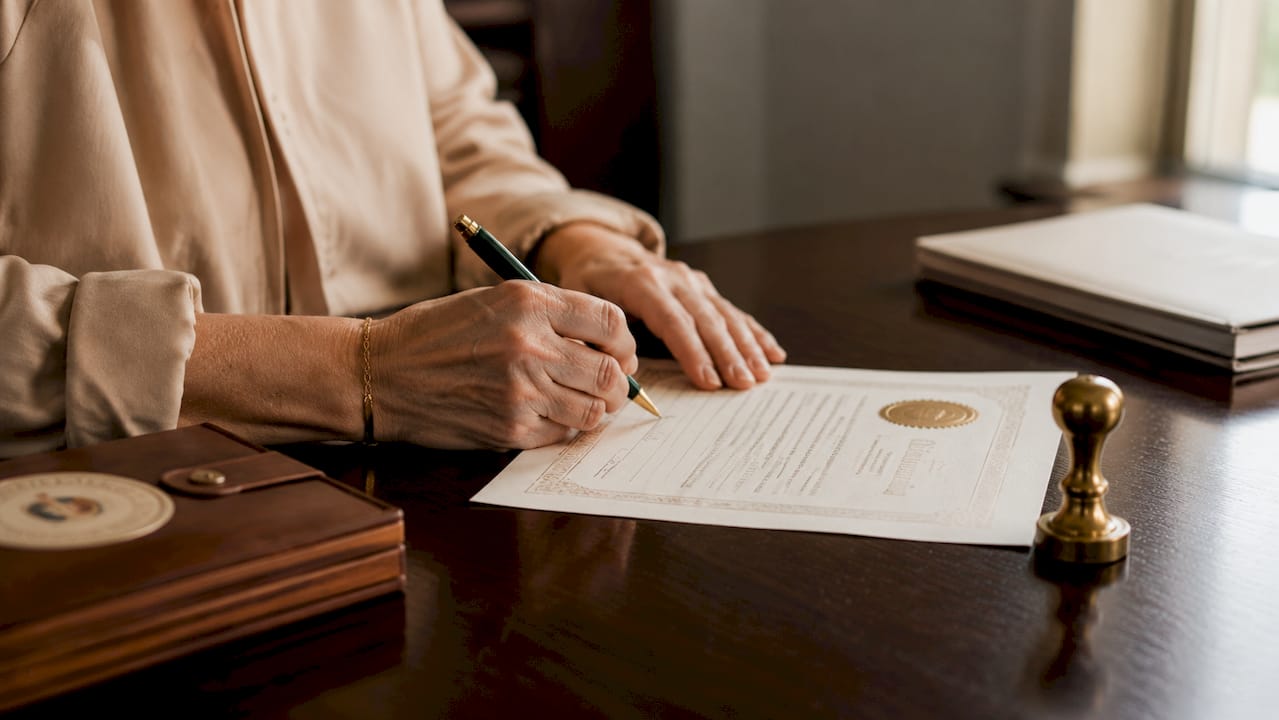
The RULONA framework, adopted in whole or in part by many states, draws a clear line between errors that can be corrected administratively and errors that require a full new notarization. Florida's notary statutes align with this framework, making it especially relevant for anyone dealing with Florida notarization requirements. Knowing which side of that line your error falls on saves time, money, and legal exposure.
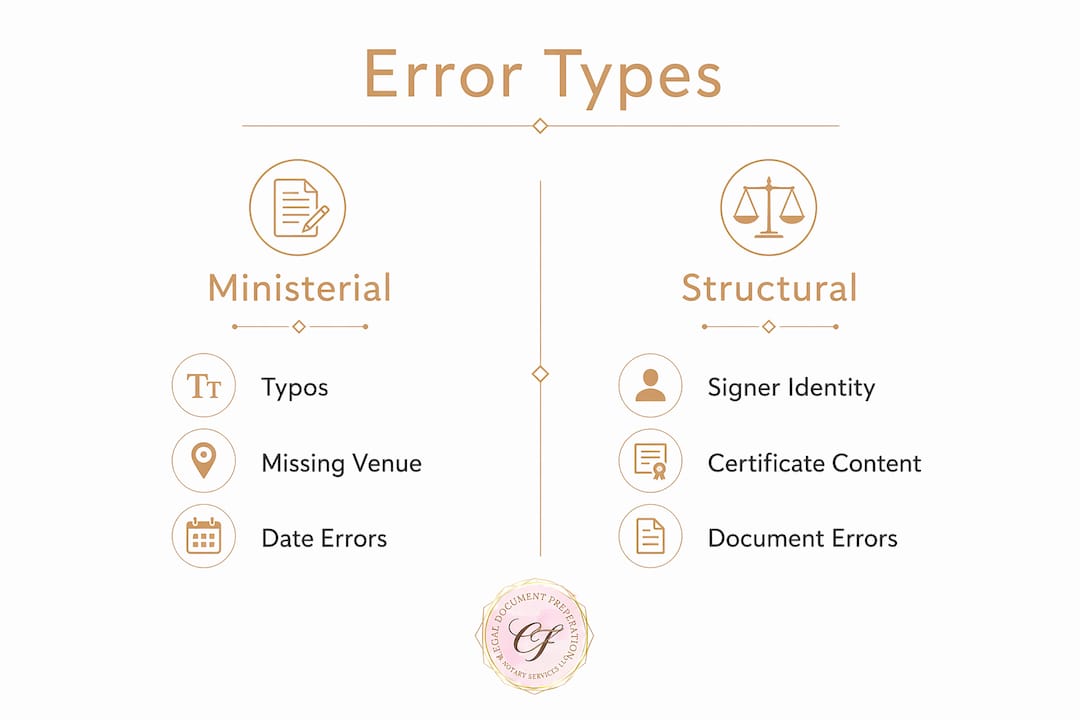
What kinds of errors can be corrected vs. what requires re-notarization?
Errors are classified into two categories: ministerial errors and structural errors. The category determines whether a simple correction fixes the problem or whether the signer must appear again before a notary.
Ministerial errors are clerical in nature. They include:
- A typo in the county or state name (venue)
- An incorrect date on the certificate
- A misspelled signer name that does not affect identification
- A missing notary title or commission expiration date
- Leaving a checkbox unchecked when the correct act was performed
These errors can be corrected by the original notary without requiring the signer to return. The document does not need to be re-signed.
Structural errors are procedural failures that go to the heart of the notarial act. They include:
- Notarizing without the signer physically or remotely present
- Performing the wrong type of notarial act (an acknowledgment instead of a jurat, for example)
- Notarizing with an expired commission, which can render the entire notarization void
- Failing to administer an oath when a jurat requires one
- Notarizing a document for a family member in a prohibited state
Pro Tip: If you are unsure whether an error is ministerial or structural, contact the receiving agency first. A county recorder or lender's title department will tell you exactly what they need to accept the document. That one call can save you from unnecessary re-execution.
Attempting to fix a structural error through a certificate correction does not work. The notarization remains void, and altering the certificate to cover a procedural failure can create fraud exposure for both the notary and the document holder.
What is the proper process for correcting a notary certificate error?
The notary correction process follows a specific sequence. Skipping any step risks creating a document that looks altered rather than properly corrected.
- Identify the error type. Confirm the mistake is ministerial before proceeding. Structural errors require re-execution, not correction.
- Contact the original notary. Only the original notary may amend the notarial certificate. Any unauthorized alteration by another person may invalidate the notarization and raise fraud concerns.
- Cross out the error with a single line. The incorrect text must remain legible. Do not obscure it.
- Write the correct information nearby. Place the correction directly above or beside the crossed-out text, in the margin, or in available white space on the certificate.
- Initial and date the correction. The notary initials next to the change and writes the date the correction was made. This creates a transparent, dated record.
- Avoid correction fluid entirely. White-out and correction fluid are prohibited in notarial corrections. Covering text suggests concealment and can void the document.
- Attach a new loose certificate if needed. When the certificate has no space for a correction, or when the error scope is too large, the notary completes a fresh certificate on a separate page and attaches it to the original document.
- Update the notary journal. The notary must make a journal entry noting the correction with the date and specific details of what was changed.
Pro Tip: Ask the notary to write a brief note in the journal explaining why the correction was made. That entry becomes your paper trail if a receiving agency or court later questions the amendment.
Most minor clerical errors can be corrected by the original notary without re-signing the document, typically at no charge. The cost only rises when a new notarization or recorded corrective instrument is required.
How do notary corrections differ from fixing errors in the document itself?
The notary's authority stops at the edge of the certificate. A notary cannot alter the terms of the document. Changing a purchase price, a party's name in the contract body, or any substantive clause is outside the notary's legal authority, regardless of whether the change is minor.
When the document text contains an error, the correction process is different:
- All parties to the document must agree to the change and initial it.
- If the change is substantive, a formal amendment or entirely new document may be required.
- The corrected or amended document must then go through a fresh notarization, with all signers appearing before the notary again.
- The notary's role in that process is to notarize the new or amended document, not to authorize the change itself.
This distinction matters because people often assume the notary can "fix" a document the way an editor fixes a draft. The notary's role is to authenticate the act of signing, not to verify or correct the document's content. Understanding notary and signer roles prevents this common misunderstanding.
A practical example: a deed lists the wrong parcel number in the legal description. The notary cannot cross that out and write the correct number. The parties must execute a corrected deed, and a notary must then notarize that new document. The original deed with the wrong parcel number does not get "corrected." It gets replaced.
What should you do if the document was already recorded?
Once a document enters the public record, a simple notary certificate correction is no longer enough. The recorded version is the legal version, and it cannot be changed by marking up the original paper.
The table below outlines the main corrective instruments used for recorded documents and when each applies.
| Corrective instrument | When it applies | Who typically handles it |
|---|---|---|
| Scrivener's affidavit | Minor clerical errors (wrong name spelling, typo in legal description) | Attorney or title company |
| Correction deed | Significant errors requiring re-execution (wrong grantor, wrong property) | Attorney, with all original parties |
| Affidavit of correction | Errors in recorded instruments other than deeds | Attorney or authorized party |
| Re-recorded document | When the original document was structurally defective | Attorney, with fresh notarization |
A scrivener's affidavit or correction deed must itself be notarized and then recorded alongside the original document. That creates a public record showing both the error and its correction. Recording fees for corrective instruments typically range between $10 and $50 depending on jurisdiction. That fee is small compared to the cost of a title dispute or a rejected mortgage application.
Document holders who discover errors in recorded documents should consult the receiving agency first, then contact an attorney or title company to prepare the corrective instrument. Prompt action prevents the error from compounding into a chain of title problem or a delayed closing. Jurisdictional rules vary, so checking state vs. federal notary rules before filing any corrective instrument is the right first step.
Key Takeaways
A notary error correction fixes only the certificate, not the document, and only the original notary has the legal authority to make that change.
| Point | Details |
|---|---|
| Two error categories | Ministerial errors are correctable; structural errors require full re-notarization with signer present. |
| Correction method | Cross out with a single line, write the correction nearby, then initial and date it. |
| White-out is prohibited | Using correction fluid voids the document and may raise fraud concerns. |
| Document text is off-limits | Only parties to the document can change its content; the notary cannot alter contract terms. |
| Recorded documents need more | Use a scrivener's affidavit or correction deed, recorded alongside the original, to fix public record errors. |
Why transparency in corrections is the only safe path
Working with notarized documents every day, I have seen one pattern repeat itself: people try to quietly fix a mistake instead of correcting it properly. They cross out text without initialing it, or they ask someone other than the original notary to make a change. Both approaches backfire.
The 'golden rule' in notarial practice is not to alter the original certificate once completed without full transparency. That means every correction must be visible, initialed, dated, and logged in the journal. A correction that looks clean and undetectable is actually more suspicious to a trained reviewer than one that shows the original error alongside the fix.
Ignoring serious procedural errors jeopardizes future liability and document validity. I have seen real estate transactions fall apart at closing because a deed recorded years earlier had a structural notarization defect that no one addressed. By the time it surfaced, the original notary was unreachable, and the parties had to reconstruct the entire chain of title.
My strongest advice: address errors the moment you spot them. Contact the original notary, explain the issue, and get the correction documented properly. If the error is in a recorded document, bring in an attorney or a qualified document preparation professional before filing anything. The cost of doing it right the first time is always lower than the cost of fixing a compounded problem later.
— Cristina
How Cflegalformhelp handles notary corrections and document preparation
Notary errors create real pressure, especially when a closing, a court filing, or an immigration deadline is on the line.
Cflegalformhelp provides professional notary and document preparation services that include expert handling of certificate corrections, preparation of corrective instruments, and fresh notarizations when re-execution is required. Cristina Fernandez and the Cflegalformhelp team serve clients across South Florida in both English and Spanish, with flat-fee pricing and no hidden costs. Whether you need a corrected certificate, a scrivener's affidavit, or a full document preparation service, Cflegalformhelp offers clear guidance and reliable execution at every step.
FAQ
What is a notary error correction exactly?
A notary error correction is the authorized process of fixing a clerical mistake in the notarial certificate, such as a wrong date or misspelled venue, without voiding the document. Only the original notary may make this correction using approved methods.
Can a notary fix a mistake without the signer coming back?
Yes, for ministerial errors like typos or missing venue information. Structural errors, such as notarizing without the signer present, require the signer to appear again for a full new notarization.
Is white-out allowed when correcting a notary certificate?
No. Correction fluid is prohibited in notarial corrections. The accepted method is a single line through the error, the correction written nearby, and the notary's initials and date beside the change.
What happens if a notarized document with errors was already recorded?
A simple certificate correction is not enough once a document is recorded. A scrivener's affidavit or correction deed must be prepared, notarized, and recorded alongside the original to fix the public record.
Can the notary change the content of the document itself?
No. A notary's authority is limited strictly to the certificate portion. Changes to the document's substantive content require agreement from all parties and a fresh notarization of the amended document.