

A notary journal record is the official, chronological log of every notarial act a notary public performs. Think of it as the paper trail that proves a notarization actually happened, who was present, how identity was verified, and what document was involved. If a notarization is ever challenged in court, that journal entry is often the only independent evidence that proper procedures were followed.
Each entry in a notary public journal typically captures:
- Date and time of the notarial act
- Type of notarization performed (acknowledgment, jurat, oath, affirmation, copy certification)
- Document description including title and date of the document
- Signer's full name and address
- Identification method used to verify the signer's identity (driver's license, passport, credible witness, or personal knowledge), along with the issuing agency and expiration date
- Signer's signature or mark placed directly in the journal
- Fee charged for the notarial act, or a notation of "No Fee" if none was collected
The National Notary Association and Notary Public Underwriters both recognize the journal as the notary's primary liability safeguard. The Revised Uniform Law on Notarial Acts (RULONA), which a growing number of states have adopted, sets the standard framework for what these records must contain. Whether you call it a notary log book, a notary ledger, or a record book of notarial acts, the function is the same: a permanent, verifiable account of every notarization you perform.
Why every notary should keep a journal
Most states either require or strongly recommend that notaries maintain a journal documenting every notarial act. Even in states where it is not legally mandated, the professional case for keeping one is clear.

The journal protects you. When a notarization is questioned years later, whether due to a fraud allegation, a disputed deed, or a missing document, your journal entry is frequently the only proof that you followed the correct process. Without it, your word stands alone against a claimant's.
Key reasons to maintain a notary public journal:
- Legal defense: The journal serves as independent evidence if you are sued or accused of negligence, proving that proper identification and procedures were followed.
- Fraud deterrence: A detailed record discourages bad actors from claiming a notarization never occurred or was improperly performed.
- Document recovery: If a notarized document is lost or altered, the journal entry can reconstruct the key facts of the transaction.
- State compliance: Roughly half of U.S. states legally require journal keeping, and most others strongly recommend it.
- Professional credibility: Consistent record keeping signals that you take your commission seriously and operate with care.
The journal is the notary's primary defense tool if sued or accused of negligence — it is often the only independent proof that proper identification and procedures were followed.
Florida, for example, does not require traditional notaries to keep a physical journal, but state officials have strongly recommended the practice for all Florida notaries. If you perform remote online notarizations in Florida, a secure electronic journal is required. That distinction matters in practice: a notary who skips the journal in a permissive state has no documentation to fall back on when a dispute arises.

What information goes into each notary journal entry
The specific data points required in a notary journal entry vary by state, but most jurisdictions align closely with the RULONA model. Washington State law, for instance, requires the date and time, a description of the record and type of notarial act, and the full name and address of each individual for whom the act was performed.
California has some of the most detailed notarization requirements in the country. California notaries must record:
- Date, time, and type of notarization
- Type of document notarized
- Signer's signature or mark
- Satisfactory evidence of identity, including the type of ID, issuing agency, serial number, and issue or expiration date
- Fee charged (or "No Fee" / "0" if none)
- Right thumbprint of the signer when the document is a power of attorney, deed, quitclaim deed, deed of trust, or any document affecting real property
Not every state goes that far. Pennsylvania requires the date and time, a description of the record and act type, the signer's full name and address, the identification method with credential details, and the fee. Montana and Texas require identity verification details but prohibit recording personal identification numbers such as Social Security numbers or ID serial numbers.
The table below summarizes core journal entry elements across several major states:
| Element | California | Washington | Pennsylvania | Florida (recommended) |
|---|---|---|---|---|
| Date and time | Required | Required | Required | Recommended |
| Type of notarial act | Required | Required | Required | Recommended |
| Document description | Required | Required | Required | Recommended |
| Signer name and address | Required | Required | Required | Recommended |
| ID type and details | Required (full detail) | Required | Required | Recommended |
| Signer's signature | Required | Not specified | Not specified | Recommended |
| Fee charged | Required | Not specified | Required | Recommended |
| Thumbprint | Required (real property) | Not required | Not required | Not required |
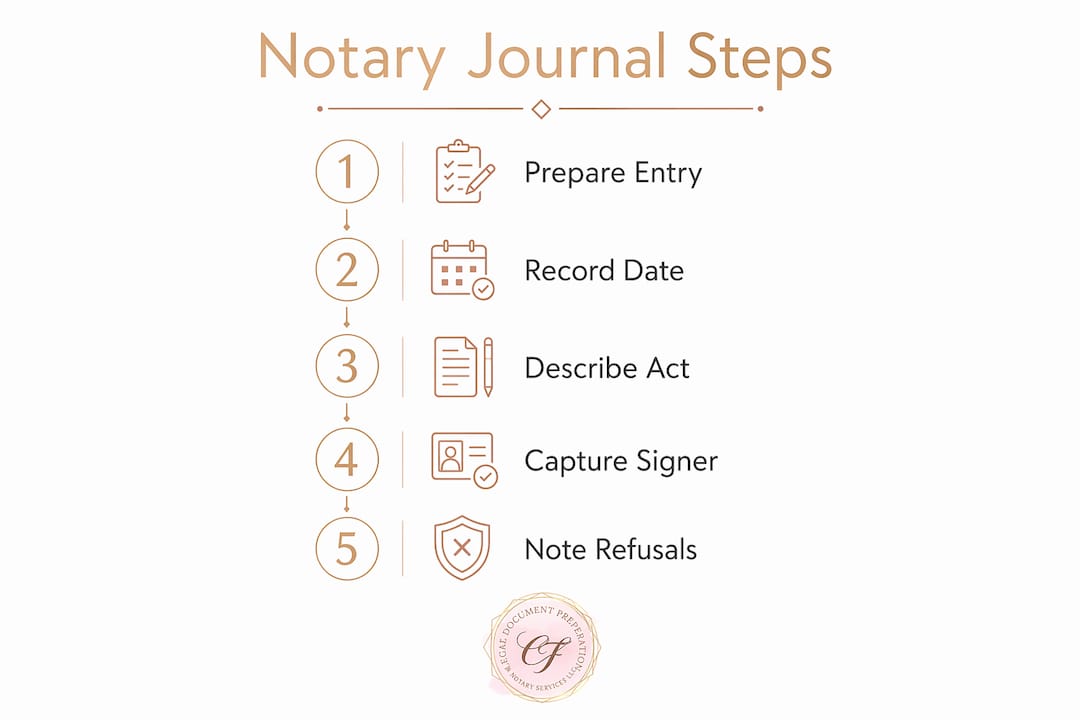
One entry type that notaries often overlook: declined notarizations. When you refuse to perform a notarization, record it. Note who appeared, what document they presented, and why you declined. That entry protects you if the person later claims you refused service improperly, or if the document turns out to be fraudulent and someone questions your involvement.
Understanding why notaries check signer identification is directly tied to what belongs in the journal. The identification method you used, and the specific credential details, are what give the journal entry its evidentiary weight.
When and how to make notary journal entries
Timing is not a technicality. It directly affects whether your journal entry holds up as evidence.
The rule is straightforward: record the entry while the signer is present and before you complete the notarization. The contemporaneous recording requirement exists because waiting until after the signer leaves creates gaps. You may forget details. You cannot obtain the signer's signature. The entry becomes incomplete, and an incomplete entry loses much of its legal value.
Best practices for timing and method:
- Record during the appointment, not after. Obtain the signer's signature and any required thumbprint before they leave.
- Use a bound, permanently sewn journal with numbered pages. Loose-leaf binders or spiral notebooks do not meet the requirements in most states that mandate journals.
- For electronic journals, use only software that produces a tamper-evident record compliant with your state's administrative rules. A standard word processing file or spreadsheet does not qualify.
- Record declined notarizations at the time of the refusal, noting the reason clearly.
- Write legibly and in permanent ink for physical journals. Erasures or correction fluid raise questions about tampering.
- Never leave blank lines between entries in a physical journal. Draw a line through unused space to prevent later additions.
Delayed entries are a common problem in high-volume notary work, particularly for loan signing agents handling large document packages. The National Notary Association advises completing all parts of the journal entry before finishing the notarization, precisely because once the signer walks out the door, certain information becomes impossible to capture accurately.
Legal requirements for handling and storing your notary journal
Your notary journal is your personal property. That point is widely misunderstood, and the misunderstanding has real consequences.
In nearly all U.S. jurisdictions, the journal belongs to the notary, not the employer, even if the employer purchased it. Surrendering your journal to an employer when you leave a job violates notary law. You keep the journal. Period.
Key legal handling requirements:
- Retain the journal for the required period. Washington State law mandates a ten-year retention period after the last notarial act recorded in that volume. Retention periods vary by state, ranging from seven years to permanent retention in some jurisdictions.
- Keep only one active journal at a time for tangible records. Most states with journal requirements prohibit maintaining multiple simultaneous physical journals.
- Store the journal securely under your exclusive control. No other person, including a co-worker or supervisor, may use it.
- Maintain a backup for electronic journals. Delaware law, for example, requires notaries to maintain a backup record of any electronic journal and protect it from unauthorized access.
- Report a lost or stolen journal promptly. Most state laws require immediate notification to the relevant state authority upon discovering the journal is missing. Prompt reporting helps limit liability and regulatory penalties.
- Do not destroy the journal except as directed by law, court order, or the state's commissioning authority.
- Upon resignation or death, some states require the journal to be deposited with a designated government office. Check your state's specific rules.
Mishandling the journal, whether by surrendering it to an employer, failing to report its loss, or destroying it prematurely, can result in administrative action against your commission. Failure to secure the journal can lead to commission loss.
Privacy and public access rules for notary journals
Notary journals are not public records in the general sense. They contain sensitive personal information, including names, addresses, identification details, and sometimes financial transaction data. That sensitivity creates real obligations for the notary.
Access to a notary journal is restricted to authorized parties:
- Court orders and subpoenas compel production of journal records in legal proceedings.
- Law enforcement may access journals as part of a legitimate investigation.
- The Secretary of State or equivalent commissioning authority may inspect journals for compliance purposes.
- The notary retains exclusive control at all other times.
California is a notable exception to the general rule. California notaries are required by law to provide copies of journal information to the public upon a written request, which is why California prohibits ditto marks and requires complete information in every line item. That public-access obligation makes accuracy even more critical there.
Notaries have a fiduciary obligation to safeguard the journal's confidentiality at all times. Leaving a journal unattended, storing it in an unsecured location, or allowing unauthorized individuals to view it can expose the notary to legal consequences, independent of any other violation.
Pro Tip: Store your physical journal in a locked drawer or cabinet when not in use. For electronic journals, use password protection and encrypted storage, and never sync journal files to shared cloud folders accessible by others.
The notary, witness, and signer roles each carry distinct privacy responsibilities. As the notary, you are the custodian of the record. That responsibility does not transfer to anyone else, regardless of who is present during the notarization.
How state laws and electronic journals differ
No two states treat notary journal requirements identically. Some require journals for all notarial acts. Others require them only for remote online notarizations. A few make the practice optional but strongly recommended.
Physical vs. electronic journal standards vary significantly:
- Physical journals must generally be permanently bound with numbered pages. Spiral-bound or loose-leaf formats do not meet requirements in most states.
- Electronic journals are accepted in a growing number of states, but only when they produce a permanent, tamper-evident record that complies with the state's specific administrative rules. A generic spreadsheet or word processing file does not qualify.
- Remote online notarization (RON) typically requires an electronic journal plus an audio-visual recording of the session. Arizona, for example, requires traditional and in-person electronic notaries to keep a paper journal, while RON notaries must use a permanent, tamper-evident electronic format.
- State-specific rules govern electronic adoption. Notaries should verify state rules before switching to an electronic journal, since generic digital files do not satisfy requirements.
A few state-specific examples worth knowing:
- Washington requires one tangible journal at a time, permanently bound with numbered pages, retained for ten years after the last entry.
- Massachusetts requires a permanently bound journal, kept for seven years after commission expiration, and treats the journal as the notary's exclusive property.
- Missouri requires a permanently bound journal with numbered pages for all notarial acts.
- Florida does not require a physical journal for traditional notaries but mandates a secure electronic journal for remote online notarizations.
- Idaho does not require a journal but recommends recording the date and time, document type, and ID type used.
The state vs. federal notary document distinctions affect what your journal must capture. Federal documents often carry their own execution requirements, and your journal entry should reflect the specific act performed regardless of whether the underlying document is state or federal in origin.
If you are considering a document audit tool to review your notarization records for accuracy and completeness, verify that any digital output meets your state's tamper-evident standard before treating it as a compliant journal.
Expert advice on keeping your notary journal accurate and secure
The journal is only as useful as the care you put into it. A sloppy or incomplete journal can actually work against you in a legal dispute, raising questions about whether you followed proper procedures at all.
Recognized guidance from the National Notary Association and notary law experts points to the same core practices:
- Complete every entry before the signer leaves. This is the single most important habit. Once the signer is gone, you cannot obtain their signature, thumbprint, or clarification on identification details.
- Record every notarial act without exception, including acts for which no fee was charged. Gaps in a sequential journal invite scrutiny.
- Document refused notarizations. Note the date, who appeared, what they presented, and why you declined. This creates a protective trail that deters false claims and documents your due diligence.
- Never alter or white-out an entry. If you make an error, draw a single line through the mistake, write the correction, and initial it. Erasures suggest tampering.
- Keep the journal under your exclusive control at all times, regardless of your employment situation. Your employer has no legal right to your journal, even if the employer paid for it.
- Use a bound journal with numbered pages unless your state explicitly permits and regulates electronic alternatives.
- Back up electronic journals regularly and store backups in a secure, access-controlled location separate from the primary record.
- Review your state's current rules annually. Electronic notarization laws are evolving quickly, and requirements that applied last year may have changed.
The journal's value as a defense tool depends entirely on its completeness and credibility. A court reviewing a notary journal entry looks for consistency, legibility, and the presence of all required data points. An entry that is missing the signer's signature, or that was clearly filled in after the fact, carries far less weight than one that is complete, contemporaneous, and consistent with the surrounding entries.
Notary Public Stamps and related notarial supplies are tools of the commission, but the journal is the record of how those tools were used. One without the other tells an incomplete story.
Key Takeaways
A notary journal record is the notary's most important legal protection, and its value depends entirely on entries being complete, contemporaneous, and securely maintained under the notary's exclusive control.
| Point | Details |
|---|---|
| Core journal purpose | The journal is the notary's primary defense tool, providing independent proof that proper procedures were followed. |
| Required entry elements | Every entry should capture the date and time, act type, document description, signer details, ID method, signer signature, and fee charged. |
| Contemporaneous recording | Entries must be made while the signer is present; waiting until after they leave risks incomplete and legally weaker records. |
| Journal ownership | The journal is the notary's personal property in nearly all U.S. jurisdictions, not the employer's, even if the employer purchased it. |
| State law variation | Requirements differ significantly by state; about half legally require journals, while most others strongly recommend them as best practice. |
Need help with notarization in Florida?

Cflegalformhelp provides professional mobile notary and loan signing services across South Florida, with bilingual support in English and Spanish. Whether you need a document notarized, assistance preparing legal paperwork, or guidance on Florida's notarization requirements, Cflegalformhelp offers flat-fee, transparent services designed for individuals and small businesses who want reliable help without the complexity of attorney involvement. Reach out to Cflegalformhelp to get your documents handled correctly the first time.